Australian War Memorial collection data identifies four soldiers preparing a 120 mm L4 MOBAT, commonly known as a BAT gun, at Sunggi Linggi in Malacca in November 1964 during the Indonesian Confrontation.
Infantry Weapons
120mm L2 BAT
Also known as
- L2 BAT
- L1 BAT
- BAT recoilless rifle
- Battalion Anti-Tank gun
- 120 mm BAT recoilless rifle
- 120mm BAT
- L4 MOBAT
- L6 WOMBAT
- L7 CONBAT
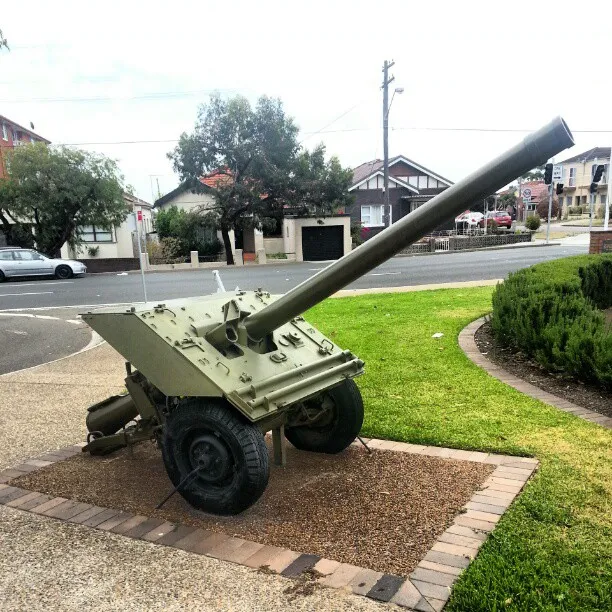
The 120mm L2 BAT was the British Battalion Anti-Tank recoilless rifle, a heavy towed 120 mm HESH-firing weapon introduced in 1953 as a postwar infantry anti-armor system. Its same-family L4 MOBAT, L7 CONBAT, and L6 WOMBAT variants traded the shielded L2 carriage for lighter or better-sighted configurations; Australian War Memorial records place an L4 MOBAT/BAT gun with Commonwealth forces in Malacca during the Indonesian Confrontation.
Role in Conflicts
Profile / Specs
Profile
- Origin
- United Kingdom
- Built by
- Royal Ordnance
- Type
- 120 mm recoilless anti-tank rifle
- Service note
- Cold War British and Commonwealth anti-tank weapon family, introduced in the early 1950s and succeeded in many units by lighter BAT variants and anti-tank guided missiles.
- Designer
- British state ordnance design lineage
- Designed
- Early 1950s development
- Produced
- Production reported from 1953
Specifications
- Caliber
- 120 mm
- Weapon type
- Breech-loaded recoilless rifle
- Crew
- 3 for L2 BAT and L6 WOMBAT references
- L2 BAT weight
- About 1 tonne
- L4 MOBAT weight
- 766 kg
- L2 BAT length
- 4.02 m overall with a 2.34 m barrel
- L4 MOBAT length
- 4.04 m overall with a 2.34 m barrel
- Muzzle velocity
- 463 m/s
- Rate of fire
- 4 rounds per minute
- L2 BAT range
- 450 m effective and 1.6 km maximum reported by WeaponSystems.net
- L4 MOBAT range
- 825 m effective and 1.6 km maximum reported by WeaponSystems.net
- L6 WOMBAT weight
- 308 kg (680 lb)
- L6 WOMBAT length
- 3.86 m
- L6 WOMBAT sighting
- .50 caliber spotting rifle with optical sighting support
- L6 WOMBAT range
- Airborne Assault Museum describes target engagement out to 2,000 m with the spotting rifle
- L4 MOBAT sighting
- Optical sight with 7.62 mm Bren spotting rifle
- Ammunition
- 120 mm HESH; Australian War Memorial record notes BAT HESH ammunition tubes with the L4 MOBAT
- Carriage
- Two-wheel carriage with shield on L2 BAT; lightweight carriage on L6 WOMBAT
BAT Family Design
The L2 BAT was heavy for an infantry anti-tank weapon, so the family evolved through lighter and better-sighted versions while retaining the 120 mm recoilless anti-armor role.
Original BAT
The L2 used a two-wheel carriage, gun shield, optical sight, and 120 mm breech-loaded recoilless barrel.
Source: WeaponSystems.net 120mm L2 BAT.
MOBAT
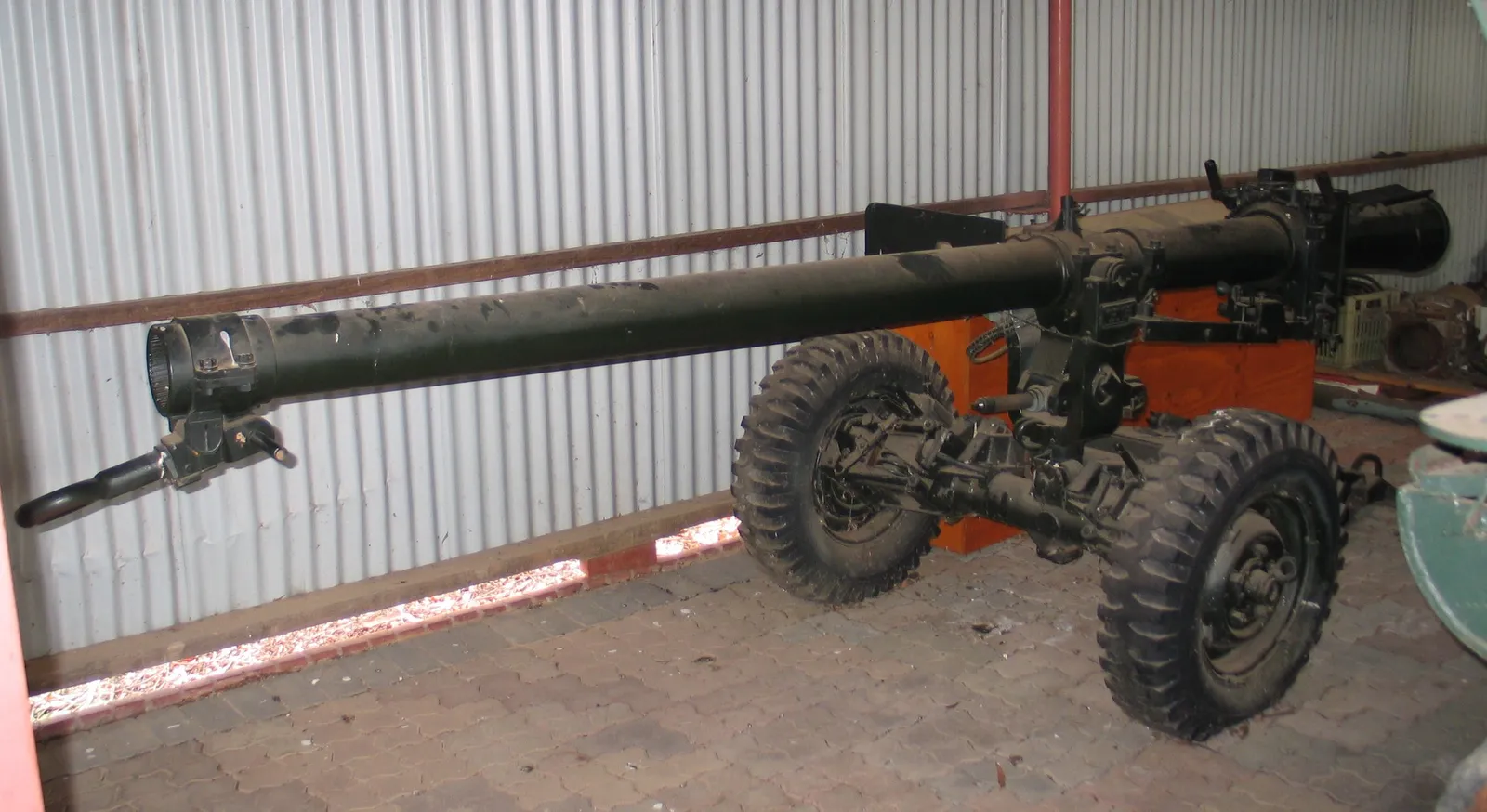
The L4 MOBAT removed the BAT gun shield, used a Bren spotting rifle, and reduced the system to about 766 kg for light-vehicle towing.
Sources: WeaponSystems.net 120mm L4 MOBAT; Australian War Memorial L4 MOBAT Malacca.
WOMBAT
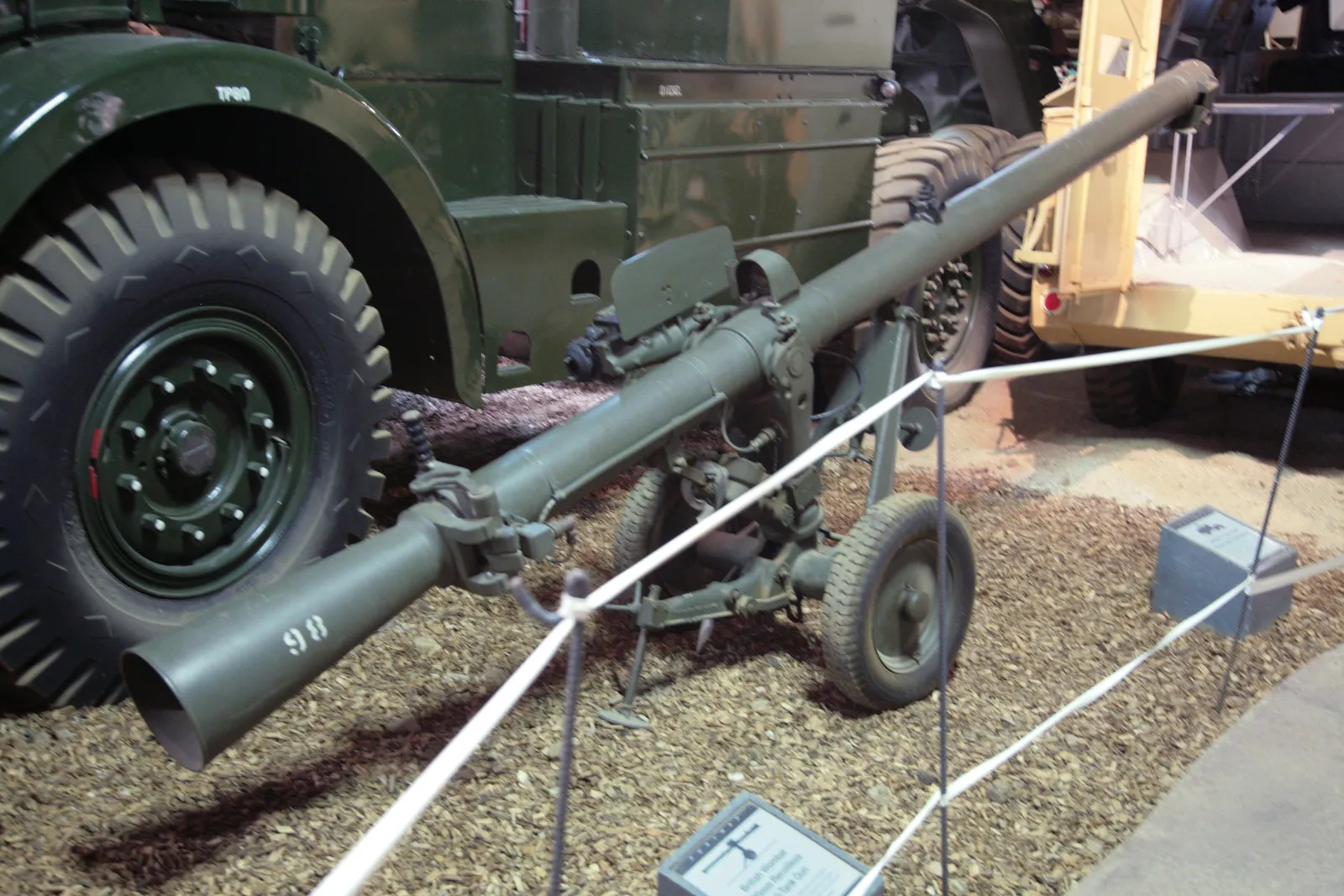
The L6 WOMBAT put an L12A3 BAT gun on a lightweight carriage and added .50 caliber spotting-rifle support for longer practical engagement.
Source: Airborne Assault Museum L6 WOMBAT.
Variants
The BAT family used the same British 120 mm recoilless anti-tank concept across shielded, lightened, and spotting-rifle-equipped versions.
| Variant | Configuration | Designation notes |
|---|---|---|
| L1/L2 BAT | Original shielded towed BAT gun | WeaponSystems.net lists L1 and L2 as the BAT designations in UK service, with a two-wheel carriage, gun shield, optical sight, and no spotting rifle. Sources: WeaponSystems.net 120mm L2 BAT |
| L4 MOBAT | Lighter mobile BAT variant | WeaponSystems.net identifies the L4 MOBAT as the Mobile Battalion Anti-Tank version with the shield removed, 7.62 mm Bren spotting rifle, 766 kg weight, and 825 m effective range; the Australian War Memorial documents one in Malacca during the Indonesian Confrontation. Sources: WeaponSystems.net 120mm L4 MOBAT, Australian War Memorial L4 MOBAT Malacca |
| L6 WOMBAT | Lightweight airborne and mobile variant | Airborne Assault Museum identifies the L6 WOMBAT as an L12A3 120 mm BAT gun on a lightweight carriage, towable by or mountable on a Land Rover and used by airborne units. Sources: Airborne Assault Museum L6 WOMBAT |
| L7 CONBAT | Converted BAT/MOBAT with spotting rifle | Specialist summaries identify CONBAT as a BAT-family conversion with a spotting-rifle attachment, bridging the earlier BAT/MOBAT guns and the later WOMBAT configuration. Sources: The Armourers Bench L2 BAT |
Timeline
120mm L2 BAT Key Events
L2 BAT enters service
WeaponSystems.net reports the 120 mm L2 BAT entered service in 1953 after early-1950s development.
Sources: WeaponSystems.net 120mm L2 BAT
L6 WOMBAT appears in airborne trials
Airborne Assault Museum collection data identifies an L6 WOMBAT taking part in Army Air Transport Training and Development Centre trials at Old Sarum and Salisbury Plain in July 1959.
Sources: Airborne Assault Museum L6 WOMBAT Trials
L4 MOBAT documented in Malacca
Australian War Memorial collection record P04762.016 places a 120 mm L4 MOBAT/BAT gun at Sunggi Linggi, Malacca, during the Indonesian Confrontation.
Sources: Australian War Memorial L4 MOBAT Malacca
8 RAR trains on WOMBAT in Malaysia
Australian War Memorial film metadata records 8th Battalion, Royal Australian Regiment anti-tank troops running through the 120 mm Wombat at Terendak Garrison and the nearby Asahan field firing range in Malaysia.
Sources: Australian War Memorial 8 RAR Wombat Malaysia
WOMBAT photographed beside MILAN
A National Army Museum photograph of the Duke of Edinburgh's Royal Regiment shows a Wombat anti-tank recoilless rifle with a MILAN missile, illustrating the overlap between the older recoilless rifle and the missile that replaced it.
Sources: National Army Museum Wombat and Milan
WOMBAT embarked but not fought in the Falklands
Airborne Assault Museum records WOMBATs as embarked for the Falklands but not deployed in combat, a useful boundary for excluding a Falklands conflict-use row.
Sources: Airborne Assault Museum L6 WOMBAT
L6 WOMBAT Service Context
The L6 WOMBAT was the late lightweight BAT-family service weapon. Museum records connect it to airborne trials, British airborne service, Malaysia-based training, and the transition from recoilless anti-tank rifles to guided missiles.
Air transportable role
Airborne Assault Museum describes the L6 as a lightweight-carriage 120 mm recoilless rifle that could be towed by or mounted on a Land Rover and was used by airborne units.
Source: Airborne Assault Museum L6 WOMBAT.
Malaysia training
Australian War Memorial footage metadata places 8 RAR anti-tank troops training on the 120 mm Wombat at Terendak and Asahan in February 1969, noting that the British Army used the weapon in Malaysia.
Source: Australian War Memorial 8 RAR Wombat Malaysia.
Missile replacement
National Army Museum and Airborne Assault Museum records frame WOMBAT as a legacy recoilless anti-tank rifle that overlapped with, then gave way to, guided anti-tank missiles such as MILAN.
Sources: National Army Museum Wombat and Milan; Airborne Assault Museum L6 WOMBAT.
Media
Related Weapon Systems


Sources
WeaponSystems.net 120mm L2 BATPublisher: WeaponSystems.net | Note: Supports L2 BAT identity, origin, entered-service date, early-1950s development, production country/date, designations, core L2 specifications, and related BAT-family variant context. | Accessed: 2026-07-06WeaponSystems.net 120mm L4 MOBATPublisher: WeaponSystems.net | Note: Supports L4 MOBAT identity, Mobile Battalion Anti-Tank designation, mid-1950s development context, BAT-derived shieldless design, Bren spotting rifle, light-vehicle towing, L4 dimensions, weight, range, rate of fire, and ConBAT variant relationship. | Accessed: 2026-07-06Australian War Memorial L4 MOBAT MalaccaPublisher: Australian War Memorial | Note: Supports Indonesian Confrontation 1962-1966 direct use: AWM identifies a 120 mm L4 MOBAT/BAT gun prepared by soldiers at Sunggi Linggi, Malacca, in November 1964 and links the item to the Indonesian Confrontation. Also supports L4 MOBAT variant and BAT HESH ammunition context. | Accessed: 2026-07-06Airborne Assault Museum L6 WOMBATPublisher: Airborne Assault Museum | Note: Supports L6 WOMBAT variant background, L12A3 BAT gun/lightweight carriage configuration, Land Rover mobility, spotting rifle, HESH round, 4 rpm rate, crew, dimensions, armor effect, and the Falklands non-use boundary. | Accessed: 2026-07-06Airborne Assault Museum L6 WOMBAT TrialsPublisher: Airborne Assault Museum | Note: Supports L6 WOMBAT airborne trial context: the collection record identifies an L6 Wombat taking part in Army Air Transport Training and Development Centre trials at Old Sarum and Salisbury Plain in July 1959. | Accessed: 2026-07-06Australian War Memorial 8 RAR Wombat MalaysiaPublisher: Australian War Memorial | Note: Supports L6 WOMBAT service and training context: AWM film metadata records 8th Battalion, Royal Australian Regiment anti-tank troops training with the 120 mm Wombat at Terendak Garrison and Asahan field firing range in Malaysia in February 1969. | Accessed: 2026-07-06National Army Museum Wombat and MilanPublisher: National Army Museum | Note: Supports L6 WOMBAT British Army service context and replacement by MILAN through a 1980 photograph record showing a Wombat anti-tank recoilless rifle with a MILAN anti-tank missile. | Accessed: 2026-07-06The Armourers Bench L2 BATPublisher: The Armourer's Bench | Note: Supports L2 BAT historical context from a specialist article/video summary: development to replace the 17-pounder anti-tank gun and Cold War service of BAT-family successors. | Accessed: 2026-07-06Commons L2 BAT Maroubra ImagePublisher: Wikimedia Commons | Note: Supports primary image provenance and reuse terms for an L2 BAT photographed at Maroubra Junction, Sydney, reviewed from Flickr and licensed CC BY 2.0. | Accessed: 2026-07-06Commons Puckapunyal L4 MOBAT ImagePublisher: Wikimedia Commons | Note: Supports gallery image provenance and reuse terms for a BAT-series L4 MOBAT recoilless rifle at the Royal Australian Armoured Corps Tank Museum, licensed under GFDL / CC BY 2.5 terms. | Accessed: 2026-07-06Commons Wombat Recoilless Weapon ImagePublisher: Wikimedia Commons | Note: Supports gallery image provenance and reuse terms for a British Wombat recoilless rifle at RAF Duxford, released to the public domain. | Accessed: 2026-07-06