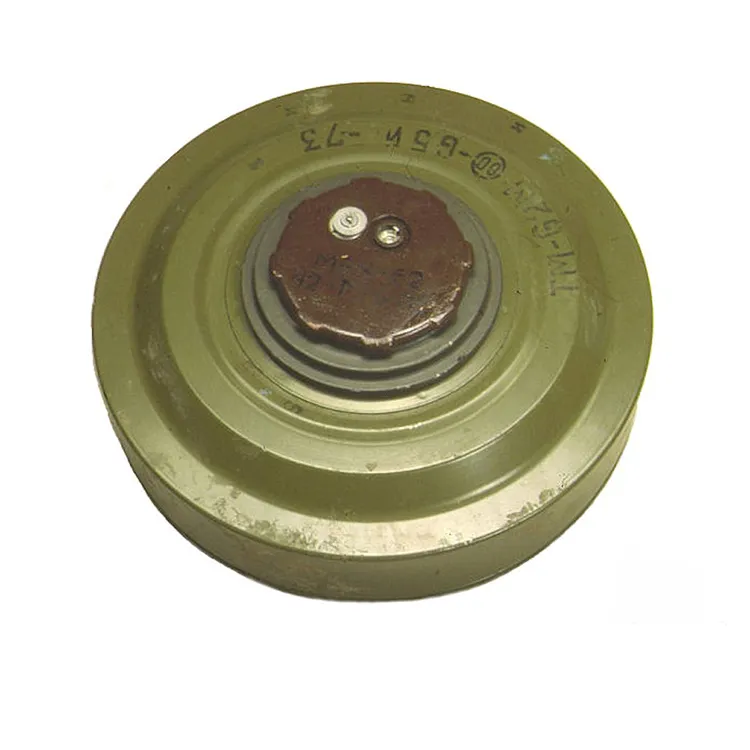


Used by both Russian and Ukrainian forces as a hand- or mechanically emplaced anti-vehicle mine; Human Rights Watch identified TM-62M and TM-62P3 use in Ukraine, and Mine Action Review described TM-62-series mines as the main anti-vehicle mines used by both sides after February 2022.
Role detailsInfantry Weapons
TM-62
Also known as
- TM-62 mine
- TM-62 series
- TM 62
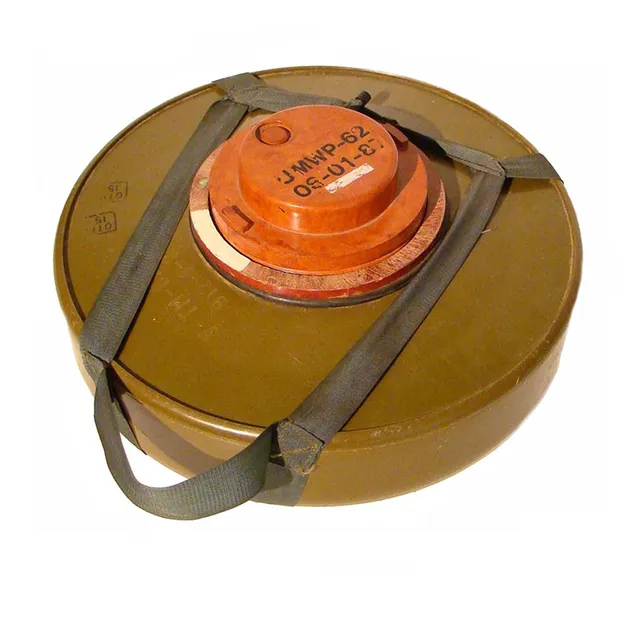
The TM-62 is a Soviet family of circular anti-tank blast mines built around a central fuze well and a large high-explosive charge. Metal, plastic, wooden, and low-metal case variants appear in mine-action reporting, and the TM-62M/TM-62P3 are documented in current conflicts including Ukraine, Syria, Yemen, Libya, and Nagorno-Karabakh.
Role in Conflicts

Used by Houthi-Saleh forces as an anti-vehicle mine; Human Rights Watch documented TM-62 and TM-57 mines among Soviet-made anti-vehicle mines used indiscriminately in Yemen after the Saudi-led coalition intervention began in March 2015.
Role details- Role in conflict
- Tripoli mine warfare and booby-trap contamination

Used by Russian mercenaries fighting on behalf of the Libyan National Army in the Tripoli area; Landmine Monitor lists TM-62M anti-vehicle mines as used in Tripoli in 2019-2020 by Russian mercenaries.
- Role in conflict
- Anti-vehicle mine warfare and route denial

Fielded as anti-tank mines in mined areas and supply roads during post-2020 Armenia-Azerbaijan hostilities; Azerbaijan's defense ministry said engineer-sapper units cleared 8 TM-62 anti-tank mines in the Kalbajar direction after Armenian armed forces sabotage activity in September 2022.

Used by Syrian government forces during the Syrian Civil War; Landmine Monitor reporting lists TM-62M and TM-62P3 anti-vehicle mines among Soviet/Russian mines used by government forces since 2012, including along the borders with Lebanon and Turkey.
Role detailsUkraine Field Adaptations
In Ukraine, the TM-62 is not limited to buried route denial. Mine Action Review describes the TM-62 series as the principal anti-vehicle mine family used by both sides after February 2022, while specialist video analysis has documented Ukrainian heavy drones carrying and releasing TM-62M mines as large improvised aerial munitions.
| Adaptation | Documented context | Sourcing limit |
|---|---|---|
| Manual and mechanical mine laying | Route denial, defensive belts, and contaminated farmland or approaches in the 2014 Russia-Ukraine War. | Supported by mine-action and Human Rights Watch reporting. |
| Heavy-drone dropped mine | Ukrainian videos analyzed by The Armourer's Bench show TM-62 mines carried in drone release trays and sometimes fitted with improvised tail assemblies. | Video-derived OSINT; useful for adaptation context, not for exact inventory counts. |
Sources: Clearing the Mines 2023: Ukraine; Heavy Drone Bombers Dropping Anti-Tank Mines.
Profile / Specs
Profile
- Origin
- Soviet Union
- Built in
- Soviet UnionRussia
- Type
- Anti-tank blast mine
- Service note
- Cold War-era Soviet design still encountered in current conflicts
- Designer
- Soviet state design bureau
- Designed
- 1960s
- Produced
- 1960s onward
Specifications
- Mine family
- TM-62 series anti-vehicle blast mine
- Typical explosive charge
- 7.5 kg TNT in the TM-62M
- Weight
- 9.5 kg for the TM-62M
- Diameter
- 320 mm for the TM-62M
- Height
- 128 mm for the TM-62M
- Initiation
- Central pressure fuze; TM-62 variants can use several fuze types
- Operating pressure
- 150 to 550 kg for the TM-62M
- Emplacement
- Manual emplacement, mechanical minelayers, or helicopter mine-laying systems
- Representative case variants
- TM-62M metal; TM-62P/P2/P3 plastic; TM-62B paper or cardboard; TM-62D wooden; TM-62T fabric/epoxy
Variant And Fuze Notes
The TM-62 family is best read as a mine body and fuze ecosystem rather than as one fixed article. The central fuze well lets different case types use related pressure or influence fuzes, while the large explosive charge makes the mine useful for both intended anti-vehicle mining and later improvised battlefield adaptations.
| Family branch | Case or fuze point | Reader-visible significance |
|---|---|---|
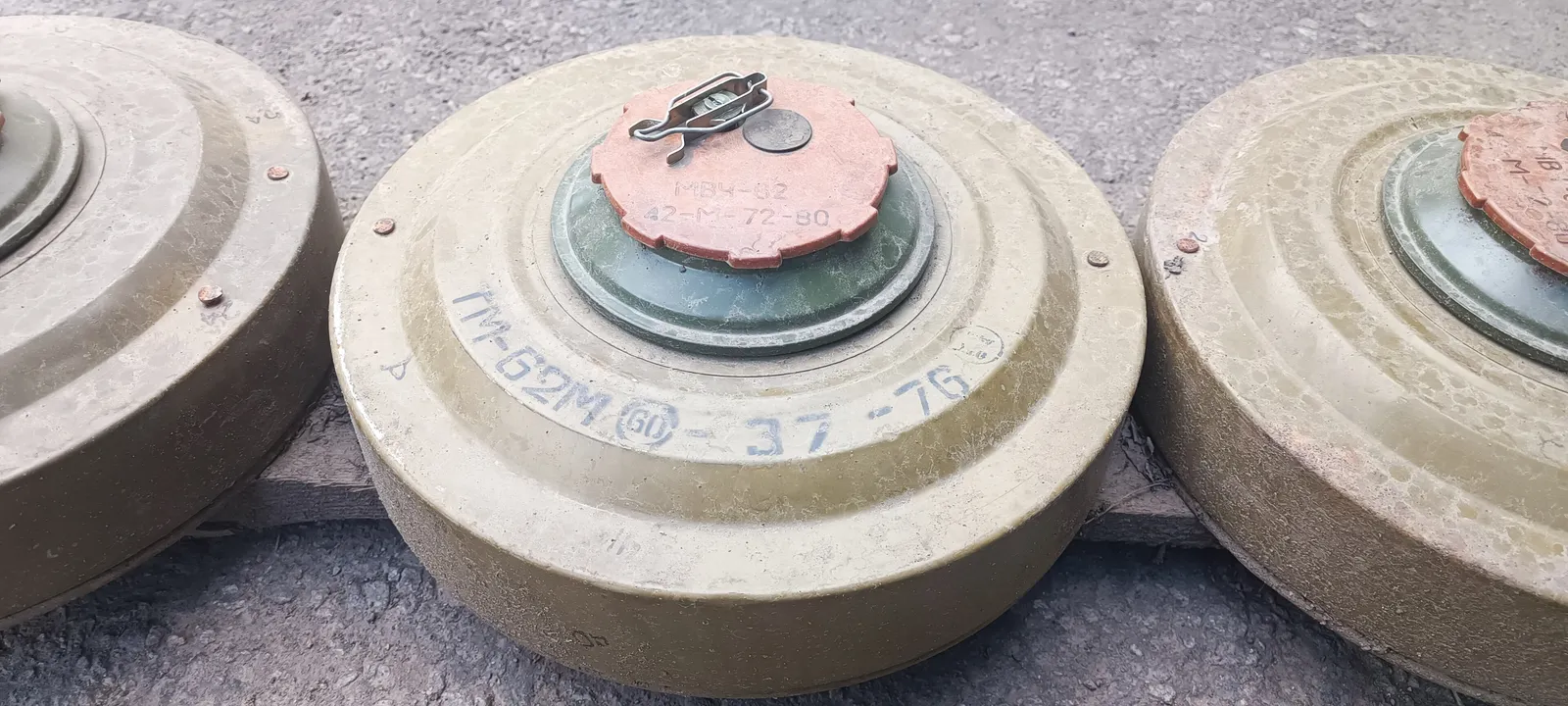
| TM-62M | Metal circular case | Common, easily recognized representative model documented in Ukraine and technical references. |
| TM-62P / P2 / P3 | Plastic cases | Lower-metal variants complicate detection and appear in Ukraine and Syria reporting. |
| TM-62B / D / T | Paper, wooden, or fabric/epoxy cases | Alternate case materials keep the same broad anti-tank blast role while changing detectability and field handling. |
| MVCh-62 / MVP-62 and related fuzes | Pressure or delayed-arming fuze options | Fuze selection affects arming delay, activation pressure, and how the mine can be emplaced or adapted. |
Sources: TM-62 Russian Anti-Tank Mine - ODIN; CISR Munitions Reference Guide; Background Briefing on Landmine Use in Ukraine.
Variants
TM-62 designations identify a family of Soviet anti-tank blast mines that share the central fuze concept but use different case materials and fuze options.
| Variant | Configuration | Designation notes |
|---|---|---|
| TM-62M | Metal-cased anti-tank blast mine | The common metal-case model is the representative TM-62 variant in several technical references and is documented in current conflict-use reporting. Sources: TM-62 Russian Anti-Tank Mine - ODIN, CISR Munitions Reference Guide, Background Briefing on Landmine Use in Ukraine |
| TM-62P3 | Plastic-cased anti-tank blast mine | Plastic-case TM-62P3 mines reduce metal content compared with the TM-62M; Human Rights Watch documented TM-62P3 mines in Ukraine, and Landmine Monitor lists the type in Syria reporting. Sources: CISR Munitions Reference Guide, Background Briefing on Landmine Use in Ukraine, Russian Federation Mine Ban Policy 2019 |
| TM-62P / TM-62P2 | Plastic-cased family members | Reference material groups the TM-62P and TM-62P2 with the plastic-case branch of the family, separate from the smooth-cased TM-62P3. Sources: CISR Munitions Reference Guide |
| TM-62B / TM-62D / TM-62T | Paper, wooden, and fabric/epoxy case variants | Specialist references distinguish additional low-metal or alternate-case variants around the same central-fuze anti-tank mine family. Sources: CISR Munitions Reference Guide, TM-62 Russian Anti-Tank Mine - ODIN |
Timeline
TM-62 Key Events
Soviet TM-62 family introduced
Technical references describe the TM-62 as a Soviet anti-tank blast mine series developed during the Cold War around a central fuze and large explosive charge.
Syrian government mine use reported
Landmine Monitor reporting lists TM-62M and TM-62P3 anti-vehicle mines among Soviet/Russian mines used by Syrian government forces during the Syrian Civil War.
Expanded use in Ukraine after full-scale invasion
Mine Action Review described TM-62-series mines as the main anti-vehicle mines used by both Russian and Ukrainian forces after February 2022.
Heavy-drone drop adaptations appear
The Armourer's Bench documented Ukrainian heavy-drone videos showing TM-62 mines carried and dropped as improvised large drone munitions.
Related Weapon Systems


Sources
TM-62 Russian Anti-Tank Mine - ODINPublisher: U.S. Army Training and Doctrine Command ODIN | Note: Supports TM-62 family background, Soviet anti-tank blast-mine classification, central fuze layout, typical charge, case-variant framing, and representative emplacement context. | Accessed: 2026-06-30CISR Munitions Reference GuidePublisher: James Madison University Center for International Stabilization and Recovery | Note: Supports TM-62 family variant distinctions, case-material differences, fuzing context, and general munitions-reference background. | Accessed: 2026-06-30Anti-Tank Mine TM-62MPublisher: Armatec | Note: Provides TM-62M technical data including charge weight, dimensions, pressure range, and emplacement methods. | Accessed: 2026-06-20Russian Landmine, AT, TM-62MPublisher: Bulletpicker | Note: Summarizes the TM-62 series role as high-explosive anti-tank mines and lists emplacement methods. | Accessed: 2026-06-20TM-62MPublisher: METIS by Fenix Insight | Note: Identifies the TM-62M as a Soviet-era, Russian Federation metal-cased anti-tank blast mine and lists USSR/Russian Federation manufacture. | Accessed: 2026-06-20Russian Federation Mine Ban Policy 2019Publisher: Landmine and Cluster Munition Monitor | Note: 2011 Syrian Civil War direct-use source: lists TM-62M and TM-62P3 anti-vehicle mines among Soviet/Russian mines used by Syrian government forces since 2012, including along the borders with Lebanon and Turkey. | Accessed: 2026-06-30Background Briefing on Landmine Use in UkrainePublisher: Human Rights Watch | Note: 2014 Russia-Ukraine War direct-use source: used by both Russian and Ukrainian forces as anti-vehicle mines, including documented TM-62M and TM-62P3 mines. | Accessed: 2026-06-20Heavy Drone Bombers Dropping Anti-Tank MinesPublisher: The Armourer's Bench | Note: 2014 Russia-Ukraine War direct-use and adaptation source: documents Ukrainian heavy-drone videos showing TM-62 mines carried and dropped as improvised large munitions. | Accessed: 2026-06-30Clearing the Mines 2023: UkrainePublisher: Mine Action Review | Note: Directly supports 2014 Russia-Ukraine War use by stating that both Russian and Ukrainian forces used anti-vehicle mines, mostly manually or mechanically emplaced TM-62-series mines, after February 2022. | Accessed: 2026-06-20Yemen: Houthi-Saleh Forces Using LandminesPublisher: Human Rights Watch | Note: 2014 Yemen Civil War direct-use source: used by Houthi-Saleh forces as anti-vehicle mines, including TM-62 mines documented after the Saudi-led coalition intervention began in March 2015. | Accessed: 2026-06-20Mine Ban Policy: LibyaPublisher: Landmine and Cluster Munition Monitor | Note: 2014 Second Libyan Civil War direct-use source: used by Russian mercenaries in Tripoli in 2019-2020 as TM-62M anti-vehicle mines while Wagner-linked forces fought for the Libyan National Army. | Accessed: 2026-06-20Mines Buried in the Kalbajar Direction Were NeutralizedPublisher: Ministry of Defense of the Republic of Azerbaijan | Note: 2020 Nagorno-Karabakh Conflict direct-use source: fielded by Armenian armed forces sabotage groups in mined territories and supply roads, with 8 TM-62 anti-tank mines cleared in the Kalbajar direction in September 2022. | Accessed: 2026-06-20File: TM-62M.jpgPublisher: Wikimedia Commons | Note: Image of a TM-62M from the State Emergency Service of Ukraine, licensed CC BY 4.0 on Wikimedia Commons. | Accessed: 2026-06-20File: TM-62P3.jpgPublisher: Wikimedia Commons | Note: Image of a TM-62P3 from the State Emergency Service of Ukraine, licensed CC BY 4.0 on Wikimedia Commons. | Accessed: 2026-06-20File: TM-62M Mines at a Checkpoint in Zaporizhzhia OblastPublisher: Wikimedia Commons | Note: Gallery image of TM-62M mines at a checkpoint in Zaporizhzhia Oblast, licensed CC BY-SA 4.0 by the uploader. | Accessed: 2026-06-20