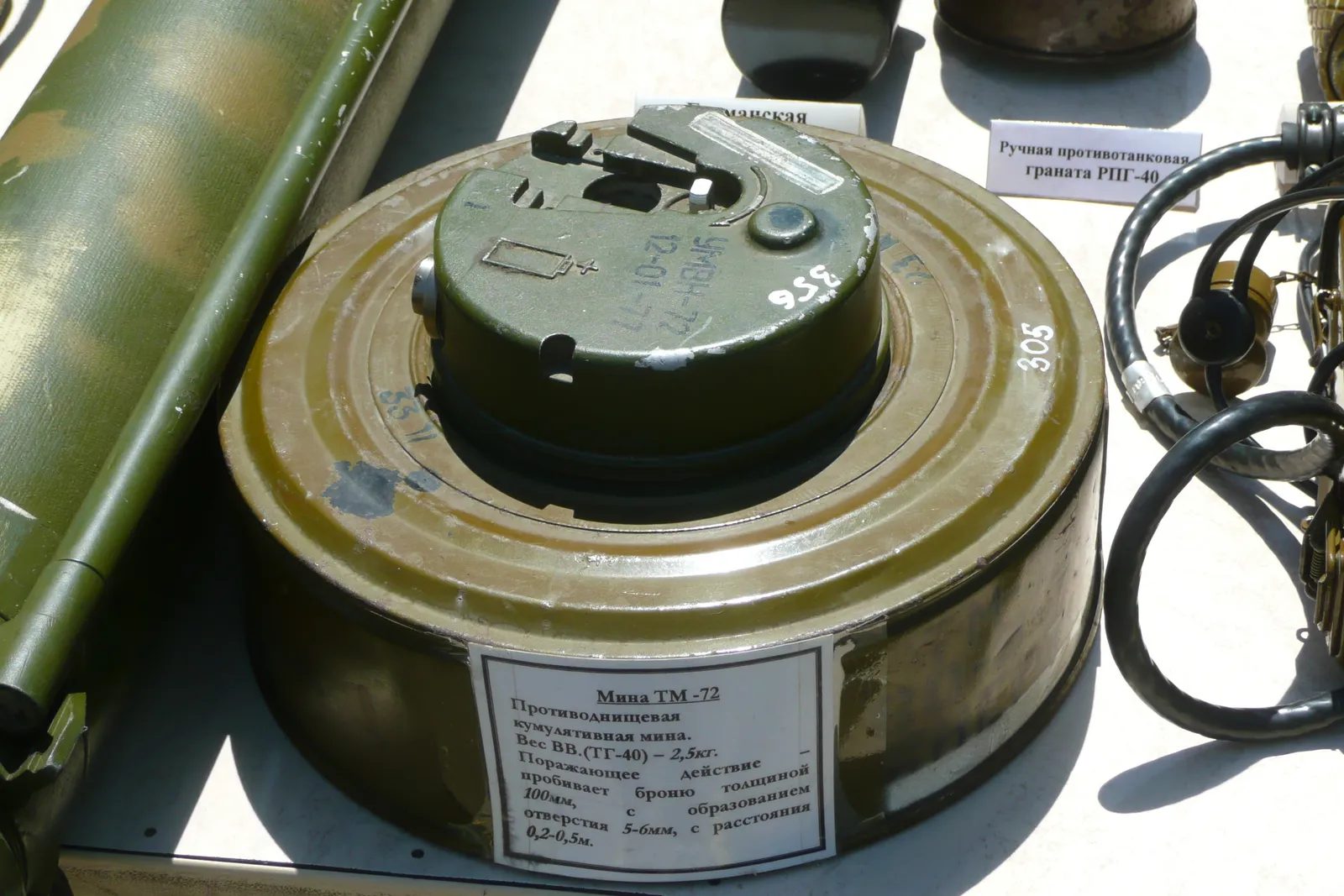


Terrogence reported limited TM-72 use by both sides in the 2014 Russia-Ukraine War, while Ukrinform reported Russian engineer units using TM-72 mines for manual and drone-assisted mining around Huliaipole in January 2026.
Role detailsMunitions
TM-72
Also known as
- TM 72
- TM72
- ТМ-72
The TM-72 is a Soviet bottom-attack anti-tank mine built around magnetic-influence fuzing and a shaped-charge effect against vehicle undersides. A 1974 Soviet manual documents the mine and its MVN-72 fuze, open technical references place later manufacture in Russia as well as the Soviet Union, and 2026 reporting shows it still appears in the 2014 Russia-Ukraine War.
Role in Conflicts
Profile / Specs
Profile
- Origin
- Soviet Union
- Built in
- Soviet UnionRussian Federation
- Type
- Shaped-charge anti-tank mine
- Service note
- Cold War Soviet design, still encountered in the 2014 Russia-Ukraine War
- Designed
- Documented by 1974
Specifications
- Mine type
- Anti-vehicle / anti-tank shaped-charge mine
- Body
- Circular sheet-metal body
- Diameter
- 250 mm
- Body height
- 80-82 mm
- Height with fuze
- About 128 mm
- Weight
- About 6 kg
- Main charge
- About 2.5 kg TG-40 explosive charge
- Fuzing
- Typically MVN-72 or MVN-80 magnetic-influence fuze
- Attack effect
- Shaped-charge bottom attack intended to perforate vehicle floors or tracks
- Reported penetration
- About 100 mm of armor plate at 0.25-0.5 m standoff in open technical references
- Emplacement
- Manual or vehicle-laid; 30-50 mm earth cover commonly described
Shared Fuze Family
GICHD places TM-72 fuzes in the same 85 mm threaded mine-fuze family used across TM-62 and TM-80 series mines.
| Compatible item | Item type | Compatibility evidence |
|---|---|---|
 | Anti-tank mine family | The guide identifies multiple 85 mm threaded fuzes for the TM-62, TM-72, and TM-80 series, making TM-62 the closest catalog comparison point for the shared Soviet/Russian anti-tank mine fuze family. Sources: Explosive Ordnance Guide for Ukraine - Third Edition |
Timeline
TM-72 Key Events
Soviet manual documents the mine
A 1974 Soviet Ministry of Defence manual on the TM-72 mine and MVN-72 fuze shows the mine and its magnetic-influence fuze as a documented Soviet-era system by that year.
Sources: Anti-Tank Mine TM-72 and Mine Fuse MVN-72, 1974
2014 Russia-Ukraine War reporting shows continued use
Ukrinform reported Russian engineer units using TM-72 mines to mine roads, streets, and yards around Huliaipole in January 2026, including manual and drone-assisted emplacement.
Sources: Russian Forces Cannot Capture Huliaipole and Are Trying to Mine It, Voloshyn Says
Fuze And Family Notes
The TM-72 combines a metal mine body, a magnetic-influence fuze, and a shaped-charge bottom-attack effect rather than the pressure-only blast pattern associated with simpler anti-tank mines.
| Topic | Documented detail | Source |
|---|---|---|
| Target sensing | Open technical references place the mine with MVN-72 or MVN-80 magnetic-influence fuzes that react to a vehicle's magnetic signature. | TM-72 Landmine; TM-72 Anti-Tank Bottom Attack Mine |
| Attack effect | The mine is described as a shaped-charge bottom-attack weapon intended to damage the underside, floor, or track area of armored vehicles. | TM-72 Anti-Tank Bottom Attack Mine; TM-72 |
| Shared threading | GICHD identifies 85 mm threaded fuzes used across TM-62, TM-72, and TM-80 series anti-tank mines. | Explosive Ordnance Guide for Ukraine - Third Edition |
| 2026 use | Reporting in January 2026 described Russian engineer units receiving TM-72 mines for manual and drone-assisted mining around Huliaipole. | Russian Forces Cannot Capture Huliaipole and Are Trying to Mine It, Voloshyn Says |
Media
TM-72 Images
Related Weapon Systems


Sources
TM-72 LandminePublisher: CAT-UXO | Note: Supports mine type, dimensions, explosive weight, body material, and fuze/effect details. | Accessed: 2026-06-30TM-72 Anti-Tank Bottom Attack MinePublisher: Sappers.org | Note: Supports bottom-attack classification, MVN-72/MVN-80 fuze context, height with fuze, explosive filling, reported penetration, and manual or vehicle emplacement details. | Accessed: 2026-06-30TM-72Publisher: METIS by Fenix Insight | Note: Supports Soviet-era background, countries of manufacture, metal-cased anti-tank shaped-charge description, and general munition context. | Accessed: 2026-06-30Anti-Tank Mine TM-72 and Mine Fuse MVN-72, 1974Publisher: Internet Archive | Note: Archived Russian Ministry of Defence manual metadata for the TM-72 mine and MVN-72 magnetic-influence fuze. | Accessed: 2026-06-30TM-72 Manual Cover ThumbnailPublisher: Internet Archive | Note: Public-domain archive thumbnail of the 1974 TM-72/MVN-72 manual cover used as the secondary gallery image. | Accessed: 2026-06-30Mobius Report 1/2026: TM-72 AT Mines with Standard Magnetic Fuzes, UkrainePublisher: Terrogence | Note: Directly supports 2014 Russia-Ukraine War use context, including TM-72 anti-tank mines used by both sides in limited numbers and their rarity relative to other magnetic-fuze anti-tank mines. | Accessed: 2026-06-30Russian Forces Cannot Capture Huliaipole and Are Trying to Mine It, Voloshyn SaysPublisher: Ukrinform | Note: Directly supports 2014 Russia-Ukraine War context for TM-72 mines fielded by Russian engineer units for manual and drone-assisted mining of roads, streets, and yards around Huliaipole. | Accessed: 2026-06-30TM-72 Mine Displayed in Donetsk, 2011Publisher: Wikimedia Commons | Note: Image provenance and licensing source; photograph by Andrew Butko, available under CC BY-SA 3.0 or GFDL 1.3. | Accessed: 2026-06-30Explosive Ordnance Guide for Ukraine - Third EditionPublisher: GICHD | Note: Supports the TM-62/TM-72/TM-80 shared 85 mm threaded minimum-metal fuze family and broader technical background for TM-72 compatibility context. | Accessed: 2026-06-30