

OSCE SMM reports observed GMZ-3 mine layers in Ukrainian government-controlled areas during the Donbas phase; Oryx, UNIAN, and Defense Express later documented Russian GMZ-3 losses, capture, and a Ukrainian UAV strike during the full-scale invasion phase.
Role detailsArmored Vehicles
GMZ-3
Also known as
- GMZ-3 Granilnik
- GMZ-3K
- Gusenichnyi minnyi zagraditel-3
- Object 318
- Izdelie 318
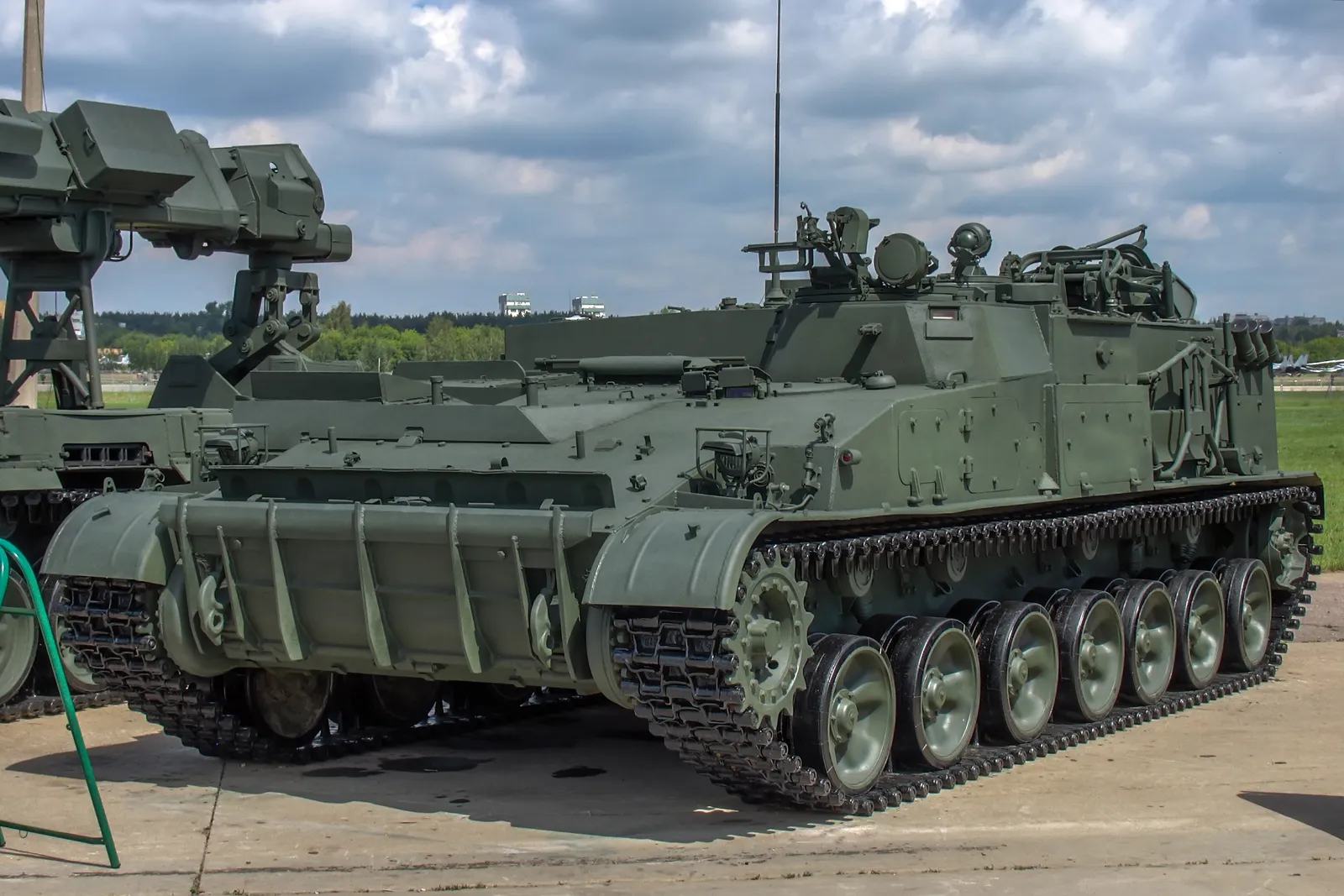
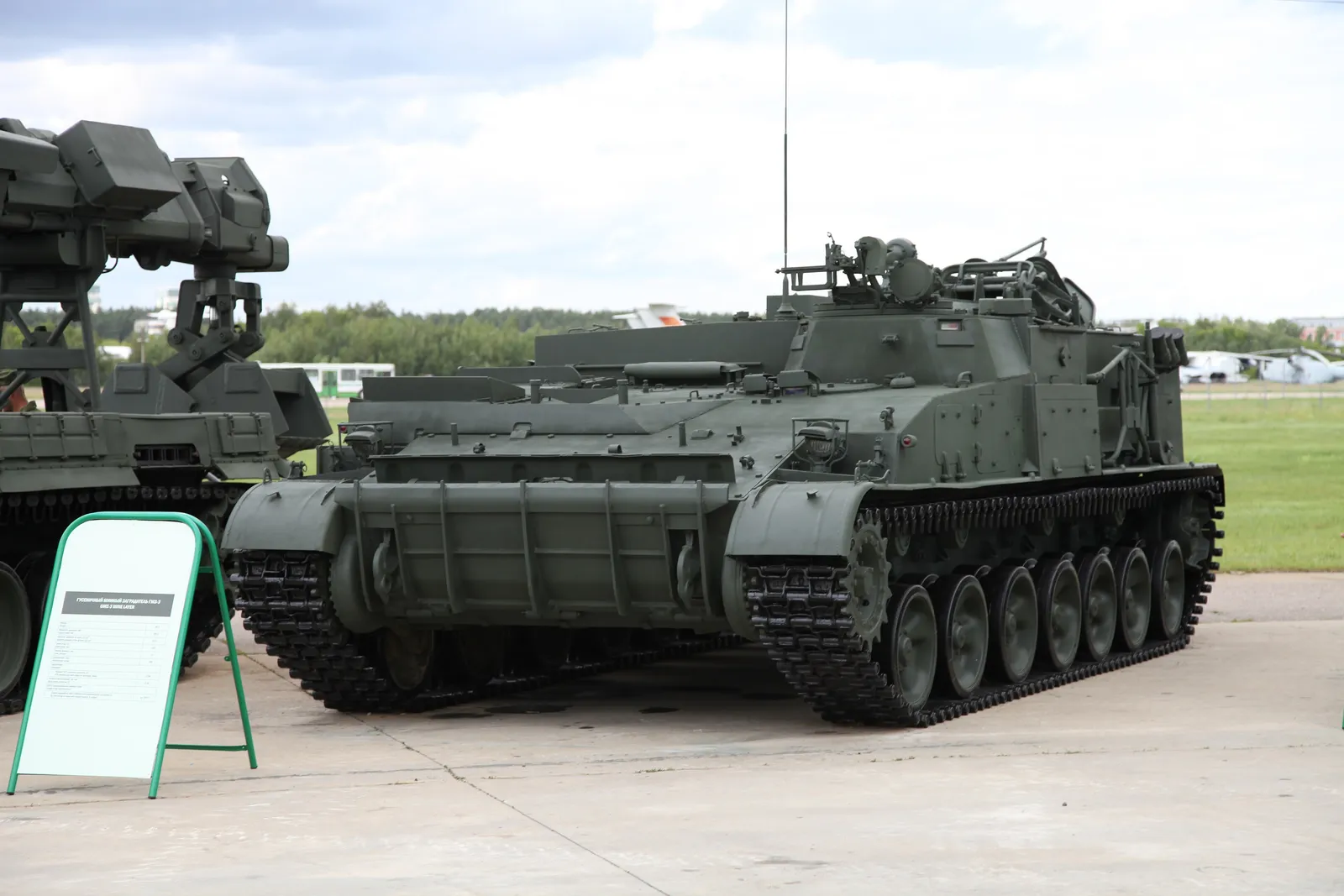
The GMZ-3 is a Soviet tracked armored minelayer built for engineer troops to emplace anti-tank minefields during maneuver or defensive preparation. Developed from the GMZ family and associated with Uraltransmash production, it carries a large mine load, uses a conveyor and plough assembly to lay mines on the surface or bury them, and has been documented in Ukrainian government-controlled areas as well as among Russian engineering vehicles lost or captured during the 2014 Russia-Ukraine War.
Role in Conflicts
Profile / Specs
Profile
- Origin
- Soviet Union
- Built by
- Uraltransmash
- Built in
- Soviet UnionRussia
- Type
- Tracked armored minelayer
- Service note
- Entered Soviet service in 1984; retained in post-Soviet engineer units.
- Designer
- Uraltransmash design bureau lineage; Russian histories credit the GMZ-3 modernization to OKB Uraltransmash
- Designed
- 1980-1984 modernization program
- Produced
- Serial production reported from 1985
Specifications
- Crew
- 3
- Combat weight
- About 28.5 tonnes
- Mine payload
- Up to 208 anti-tank mines
- Mine types noted
- TM-57, TM-62-series, TM-46, TMD-B and proximity-fuze options appear in public GMZ-3/GMZ-family descriptions
- Laying modes
- Surface laying or concealed laying in soil or snow
- Mine spacing
- Public WEG and Army Recognition profiles describe 5 m or 10 m mine intervals
- Mine-laying speed
- Up to about 16 km/h on the surface and 6 km/h when burying mines
- Road speed
- About 60 km/h
- Operational range
- About 500 km on roads
- Dimensions
- About 8.62-9.3 m long, 3.25 m wide, and 2.7 m high in open references
- Obstacle capability
- Army Recognition lists 1 m fording, 0.7 m vertical obstacle, and 2.5 m trench-crossing capability
- Engine
- V-59UMS or similar 520 hp class diesel in Russian-language GMZ-3 history; some English summaries list KaMAZ-7482 at 525 hp
- Defensive armament
- 7.62 mm PKT machine gun in a GMZ-3 cupola; some sources note other heavy-machine-gun fits on GMZ-family vehicles
- Protection
- Armored hull intended to protect the crew from small-arms fire and fragments
Tracked Chassis Lineage
The GMZ-3 belongs to the Soviet GM tracked chassis and Object 318 lineage associated with Uraltransmash engineering work. English-language references connect the vehicle to the SA-4 Ganef chassis family represented by the 2K11 Krug, while a TASS-based Army Recognition report says the Granilnik chassis shares components with the 2S3M Akatsiya and 2S4 Tyulpan. The relationship is best treated as shared tracked-chassis lineage and component context, not as operational compatibility.
Mine-Laying System
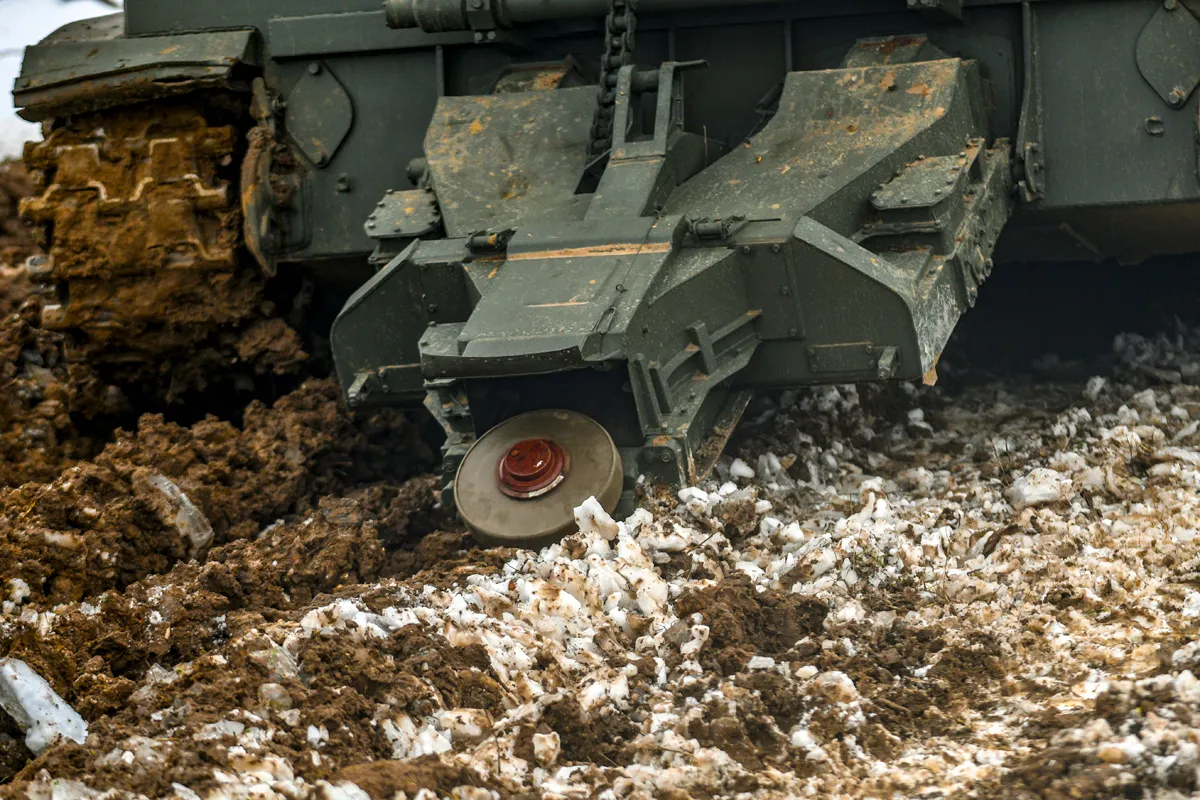
The GMZ-3's mine load is stored inside the hull and fed to a rear conveyor. Sources describe surface laying and buried laying through a plough assembly, with mine spacing controlled by the vehicle's mechanisms rather than by manual placement.
Mine load
Up to 208 anti-tank mines in the GMZ-3/GMZ-3K reporting used here.
Supported by Army Recognition and battlefield reporting summaries.
Laying modes
Surface emplacement or concealed emplacement in soil or snow using the rear conveyor and plough.
Army Guide and Voentex describe the conveyor and plough workflow.
Navigation
Navigation equipment records vehicle and minefield coordinates for mapping.
Voentex and Armforc describe coordinate indexing and topographic support.
Variants
Public sources treat GMZ-3, GMZ-3K, and Granilnik wording as closely related naming around the late Soviet tracked minelayer rather than clearly separate catalog families.
| Variant | Configuration | Designation notes |
|---|---|---|
| GMZ-3K Granilnik | Modernized or alternate heavy-minelayer designation | Army Recognition's TASS-based report uses GMZ-3K and Granilnik wording for a Russian heavy tracked minelayer that carries more than 200 mines and was adopted in 1984. |
Carried Mines
The tracked minelayer carries anti-tank mines as payload; this relationship is limited to mine types explicitly listed for the GMZ-3.
| Carried item | Item type | Carriage evidence |
|---|---|---|
 | Anti-tank blast mine | The Worldwide Equipment Guide lists TM-62-series mines among GMZ-3 mine types and gives the tracked minelayer a 208-mine load. Sources: Worldwide Equipment Guide 1999 |
Timeline
GMZ-3 Key Events
GMZ modernization work begins
Russian-language engineering history places the GMZ-3 modernization program at Uraltransmash's design bureau from 1980.
Sources: Armforc GMZ family history
Soviet service adoption
The GMZ-3 was accepted into Soviet Army service in 1984 as the updated tracked minelayer variant.
Sources: Armforc GMZ family history, Voentex GMZ-3 overview
Serial production at Uraltransmash
Russian-language GMZ family history places serial production of the GMZ-3 at Uraltransmash from 1985.
Sources: Armforc GMZ family history
OSCE observes GMZ-3 near Volnovakha
The OSCE SMM reported observing a GMZ-3 minelayer near government-controlled Volnovakha in Donetsk region during the Donbas phase of the war.
Sources: OSCE SMM Volnovakha GMZ-3 report
OSCE UAV spots GMZ-3 near Loskutivka
An OSCE SMM UAV spotted a GMZ-3 mine layer near Loskutivka in Ukrainian government-controlled territory west of Luhansk.
Sources: OSCE SMM Loskutivka GMZ-3 report
Captured vehicle reported by Ukrainian forces
UNIAN reported that Ukrainian military communications showed a captured Russian GMZ-3 minelayer during the full-scale war.
Sources: UNIAN captured GMZ-3 report
Drone strike near Kupiansk
Defense Express reported that the Achilles UAV unit of Ukraine's 92nd Separate Assault Brigade destroyed a Russian GMZ-3 near Zahryzove, south of Kupiansk, during strikes on January 3-4, 2025.
Sources: Defense Express Achilles GMZ-3 strike, Defense Express Kupiansk GMZ-3 video report
Related Weapon Systems


Sources
Worldwide Equipment Guide 1999Publisher: U.S. Army TRADOC DCSINT Threat Support Directorate / Internet Archive | Note: Public-release U.S. Army reference supporting GMZ-3 crew, mine capacity, mine-laying speed, minefield spacing, burial depth, mine types, 7.62 mm PKT armament, navigation equipment, NBC protection, and smoke-screening fit. | Accessed: 2026-07-13ODIN GMZ-3 WEG profilePublisher: U.S. Army ODIN / Worldwide Equipment Guide | Note: Supports GMZ-3 identity, tracked mine-laying role, anti-tank mine employment in soil or snow, and WEG-derived specification context. | Accessed: 2026-07-13Army Recognition GMZ-3 profilePublisher: Army Recognition | Note: Supports GMZ-3 identity, mine-laying modes, mine payload, mobility figures, SA-4 Ganef chassis relationship, navigation context, and broad service background. | Accessed: 2026-07-13Army Guide GMZ-3 product pagePublisher: Army Guide | Note: Supports the tracked minelayer role and the automatic feed, rear conveyor, and plough workflow for surface or concealed anti-tank mine laying. | Accessed: 2026-07-13Army Recognition Granilnik upgrade reportPublisher: Army Recognition | Note: TASS-based report supporting Uraltransmash/Omsktransmash modernization context, GMZ-3K/Granilnik naming, 1984 adoption, payload, weight, crew, and shared chassis-component relationships with Akatsiya and Tyulpan. | Accessed: 2026-07-13Armforc GMZ family historyPublisher: Armforc | Note: Russian-language engineering history supporting Uraltransmash design lineage, GMZ-3 modernization from 1980, 1984 adoption, 1985 serial production, navigation equipment, engine-power change, crew, mine load, and smoke-launcher fit. | Accessed: 2026-07-13Voentex GMZ-3 overviewPublisher: Voentex | Note: Russian-language overview supporting Object/Izdelie 318 naming, 1980 development start, 1984 Soviet Army adoption, minefield-length claims, laying-speed range, navigation coordinate indexing, and reload context. | Accessed: 2026-07-13Oryx Russian equipment losses in UkrainePublisher: Oryx | Note: Supports 2014 Russia-Ukraine War direct conflict-use evidence by listing Russian GMZ-3 minelayers destroyed and captured during the 2022 invasion phase. | Accessed: 2026-07-13OSCE SMM Volnovakha GMZ-3 reportPublisher: OSCE Special Monitoring Mission to Ukraine | Note: Supports 2014 Russia-Ukraine War direct conflict-use evidence for the OSCE observing a GMZ-3 minelayer near government-controlled Volnovakha on December 21, 2015. | Accessed: 2026-07-13OSCE SMM Loskutivka GMZ-3 reportPublisher: OSCE Special Monitoring Mission to Ukraine | Note: Supports 2014 Russia-Ukraine War direct conflict-use evidence for an OSCE UAV spotting a GMZ-3 mine layer near Loskutivka in Ukrainian government-controlled territory on November 21, 2018. | Accessed: 2026-07-13Defense Express Achilles GMZ-3 strikePublisher: Defense Express | Note: Supports 2014 Russia-Ukraine War direct conflict-use evidence for a Russian GMZ-3 targeted and destroyed by a Ukrainian UAV unit near Kupiansk. | Accessed: 2026-07-13Defense Express Kupiansk GMZ-3 video reportPublisher: Defense Express | Note: Supports 2014 Russia-Ukraine War direct conflict-use evidence for footage and reporting that Ukrainian drone units destroyed a Russian GMZ-3 near Zahryzove in the Kupiansk direction on January 3-4, 2025. | Accessed: 2026-07-13UNIAN captured GMZ-3 reportPublisher: UNIAN | Note: Supports 2014 Russia-Ukraine War direct conflict-use evidence for Ukrainian forces displaying a captured Russian GMZ-3 minelayer in October 2022. | Accessed: 2026-07-13Commons GMZ-3 Engineering Technologies imagePublisher: Wikimedia Commons | Note: Supports reusable image provenance for the GMZ-3 photograph by Mike1979 Russia, licensed under CC BY-SA 3.0. | Accessed: 2026-07-13Commons GMZ-3 Vitaly Kuzmin imagePublisher: Wikimedia Commons | Note: Supports reusable image provenance for a GMZ-3 photograph by Vitaly V. Kuzmin at Engineering Technologies 2012, licensed under CC BY-SA 4.0 with Wikimedia VRT permission. | Accessed: 2026-07-13Commons GMZ-3 engineer exercise imagePublisher: Wikimedia Commons | Note: Supports reusable image provenance for a Russian Ministry of Defence GMZ-3 engineer-exercise photograph, licensed CC BY 4.0 with Mil.ru attribution. | Accessed: 2026-07-13