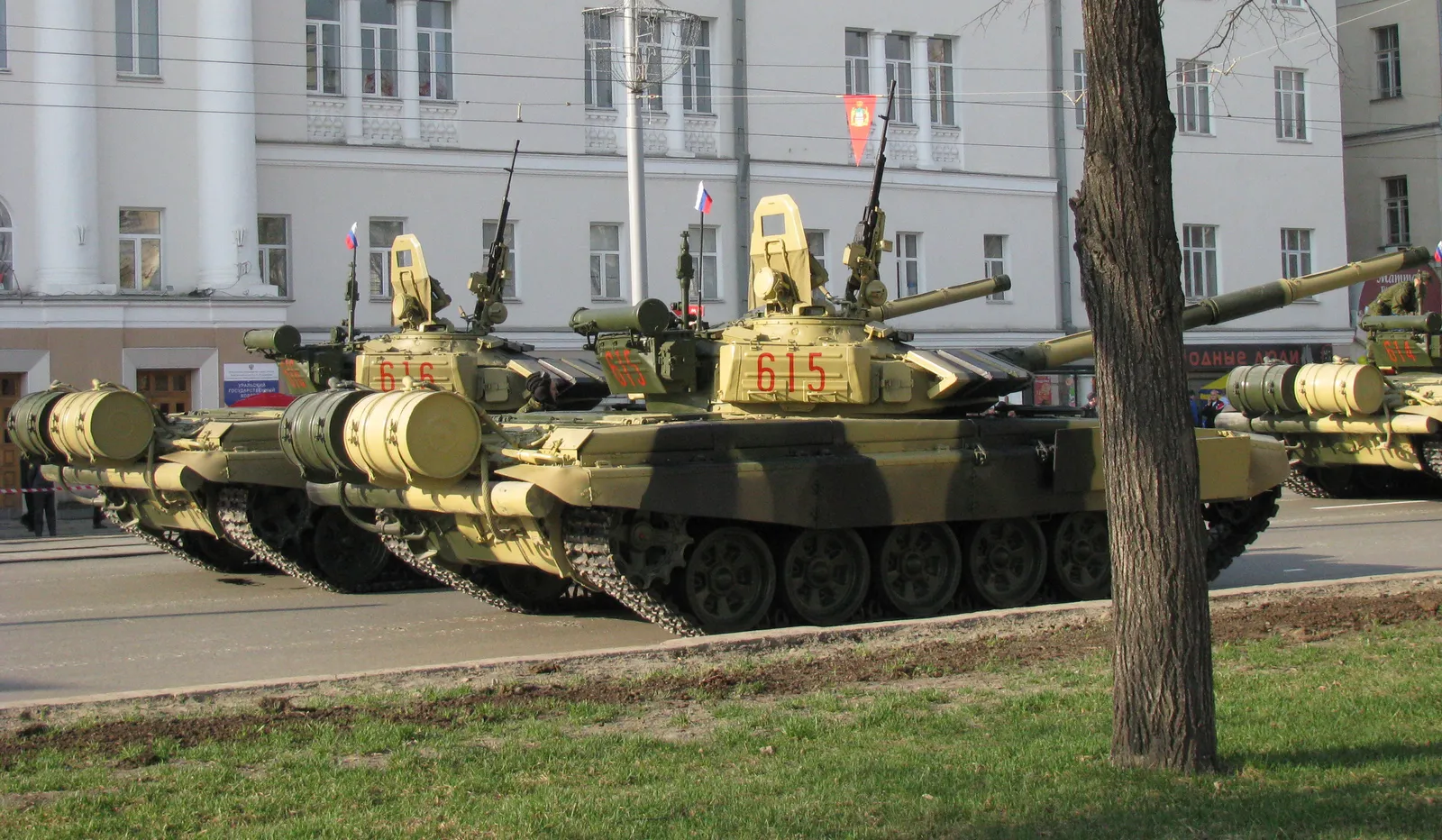


Used by both sides: Bellingcat and defense-journal reporting document early Donbas T-72B3 use, Oryx has visually documented Russian and Ukrainian T-72-series losses after the full-scale invasion, and U.S. releases list T-72B tanks supplied to Ukraine.
Role detailsTanks
T-72
Also known as
- Ural
- Object 172
- Object 172M
- T-72M
- T-72M1
- Lion of Babylon
- Asad Babil
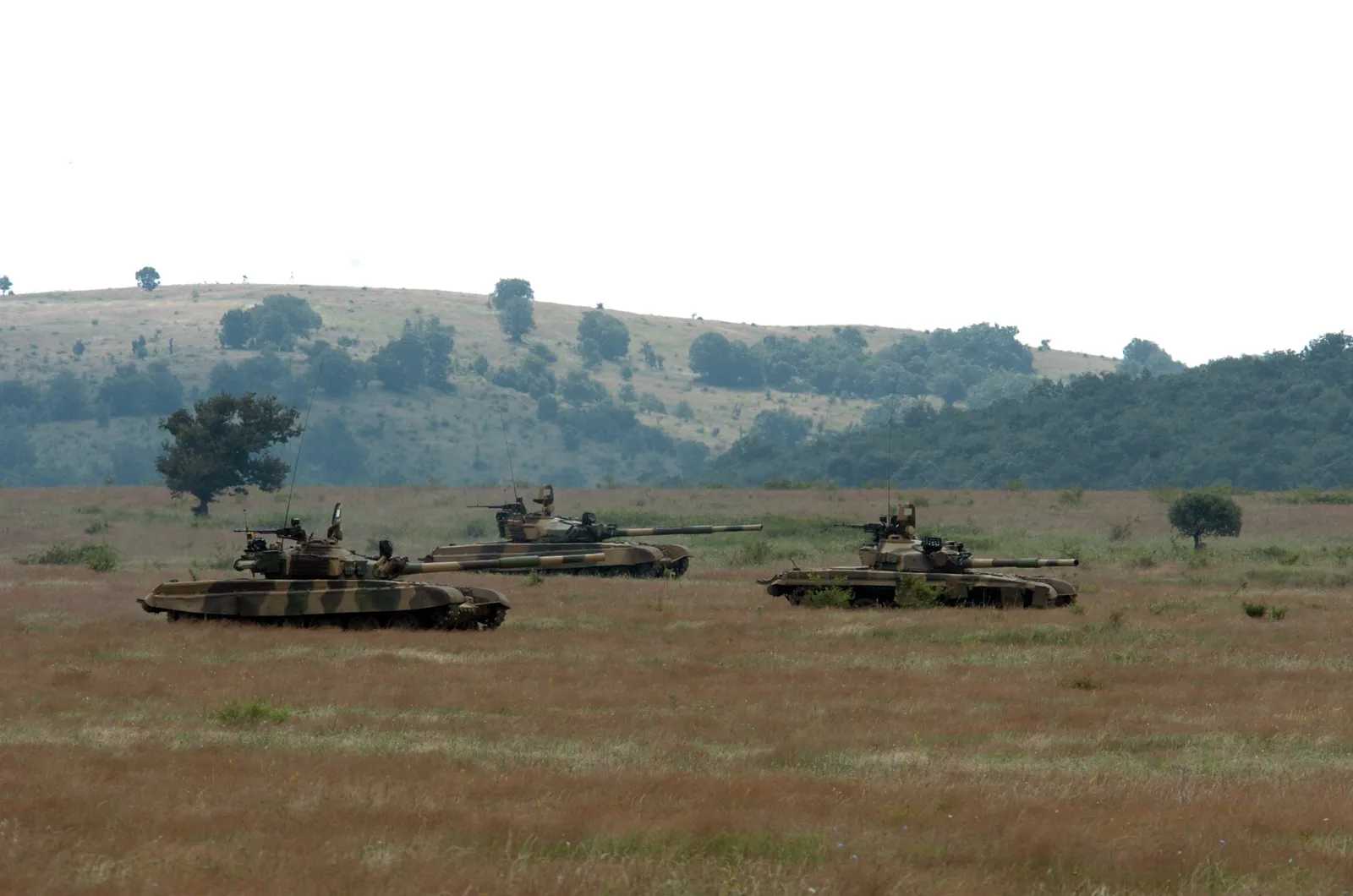
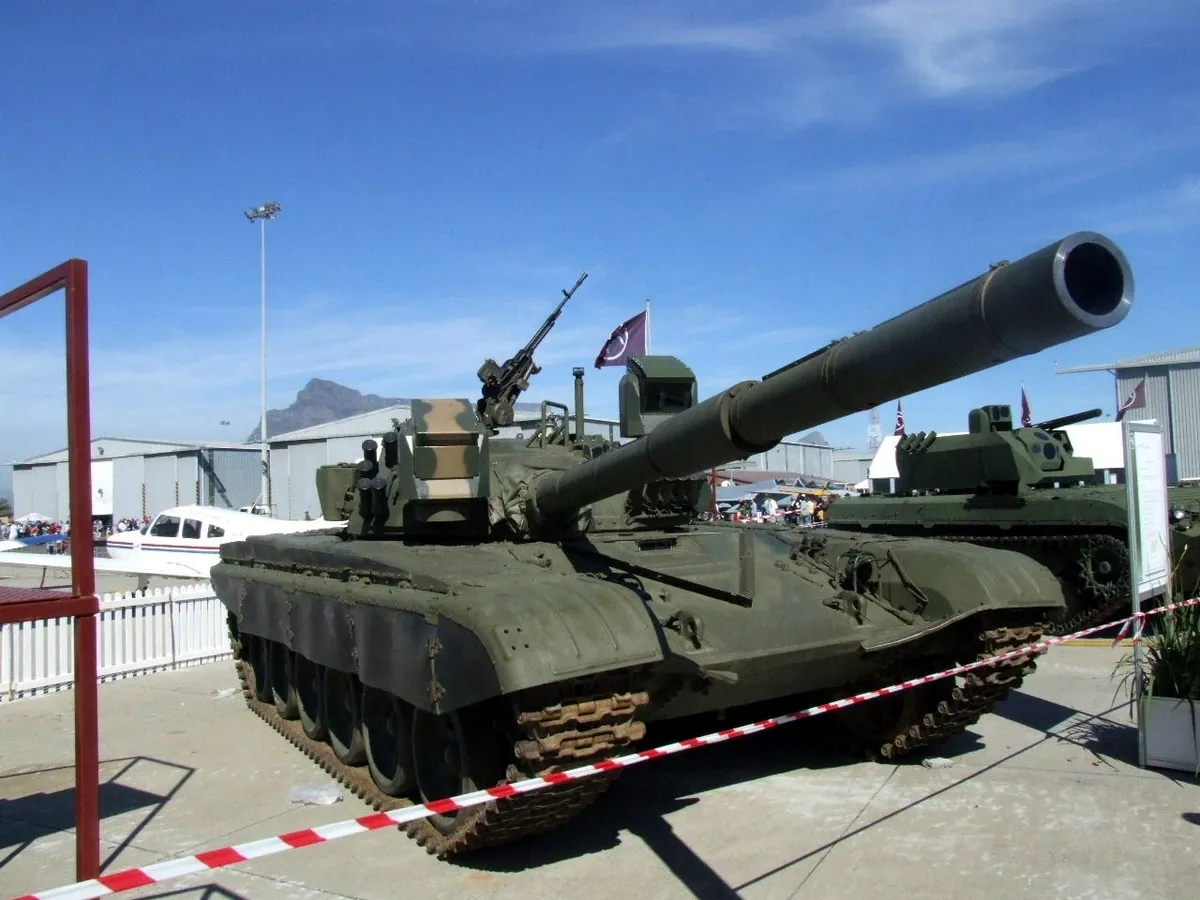
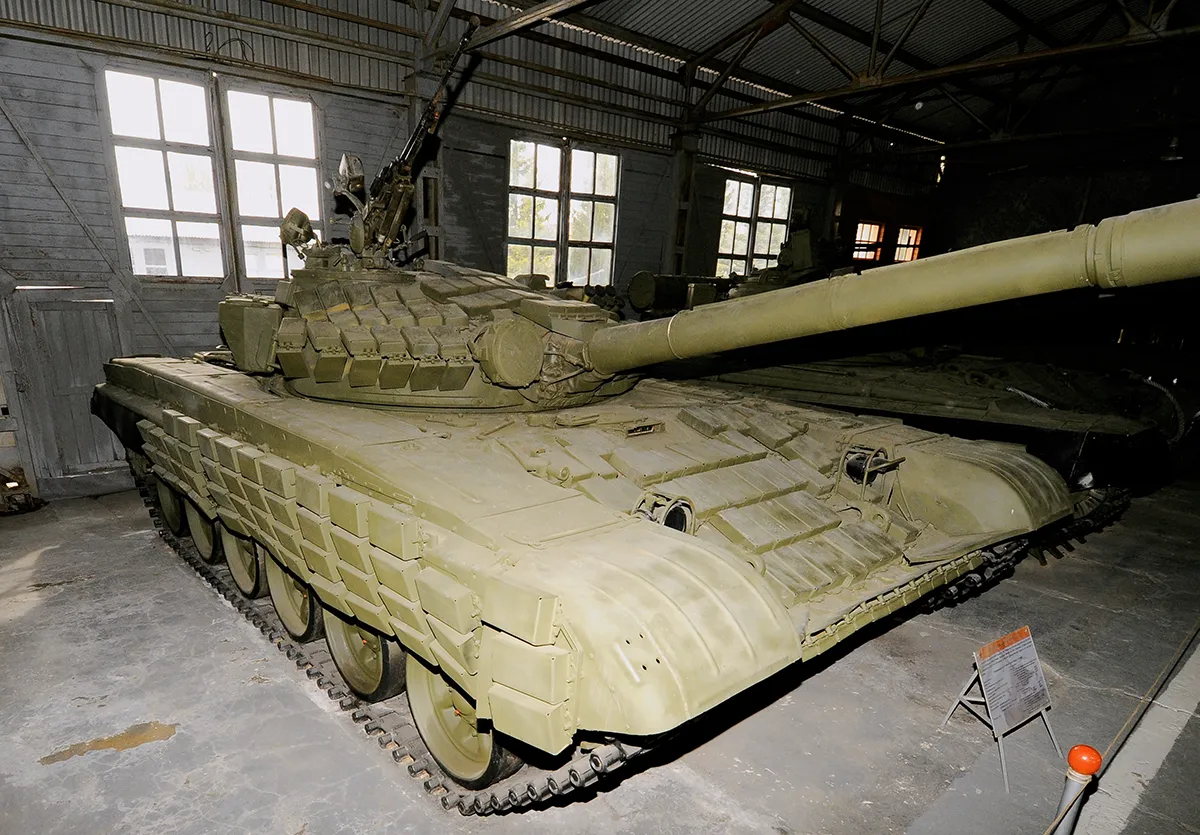
The T-72 is a Soviet main battle tank family built around a three-person crew, an autoloaded 125 mm gun, and a compact tracked chassis that entered Soviet service in 1974. Its long production run, licensed derivatives, and post-Soviet stockpiles made it a recurring armored vehicle in Iraq, Chechnya, Georgia, Syria, Yemen, Nagorno-Karabakh, and the Russia-Ukraine War.
Role in Conflicts

Fielded by the Syrian Arab Army in the 2011 Syrian Civil War; Bellingcat documented T-72 tanks among visually confirmed Syrian government armored vehicle losses through post-2015 fighting.
Role details- Role in conflict
- Armored maneuver and direct fire


Used by both Armenian/Artsakh and Azerbaijani forces in the 2020 Nagorno-Karabakh fighting; Oryx documented Armenian/Artsakh T-72AV losses and Azerbaijani T-72AV/T-72 "Aslan" losses.

Fielded from Yemeni Army stocks after the Houthi takeover; Oryx identified T-72B tanks among pre-war Yemeni fighting vehicles available to battlefield parties during the 2014 Yemen Civil War.
Role details- Side
- Iraq

Fielded by Iraqi forces in the 1990 Gulf War; Army University Press and Iraqi-service references describe T-72-family tanks in Iraqi armored formations engaged by coalition forces.
Role detailsUsed by Iraqi forces during the 2003 invasion phase; Army University Press and Iraqi-service references identify T-72-family tanks in Iraqi armored units encountered by U.S.-led coalition forces.
Role details- Side
- Iraq
- Role in conflict
- Iraqi armored formations
Operated by Iraq during the 1980 Iran-Iraq War as part of the Iraqi Army's Soviet-equipped armored force, including T-72-family vehicles later associated with Iraqi-service designations.
- Role in conflict
- Urban armored assault and captured armor
Used in the 1994 First Chechen War; RAND's study of the Chechen wars discusses T-72 tanks in the urban armored context around Grozny and in captured-equipment reporting.
- Side
- GeorgiaRussia and South Ossetian forces
- Role in conflict
- Armored maneuver around South Ossetia

Used by both Georgian and Russian forces in the 2008 Russo-Georgian War; The Tanks of August documents Georgian T-72 tanks committed around Tskhinvali and Russian T-72 tanks entering the theater.
Profile / Specs
Profile
- Origin
- Soviet Union / multiple donors
- Type
- Main battle tank
- Service note
- Cold War design, wartime donor stocks
- Designed
- Early 1970s
- Unit cost
- About $3.21 million in 2002 dollars for a new-production Russian T-72B1 in an archived Forecast International report
- Produced
- 1973-1992 Soviet production; licensed production continued abroad
- Number built
- At least 27,149 through 2012, including licensed production
Specifications
- Crew
- 3
- Armament
- 125 mm 2A26M2 or 2A46-series smoothbore gun with autoloader; later T-72B variants could fire 9K120 guided missiles; 7.62 mm coaxial MG; 12.7 mm roof MG on many variants
- Weight
- About 41 t for baseline variants; later variants vary
- Mobility
- About 60 km/h road speed; 500-700 km range depending on fuel fit
- Protection
- Steel/composite armor; many later variants use explosive reactive armor
Upgrade And Export Patterns
The T-72 spread through Soviet production, licensed manufacture, post-Soviet transfers, and national upgrade packages, which is why conflict reporting often identifies local marks rather than a single baseline tank.
| Pattern | Examples | Why it matters |
|---|---|---|
| Soviet production ladder | T-72 Ural, T-72A, T-72B | Weaponsystems.net separates the early Ural, high-volume T-72A, and T-72B guided-weapons branch, giving the family clear chronological steps. |
| Licensed and derivative builds | T-72M1, PT-91, Lion of Babylon | Licensed and locally assembled tanks created country-specific identifiers that still appear in battlefield and export-source reporting. |
| National modernization packages | Aslan, T-72B3M | Azerbaijani and Russian upgrade packages changed sights, protection, communications, and powertrain details without replacing the underlying T-72 family identity. |
Sources: T-72 Ural, T-72A, T-72B, T-72B3M Main Battle Tank, PT-91 Twardy Main Battle Tank.
Variants
The catalog record treats T-72 as a broad family page: early Soviet production marks, export models, licensed derivatives, and modernized branches are grouped here unless a later variant has enough distinct sourced conflict coverage for its own page.
| Variant | Configuration | Designation notes |
|---|---|---|
| T-72 Ural | Original production model | Weaponsystems.net places T-72 Ural production in 1973 and Soviet service entry in 1974. Sources: T-72 Ural |
| T-72A | First major production variant | Weaponsystems.net identifies the T-72A as the first major production variant and reports a production run of more than 10,000 vehicles. Sources: T-72A |
| T-72AV | Kontakt-1 reactive-armor fit | The AV designation is used in conflict reporting for T-72A-family tanks fitted with explosive reactive armor, including documented Nagorno-Karabakh losses. Sources: The Fight For Nagorno-Karabakh: Documenting Losses On The Sides Of Armenia And Azerbaijan |
| T-72B | Improved Soviet production model | The T-72B branch added improved protection and a 9K120 guided-weapons capability. Sources: T-72B |
 | Russian modernization branch | The B3M is linked as a distinct late modernization because its sights, protection package, powerpack, and Ukraine-war evidence are handled on a separate page. Sources: T-72B3M Main Battle Tank |
 | Polish T-72M1 modernization | The PT-91 page is linked as a Polish modernization of the T-72M1 lineage rather than a generic T-72 production mark. Sources: PT-91 Twardy Main Battle Tank |
| T-72AV/T-72 "Aslan" | Azerbaijani upgrade package | Army Recognition describes Azerbaijani T-72A and T-72M1 upgrades under the Aslan designation after Israeli-assisted modernization. Sources: Upgraded T-72 and T-90S main battle tanks remain the Azerbaijani Army's key striking power |
| Lion of Babylon / Asad Babil | Iraqi T-72-family designation | The Iraqi-service source treats Lion of Babylon and Asad Babil as Iraqi T-72-family designations tied to Iraq's Soviet-supplied and locally assembled tanks. Sources: T-72 Tanks in Iraqi Service |
Timeline
T-72 Key Events
T-72 Ural production starts
Weaponsystems.net describes the original T-72 Ural as entering production in 1973, setting up the tank family that followed.
Sources: T-72 Ural
Soviet service begins
The first T-72 Ural tanks entered Soviet service in 1974, anchoring the type in the late Cold War armored force structure.
Sources: T-72 Ural
T-72A becomes the main production variant
Weaponsystems.net identifies the T-72A as the first major production variant and says more than 10,000 were built.
Sources: T-72A
T-72B adds missile capability
The T-72B brought a 9K120 guided-weapons system and another major step in fire-control and protection refinement.
Sources: T-72B
Related Weapon Systems


Sources
T-72 SpecificationsPublisher: GlobalSecurity.org | Note: Supports general system specifications and background. | Accessed: 2026-06-19T-72Publisher: The Tank Museum | Note: Supports general T-72 background, crew, armament, weight, speed, and production context. | Accessed: 2026-06-20Wikipedia T-72Publisher: Wikipedia | Note: Supports additional system background. | Accessed: 2026-06-30TRADOC ODIN T-72Publisher: U.S. Army Training and Doctrine Command | Note: Supports official U.S. Army reference context for T-72 identity, type, and battlefield recognition. | Accessed: 2026-06-30Upgraded T-72 and T-90S main battle tanks remain the Azerbaijani Army's key striking powerPublisher: Army Recognition | Note: Supports background and modernization context for Azerbaijani T-72A/T-72M1 tanks designated Aslan after Israeli-assisted upgrades. | Accessed: 2026-06-20T-72B3M Main Battle TankPublisher: Army Technology | Note: Supports the T-72B3M as a Russian modernization branch of the T-72 family. | Accessed: 2026-06-30PT-91 Twardy Main Battle TankPublisher: Army Technology | Note: Supports the PT-91 Twardy as a Polish main battle tank developed from the T-72M1 lineage. | Accessed: 2026-06-30Fact Sheet on U.S. Security Assistance to UkrainePublisher: U.S. Department of Defense | Note: Supports 2014 Russia-Ukraine War direct-use context for T-72B tanks supplied to Ukraine as ground maneuver equipment. | Accessed: 2026-06-19Attack On Europe: Documenting Russian Equipment Losses During The Russian Invasion Of UkrainePublisher: Oryx | Note: Supports 2014 Russia-Ukraine War direct-use context for Russian T-72-series tanks through visually documented battlefield losses. | Accessed: 2026-06-30Nine Years of War - Documenting Syrian Arab Army's Armored Vehicles LossesPublisher: Bellingcat | Note: Supports 2011 Syrian Civil War direct-use context for T-72 tanks fielded by the Syrian Arab Army in fighting against opposition and anti-government forces. | Accessed: 2026-06-20T-72 Tanks in Iraqi ServicePublisher: Wikipedia | Note: Supports direct conflict-use context for Iraqi T-72-family tanks in the 1980 Iran-Iraq War, 1990 Gulf War, and 2003 Iraq War. | Accessed: 2026-06-30Certain VictoryPublisher: Army University Press | Note: Supports 1990 Gulf War direct-use context for Iraqi T-72 tanks in armored combat with coalition forces. | Accessed: 2026-06-30On Point: The United States Army in Operation Iraqi FreedomPublisher: Army University Press | Note: Supports 2003 Iraq War direct-use context for Iraqi T-72 tanks during the 2003 invasion phase. | Accessed: 2026-06-30Russia's Chechen Wars 1994-2000Publisher: RAND Corporation | Note: Supports 1994 First Chechen War direct-use context for T-72 tanks in Russian urban armored operations and rebel captured-equipment context. | Accessed: 2026-06-30The Tanks of AugustPublisher: Centre for Analysis of Strategies and Technologies | Note: Supports 2008 Russo-Georgian War direct-use context for Georgian and Russian T-72 tanks in and around Tskhinvali. | Accessed: 2026-06-30The Fight For Nagorno-Karabakh: Documenting Losses On The Sides Of Armenia And AzerbaijanPublisher: Oryx | Note: Supports 2020 Nagorno-Karabakh Conflict direct-use context for T-72AV/T-72 "Aslan" tanks used by Azerbaijan and other T-72-series tanks used by Armenian/Artsakh forces, including destroyed, damaged, abandoned, and captured vehicles. | Accessed: 2026-06-20Handbook Of Pre-War Yemeni Fighting VehiclesPublisher: Oryx | Note: Supports 2014 Yemen Civil War direct-use context for T-72B tanks fielded by Yemeni battlefield parties after the Houthi takeover of state armored stocks. | Accessed: 2026-06-20Commons File: Tank T-72.jpgPublisher: Wikimedia Commons | Note: Supports image provenance and CC BY-SA 3.0 licensing for the primary T-72 gallery image. | Accessed: 2026-06-20Commons File: Bulgarian T-72 tanks.JPEGPublisher: Wikimedia Commons | Note: Supports image provenance for the Bulgarian T-72 tanks gallery image. | Accessed: 2026-06-20Commons File: ATE Main battle tank T-72Publisher: Wikimedia Commons | Note: Supports image provenance for the ATE T-72 gallery image. | Accessed: 2026-06-20Tank T-72AVPublisher: Wikimedia Commons | Note: Supports image provenance for a T-72AV photograph licensed CC BY-SA 2.0 by Aleksandr Markin. | Accessed: 2026-06-20T-72 UralPublisher: Weaponsystems.net | Note: Supports background, specifications, and production chronology for the original T-72 Ural, including 1973 production start and 1974 Soviet service. | Accessed: 2026-06-27T-72APublisher: Weaponsystems.net | Note: Supports background and variant chronology for the T-72A as the first major production variant, including its production scale. | Accessed: 2026-06-27T-72BPublisher: Weaponsystems.net | Note: Supports background and specifications for the T-72B, including its guided-weapons capability and upgrade chronology. | Accessed: 2026-06-27ARCHIVED REPORT T-72 - Forecast InternationalPublisher: Forecast International | Note: Supports representative unit-cost reporting and long-run production totals for the T-72 family, including an archived estimate for the T-72B1 and a total built figure through 2012. | Accessed: 2026-06-27