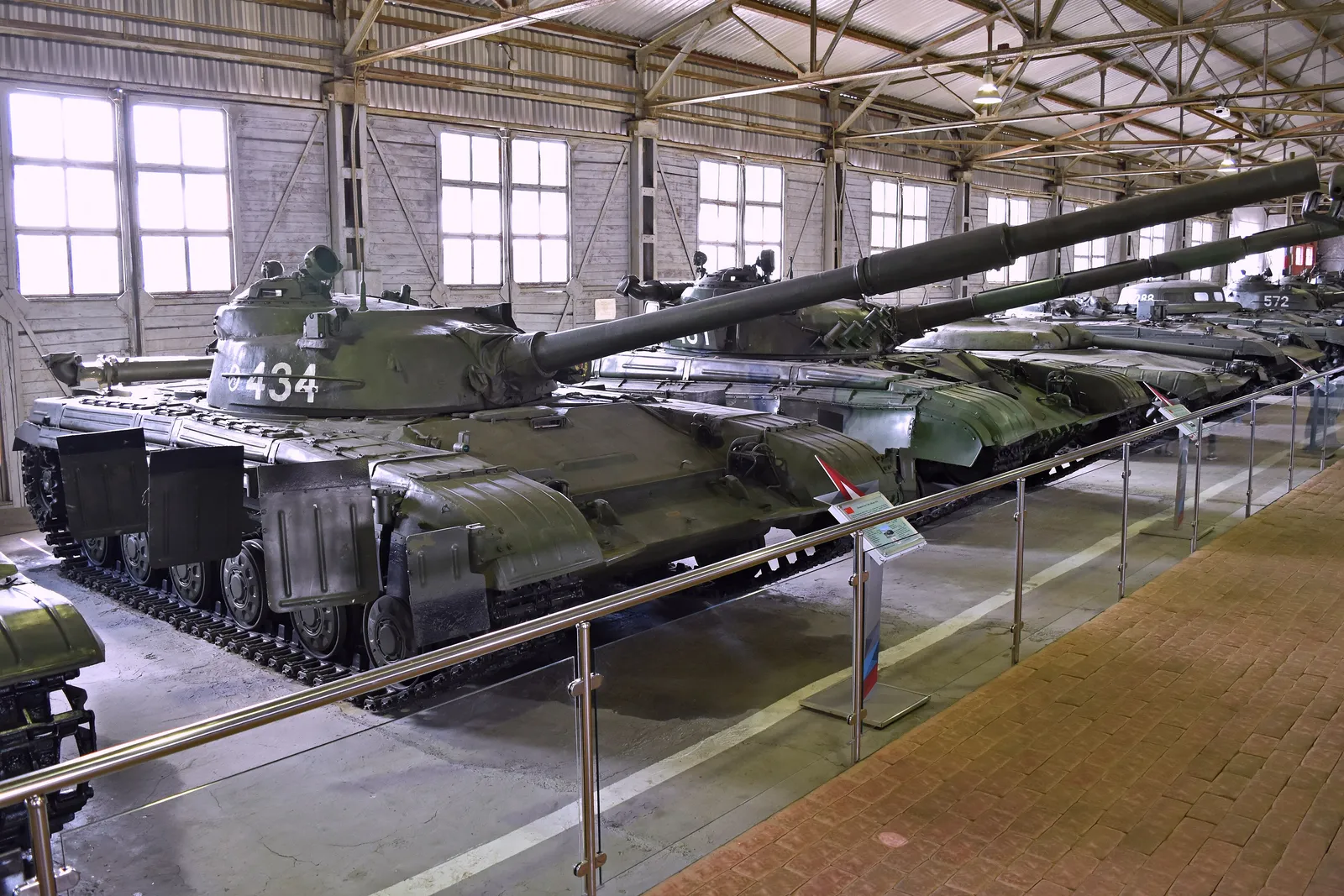


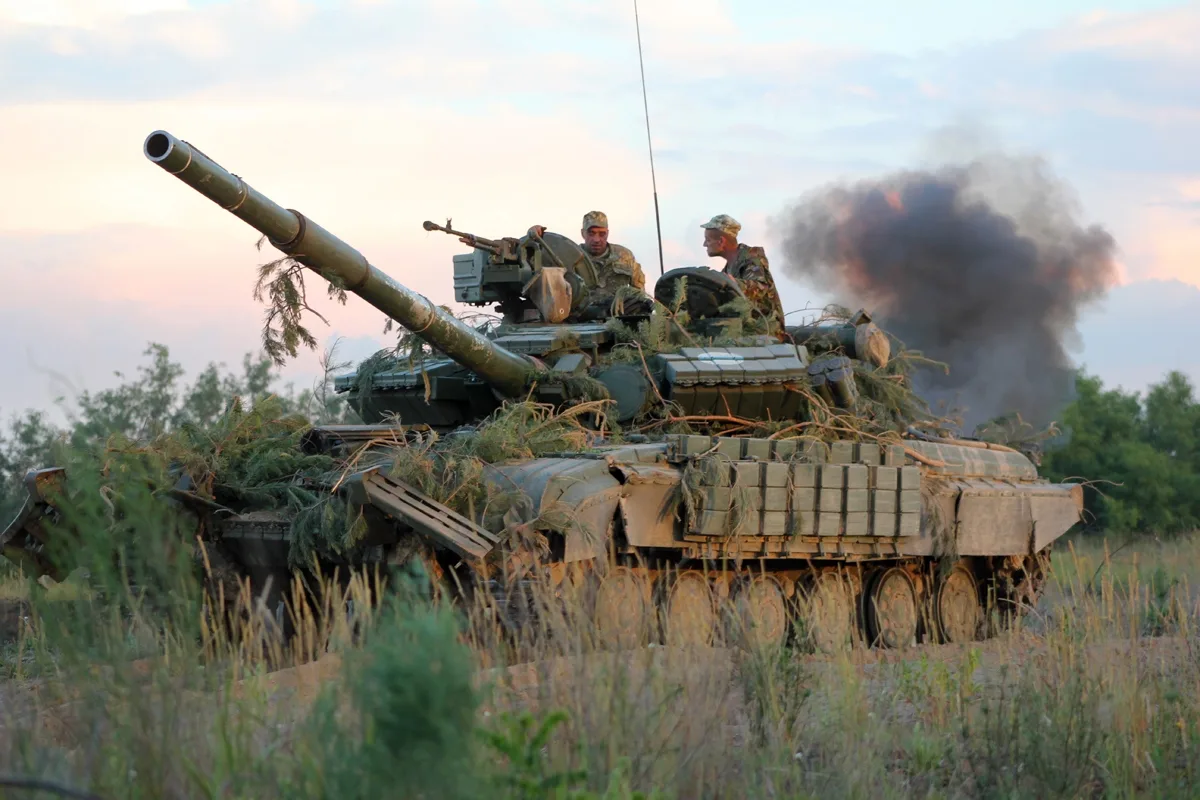
T-64-family tanks are documented on both sides: 2014 U.S. and NATO-attributed reporting placed unmarked or Russian-supplied T-64s with separatist forces in eastern Ukraine, Ukrainian reporting documented an ATO T-64B damaged in clashes with militants, and later Defense Express and Oryx records show Ukrainian and Russian-side T-64-family combat use and visual losses during the full-scale phase.
Role detailsTanks
T-64
Also known as
- Object 432
- Object 434
- T-64 tank
- T-64A
- T-64B
- T-64BV
- T-64BM
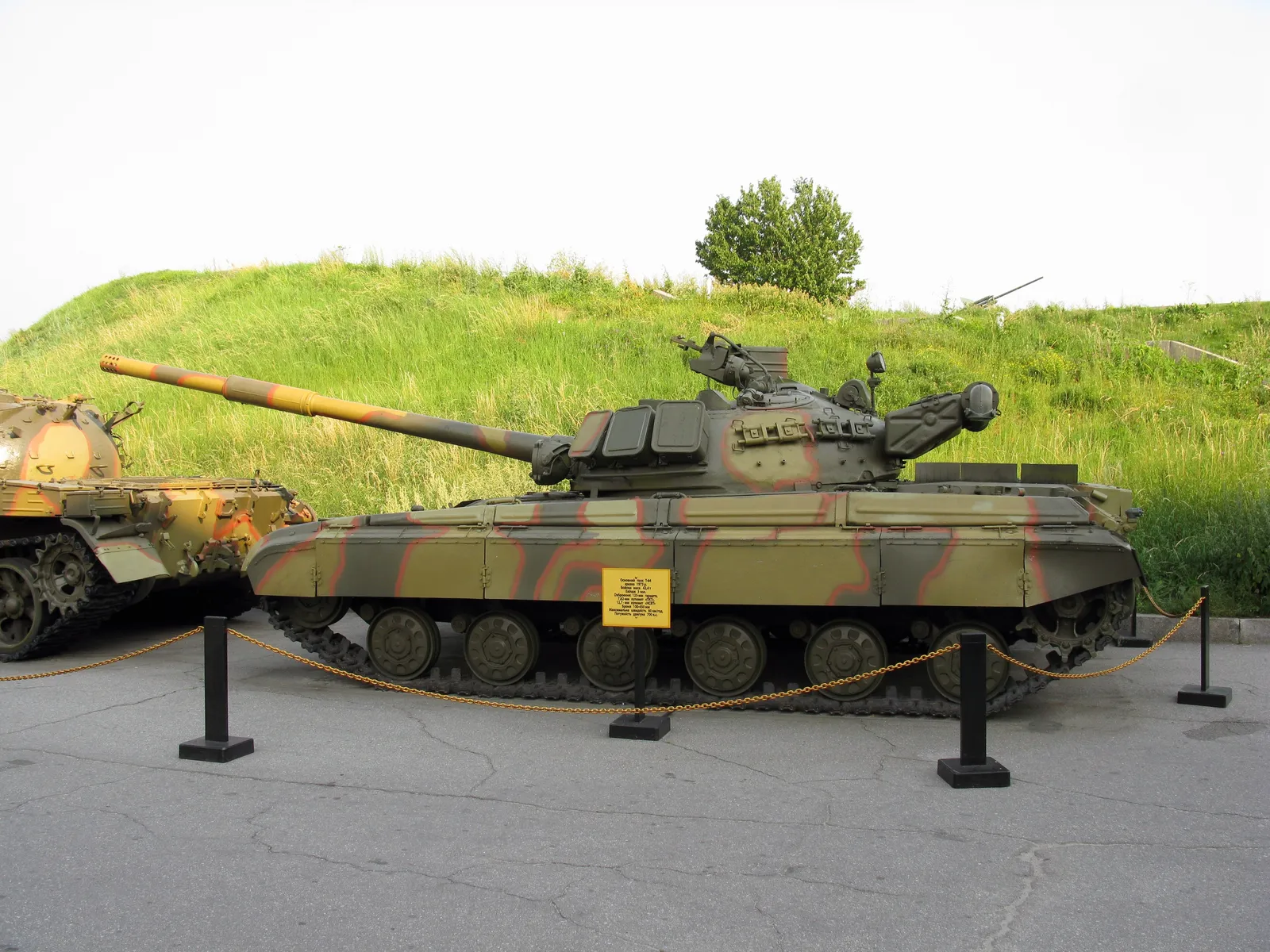
The T-64 is the Kharkiv-designed Soviet main battle tank family that introduced a compact three-person layout, automatic loading, composite armor, and later 125 mm smoothbore armament into Soviet service. Ukraine inherited and modernized large T-64 stocks, while the Russia-Ukraine War has documented T-64-family tanks in Ukrainian service and among Russian-side or separatist equipment.
Role in Conflicts
Profile / Specs
Profile
- Origin
- Soviet Union / Ukraine
- Type
- Main battle tank
- Service note
- Cold War Soviet service with later Ukrainian and Russian-side wartime use
- Designer
- Alexander Morozov / Kharkiv Morozov Machine Building Design Bureau
- Designed
- Early 1960s
- Produced
- Serial production from 1963; Soviet service acceptance in 1966-1967; production ended in 1987
- Number built
- Open references commonly report roughly 9,700 to 13,500 T-64-family tanks, depending source and variant counting
- Developed from
- Object 430
Specifications
- Crew
- 3
- Armament
- Early Object 432 vehicles used a 115 mm smoothbore gun; T-64A/B/BV variants used 125 mm smoothbore guns with automatic loading, plus coaxial and anti-aircraft machine guns depending variant
- Weight
- About 38-42.5 t depending variant and armor package
- Engine
- 5TDF opposed-piston multifuel diesel family, commonly cited at about 700 hp on T-64A/BV references
- Mobility
- Tracked main battle tank; references cite about 45-50 km/h road speed for T-64A and up to about 60 km/h road speed for T-64BV
- Protection
- Composite armor on the base family, with later variants adding explosive reactive armor packages such as Kontakt-1 on T-64BV
- Fire control
- T-64B/T-64BV references describe 9K112 Kobra gun-launched missile capability on relevant variants
Variants
This page covers the broader T-64 family, including early 115 mm Object 432 vehicles, 125 mm T-64A/T-64B standards, and later Ukrainian modernizations. The catalog tracks T-64BV and BM Bulat as separate linked variants because they have distinct modernization and wartime-use sourcing.
| Variant | Configuration | Designation notes |
|---|---|---|
| Object 432 | Variant | |
| T-64A | Variant | |
| T-64B | Variant | |
 | Kontakt-1-equipped T-64B modernization | Army Recognition describes the T-64BV as a T-64B modernization with Kontakt-1 explosive reactive armor and 125 mm 2A46M-1 armament. Sources: T-64BV Main Battle Tank |
 | Ukrainian deep T-64B modernization | The catalog tracks BM Bulat as a separate Ukrainian T-64BM/T-64BM2 modernization path. Sources: RFE/RL Lviv T-64 modernization |
Main Guns
The T-64 family moved from the early 115 mm Object 432 gun fit to 125 mm smoothbore weapons, with T-64A and later variants using Soviet 125 mm tank-gun families represented by separate catalog component pages.
| Compatible item | Item type | Compatibility evidence |
|---|---|---|
 | Early 125 mm smoothbore tank gun | T-64A-family tanks used the 125 mm D-81 / 2A26 line with the T-64 loading mechanism before later 2A46-series guns displaced it. Sources: National Defence University T-64A, Weaponsystems.net 2A26 |
 | Later 125 mm smoothbore tank gun family | Later T-64A/B-family tanks used 2A46-series guns; T-64BV references identify the 2A46M-1 fit and Kobra missile-firing context. Sources: Weaponsystems.net 125mm 2A46, T-64BV Main Battle Tank |
Timeline
T-64 Key Events
Kharkiv starts new-tank work under Morozov
GlobalSecurity describes KB-60M in Kharkiv, led by A.A. Morozov, beginning the Object 430 design path that led toward the T-64 family.
Sources: T-64 Tank
Object 432 serial production begins
Object 432 serial production was organized at the Malyshev plant before the tank was formally accepted as the T-64.
Sources: T-64 Tank
T-64 accepted into Soviet service
The Object 432 was accepted into service as the T-64, pairing a compact Kharkiv layout with an automatic loader and three-person crew.
Sources: T-64 Tank, National Defence University T-64A
T-64A brings 125 mm armament
The T-64A/Object 434 introduced the 125 mm D-81 smoothbore gun and T-64-style loading mechanism that shaped later Soviet tank armament patterns.
Sources: National Defence University T-64A, Weaponsystems.net 2A26
T-64B adds missile-capable fire control
The T-64B added improved fire control and 9K112 Kobra gun-launched missile capability to the family.
Sources: Weaponsystems.net 125mm 2A46, T-64BV Main Battle Tank
T-64BV production starts
The T-64BV added Kontakt-1 explosive reactive armor to the T-64B baseline.
Sources: T-64BV Main Battle Tank
Related Weapon Systems


Sources
T-64 TankPublisher: GlobalSecurity.org | Note: Supports T-64 background, Kharkiv/Malyshev design and production context, Object 430/Object 432 development, production timing, service acceptance, variant milestones, production-count range, and general specifications. | Accessed: 2026-07-13National Defence University T-64APublisher: National Defence University of Ukraine | Note: Supports T-64A service context, Kharkiv and Morozov background, serial production years, T-64 family design features, 125 mm D-81 / 2A46-1 gun context, autoloading mechanism, crew, mobility, armament, and CC BY 4.0 site licensing context. | Accessed: 2026-07-13T-64BV Main Battle TankPublisher: Army Recognition | Note: Supports T-64BV variant specifications used for family context, including Kontakt-1 ERA, 125 mm 2A46M-1 armament, Kobra missile context, mobility, dimensions, and the linked T-64BV variant row. | Accessed: 2026-07-13Weaponsystems.net 2A26Publisher: Weaponsystems.net | Note: Supports 125 mm 2A26 / D-81T identity, T-64A armament relationship, T-64-style autoloader context, and 2A46 successor background. | Accessed: 2026-07-13Weaponsystems.net 125mm 2A46Publisher: Weaponsystems.net | Note: Supports 125 mm 2A46 / D-81TM identity, T-64/T-80 autoloader context, 2A46-2 use on T-64B, and Kobra missile-capable fire-control background. | Accessed: 2026-07-13RFE/RL Lviv T-64 modernizationPublisher: Radio Free Europe/Radio Liberty | Note: Supports Ukrainian T-64 modernization context, including Lviv Tank Plant production of modernized T-64s, T-64 model 2017 features, and Kharkiv Armored Plant modernization quantities. | Accessed: 2026-07-13TIME Russia Sent T-64 TanksPublisher: TIME | Note: Supports 2014 Russia-Ukraine War direct-use context: reports U.S. statements that three T-64 tanks crossed from Russia into Ukraine near Snizhne in June 2014 in support of separatist forces. | Accessed: 2026-07-13BBC Russia and Ukraine's Mystery TanksPublisher: BBC News | Note: Supports 2014 Russia-Ukraine War direct-use context: reports NATO imagery and open-source video assessment of unmarked T-64 tanks seen in Snizhne and Makiivka in June 2014. | Accessed: 2026-07-13ABC Russia Providing T-64 TanksPublisher: ABC News | Note: Supports 2014 Russia-Ukraine War direct-use context: carries reporting on U.S. statements that T-64 tanks and other heavy equipment crossed from Russia into Ukraine for separatist forces. | Accessed: 2026-07-13ZN.ua Ukrainian T-64B Damaged in ATOPublisher: ZN.ua | Note: Supports 2014 Russia-Ukraine War direct-use context: reports a Ukrainian ATO spokesman saying a Ukrainian T-64B was damaged during clashes with militants in June 2014. | Accessed: 2026-07-13Defense Express T-64BV 1K reportPublisher: Defense Express | Note: Supports 2014 Russia-Ukraine War direct-use context for Ukrainian T-64BV 1K tanks in full-scale-war service and supports the selected official-video candidate. | Accessed: 2026-07-13Oryx Ukrainian Equipment LossesPublisher: Oryx | Note: Supports 2014 Russia-Ukraine War direct-use context: visually documents Ukrainian T-64-family tanks among destroyed, damaged, abandoned, and captured equipment during the full-scale invasion. | Accessed: 2026-07-13Oryx Russian Equipment LossesPublisher: Oryx | Note: Supports 2014 Russia-Ukraine War direct-use context: visually documents Russian-side T-64-family losses during the full-scale invasion. | Accessed: 2026-07-13Wikimedia Commons T-64A imagePublisher: Wikimedia Commons | Note: Supports image provenance for the T-64A/Object 434 primary image, a CC BY-SA 2.0 reviewed Flickr image from Alan Wilson. | Accessed: 2026-07-13Wikimedia Commons T-64 museum imagePublisher: Wikimedia Commons | Note: Supports image provenance for the T-64 museum gallery image, a CC BY-SA 2.0 reviewed Flickr image by Andrew Bossi. | Accessed: 2026-07-13Wikimedia Commons T-64BV imagePublisher: Wikimedia Commons | Note: Supports image provenance for the T-64BV gallery image from the Ministry of Defense of Ukraine Flickr stream, reviewed as CC BY-SA 2.0. | Accessed: 2026-07-13