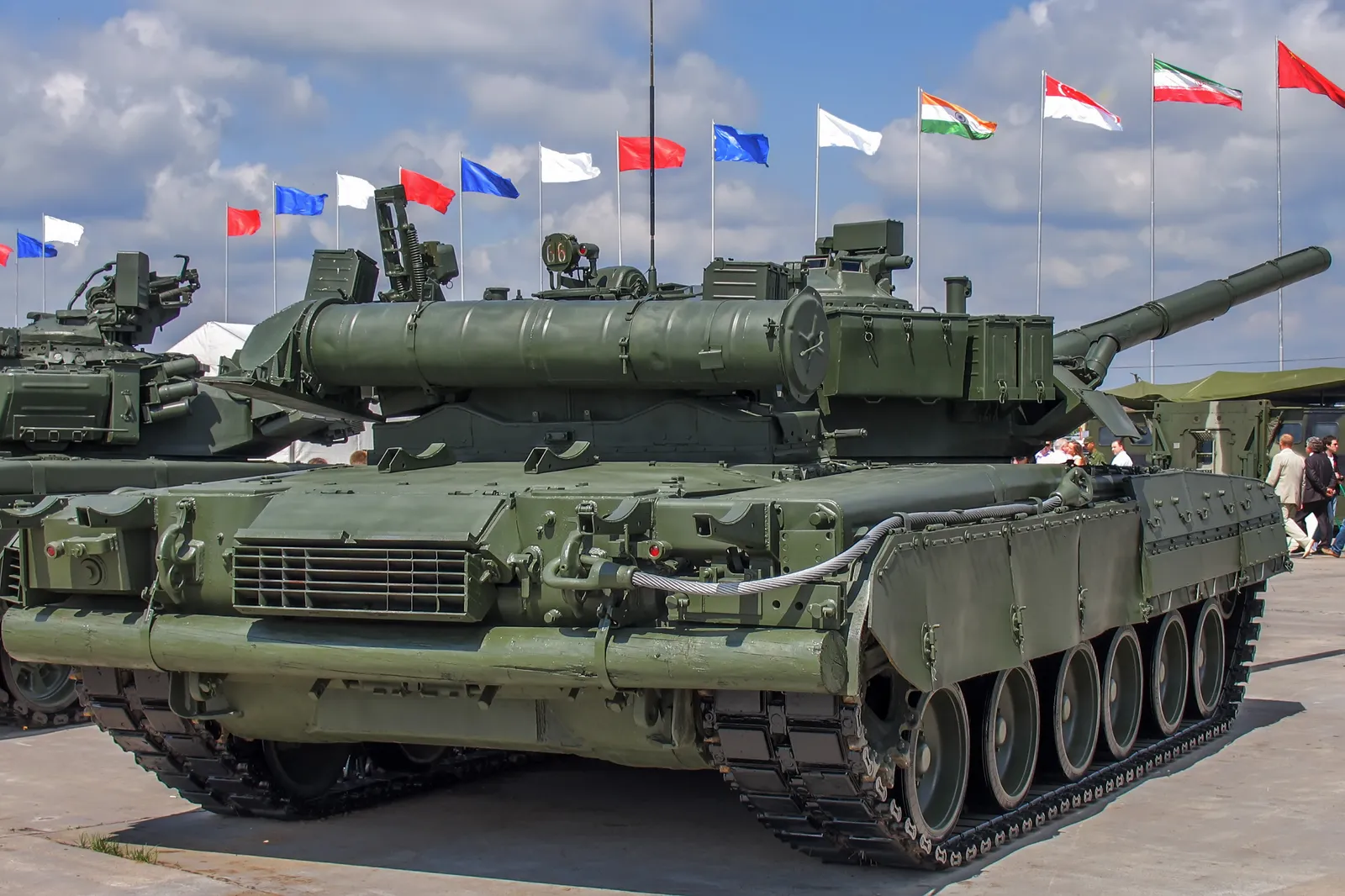


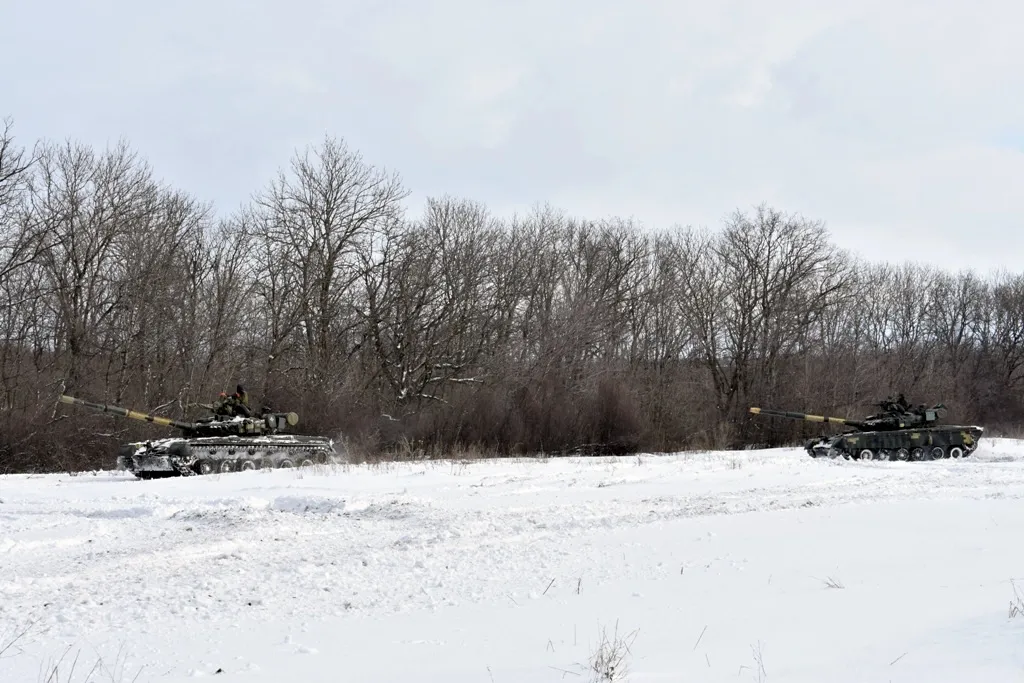
Russian forces have fielded T-80-series tanks during the full-scale invasion, while Ukrainian units have also used captured Russian T-80s, including examples reported in combat around Bakhmut.
Role detailsTanks
T-80
Also known as
- Object 219
- Obiekt 219
The T-80 is a Soviet-designed main battle tank built around a compact three-man layout, autoloaded 125 mm gun, and gas-turbine mobility in most major variants. It has appeared in very different combat settings: Russian T-80s fought in Grozny during the 1994 First Chechen War, Russia and Ukraine both operate T-80-family tanks in the 2014 Russia-Ukraine War, and Houthi-aligned forces have displayed T-80BV tanks in Yemen.
Role in Conflicts

A 2022 Sana'a parade showed T-80BV tanks with explosive reactive armor fielded by Houthi-controlled Presidential Protection Brigades, reportedly drawn from former 3rd Republican Guard brigade stocks.
Role details- Side
- Russia
- Role in conflict
- Urban armored assault and direct fire
Russian forces used T-80-series tanks in the first assault on Grozny; the Foreign Military Studies Office account lists T-80 tanks among Russian armored vehicles destroyed during the urban fighting.
Profile / Specs
Profile
- Origin
- Soviet Union
- Built in
- Soviet UnionRussiaUkraine
- Type
- Main battle tank
- Service note
- Introduced in 1976; modernized variants remain in Russian and Ukrainian service
- Designer
- SKB-2 design bureau, Leningrad Kirov Plant
- Designed
- 1960s-1970s
- Produced
- 1970s-2000s depending on variant and plant
- Number built
- More than 5,000 T-80-family tanks reported across variants
Specifications
- Crew
- 3
- Main armament
- 125 mm 2A46-series smoothbore gun with automatic loader
- Weight
- About 42.5 tonnes for T-80B; about 46 tonnes for T-80U
- Mobility
- Gas-turbine powerpack on most Soviet/Russian variants; original T-80 used a 1,000 hp turbine and later T-80U used GTD-1250-series power
- Protection
- Composite armor with explosive reactive armor on later variants such as T-80BV and T-80U
- Ammunition
- 125 mm APFSDS, HEAT, HE-fragmentation, and gun-launched anti-tank missiles on missile-capable variants
Variants
The T-80 family split between Soviet and Russian gas-turbine models and the diesel-powered Kharkiv T-80UD branch, with modern Russian upgrades such as the T-80BVM applied to older hulls.
| Variant | Configuration | Designation notes |
|---|---|---|
| T-80B | Early upgraded production model | A pre-reactive-armor production branch that preceded the Kontakt-1-equipped T-80BV. Sources: T-80 Main Battle Tank Data |
| T-80BV | Explosive-reactive-armor variant | The BV variant added Kontakt-1 explosive reactive armor; Yemen reporting specifically identifies T-80BV tanks in Houthi-aligned stocks. Sources: T-80 Main Battle Tank Data, The Houthi Jihad Council: Command and Control in 'the Other Hezbollah' |
| T-80U | Improved armor and fire-control model | The T-80U is the later Soviet gas-turbine model commonly associated with the GTD-1250 powerpack and improved protection package. Sources: T-80 Main Battle Tank Data |
| T-80UD | Diesel-powered Kharkiv branch | The T-80UD retained the T-80 family layout but replaced the turbine powerpack with a diesel engine in the Ukrainian production branch. Sources: T-80 Main Battle Tank Data |
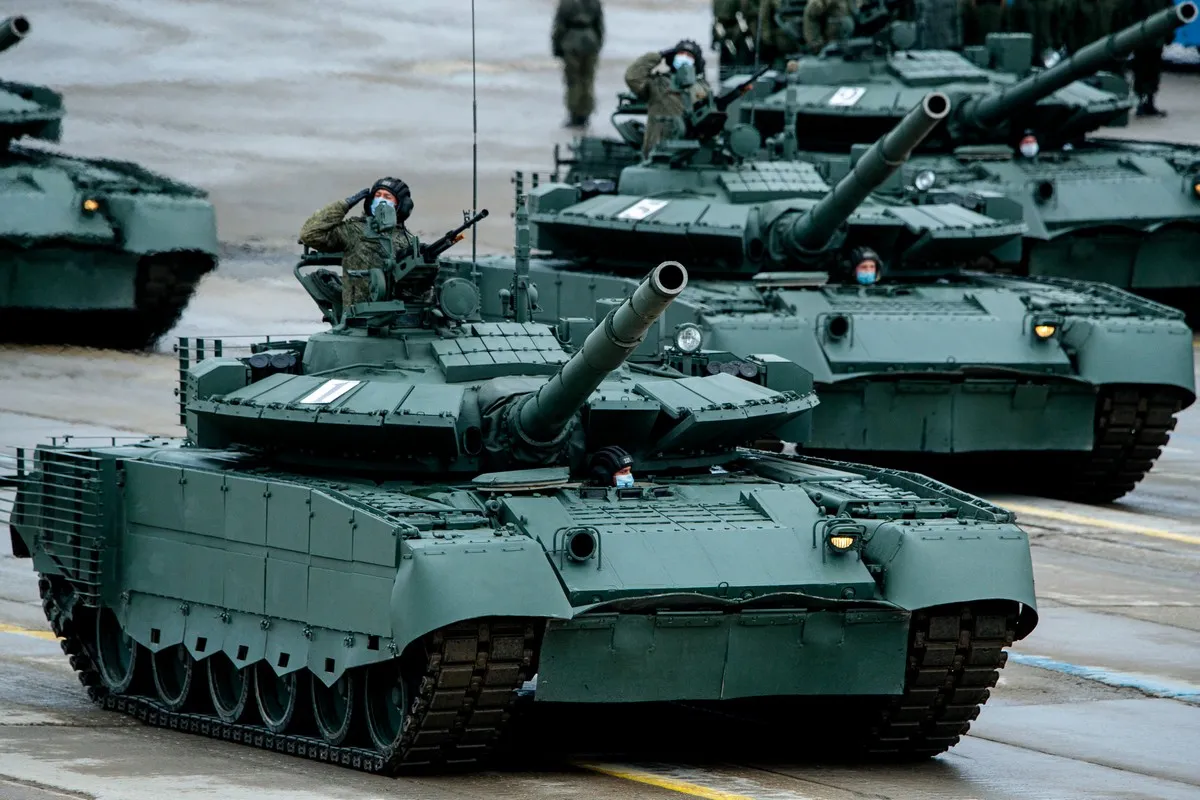
| T-80BVM | Modernized Russian T-80BV | The BVM upgrade is a Russian modernization of older T-80BV tanks, adding a refreshed protection and sighting package while preserving the turbine-powered mobility niche. |
Timeline
T-80 Key Events
T-80 enters Soviet service
The T-80 family entered Soviet service in the mid-1970s as a turbine-powered main battle tank built around a compact three-person crew and autoloaded 125 mm gun.
Sources: T-80 Main Battle Tank Data
BV, U, and UD branches define the family
Later production split into the reactive-armor T-80BV, the improved T-80U, and the diesel-powered T-80UD branch built around Kharkiv production experience.
Sources: T-80 Main Battle Tank Data
T-80s fight in Grozny
Russian T-80 tanks were committed to urban fighting in Grozny during the 1994 First Chechen War, where Russian armored columns suffered heavy losses.
Sources: Russian-Manufactured Armored Vehicle Vulnerability in Urban Combat
Full-scale Ukraine war exposes both sides' T-80 fleets
Russian T-80-family losses and Ukrainian use of captured T-80 tanks made the family visible on both sides after Russia's full-scale invasion of Ukraine.
Sources: Attack On Europe: Documenting Russian Equipment Losses During The Russian Invasion Of Ukraine, Ukrainians Are Riding Tanks Captured From an Elite Russian Unit Into Battle in Bakhmut
T-80BV tanks appear in Yemen
A Sana'a parade showed T-80BV tanks in Houthi-aligned Presidential Protection Brigades service, documenting the type outside its better-known post-Soviet operators.
Sources: The Houthi Jihad Council: Command and Control in 'the Other Hezbollah'
Variant and Powerpack Split
The T-80 is best read as a family with two recurring questions: which armor and fire-control package is fitted, and whether the tank keeps the gas-turbine powerpack or moves to the diesel T-80UD branch.
| Branch | Powerpack pattern | Reader cue |
|---|---|---|
| T-80BV | Gas turbine | Kontakt-1 explosive reactive armor makes the BV easy to distinguish from earlier T-80B tanks. |
| T-80U | Gas turbine | Later Soviet model with improved protection and GTD-1250-series mobility in common references. |
| T-80UD | Diesel | Kharkiv-produced diesel branch that kept the T-80 layout while dropping the turbine powerpack. |
| T-80BVM | Gas turbine modernization | Russian upgrade path for older T-80BV hulls, visible in 2014 Russia-Ukraine War loss documentation. |
Sources: T-80 Main Battle Tank Data; T-80BVM Main Battle Tank Technical Data.
Media
Related Weapon Systems


Soviet Tank Family Context
The T-80 sits beside the T-72 and T-64BV in the catalog: all three preserve the Soviet three-person, autoloaded 125 mm tank pattern, but the T-80 page is the gas-turbine-centered branch, while the T-64BV page covers Ukraine's long-lived T-64 modernization path and the T-72 page covers the mass-production export family.
Sources
T-80 Main Battle Tank DataPublisher: Army Recognition | Note: Supports T-80 background, designer and production context, variants, armament, protection, and mobility specifications. | Accessed: 2026-06-19T-80BVM Main Battle Tank Technical DataPublisher: Army Recognition | Note: Supports T-80BVM modernization background, variant context, and related specifications. | Accessed: 2026-06-29Attack On Europe: Documenting Russian Equipment Losses During The Russian Invasion Of UkrainePublisher: Oryx | Note: Supports 2014 Russia-Ukraine War fielded by Russian forces context by documenting visually confirmed Russian T-80-family tank losses, including destroyed, abandoned, and captured vehicles. | Accessed: 2026-06-19Russian-Manufactured Armored Vehicle Vulnerability in Urban CombatPublisher: Federation of American Scientists / Foreign Military Studies Office | Note: Supports 1994 First Chechen War direct-use context by describing Russian T-80 tanks committed to and lost in the urban battle for Grozny. | Accessed: 2026-06-29Ukrainians Are Riding Tanks Captured From an Elite Russian Unit Into Battle in BakhmutPublisher: Business Insider | Note: Supports Ukrainian use of captured Russian T-80 tanks in the 2014 Russia-Ukraine War. | Accessed: 2026-06-19The Armed Forces of Ukraine Have Whole Tank Company of Captured T-80 TanksPublisher: Defense Express | Note: Supports 2014 Russia-Ukraine War used by Ukrainian forces context by reporting captured T-80 tanks repaired and deployed into battle. | Accessed: 2026-06-20T-80U Main Battle Tank at Engineering Technologies 2012Publisher: Wikimedia Commons | Note: Supports image provenance and licensing for the primary T-80U image. | Accessed: 2026-06-19T-80BV 25th Brigade 2Publisher: Wikimedia Commons | Note: Supports image provenance and licensing for the Ukrainian T-80BV gallery image. | Accessed: 2026-06-29T-80BVM (2)Publisher: Wikimedia Commons | Note: Supports image provenance and licensing for the T-80BVM gallery image. | Accessed: 2026-06-29The Houthi Jihad Council: Command and Control in 'the Other Hezbollah'Publisher: Combating Terrorism Center at West Point | Note: Supports 2014 Yemen Civil War fielded by Houthi-aligned forces context by reporting T-80BV tanks in service with the Presidential Protection Brigades in Sana'a in 2022. | Accessed: 2026-06-20