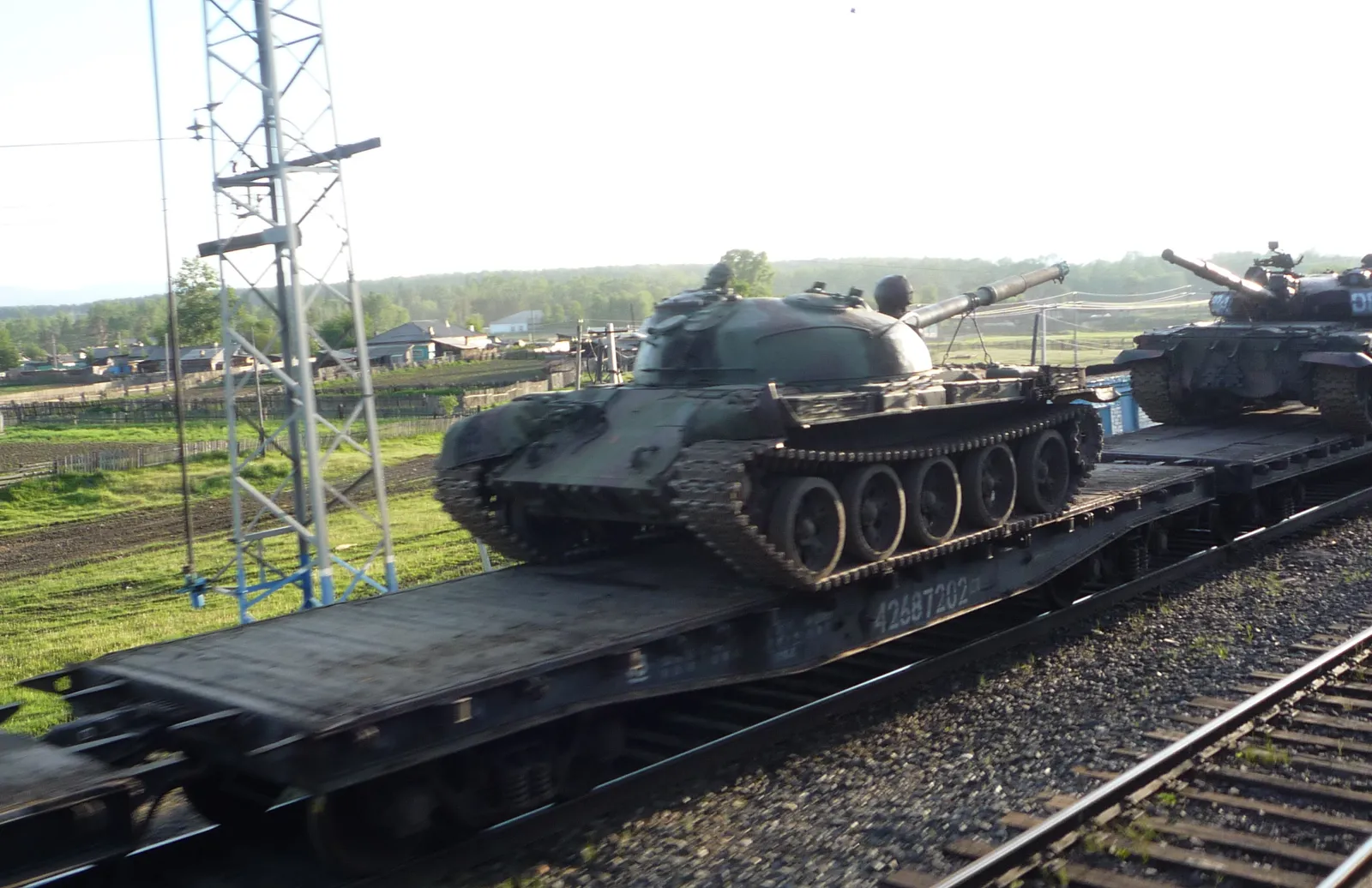
Egyptian forces fielded T-62 tanks during the Yom Kippur War; U.S. Army analysis of the 162nd Armored Division describes the Egyptian 25th Independent Armored Brigade and its T-62s being engaged east of the Suez Canal on 17 October 1973.
Tanks
T-62
Also known as
- Object 166
- T62
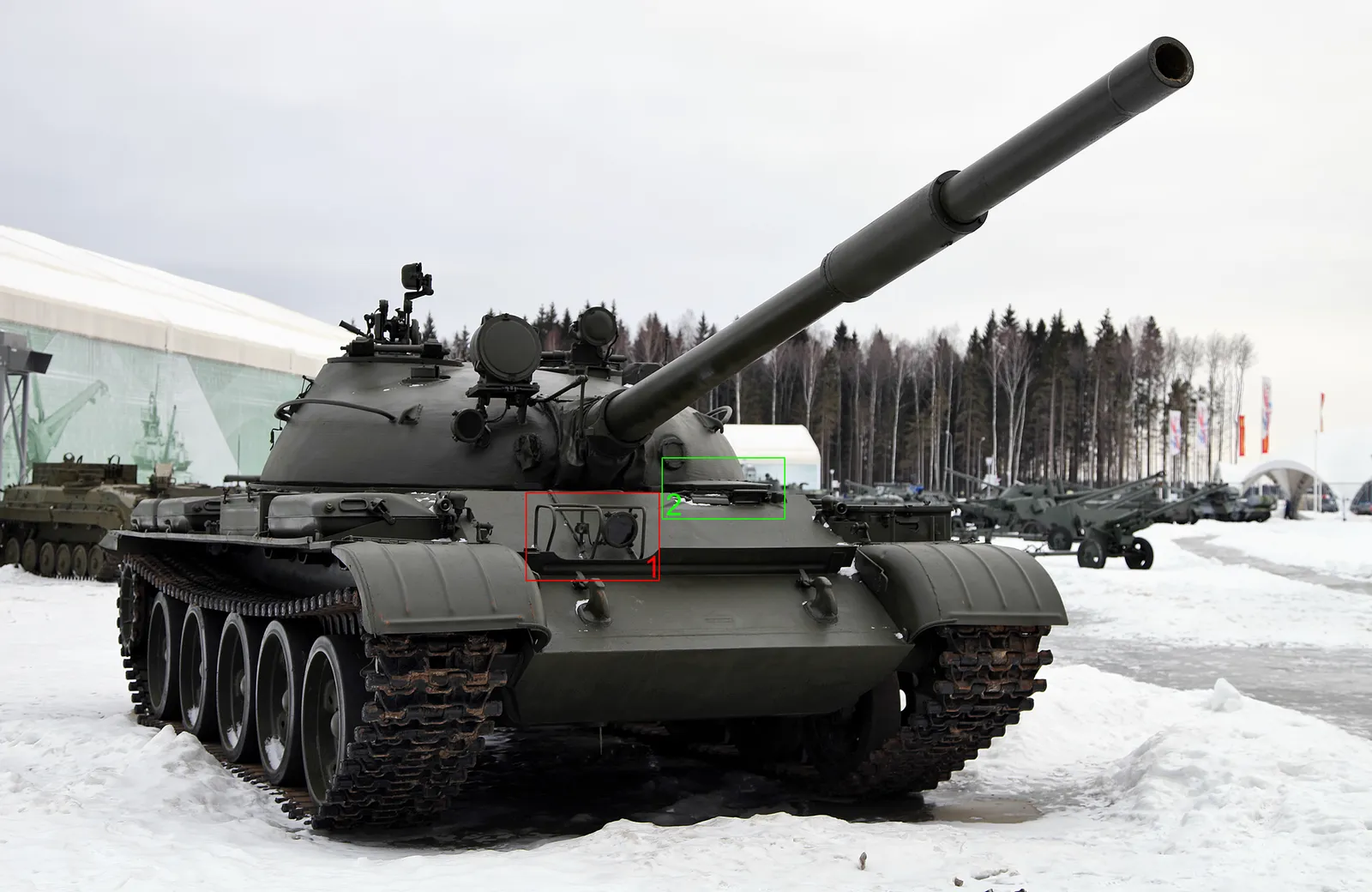
The T-62 is a Soviet main battle tank built around a 115 mm U-5TS/2A20 smoothbore gun, a four-person crew, and a conventional tracked armor layout inherited from the T-54/T-55 design line. Produced in large numbers by Uralvagonzavod, it moved from Cold War export and Soviet service into long-tail combat use: Egyptian and Iraqi T-62s appear in 1970s and 1991 conflict records, while upgraded or inherited T-62M/T-62MV stocks reappeared in Syria, Libya, Ukraine, Tigray, and Yemen.
Role in Conflicts
- Side
- Soviet Union and Afghan government forces
- Role in conflict
- Soviet armored direct fire support


The Tank Museum records Soviet T-62 service in the war in Afghanistan from 1979 to 1988, placing the type among Soviet tracked armor used in the conflict.
- Side
- Iraq
- Role in conflict
- Iraqi armored assault force

The Tank Museum's Operation Nasr video coverage identifies the T-62 in the Iran-Iraq War context, focusing on the Iraqi T-62 and Iranian Chieftain fight during Operation Nasr in 1981.
- Side
- Iraq
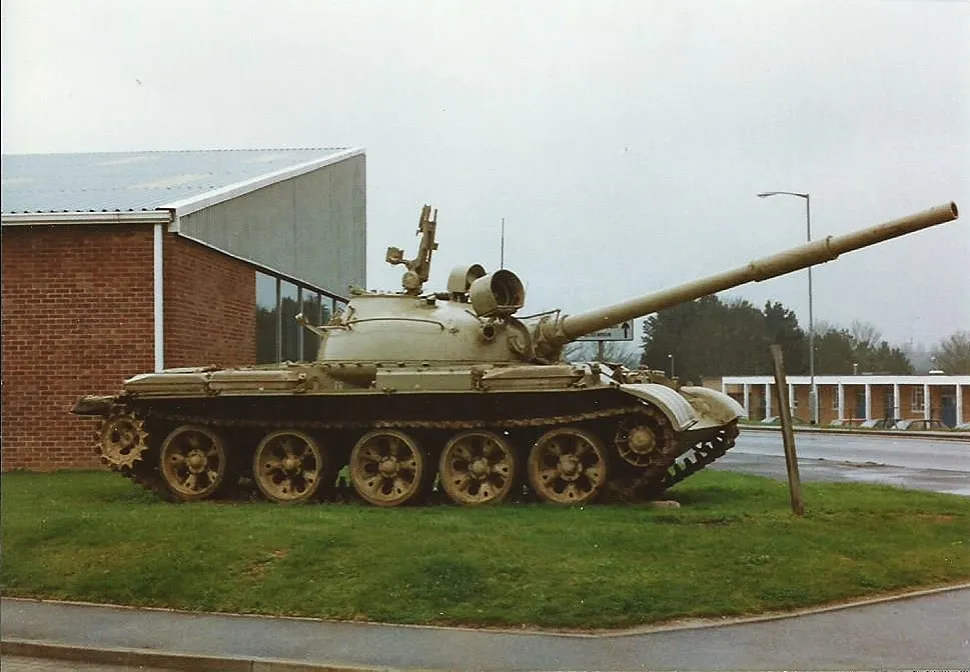
Iraqi forces fielded T-62 tanks in the 1991 Gulf War; U.S. Army campaign history places Iraqi T-55 and T-62 tanks against the 1st Marine Division on February 24, 1991, and The Tank Museum identifies its T-62 as an Iraqi vehicle captured during the war.
Role details- Side
- Russia
Russian forces returned stored T-62M and T-62MV tanks to service for the invasion of Ukraine, with documented battlefield losses and captures after their reappearance in the theater.
Role details
Russian-supplied T-62M and T-62MV tanks were fielded by Syrian government forces, including 5th Corps elements fighting Islamic State around T4 airbase and Tadmur and later vehicles documented in Idlib Governorate.
Role details- Role in conflict
- Armored direct fire support

The Libyan National Army operated older T-62s and received Russian-supplied T-62M/T-62MV tanks; GNA forces captured T-62 variants at Tarhuna in June 2020 after the LNA withdrawal.
- Side
- Tigray forces
- Role in conflict
- Captured armored fire support

Tigray forces operated captured or retained T-62 tanks during the 2020 Tigray War, with Oryx listing visually documented T-62s among Tigray Defence Forces heavy weaponry.

Houthi-aligned forces fielded inherited Yemeni T-62 tanks from the pre-war army inventory; open-source assessments also list T-62s among heavy armor available to Yemen's government-side forces, so this entry treats the type as legacy battlefield armor rather than a new wartime transfer.
Role detailsProfile / Specs
Profile
- Origin
- Soviet Union
- Built by
- Uralvagonzavod
- Type
- Main battle tank
- Service note
- Cold War design; retained or reactivated in post-2015 conflicts including Ukraine and Yemen
- Designer
- UKBTM design bureau, Factory No. 183
- Designed
- Late 1950s to 1961
- Produced
- 1961-1975 Soviet production; main UVZ production through 1973
- Number built
- About 19,000 Soviet-built T-62 tanks; more than 20,000 total cited by museum sources
- Developed from
- T-54/T-55 family
Specifications
- Crew
- 4
- Main armament
- 115 mm U-5TS / 2A20 smoothbore gun
- Secondary armament
- 7.62 mm coaxial machine gun; later variants could mount a 12.7 mm DShK/DShKM anti-aircraft machine gun
- Combat weight
- About 37-40 tonnes depending on variant and source
- Engine
- V-55 series diesel, 580 hp on baseline T-62; 620 hp listed for T-62M
- Range
- About 450 km on roads with integral fuel, or up to 650 km with auxiliary fuel tanks
- Protection
- Cast turret and sloped steel hull armor, with later T-62M/T-62MV upgrades adding passive or explosive reactive armor packages
Design Lineage And Late-Life Use
The T-62 sits between the T-54/T-55 family and later Soviet smoothbore main battle tanks: it kept a familiar four-person tracked layout while moving to the 115 mm U-5TS/2A20 gun. Its recent combat appearances usually reflect stored, upgraded, captured, or inherited stocks rather than new production.
| Thread | What to notice | Source base |
|---|---|---|
| T-54/T-55 lineage | Developed as a successor family while retaining the compact Soviet tracked-tank layout. | Tank Encyclopedia and Tank Museum background |
| 115 mm smoothbore gun | The U-5TS/2A20 armament is the main technical break from the earlier 100 mm T-54/T-55 gun line. | FAS and Tank Museum specifications |
| Stored and export stocks | Modern rows on this page are mostly about reactivated Russian vehicles, Russian deliveries, captures, or inherited local inventories. | Conflict-use sources listed on this record |
Variants
T-62 designations combine baseline production models, command vehicles, and later survivability upgrades; recent conflict sources most often identify the T-62M and T-62MV.
| Variant | Configuration | Designation notes |
|---|---|---|
| T-62M | Modernized armor and fire-control package | The T-62M is the principal late-life modernization family cited in technical references and appears in Russian reactivation and export-delivery reporting. Sources: T62 Main Battle Tank, T-62 (Object 166) |
| T-62MV | Explosive-reactive-armor upgrade | T-62MV rows are useful on this page because the variant is specifically documented among Russian-supplied Syrian vehicles and Russian losses or captures in Ukraine. Sources: T-62 (Object 166), Rearming Syria: Russian deliveries of T-62MVs and BRM-1(K)s arrive, Attack On Europe: Documenting Russian Equipment Losses During The Russian Invasion Of Ukraine |
| T-62K | Command tank | The K designation marks the command-tank branch of the T-62 family rather than a separate unrelated vehicle line. Sources: T-62 (Object 166) |
| T-62 obr. 1967 / obr. 1972 | Production-model export stocks | Yemen inventory documentation distinguishes 1967 and 1972 pattern T-62 tanks, showing how older export stocks are often described by production model year. |
Timeline
T-62 Key Events
T-62 enters Soviet production and service
The T-62 emerged as a successor to the T-54/T-55 family, pairing Soviet tracked-tank layout with a 115 mm smoothbore main gun.
Sources: T-62, T-62 (Object 166)
Egyptian T-62 brigade engaged in Sinai
During the Yom Kippur War, Egypt's 25th Independent Armored Brigade and its T-62 tanks were engaged by Israeli armored forces east of the Suez Canal.
Sources: Fighting with Agility: The 162nd Armored Division in the 1973 Arab-Israeli War
Soviet Afghan War use begins
The Tank Museum places Soviet T-62 service in the Afghanistan war period from 1979 to 1988.
Sources: T-62
Operation Nasr highlights T-62 versus Chieftain fighting
The Tank Museum's Iran-Iraq War video coverage uses Operation Nasr to frame Iraqi T-62 combat against Iranian Chieftain tanks.
Sources: April on YouTube 2024
Iraqi T-62 captured during the Gulf War
The Tank Museum identifies its T-62 as an Iraqi vehicle captured during the 1991 Gulf War and shipped to Britain for evaluation.
Sources: T-62, File:T-62 (23169124833).jpg
Stored Russian T-62 variants reappear in Ukraine
Open-source documentation recorded T-62M and T-62MV tanks returning to Russian service in Ukraine, including later losses and captures.
Sources: Ukraine army is now able to create one T-62 tank battalion thanks to tanks captured from Russian army, Attack On Europe: Documenting Russian Equipment Losses During The Russian Invasion Of Ukraine
Related Weapon Systems


Sources
T-62Publisher: The Tank Museum | Note: Supports background, role, production scale, main weapon, crew, general service context, and direct 1979 Soviet-Afghan War and 1990 Gulf War use context. | Accessed: 2026-06-30T62 Main Battle TankPublisher: Federation of American Scientists | Note: Supports technical specifications, armament, mobility, range, and limitations for the T-62/T-62M series. | Accessed: 2026-06-20T-62 (Object 166)Publisher: Tank Encyclopedia | Note: Supports designer/manufacturer background, service entry, production timeline, variants, and detailed specifications. | Accessed: 2026-06-20Ukraine army is now able to create one T-62 tank battalion thanks to tanks captured from Russian armyPublisher: Army Recognition | Note: Directly supports 2014 Russia-Ukraine War context for T-62M/T-62MV tanks used by Russian forces and captured by Ukrainian forces. | Accessed: 2026-06-20Attack On Europe: Documenting Russian Equipment Losses During The Russian Invasion Of UkrainePublisher: Oryx | Note: Directly supports 2014 Russia-Ukraine War use by documenting T-62M and T-62MV tanks fielded by Russian forces and lost during the invasion of Ukraine. | Accessed: 2026-06-20Replenishing the Stocks: Russian deliveries of T-62Ms and BMP-1s reach SyriaPublisher: Oryx | Note: Directly supports 2011 Syrian Civil War use by documenting T-62M tanks supplied to and fielded by Syrian Arab Army 5th Corps elements in combat with Islamic State. | Accessed: 2026-06-20Rearming Syria: Russian deliveries of T-62MVs and BRM-1(K)s arrivePublisher: Oryx | Note: Directly supports 2011 Syrian Civil War use by documenting T-62M/T-62MV tanks delivered to and fielded by Syrian government forces, including combat footage and captures in Idlib. | Accessed: 2026-06-20Disaster at Tarhuna: When Haftar Lost Another Stronghold In Crushing Defeat To The GNAPublisher: Oryx | Note: Directly supports 2014 Second Libyan Civil War use by documenting T-62 variants fielded by the Libyan National Army and captured by GNA forces at Tarhuna in June 2020. | Accessed: 2026-06-20Photo Report: Haftar's Last ParadePublisher: Oryx | Note: Directly supports 2014 Second Libyan Civil War use by documenting T-62M and T-62MV tanks delivered to the Libyan National Army in 2020. | Accessed: 2026-06-20The Tigray Defence Forces - Documenting Its Heavy WeaponryPublisher: Oryx | Note: Directly supports 2020 Tigray War use by documenting T-62 tanks used by Tigray Defence Forces with photo or video evidence. | Accessed: 2026-06-20Handbook Of Pre-War Yemeni Fighting VehiclesPublisher: Oryx | Note: Directly supports 2014 Yemen Civil War use by documenting T-62 Obr. 1967 and T-62 Obr. 1972 tanks in the Yemeni Army inventory at the time of the Houthi takeover and describing those vehicles as fielded by Yemeni parties on the battlefield. | Accessed: 2026-06-20Fighting with Agility: The 162nd Armored Division in the 1973 Arab-Israeli WarPublisher: Army University Press | Note: Directly supports 1973 Yom Kippur War use by describing the Egyptian 25th Independent Armored Brigade and its T-62 tanks during fighting east of the Suez Canal. | Accessed: 2026-06-30April on YouTube 2024Publisher: The Tank Museum | Note: Directly supports 1980 Iran-Iraq War context for a Tank Museum video covering T-62 and Chieftain combat during Operation Nasr in 1981. | Accessed: 2026-06-30Yemen On Precipice of Its First Armed Conflict Since 2018: Assessment of ForcesPublisher: Defense Express | Note: Directly supports 2014 Yemen Civil War use by reporting T-62 tanks fielded by or claimed in the arsenals of Houthi-aligned forces and Yemeni government-side forces. | Accessed: 2026-06-20File:T-62 and T-62M tanks transported by train.jpgPublisher: Wikimedia Commons | Note: Image provenance and licensing page; Wikimedia Commons lists the file under Creative Commons Attribution 2.0 Generic. | Accessed: 2026-06-20File:T-62 with identification marks.jpgPublisher: Wikimedia Commons | Note: Gallery image provenance and licensing page; Wikimedia Commons lists the file under Creative Commons Attribution-Share Alike 4.0 International. | Accessed: 2026-06-20File:Rear view of a T-62A.JPEGPublisher: Wikimedia Commons | Note: Gallery image provenance and licensing page for a rear-view T-62 image from U.S. Department of Defense media. | Accessed: 2026-06-20File:T-62 (23169124833).jpgPublisher: Wikimedia Commons | Note: Directly supports 1990 Gulf War use and gallery provenance by identifying the image as an Iraqi Army T-62 captured in the First Gulf War. | Accessed: 2026-06-30