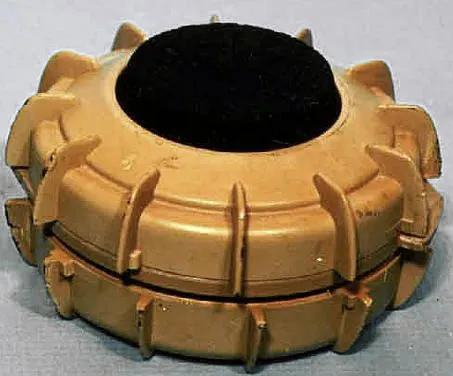
A U.S. Army Engineer article on Russian mine-warfare lessons says mujahideen anti-personnel mine inventories during the Soviet-Afghan War included Italian TS-50 mines alongside Soviet, U.S., and British types.
Infantry Weapons
TS-50 anti-personnel mine
Also known as
- TS/50
- TS 50
- TS-50 mine
- T/79
- T-79
- T/7931
- Mine Type 79
- MAT-79
- YM-1
- YM-1B
- YM-1-B
- YM-1(B)
The TS-50 is an Italian minimum-metal blast anti-personnel mine built around a small pressure-actuated plastic body and pneumatic fuze. The record covers the Italian TS/50 baseline and closely documented T/79 and YM-1 copy designations, with conflict-use evidence from Afghanistan, Iraqi Kurdistan, Nagorno-Karabakh, Syria, and the Russia-Ukraine War's Donbas supply trail.
Role in Conflicts
- Side
- Iraq

Kurdistan24 reporting with Mines Advisory Group context describes Iran-Iraq War-era Iraqi Army minefields in the Kurdistan Region and says the Italian mines found in Biwrey include VS-50 anti-personnel blast mines and the later TS-50.


Landmine Monitor identified Italian TS-50 mines among anti-personnel mine types commonly used in the Nagorno-Karabakh fighting of 1988-1994; the report documents mine use by both Armenian and Azerbaijani forces and does not assign the TS-50 to one side.

Human Rights Watch reported that the Syrian army mined the Kafr Nabl area after turning it into a military base, and that local clearance teams later found YM-1 anti-personnel mines among the mine types there; this row covers the Iranian YM-1 copy branch rather than Italian-made TS-50 stocks.
Role details- Side
- Russia

A Ukrainian EOD handbook identifies the YM-1 as an Iranian-manufactured TS-50 and says Syrian-procured YM-1 mines began moving to DPR and LPR forces through Russia in November 2017; the row therefore covers the copied YM-1 branch rather than Italian TS-50 stocks.
Role detailsProfile / Specs
Profile
- Origin
- Italy
- Built by
- Tecnovar Italiana SpA
- Type
- Minimum-metal blast anti-personnel mine
- Service note
- Cold War export-era anti-personnel mine encountered in legacy minefields
- Designer
- Tecnovar Italiana SpA
- Designed
- 1970s
- Unit cost
- Not publicly reported
- Produced
- TS-50/T/79 assembly and Tecnovar TS-50 plastic-parts production reported from 1979 to 1993; Tecnovar bankruptcy adjudicated on 1997-11-03
- Number built
- Not publicly reported
Specifications
- Diameter
- 92 mm in Italy's Mine Ban Treaty reporting; 90 mm in CISR rows for TS-50/YM-1
- Height
- 45 mm
- Weight
- 206 g in Italy's Mine Ban Treaty reporting; 186 g in CISR rows for TS-50/YM-1
- Explosive fill
- 15 g T4/RDX in Italy's Mine Ban Treaty reporting; CISR lists 50 g RDX for TS-50/YM-1 and 50 g TNT for T/79
- Fuzing
- Pressure-operated mechanical blast mine; METIS describes a pneumatic/bladder-based fuze intended to resist blast effects
- Body and detectability
- Plastic-bodied low-metal/minimum-metal mine; Italy lists TS/50 as undetectable and IMAS says YM-1(B) should be treated as minimum-metal for detection
- Deployment
- Hand-emplaced or scatterable; ordnance references describe helicopter or ground-vehicle dispenser use for TS-50-family mines
- Clearance resistance
- Designed to resist blast overpressure and common explosive countermeasure techniques
Designation Notes
Open mine-action and Landmine Monitor sources use TS/50 or TS-50 for the Italian Tecnovar mine, while treating Egypt's T/79/MAT-79 and Iran's YM-1/YM-1(B) as related local-production or copy designations. Some references compare the copies to the visually similar VS-50, so the notes below keep the source-specific caveat visible.
T/79 and MAT-79
Landmine Monitor describes Egyptian T/79 scatterable or hand-emplaced plastic blast mines as copies of the Italian TS-50. Human Rights Watch separately says the Egyptian Army renamed TS-50 mines as Mine Type 79 and exported them as MAT-79.
Sources: Landmine Monitor Report 1999; Exposing the Source.
YM-1
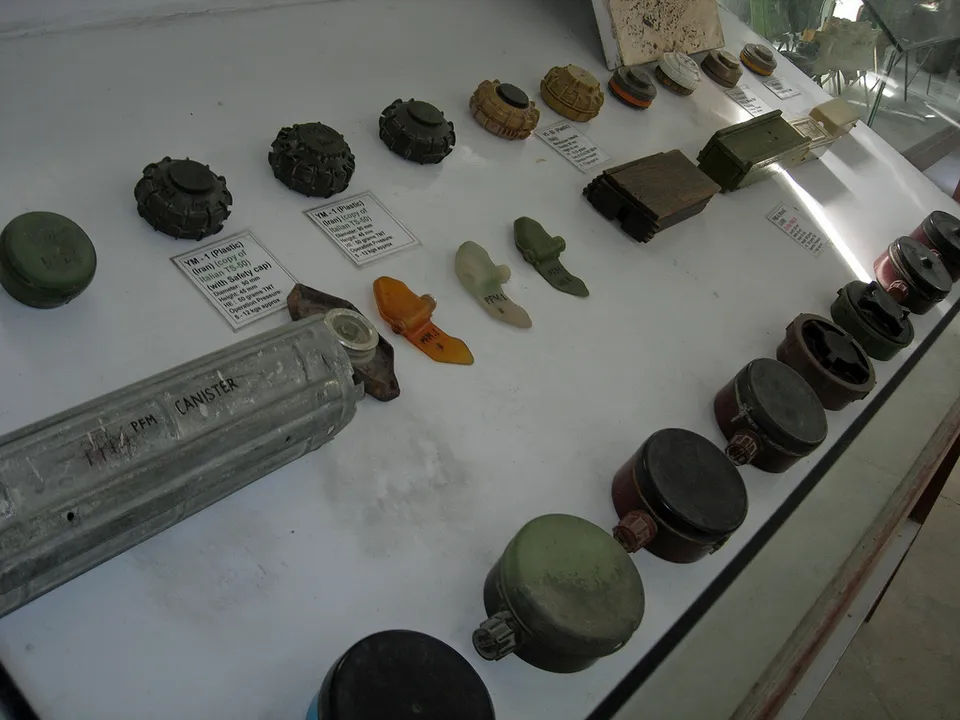
IMAS describes the Iranian-produced YM-1 as a copy of the Italian Tecnovar-produced TS-50, and CISR lists YM-1 as a TS-50 copy with similar 90 mm by 45 mm dimensions.
Sources: IMAS YM-1(B) Technical Note; CISR: Munitions Reference Guide.
YM-1(B)
IMAS treats YM-1(B) as a YM-1 variant with the same casing, pressure-plate markings, and an added bottom switch described as a safety mechanism rather than a confirmed antihandling device.
Source: IMAS YM-1(B) Technical Note.
Broader Mine Class
The TS-50 is one specific anti-personnel blast mine model inside the broader landmine class.
| Compatible item | Item type | Compatibility evidence |
|---|---|---|
 | Anti-personnel blast mine | Reference sources describe the TS-50/YM-1 pattern as a pressure-actuated blast anti-personnel landmine, while the generic Landmine entry covers the broader mine class. Sources: Italian Landmine, APERS, TS-50, CISR: Munitions Reference Guide |
Timeline
TS-50 anti-personnel mine Key Events
Egyptian assembly begins
Landmine Monitor reports that TS 50 mines were assembled in Egypt from 1979 onward with Tecnovar involvement and sold under the T/79 designation.
Sources: Landmine Monitor Report 1999, Exposing the Source
Tecnovar TS-50 plastic-parts period reported
Landmine Monitor quotes Italy's UN response stating that Tecnovar manufactured plastic parts for yellow TS 50 anti-personnel mines during the 1980-1993 period.
Sources: Landmine Monitor Report 1999
Tecnovar bankruptcy adjudicated
Italy's Mine Ban Treaty reporting states that Tecnovar had ceased activity and records bankruptcy adjudication on 3 November 1997.
Sources: Italy Article 7 Report for 2022
IMAS YM-1(B) note amended
The IMAS technical note on YM-1(B) identifies it as a YM-1 variant and traces YM-1 back to the Italian Tecnovar TS-50.
Sources: IMAS YM-1(B) Technical Note
YM-1 supply to DPR and LPR reported
A Ukrainian EOD handbook says Syrian-procured YM-1 mines began moving to DPR and LPR forces through Russia in November 2017.
Sources: Sappers YM-1 Mine Handbook
Media
TS-50 anti-personnel mine Images
Related Weapon Systems


Sources
Landmine Monitor Report 2000: Nagorny-KarabakhPublisher: Human Rights Watch / Landmine Monitor | Note: Supports 1988 First Nagorno-Karabakh War direct use: the report identifies Italian TS-50 mines among anti-personnel mine types commonly used during the Nagorno-Karabakh fighting of 1988-1994 and describes use by both Armenian and Azerbaijani forces. | Accessed: 2026-07-01Landmines: A Deadly LegacyPublisher: Human Rights Watch / Physicians for Human Rights | Note: Supports Afghanistan background: the report describes Soviet-Afghan War landmine use by Soviet, Afghan government, and mujahidin forces and lists Italian TS-50 and Egyptian T/79 anti-personnel mines among types found in Afghanistan. | Accessed: 2026-07-01Sappers YM-1 Mine HandbookPublisher: Sappers.org | Note: Supports 2014 Russia-Ukraine War direct use for the YM-1 copy: the handbook describes the YM-1 as an Iranian-manufactured TS-50 and states that Syrian-procured mines began moving to DPR and LPR forces through Russia in November 2017. | Accessed: 2026-07-01The Engineer: Mine Warfare and CounterinsurgencyPublisher: U.S. Army Engineer School | Note: Supports 1979 Soviet-Afghan War direct use: the article says mujahideen anti-personnel mine inventories in Afghanistan included Italian TS-50 mines. | Accessed: 2026-07-01Kurdistan24 MAG Landmine LegacyPublisher: Kurdistan24 | Note: Supports 1980 Iran-Iraq War direct use: reporting with Mines Advisory Group context describes Iraqi Army minefields in Kurdistan during the Iran-Iraq War and identifies Italian mines there including the later TS-50. | Accessed: 2026-07-01HRW Syria Landmines 2025Publisher: Human Rights Watch | Note: Supports 2011 Syrian Civil War direct use for the YM-1 copy: the report says the Syrian army mined Kafr Nabl after turning it into a military base and that clearance teams later found YM-1 mines among the recovered types. | Accessed: 2026-07-01Landmine Monitor Report 1999Publisher: International Campaign to Ban Landmines / Human Rights Watch | Note: Supports Egyptian T/79 production and designation context, reported TS 50 assembly in Egypt from 1979 to 1993 with Tecnovar involvement, and Tecnovar TS-50 plastic-parts production from 1980 to 1993. | Accessed: 2026-07-01IMAS YM-1(B) Technical NotePublisher: International Mine Action Standards / GICHD | Note: Supports YM-1 as an Iranian copy of the Tecnovar TS-50, YM-1(B) as a YM-1 variant, minimum-metal detection treatment, and the YM-1(B) bottom-switch safety-mechanism description. | Accessed: 2026-07-01CISR: Munitions Reference GuidePublisher: James Madison University Center for International Stabilization and Recovery | Note: Supports TS-50, T/79, YM-1, and YM-1B ordnance-reference rows, including dimensions, explosive-fill figures, copy-designation caveats, blast resistance, and hand/scatterable deployment. | Accessed: 2026-07-01Munition, mine, TS-50Publisher: Fenix Insight | Note: Supports public METIS background describing the TS-50 as an Italian mechanical, scatterable, pressure-operated, shock-resistant anti-personnel blast mine with a pneumatic fuze and Egyptian and Iranian versions. | Accessed: 2026-07-01Exposing the SourcePublisher: Human Rights Watch | Note: Supports TS-50 export and designation context, including Human Rights Watch's account that the Egyptian Army renamed TS-50 as Mine Type 79 and exported it as MAT-79. | Accessed: 2026-07-01Italian Landmine, APERS, TS-50Publisher: Bulletpicker | Note: Supports ordnance background describing the TS-50 as an Italian pressure-actuated, blast, hand-emplaced or scatterable anti-personnel landmine. | Accessed: 2026-07-01Italy Article 7 Report for 2022Publisher: Anti-Personnel Mine Ban Convention | Note: Supports official Italian technical characteristics for the TS/50 mine, including dimensions, explosive content, low detectability, and weight. | Accessed: 2026-07-01Commons Tecnovar TS-50 ImagePublisher: Wikimedia Commons | Note: Supports image provenance for the primary TS-50 image, marked as CC0/public-domain dedication on Commons. | Accessed: 2026-07-01Commons Landmine Display ImagePublisher: Wikimedia Commons | Note: Supports image provenance for a display image whose structured data identifies a depicted TS-50/YM-1 mine; licensed CC BY 2.0 on Commons. | Accessed: 2026-07-01Commons TS-50 Anti-Personnel Mine ImagePublisher: Wikimedia Commons | Note: Supports image provenance for an additional TS-50 anti-personnel mine photograph licensed CC BY-SA 3.0 on Commons. | Accessed: 2026-07-01