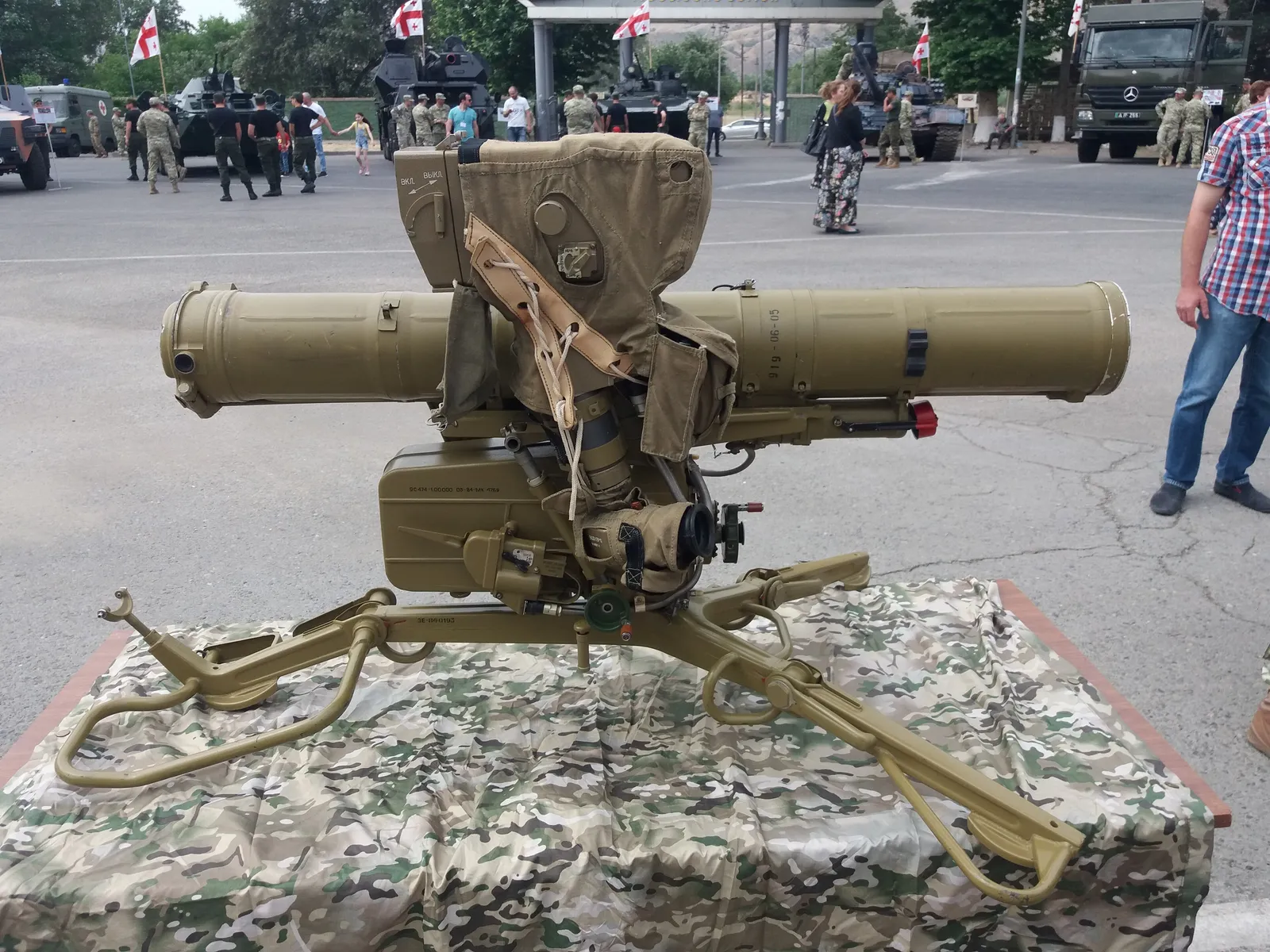

The Israel Defense Forces reported that commandos located a 9K111 Fagot missile in Khan Yunis during February 2024 operations against Hamas; Al Jazeera Mubasher later reported Al-Quds Brigades footage claiming Fagot and Malyutka use against Israeli forces in northern Khan Yunis in June 2025.
Role detailsInfantry Weapons
9K111 Fagot
Also known as
- AT-4 Spigot
- AT-4A Spigot
- AT-4B Spigot
- AT-4C Spigot
- 9M111
- 9M111M
- Fagot-M
- 9P135
The 9K111 Fagot, known to NATO as the AT-4 Spigot, is a Soviet man-portable SACLOS wire-guided anti-tank missile system built around the 9P135 tripod launcher and 9M111 missile family. Its reusable launcher, later 9P135M compatibility with the 9M113 Konkurs, and 2 to 2.5 km range kept it relevant for legacy users, with documented appearances from Ukraine to Gaza and Karabakh.
Role in Conflicts
- Role in conflict
- Defensive anti-armor missile launcher

Azerbaijan's Ministry of Defense listed three Fagot launchers among weapons seized in the Karabakh region after the September 2023 operation to disarm local Armenian/Artsakh armed formations.


Russian forces have fielded AT-4 Spigot / 9K111 Fagot systems in mobile anti-tank units during the full-scale invasion, while Ukrainian forces are also documented using 9K111 and 9K111M Fagot missiles among their anti-tank weapons.
Role details
Syrian rebel groups used 9K111 Fagot / AT-4 Spigot missiles during the war, with Bellingcat documenting renewed Soviet-model ATGM supplies, mostly Fagot systems, around the 2016 Aleppo fighting.
Role detailsProfile / Specs
Profile
- Origin
- Soviet Union
- Built by
- KBP Instrument Design Bureau
- Type
- Man-portable anti-tank guided missile system
- Service note
- Cold War design, still in service with legacy operators during the 2014 Russia-Ukraine War
- Designer
- Tula KBP
- Designed
- Early 1960s
- Produced
- 1970s onward
Specifications
- Guidance
- SACLOS wire guidance
- Launcher
- Reusable 9P135 tripod/manpack launcher, with later 9P135M compatibility for 9M113 Konkurs
- Range
- 75 m to 2.0 km for 9M111; up to 2.5 km for later 9M111M/Fagot-M variants
- Missile diameter
- 120 mm
- Warhead
- Single HEAT warhead on 9M111/9M111-2; improved Fagot-M variant listed with higher penetration
- Launch container weight
- About 13 kg with missile and launch container, depending on variant
Missile and Launcher Structure
The family combines disposable missile launch containers with reusable 9P135-series firing posts, so missile designations and launcher compatibility are separate parts of the system.
| Element | Catalog role | Documented distinction |
|---|---|---|
| 9M111 and 9M111-2 | Fagot missiles | Early SACLOS wire-guided 120 mm anti-tank missiles for the Fagot launcher family, listed with roughly 75 m to 2 km range. |
| 9M111M Fagot-M | Later missile | Improved family member listed with about 2.5 km maximum range and higher penetration than earlier single-HEAT variants. |
| 9P135 and 9P135M | Reusable firing posts | The later 9P135M firing post is documented as compatible with both Fagot-family missiles and the larger 9M113 Konkurs missile. |
Variants
The Fagot family is commonly separated by missile designation and NATO AT-4 Spigot suffix, while the reusable 9P135-series launcher remains central to the system.
| Variant | Configuration | Designation notes |
|---|---|---|
| 9M111 Fagot / AT-4A Spigot | Baseline missile | Early 120 mm SACLOS wire-guided missile for the 9P135 launcher family, listed with a 75 m to 2 km engagement range. Sources: 9K111 Fagot |
| 9M111-2 Fagot / AT-4B Spigot | Improved missile | WeaponSystems.net treats the 9M111-2 as an improved Fagot missile with the same general launcher family and anti-armor role. Sources: 9K111 Fagot |
| 9M111M Fagot-M / AT-4C Spigot C | Extended-range Fagot-M missile | Later Fagot-M family missile, listed with increased maximum range of about 2.5 km and improved penetration over earlier single-HEAT rounds. Sources: 9K111 Fagot, 9K111 Fagot/AT-4 Spigot, Anti-tank guided missile launcher |
Missile Compatibility
The Fagot missile family is tied to reusable tripod firing posts, and later launcher upgrades widened missile compatibility.
| Compatible item | Item type | Compatibility evidence |
|---|---|---|
 | 9P135M-compatible anti-tank missile | Army Guide describes the 9P135M firing post as able to fire 9M113 Konkurs missiles alongside the Fagot family. Sources: 9K111 Fagot/AT-4 Spigot, Anti-tank guided missile launcher |
Vehicle Mounts
Open references also tie the system to several armored and soft-skin carriers used as launch platforms.
| Compatible item | Item type | Compatibility evidence |
|---|---|---|
 | Infantry fighting vehicle mount | Army Guide lists BMP-1P as one of the armored vehicle applications for the Fagot launcher family. Sources: 9K111 Fagot/AT-4 Spigot, Anti-tank guided missile launcher |
 | Airborne fighting vehicle mount | Army Guide lists BMD-1P as another armored vehicle application for the Fagot launcher family. Sources: 9K111 Fagot/AT-4 Spigot, Anti-tank guided missile launcher |
Launch Platforms
| Launcher | Launcher type | Launch evidence |
|---|---|---|
 | Airborne infantry fighting vehicle | WeaponSystems.net identifies the BMD-2 as a launch platform that can fire the 9M111 Fagot missile family. Sources: Weaponsystems.net BMD-2 |
 | Mechanized infantry combat vehicle | The 9K111 Fagot page describes the 9P135M launcher as able to fire 9M111 Fagot missiles, matching the BMP-2's roof-mounted missile launcher. Sources: 9K111 Fagot |
Timeline
9K111 Fagot Key Events
Early development
Development began at Tula KBP in the early 1960s.
Sources: 9K111 Fagot, 9K111 Fagot/AT-4 Spigot, Anti-tank guided missile launcher
Operational service
Army Guide places the system's entry into operational service in 1973.
Sources: 9K111 Fagot/AT-4 Spigot, Anti-tank guided missile launcher
Karabakh seizures
Azerbaijan said three Fagot launchers were seized in Karabakh after the September 2023 operation.
Sources: Military equipment, weapons and ammunition seized until 23.09.2023 in the Karabakh region
Khan Yunis missile find
IDF commandos reported finding a 9K111 Fagot missile in Khan Yunis during February 2024 operations against Hamas.
Sources: Commando Forces Locate Missiles and Means for Underground Combat
Media
9K111 Fagot Videos
Related Weapon Systems


Sources
9K111 Fagot (AT-4 Spigot) Russian Anti-Tank Guided Missile (ATGM)Publisher: U.S. Army ODIN Worldwide Equipment Guide | Note: Supports general system background for the man-portable Fagot / AT-4 Spigot anti-tank guided missile system. | Accessed: 2026-06-209K111 FagotPublisher: WeaponSystems.net | Note: Supports origin, guidance method, variant range, dimensions, warhead, and related specifications. | Accessed: 2026-06-209K111 Fagot/AT-4 Spigot, Anti-tank guided missile launcherPublisher: Army Guide | Note: Supports the 1973 service entry, launcher family, 9P135M compatibility, vehicle-mount use, and later Fagot range/variant context. | Accessed: 2026-06-24Weaponsystems.net BMD-2Publisher: WeaponSystems.net | Note: Supports the BMD-2 launch-platform relationship for the 9M111 Fagot missile family. | Accessed: 2026-06-28New Russian highly mobile anti-tank units using an all-terrain type vehicle fight Ukrainian tanksPublisher: Army Recognition | Note: Directly supports 2014 Russia-Ukraine War context for Russian units fielding AT-4 Spigot / 9K111 Fagot anti-tank guided missile systems. | Accessed: 2026-06-20Military equipment, weapons and ammunition seized until 23.09.2023 in the Karabakh regionPublisher: Ministry of Defense of the Republic of Azerbaijan | Note: Directly documents the Karabakh conflict-use claim by listing three Fagot launchers seized in the Karabakh region after local anti-terror measures. | Accessed: 2026-06-24Analysis: Discover the use of anti-tank weapons by Ukrainian soldiers to destroy Russian tanksPublisher: Army Recognition | Note: Directly supports 2014 Russia-Ukraine War context for Ukrainian forces using 9K111 and 9K111M Fagot anti-tank weapons. | Accessed: 2026-06-20Military equipment, weapons and ammunition seized in the Karabakh region - LIST - VIDEOPublisher: Ministry of Defense of the Republic of Azerbaijan | Note: Directly supports 2020 Nagorno-Karabakh Conflict context for Fagot launchers fielded by Armenian/Artsakh armed formations and seized by Azerbaijani forces in the Karabakh region after the September 2023 operation. | Accessed: 2026-06-20Seven Years of War: Documenting Syrian Rebel Use of Anti-Tank Guided MissilesPublisher: Bellingcat | Note: Directly supports 2011 Syrian Civil War context for rebel use and supply of 9K111 Fagot / AT-4 Spigot anti-tank guided missiles. | Accessed: 2026-06-20Commando Forces Locate Missiles and Means for Underground CombatPublisher: Israel Defense Forces | Note: Directly supports 2023 Israel-Hamas War context by reporting that IDF commandos located a 9K111 Fagot missile in Khan Yunis during February 2024 operations against Hamas. | Accessed: 2026-06-30Al Jazeera Mubasher Fagot and Malyutka Khan YunisPublisher: Al Jazeera Mubasher | Note: Directly supports 2023 Israel-Hamas War context by reporting Al-Quds Brigades footage and claims that fighters used Fagot and Malyutka weapons against Israeli forces in northern Khan Yunis on June 23, 2025. | Accessed: 2026-07-03AT-4 Fagot on display.jpgPublisher: Wikimedia Commons | Note: Image provenance and licensing source for the primary 9K111 Fagot image; file page lists CC BY-SA 4.0 licensing. | Accessed: 2026-06-20Al-Quds Brigades Fagot ATGM 2022.jpgPublisher: Wikimedia Commons | Note: Image provenance and licensing source for the gallery image of an Al-Quds Brigades Fagot anti-tank guided missile in Gaza; file page lists Creative Commons attribution licensing. | Accessed: 2026-06-30