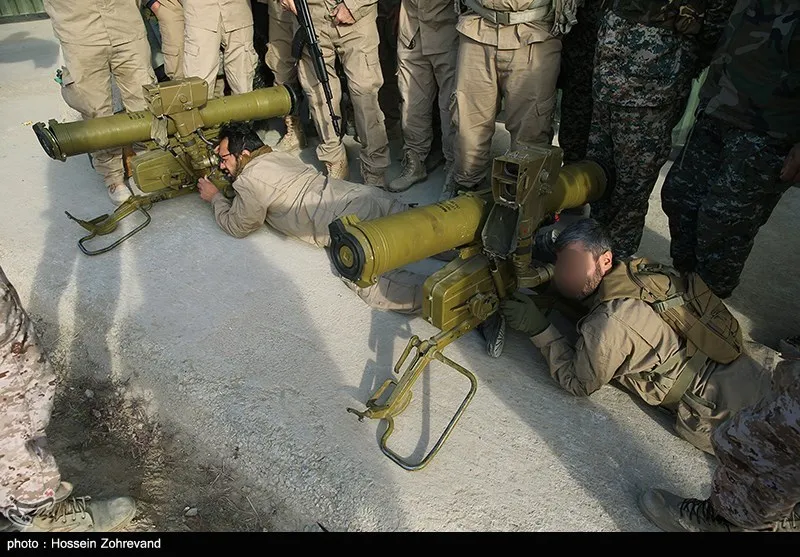

Documented in Yemen through Iranian-made Tosan missiles seized from Houthi-linked arms flows and stockpiles; CSIS and UN-linked reporting also describe Houthi use of visually similar Konkurs/Tosan-class ATGWs, but public model-specific evidence remains strongest for Tosan transfer and possession rather than a confirmed Tosan firing.
Role detailsInfantry Weapons
Tosan anti-tank guided missile
Also known as
- Tosan
- Tosan-1
- Towsan
- Towsan-1
- Towsan-1/M113
- Tosan ATGM
- Tosan anti-armor missile
- Iranian 9M113 Konkurs
- 9M113 Tosan
The Tosan anti-tank guided missile is an Iranian wire-guided SACLOS anti-armor weapon in the 9M113 Konkurs lineage. Iran Press describes it as an Iranian reverse-engineered Konkurs-derived system used from ground and vehicle launchers, while Iran Watch links Tosan-1 production to the Aerospace Industries Organization. Conflict documentation ties Towsan-1 to Hezbollah's 2006 anti-armor inventory and Tosan missiles to Houthi-linked arms-flow and stockpile evidence in Yemen.
Role in Conflicts
SIPRI lists Konkurs/AT-5 anti-tank missiles, including the Iranian-produced Towsan-1 version, among major conventional weapons used by Hezbollah in 2006; the source supports wartime Hezbollah use at inventory/type level rather than a named Towsan firing incident.
Profile / Specs
Profile
- Origin
- Iran
- Type
- Wire-guided SACLOS anti-tank guided missile
- Service note
- Iranian production reported around 2000; documented in Hezbollah and Yemen conflict-source reporting from 2006 onward
- Designer
- Aerospace Industries Organization; based on the 9M113 Konkurs design
- Designed
- Iranian production reported around 2000
- Produced
- 2000-present, reported
- Developed from
- 9M113 Konkurs
Specifications
- Guidance
- Semi-automatic command to line of sight (SACLOS), wire-guided
- Range
- 70 m to 4,000 m; reported night range about 2,500 m
- Missile weight
- 26.5 kg
- Warhead
- 3.2 kg tandem HEAT warhead, reported armor penetration up to 670 mm
- Maximum speed
- About 200 m/s
- Dimensions
- About 1.3 m long and 135 mm in diameter
- Launch configurations
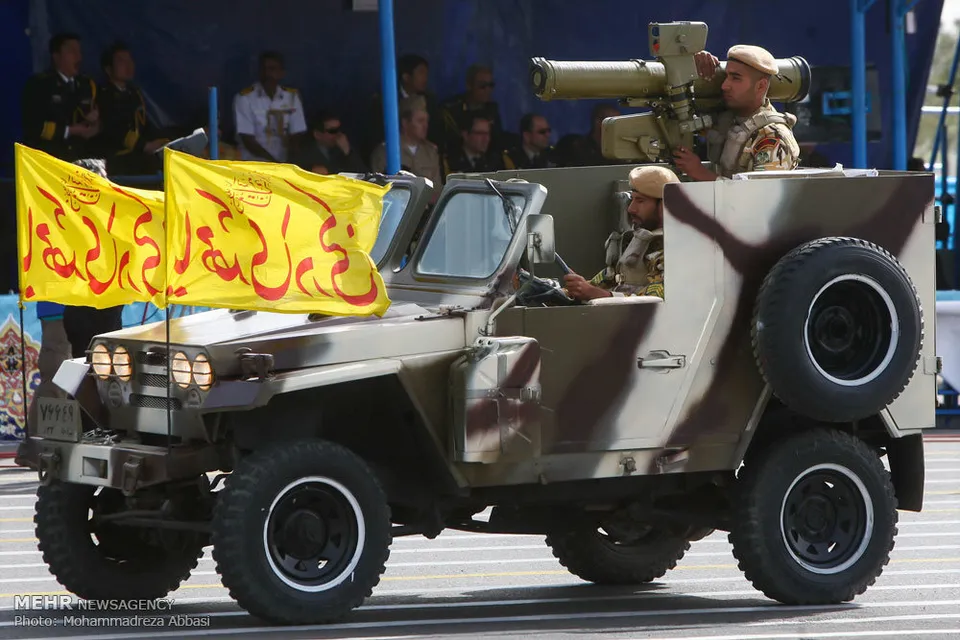
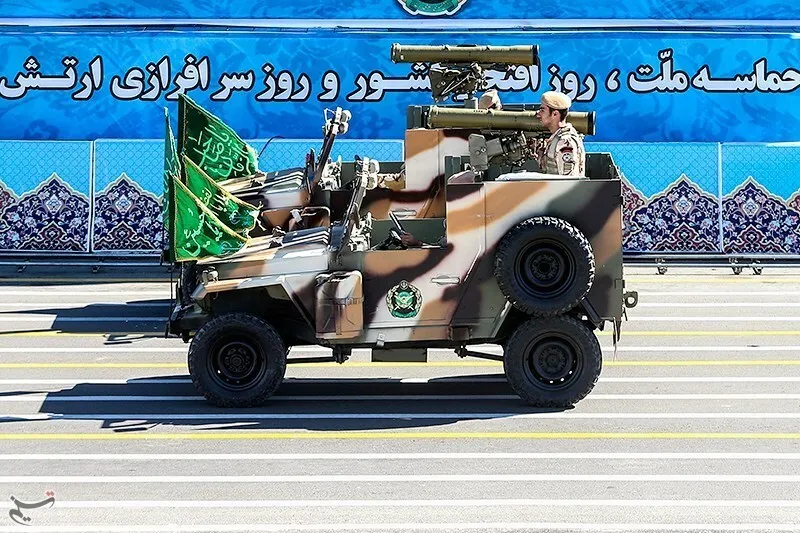
- Fixed ground launcher; vehicle-mounted use reported on Safir tactical vehicles, Boraq carriers, and BMP-2 personnel carriers
- Sight options
- RU244TK cooled and RU150TK uncooled thermographic cameras reported for Tosan-compatible anti-armor missile systems
Variants
Public sources use Tosan and Tosan-1 for Iran's Konkurs-derived ATGM; the same missile is described in ground-launcher and vehicle-mounted configurations rather than as a large family of separate marks.
| Variant | Configuration | Designation notes |
|---|---|---|
 | Soviet parent missile family | ARES describes Tosan as Iran's domestic name for licensed Konkurs missile assembly tied to the 1991 license context. |
| Ground-launched Tosan | Tripod or fixed ground-launcher configuration | Iran Press describes Tosan as usable from a fixed ground launcher with a low deployed launcher profile. Sources: Tosan anti-armor missile; effective weapon against fixed, moving targets |
| Vehicle-mounted Tosan | Light vehicle and armored-carrier launcher configuration | Iran Press describes Tosan installations on Safir tactical vehicles and Boraq or BMP-2 carriers. Sources: Tosan anti-armor missile; effective weapon against fixed, moving targets |
Launch Platforms
Source descriptions place Tosan on fixed ground launchers and selected vehicle mounts; the cataloged platform below is the linked vehicle type directly named in those launcher accounts.
| Launcher | Launcher type | Launch evidence |
|---|---|---|
 | Infantry fighting vehicle launcher | Iran Press describes Tosan as fired from a BMP-2 carrier as well as from ground launchers, with Safir tactical-vehicle and Boraq carrier installations also reported. Sources: Tosan anti-armor missile; effective weapon against fixed, moving targets |
Launcher And Service Context
Tosan is best read as Iran's local Konkurs-line ATGM rather than a separate design family. Public sources emphasize SACLOS wire guidance, a 4 km daytime range class, and launcher flexibility across fixed ground posts and vehicle mounts.
Guidance lineage
ARES and METIS connect Tosan-1 to the Soviet/Russian 9M113 Konkurs series, with Iran Press describing it as an optimized Konkurs-derived missile.
Launcher options
Iran Press lists fixed ground launchers, Safir tactical vehicles, Boraq carriers, and BMP-2 carriers as Tosan launch contexts.
Yemen documentation
Yemen sources document Tosan missiles in arms-flow and stockpile evidence linked to Houthi-aligned forces, while public reporting does not identify a separate Tosan firing event.
Timeline
Tosan anti-tank guided missile Key Events
Iranian production reported
NTI's Iran missile chronology reports that Iran inaugurated mass production of the Towsan-1 anti-armor guided missile, described as a local Konkurs version.
Sources: Iran Missile Chronology
BMP-2 firing reported in IRGC exercise
Mehr News reported that BMP-2 infantry fighting vehicles fired Tosan missiles during the IRGC Great Prophet 8 war games in Kerman.
Sources: Tondar, Tosan missiles fired during IRGC war games
CAR-linked Yemen arms-flow reporting
Washington Institute reporting on Conflict Armament Research findings identified an Iranian-made Tosan ATGM in an Oman-route cache connected to arms flows into the Yemen war.
Sources: Responding to Iran's Arms Smuggling in Yemen
Thermal camera fit reported
Tasnim reported RU244TK and RU150TK thermographic cameras for anti-armor missile systems including Tosan.
Sources: Iran Builds Thermal Imaging Infrared Cameras
U.S. display cites five seized Tosan missiles
A U.S. briefing republished by the Iran Primer said one displayed Tosan was among five seized in a Saudi forces stockpile in Yemen.
Sources: U.S. Unveils Evidence of Iranian Arms Transfer
CSIS summarizes Tosan evidence in Yemen
CSIS reported a Tosan rocket seized from a Houthi base in Marib, Houthi use of AT-5/Konkurs missiles, and a U.S.-displayed Tosan seized by Saudi forces in Yemen.
Sources: The Missile War in Yemen
Media
Tosan anti-tank guided missile Images
Related Weapon Systems


Sources
Tosan anti-armor missile; effective weapon against fixed, moving targetsPublisher: Iran Press | Note: Supports Tosan background, Konkurs-derived design, SACLOS wire guidance, range, warhead, speed, dimensions, and launcher/platform context. | Accessed: 2026-07-01Iran Missile ChronologyPublisher: Nuclear Threat Initiative / James Martin Center for Nonproliferation Studies | Note: Supports reported Towsan-1 mass-production chronology, Konkurs lineage, 4,000 m day range, 2,500 m night range, and ground or vehicle launch context. | Accessed: 2026-07-01Tondar, Tosan missiles fired during IRGC war gamesPublisher: Mehr News Agency | Note: Supports 2013 IRGC exercise context, BMP-2 firing of Tosan missiles, and a reported 4.5 km exercise range claim. | Accessed: 2026-07-01Iran Builds Thermal Imaging Infrared CamerasPublisher: Tasnim News Agency | Note: Supports Tosan-compatible RU244TK and RU150TK thermal camera context and Tasnim's CC BY 4.0 sitewide licensing statement for relevant media. | Accessed: 2026-07-01Munition, missile, Tosan-1Publisher: METIS by Fenix Insight | Note: Supports independent background that Tosan-1 is an Iranian wire-guided SACLOS ATGM associated with the 9M113 series. | Accessed: 2026-07-01Aerospace Industries Organization (AIO)Publisher: Iran Watch | Note: Supports manufacturer context for Aerospace Industries Organization and its reported manufacture of Tosan-1 anti-tank missiles. | Accessed: 2026-07-01Introduction to the 9M113 Konkurs ATGMPublisher: Armament Research Services | Note: Supports the Konkurs lineage, 9M113 family launcher context, BMP-2 launcher context, and Iran's domestic Tosan assembly under the Konkurs license. | Accessed: 2026-07-01Saudi-led Coalition seizes Iranian arms en route to YemenPublisher: Armament Research Services | Note: Supports 2014 Yemen Civil War conflict use by documenting 9M113 Konkurs ATGMs in an Iranian arms shipment reportedly en route to Yemen and noting Iran's Tosan-1 copy; evidence supports supplied to Houthi-aligned forces with caveats on the shipment route. | Accessed: 2026-07-01The Missile War in YemenPublisher: Center for Strategic and International Studies | Note: Supports 2014 Yemen Civil War conflict use by identifying Tosan as Iran's 9M113/Konkurs variant, reporting a Tosan rocket seized from a Houthi base in Marib, describing Houthi use of AT-5/Konkurs missiles, and noting a U.S.-displayed Tosan seized by Saudi forces in Yemen. | Accessed: 2026-07-01Responding to Iran's Arms Smuggling in YemenPublisher: The Washington Institute for Near East Policy | Note: Supports 2014 Yemen Civil War conflict use by summarizing CAR evidence that an Iranian-made Tosan ATGM was seized from an Oman-route cache and that related ATGMs were captured from Houthi fighters; evidence supports supplied to Houthi-aligned forces. | Accessed: 2026-07-01SIPRI Yearbook 2007 International Arms TransfersPublisher: Stockholm International Peace Research Institute | Note: Supports 2006 Lebanon War conflict use by listing Konkurs/AT-5 anti-tank missiles, including the Iranian-produced Towsan-1 version, among major conventional weapons used by Hezbollah in 2006. | Accessed: 2026-07-01U.S. Unveils Evidence of Iranian Arms TransferPublisher: The Iran Primer / United States Institute of Peace | Note: Supports 2014 Yemen Civil War conflict use by quoting a U.S. briefing that five Tosan rockets were seized in a Saudi forces stockpile in Yemen and that these missiles enhanced Houthi capabilities; evidence supports fielded by or supplied to Houthi-aligned forces. | Accessed: 2026-07-01Training exercise of Fatehin Unit (28)Publisher: Wikimedia Commons | Note: Supports primary image provenance for a Tosan anti-tank guided missile photograph and its CC BY 4.0 licensing context. | Accessed: 2026-07-01Islamic Republic of Iran Army Day 2015 (188)Publisher: Wikimedia Commons | Note: Supports secondary gallery image provenance for Tosan missile display imagery and its CC BY 4.0 licensing context. | Accessed: 2026-07-01Towsan-1.jpgPublisher: Wikimedia Commons | Note: Supports gallery image provenance for Towsan-1 missiles on Safir jeeps and CC BY 4.0 licensing context. | Accessed: 2026-07-01