- Side
- Iran

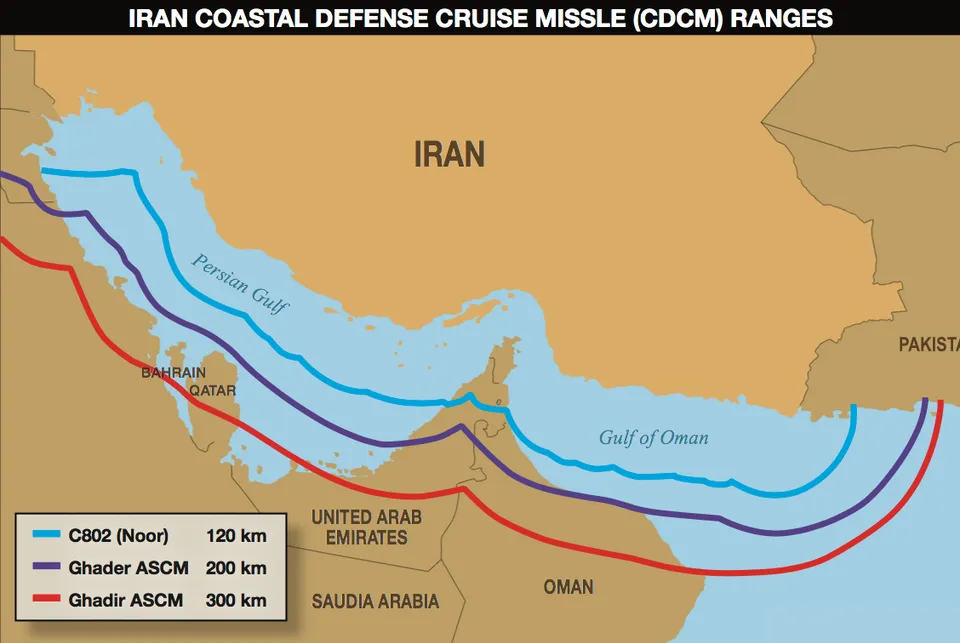
Iranian anti-ship cruise missiles formed part of Iran's Strait of Hormuz maritime-denial threat in the 2020 United States-Iran Conflict, with AP citing DIA mapping that they could reach the strait and its approaches during the Iran war.
Iranian anti-ship missile systems cover C802/Noor-derived coastal-defense cruise missiles, shorter-range C700-family boat missiles, Fateh-derived anti-ship ballistic missiles, and newer long-range anti-warship cruise missiles. The family underpins Iran's Strait of Hormuz maritime-denial posture and appears in Yemen conflict evidence through Houthi-linked Noor-family missile technology.
Iranian anti-ship cruise missiles formed part of Iran's Strait of Hormuz maritime-denial threat in the 2020 United States-Iran Conflict, with AP citing DIA mapping that they could reach the strait and its approaches during the Iran war.
Houthi-aligned forces used Iranian-linked anti-ship cruise missile technology in the Yemen war's Red Sea escalation; DIA linked engine debris from the 11 December 2023 M/T Strinda attack to the Tolu-4 engine used in Iran's Noor anti-ship cruise missile family.
Role detailsOpen references divide Iran's anti-ship missile inventory into Chinese-derived coastal-defense cruise missiles, including the C802/Noor/Ghader/Ghadir and C700-series Kosar/Nasr lines, older Silkworm-family weapons, and Fateh-derived anti-ship ballistic missiles such as Khalij-e Fars and Hormuz.
| Variant | Configuration | Designation notes |
|---|---|---|
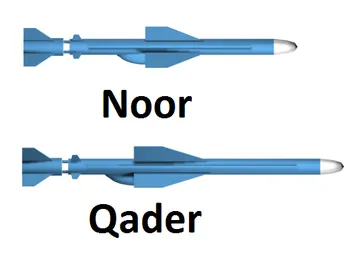
 | C802-derived anti-ship cruise missile | ONI and Iran Watch identify Noor as Iran's domestic C802 derivative, with a reported range of about 120 km. Sources: ONI Iranian Naval Forces report, Iran Watch asymmetric capabilities report |
 | Extended-range C802/Noor cruise missile | Iran Watch and DIA describe Ghader as a C802/Noor extended-range variant with a reported 200 km range. Sources: Iran Watch asymmetric capabilities report, DIA Iran Military Power report |
| Ghadir | Extended-range C802/Noor cruise missile | ONI, DIA, and Iran Watch describe Ghadir as the 300 km member of the C802/Noor-derived Iranian anti-ship cruise missile branch. Sources: ONI Iranian Naval Forces report, DIA Iran Military Power report, Iran Watch asymmetric capabilities report |
| Kosar / Kowsar | C701-derived short-range anti-ship cruise missile | Iran Watch places Kosar in the Chinese C700-series branch and reports a 15-20 km maximum range. |
| Nasr | C704-derived short-range anti-ship cruise missile | DIA and Iran Watch describe Nasr as Iran's C704-derived anti-ship cruise missile, with a reported range around 35 km. Sources: DIA Iran Military Power report, Iran Watch asymmetric capabilities report |
| Raad | Silkworm-family anti-ship cruise missile | CSIS lists Raad as an operational Iranian anti-ship cruise missile with a 350 km range, while Iran Watch treats it as part of the Silkworm-derived branch. Sources: CSIS Missiles of Iran, Iran Watch asymmetric capabilities report |
| Khalij-e Fars | Fateh-110-derived anti-ship ballistic missile | Iran Watch describes Khalij-e Fars as a Fateh-110 variant with a 300 km maximum range, reported 650 kg payload, and electro-optical terminal seeker. Sources: Iran Watch asymmetric capabilities report, Iran Watch Iran's Missile Milestones |
| Hormuz-1 / Hormuz-2 | Fateh-110-derived anti-radiation ballistic missiles | Iran Watch describes the Hormuz missiles as 300 km Fateh-110 variants with reported 500 kg payloads and anti-radiation homing terminal seekers. |
| Abu Mahdi | Long-range anti-ship cruise missile | Iran Watch describes Abu Mahdi as an anti-ship version of the Hoveizeh cruise missile with a claimed 1,000 km range. |
| Ghadr-380 | Long-range anti-warship cruise missile | AP reported an Iranian state-TV account of a Ghadr-380 test, claimed at over 1,000 km range with anti-jamming capability. Sources: AP anti-warship cruise missile test |
| Jask-2 | Submarine-launched anti-ship cruise missile | Iran Watch describes Jask-2 as a Nasr-derived submarine-launched anti-ship cruise missile tested from Iran's Ghadir-class midget submarine branch. |
Open sources document Iranian anti-ship missiles on shore batteries and small missile boats; the linked platform records below are limited to launcher fits identified in public references.
| Launcher | Launcher type | Launch evidence |
|---|---|---|
 | Missile boat | GlobalSecurity lists Peykaap II missile launchers for Kowsar/TL-10 and Peykaap III/Zolfaghar C-704/Nasr-family guided weapons. Sources: Peykaap Class |
 | Missile boat | Iran Watch says each Thondor/Houdong missile boat carries four C802-family anti-ship cruise missiles, including the Iranian-made Ghader variant. |
Iran's anti-ship missile inventory is easier to read as a network of shore batteries, missile boats, and related missile-family records. The links below separate cataloged launch platforms from cataloged missile records where the supporting source is specific enough.
| Catalog link | Connection | Source-backed note |
|---|---|---|
| Small missile-boat launcher | GlobalSecurity lists Kowsar/TL-10 launchers on Peykaap II craft and C-704/Nasr-family guided weapons on Peykaap III/Zolfaghar craft. |
| C802-family ship launcher | Iran Watch describes each Thondor/Houdong boat as fitted with four C802-family anti-ship cruise missiles and includes Iran's Ghader among those C802-family weapons. |
| Noor-family missile record | ONI describes the Noor coastal-defense cruise missile family in Iranian service, while DIA tied Houthi M/T Strinda engine debris to the Tolu-4 engine used in Iran's Noor family. |
| C-802-derived Iranian missile | Iran Watch describes Ghader as an Iranian-made C-802-derived anti-ship cruise missile and connects it to shipboard C802-family missile fits. |
 | Short-range boat missile | GlobalSecurity lists Kowsar/TL-10 launchers on the Peykaap II missile-boat variant, linking the short-range missile family to Iranian small-craft launchers. |
Iran Watch says Iran first acquired anti-ship cruise missiles when it bought Chinese Silkworm missiles in 1987, before later domestic C802 and C700 derivative production.
Sources: Iran Watch asymmetric capabilities report
Iran Watch records Iran's February 2011 test of the Khalij-e Fars anti-ship ballistic missile, described as a Fateh A-110 variant with a claimed 300 km range and 650 kg warhead.
Sources: Iran Watch Iran's Missile Milestones
Iran Watch reports Khalij-e Fars entering service in 2014 and describes Hormuz-1 and Hormuz-2 as Fateh-110 anti-radiation variants unveiled the same year.
Sources: Iran Watch asymmetric capabilities report
Iran Watch says Iran claimed a successful Jask-2 submarine-launched anti-ship cruise missile test in February 2019.
Sources: Iran Watch asymmetric capabilities report
AP reported Iranian state TV's account of a Ghadr-380 anti-warship cruise missile with a claimed range over 1,000 km and anti-jamming capability.
Sources: AP anti-warship cruise missile test