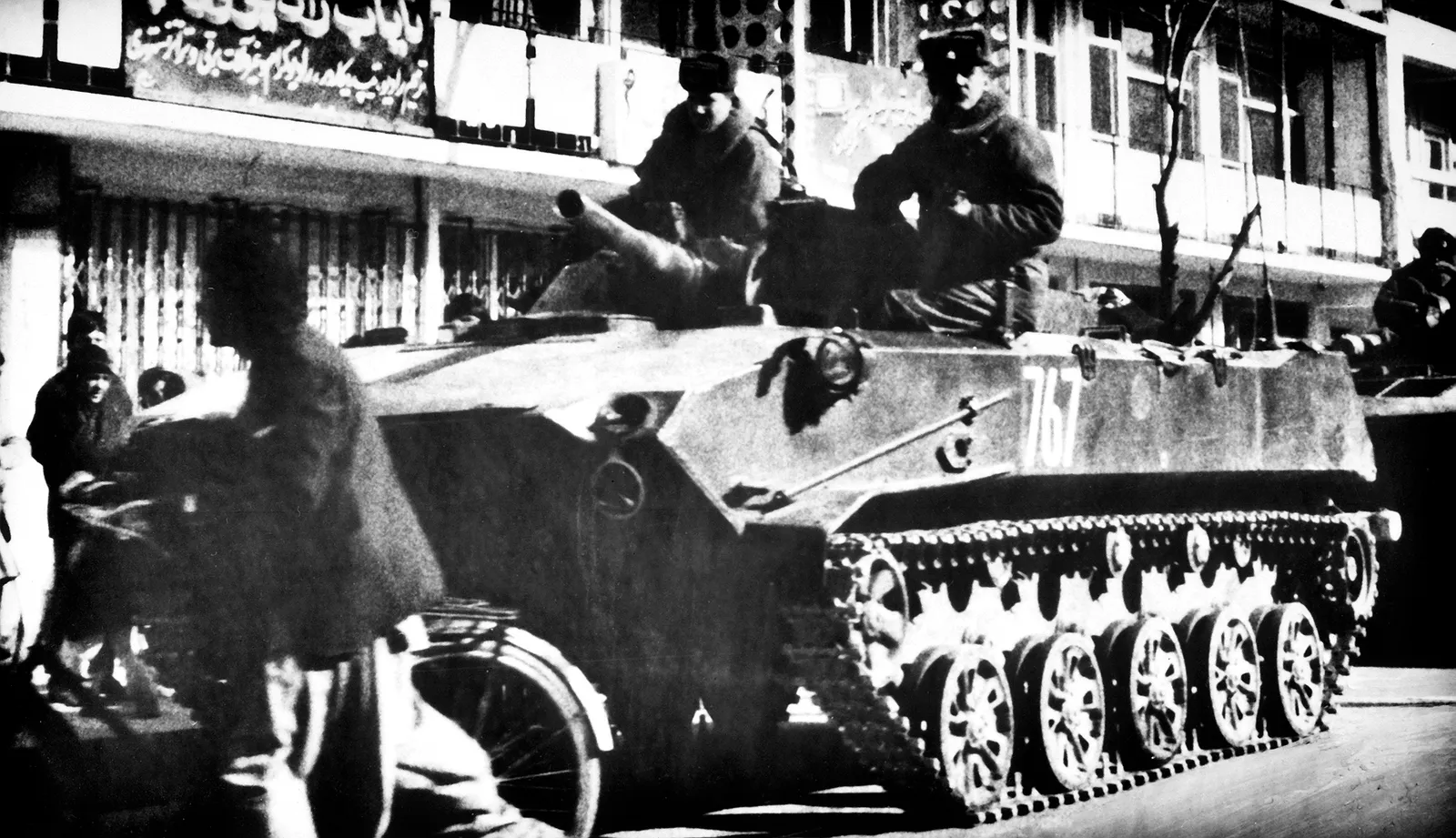
A public-domain U.S. Defense Department image dated 1986 identifies Soviet paratroopers riding on a BMD-1 in Afghanistan, directly documenting Soviet airborne use during the war.
BMD-1
- Boyevaya Mashina Desanta 1
The BMD-1 is a Soviet airborne infantry fighting vehicle built for paratroop units, combining a very light amphibious tracked chassis with the BMP-1-style 73 mm 2A28 Grom gun and anti-tank missile armament. Its hydropneumatic suspension and low combat weight supported airborne deployment, while the same design priorities left the aluminum hull protected mainly against small-arms fire and fragments. Cataloged conflict evidence spans Soviet use in Afghanistan, Russian and Iraqi wartime fielding, Russian airborne use in Georgia and Ukraine, and Ukrainian 25th Airborne Brigade service in Donbas.
Role in Conflicts
Oryx's visually documented equipment-loss list for the First Chechen War records Russian BMD-1 losses, placing the vehicle in Russian service during the campaign.
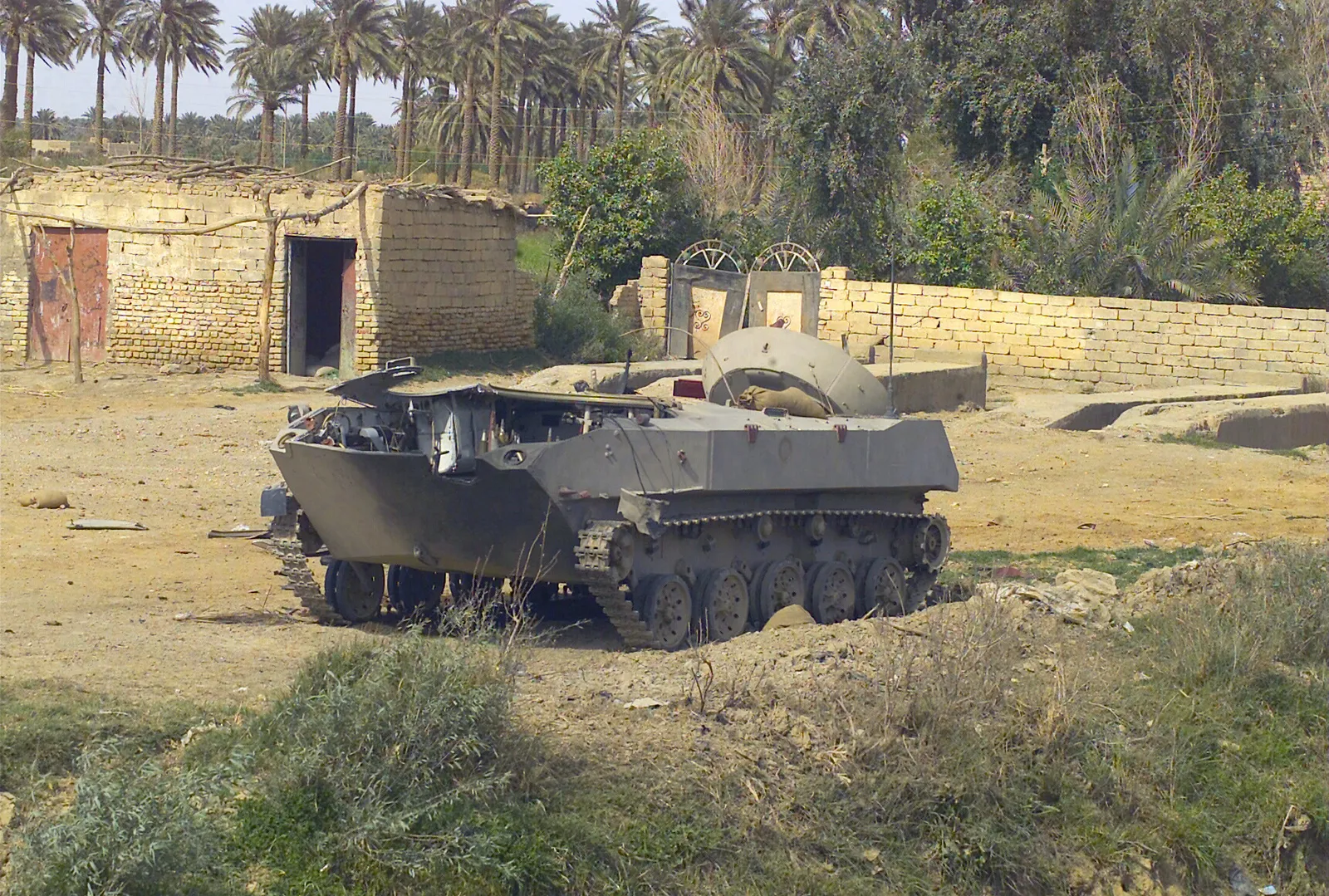
A U.S. Marine Corps photograph from Operation Iraqi Freedom shows a destroyed Iraqi BMD-1 on April 2, 2003, directly documenting Iraqi fielding during the invasion phase.
Role detailsThe CAST study The Tanks of August lists BMD-1 infantry fighting vehicles among Russian airborne forces committed to the August 2008 war.
Ukrainian Air Assault Forces document a Ukrainian 25th Airborne Brigade BMD-1 fighting around Kramatorsk and Sloviansk in April-July 2014, while Oryx lists Russian BMD-1KSh-A airborne command vehicles as destroyed or captured during the full-scale invasion.
Role detailsProfile / Specs
Profile
- Origin
- Soviet Union
- Built by
- Volgograd Tractor Plant
- Type
- Airborne amphibious infantry fighting vehicle
- Service note
- Cold War design; documented from the Soviet-Afghan War through the 2014 Russia-Ukraine War
- Designer
- Volgograd Tractor Plant design bureau
- Designed
- 1965-1969
- Produced
- 1968-1987
- Number built
- About 2,200 BMD-1 and 1,000 BMD-1P vehicles, plus command variants
- Developed into
- BMD-2 and BTR-D airborne vehicle families
Specifications
- Crew
- 2 plus 6 carried troops, including commander and bow machine gunner
- Combat weight
- About 7.2-7.5 tonnes
- Main armament
- 73 mm 2A28 Grom low-pressure gun with 40 rounds
- Anti-tank armament
- 9K11 Malyutka missile launcher on BMD-1; BMD-1P uses a 9P135M launcher for later ATGMs
- Secondary armament
- 7.62 mm PKT coaxial machine gun and two 7.62 mm bow machine guns
- Engine
- 5D20-240 diesel, about 240 hp
- Mobility
- Tracked amphibious chassis with variable-height hydropneumatic suspension; up to about 70 km/h on road and 10 km/h in water
- Protection
- Welded aluminum armor intended mainly against small-arms fire and shell splinters
Airborne Design Tradeoffs
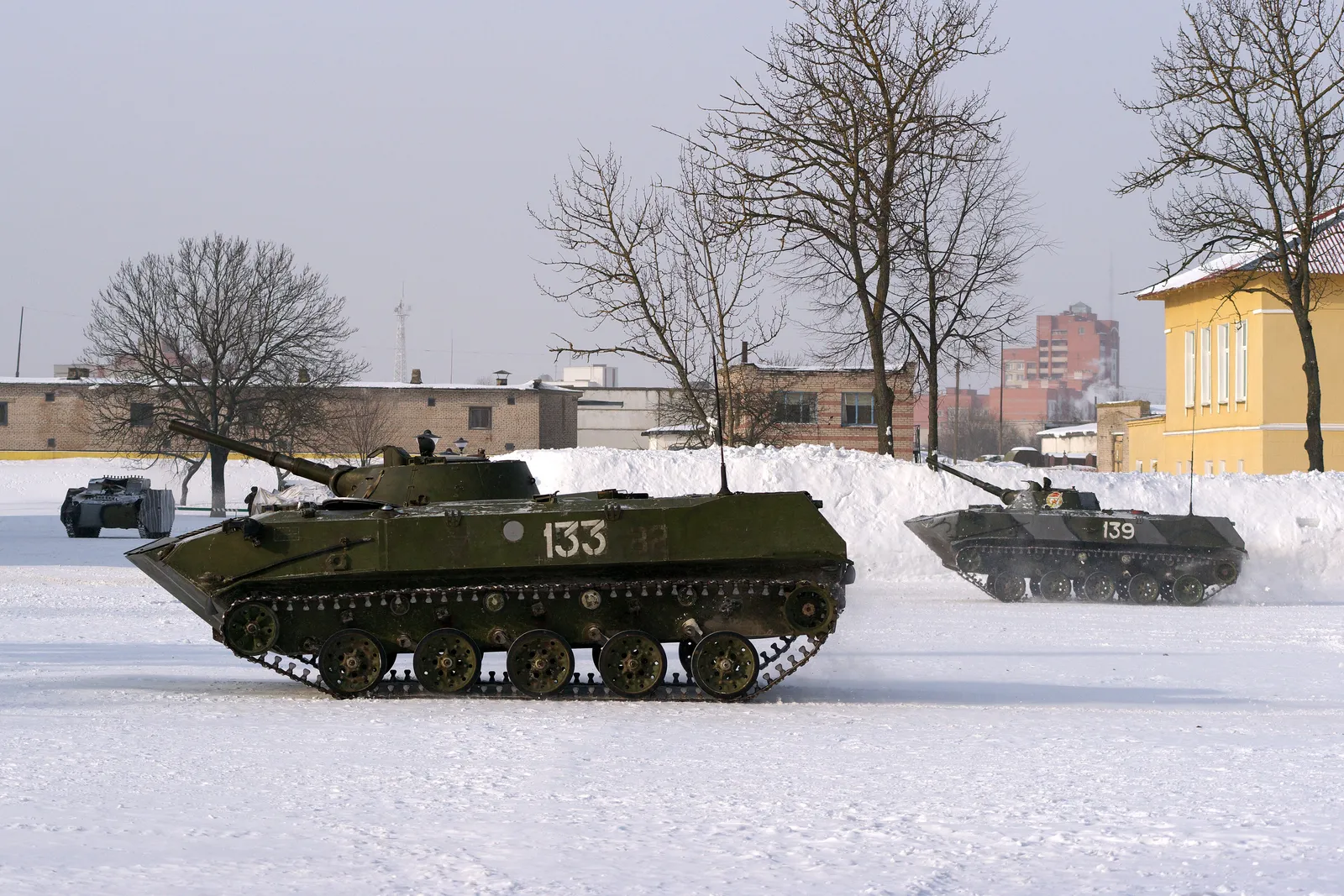
The BMD-1 was optimized around airborne carriage and amphibious mobility rather than heavy protection. Its compact aluminum hull, variable-height suspension, water mobility, and 73 mm gun gave Soviet airborne units an armored vehicle that could move with paratroop formations, but the armor standard remained limited to small-arms fire and shell splinters.
| Design area | Reader-facing significance | Catalog evidence |
|---|---|---|
| Airborne mobility | Low weight and adjustable suspension supported the vehicle's airborne role. | Combat weight, hydropneumatic suspension, and Soviet airborne-vehicle role are covered by the technical references. |
| Firepower | The turret combined a 73 mm gun with anti-tank missile capability in a very small vehicle. | Weaponsystems.net identifies the 2A28 Grom and Malyutka missile fit; later BMD-1P vehicles used a 9P135M launcher. |
| Protection | The light hull was a mobility tradeoff, not tank-level protection. | Army Recognition and Weaponsystems.net describe aluminum armor intended mainly against small-arms fire and fragments. |
Variants
The baseline BMD-1 kept the 73 mm 2A28 Grom and rail-launched Malyutka missile; later BMD-1P variants removed the rail launcher for a portable 9P135M anti-tank missile launcher, while K-suffix vehicles adapted the chassis for command roles.
| Variant | Configuration | Designation notes |
|---|---|---|
| BMD-1K | Command variant | Command version of the original BMD-1 airborne fighting vehicle family. Sources: Weaponsystems.net BMD-1 |
| BMD-1P | Anti-tank launcher update | Replaced the original over-gun 9K11 Malyutka rail with a 9P135M launcher for later Soviet wire-guided anti-tank missiles. |
| BMD-1PK | Command variant of BMD-1P | Command configuration associated with the BMD-1P modernization branch. Sources: Weaponsystems.net BMD-1 |
| BMD-1KSh-A | Airborne command-staff vehicle | Oryx lists Russian BMD-1KSh-A command vehicles among visually documented losses in Ukraine, showing the command-vehicle branch remained in wartime use. |
Launched Anti-Tank Missiles
The original BMD-1 used the 9K11 Malyutka launch rail over the 73 mm gun, while the BMD-1P branch used the portable 9P135M launcher for later Soviet anti-tank missiles.
| Launched item | Item type | Launch evidence |
|---|---|---|
![]() | MCLOS wire-guided anti-tank missile | Weaponsystems.net states that the BMD-1 carries a 9K11 Malyutka missile rail over the 73 mm 2A28 cannon, with 9M14 or 9M14M missiles carried ready to fire. Sources: Weaponsystems.net BMD-1, Weaponsystems.net 9K11 Malyutka |
![]() | SACLOS anti-tank missile system | Weaponsystems.net and Army Recognition describe the BMD-1P update as using a 9P135M launcher instead of the original over-gun Malyutka rail. |
![]() | SACLOS anti-tank missile | The BMD-1P's 9P135M launcher is the same launcher family associated with later Soviet wire-guided anti-tank missiles, giving the BMD-1P branch a different missile fit than the baseline BMD-1. |
Main Gun
Weaponsystems.net identifies the BMD-1's main armament as the 73 mm 2A28 Grom low-pressure cannon with 40 rounds.
| Ammunition | Ammunition type | Firing evidence |
|---|---|---|
![]() | 73 mm low-pressure smoothbore cannon | The 2A28 Grom gave the lightweight airborne vehicle BMP-1-style direct-fire armament, paired with a coaxial machine gun and anti-tank missile fit. Sources: Weaponsystems.net BMD-1 |
Timeline
BMD-1 Key Events
Design work
Open technical references place BMD-1 design work at the Volgograd Tractor Plant design bureau during the 1965-1969 design period.
Sources: Army Recognition BMD-1
Production begins
Weaponsystems.net lists Soviet BMD-1 production as beginning in 1968, followed by later BMD-1P production and command variants.
Sources: Weaponsystems.net BMD-1
Afghanistan image record
A Defense Department photograph dated 1986 documents Soviet paratroopers riding on a BMD-1 in Afghanistan.
Sources: BMD-1 in Afghanistan.jpg
First Chechen War losses
Oryx records Russian BMD-1 losses in the 1994-1996 First Chechen War, documenting the vehicle in Russian service during the campaign.
Sources: Oryx First Chechen War Equipment Losses
Iraq War image record
A U.S. Marine Corps image from Operation Iraqi Freedom shows a destroyed Iraqi BMD-1 in April 2003.
Sources: BMD-Iraq-20030402.JPEG
Russo-Georgian War deployment
CAST's The Tanks of August lists BMD-1 infantry fighting vehicles among Russian airborne equipment committed during the August 2008 war.
Sources: The Tanks of August
Donbas combat service
Ukrainian Air Assault Forces describe a BMD-1 of the 25th Airborne Brigade fighting near Kramatorsk and Sloviansk from April to July 2014.
Sources: Symbol of Military Valor BMD-1 Memorial Opened in Donetsk Region
Full-scale invasion losses
Oryx lists Russian BMD-1KSh-A command vehicles as visually documented destroyed or captured during the full-scale invasion of Ukraine.
Sources: Oryx Russian Equipment Losses in Ukraine
Related Weapon Systems