- Side
- Soviet Union and Afghan government forces


U.S. intelligence reporting identified BTR-D vehicles inside Soviet airborne force structure in Afghanistan, and U.S. Army ODIN summarizes the vehicle as first observed by the West during that war.
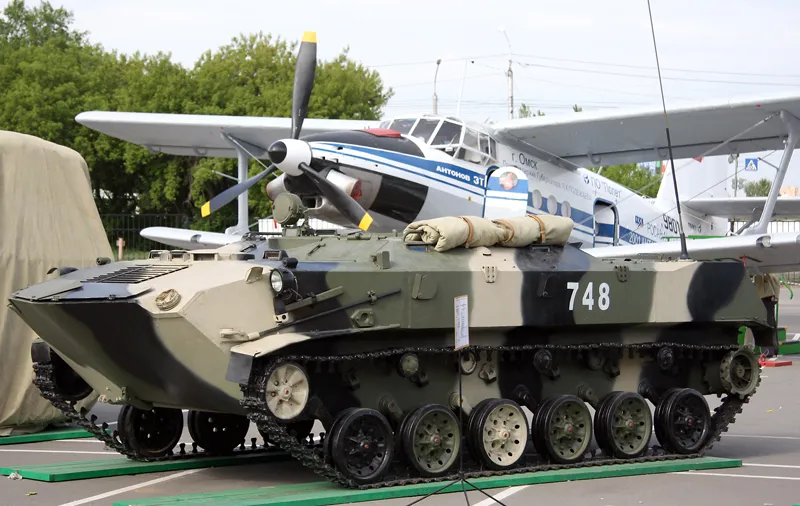
The BTR-D is a Soviet airborne tracked armored personnel carrier derived from the BMD-1 chassis for VDV units, trading the BMD turret for a longer troop compartment while retaining amphibious, air-droppable mobility and a family role as the base for airborne anti-tank, air-defense, recovery, command, and mortar-support vehicles.
U.S. intelligence reporting identified BTR-D vehicles inside Soviet airborne force structure in Afghanistan, and U.S. Army ODIN summarizes the vehicle as first observed by the West during that war.
Oryx's visually documented equipment-loss list for the First Chechen War identifies Russian BTR-D losses, including destroyed and damaged vehicles.
Oryx's Second Chechen War loss list records two Russian BTR-D vehicles destroyed during the conflict.
Oryx has separately documented Russian and Ukrainian BTR-D losses in the full-scale invasion, including destroyed, abandoned, and captured examples, showing service on both sides of the conflict.
Role detailsThe BTR-D sits between the turreted BMD-1 airborne infantry fighting vehicle and later specialized airborne support vehicles. Its longer, turretless hull gave airborne units more internal volume for troops, missiles, medical evacuation, command radios, air-defense teams, and recovery equipment while preserving amphibious tracked mobility.
BMD-1-derived light tracked airborne chassis with an added roadwheel and no turret.
Carries a crew of three and about ten dismounts in the enlarged rear compartment.
Adapted into anti-tank, air-defense, recovery, ambulance, command, communications, and 2S9 Nona-S mortar-support variants.
The BTR-D chassis became a base for airborne support vehicles that used the same light amphibious tracked platform for anti-tank, air-defense, recovery, ambulance, command, signals, and artillery-support roles.
| Variant | Configuration | Designation notes |
|---|---|---|
| BTR-DG | Cargo and support variant | Cargo configuration with personnel-carrier fittings removed; sources also describe BTR-D cargo vehicles adapted with ZU-23-2 mounts. Sources: Army Recognition BTR-D |
| BTR-RD Robot | Airborne anti-tank missile carrier | Variant carrying 9P135-series launch equipment for Fagot and Konkurs anti-tank guided missiles. |
| BTR-ZD Skrezhet | Airborne air-defense carrier | Air-defense variant using a ZU-23-2 twin 23 mm gun on the BTR-D roof and carrying a MANPADS team. |
 | Airborne armored recovery vehicle | Recovery version with crane, winch, dozer/spade equipment, generator, welding gear, and repair tools. |
| BMD-1KSh / BMD-1R / R-440-ODB | Command, signals, and satellite-communications vehicles | BTR-D-family communications and command vehicles used the chassis for radio, antenna, satellite terminal, and staff-command installations. |
 | Airborne 120 mm self-propelled mortar | The 2S9 Nona-S uses a modified BTR-D-family chassis for its airborne 120 mm gun-mortar role. Sources: Wikipedia BTR-D, WeaponSystems.net BTR-D |
The BTR-D entered production and Soviet Army service as a BMD-1-derived airborne troop carrier.
U.S. Army ODIN summarizes the BTR-D as first observed by Western analysts during the Soviet-Afghan War.
Oryx's First Chechen War list includes Russian BTR-D vehicles among visually documented armored fighting vehicle losses.
Oryx's Second Chechen War list includes destroyed Russian BTR-D vehicles.
Oryx began documenting visually confirmed BTR-D losses after Russia's full-scale invasion of Ukraine, with separate Russian and Ukrainian loss lists.