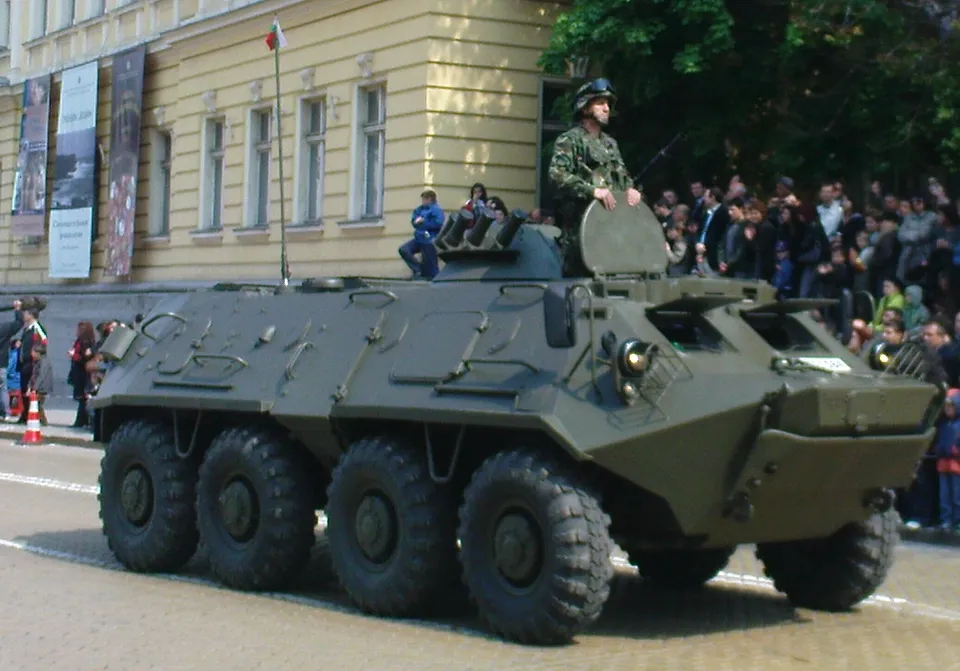
Fielded by Soviet motorized rifle units in the 1979 Soviet-Afghan War: the Russian General Staff study identifies wheeled BTR-60PB armored personnel carriers among the BTRs used in Afghanistan before newer BTR-70 and BTR-80 vehicles displaced them.
BTR-60
- BTR-60P
- BTR-60PA
- BTR-60PB
- BTR-60PU
- GAZ-49
The BTR-60 is a Soviet eight-wheeled amphibious armored personnel carrier that introduced the long-running BTR 8x8 layout later followed by the BTR-70 and BTR-80. Its BTR-60PB turreted model gave motorized troops a 14.5 mm KPVT/7.62 mm PKT armament fit, but retained thin armor and top-hatch dismounting that drove later redesigns and modernization programs.
Role in Conflicts
Documented with Syrian Democratic Forces/YPG-linked armor in northern Syria: Oryx listed two BTR-60PBs among YPG armored personnel carriers and noted that BTR-60 hulls were also mounted on trucks as improvised armored vehicles.
Role detailsFielded by the Libyan Civil War-era Libyan National Army: a 2019 report said Russian technicians inspected and repaired 210 BTR-60 armored personnel carriers for Haftar's forces before the Tripoli offensive, and later coverage showed BTR-60PBs with LNA troops.
Used in the 2014 Russia-Ukraine War by both sides: Bulgaria began shipping BTR-60 APCs to Ukraine in 2024 for troop transport, command, communications, and evacuation roles, while open-source loss documentation also records Russian BTR-60PBs destroyed in the invasion.
Role detailsFielded in the 2014 Yemen Civil War from Yemen's pre-war armored vehicle inventory: Oryx documented BTR-60PB APCs and a BTR-60 with AML-90 turret among equipment available to Yemeni battlefield parties after the Houthi takeover, while IISS lists BTR-60 APCs in the Yemen/Houthi equipment record.
Role detailsProfile / Specs
Profile
- Origin
- Soviet Union
- Built by
- Gorky Automobile Plant
- Type
- 8x8 amphibious armored personnel carrier
- Service note
- Cold War design still appearing in 2014 Russia-Ukraine War service and modernization programs
- Designer
- Soviet design bureau under GAZ production program
- Designed
- Late 1950s
- Produced
- 1960-1976 for principal Soviet production
- Number built
- Approximately 10,000 to 25,000, depending on source and variant scope
- Developed into
- BTR-70
Specifications
- Crew and passengers
- Typically 2 crew and 8-12 troops depending on variant and source
- Combat weight
- About 10.1-10.2 tonnes
- Drive
- 8x8 wheeled, fully amphibious with rear water-jet propulsion
- Engine
- Two rear-mounted six-cylinder gasoline engines, commonly listed as 90 hp each
- Speed and range
- Up to 80 km/h on road, 10 km/h swimming, and about 500 km road range
- Armament
- BTR-60PB variants mount a 14.5 mm KPVT heavy machine gun and 7.62 mm coaxial machine gun
- Protection
- All-welded steel hull with light small-arms and fragmentation protection
Family Design Notes
The BTR-60 family is useful to read as a baseline Soviet wheeled APC design: amphibious mobility and turreted firepower arrived early, while crew access, thin armor, and gasoline power shaped later successor and modernization decisions.
| Design area | Documented feature | Source |
|---|---|---|
| Amphibious mobility | Eight driven wheels and a rear water jet gave the family road, cross-country, and swimming mobility. | BTR-60 Armored Personnel Carrier |
| PB armament | The BTR-60PB enclosed the troop compartment and used a small turret with 14.5 mm KPV/KPVT and 7.62 mm coaxial armament. | BTR-60 Armored Personnel Carrier; BTR-60PB - Weaponsystems.net |
| Afghan-war limitations | Soviet combat experience emphasized the vulnerability of older BTRs and the practical value of later BTR-70 side exits and improved armor. | The Soviet-Afghan War: How a Superpower Fought and Lost |
| Ukrainian modernization | Khorunzhyi keeps the BTR-60 lineage but moves to a revised body, rear troop access, Finnish steel, and a 330 hp diesel engine. | MoD has authorized the Ukrainian armored personnel carrier Khorunzhyi |
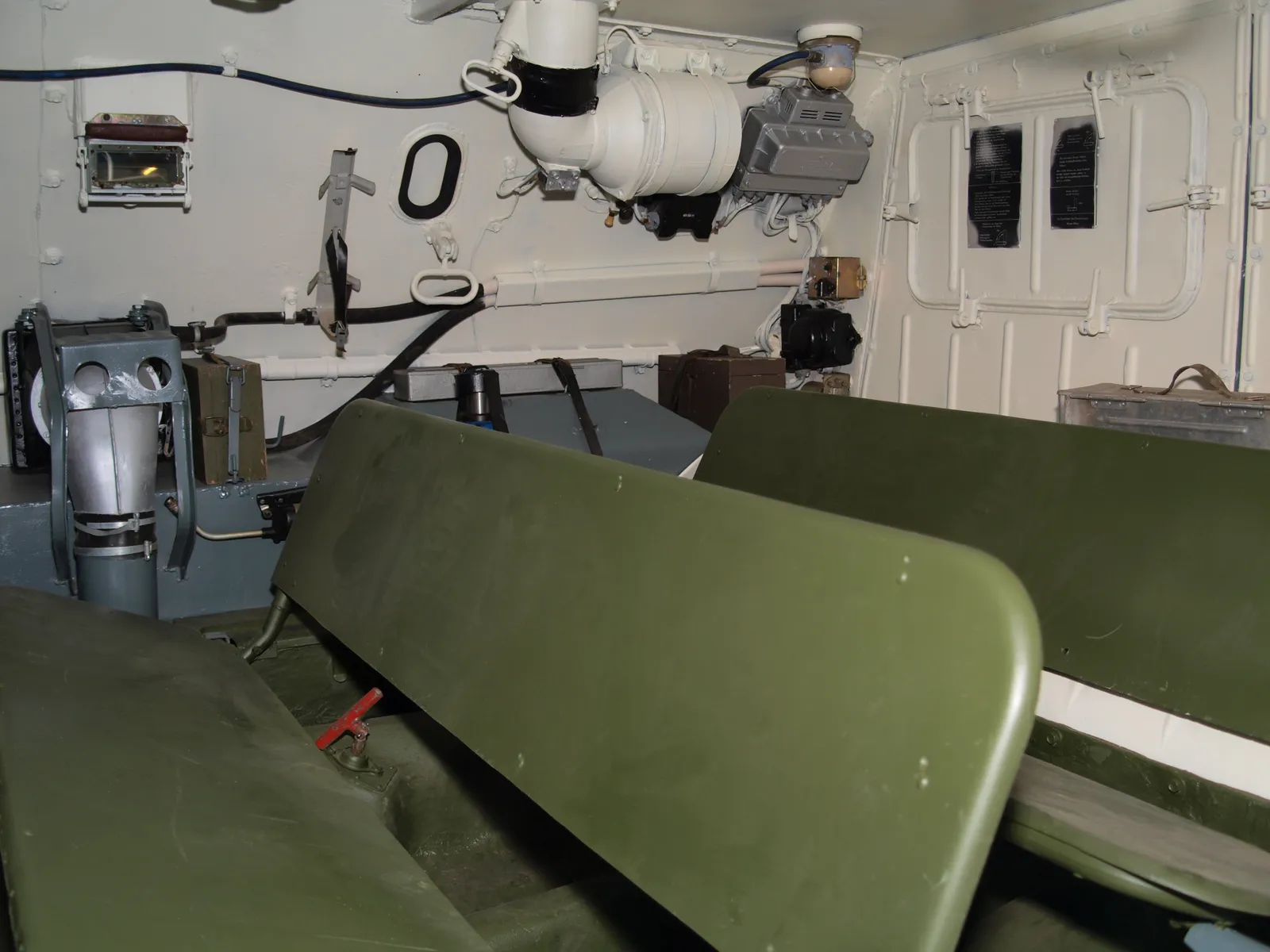
Variants
The family progressed from open troop carrier to roofed and turreted APCs, with later command, export, and modernization branches built around the same 8x8 amphibious layout.
| Variant | Configuration | Designation notes |
|---|---|---|
| BTR-60P | Original open-top APC | The original BTR-60P used the 8x8 amphibious layout and open troop compartment that the later family enclosed and armed more heavily. Sources: BTR-60 Armored Personnel Carrier |
| BTR-60PA / BTR-60PK | Roofed troop carrier | FAS describes the PA/PK step as adding overhead armor cover before the PB introduced the turreted configuration. Sources: BTR-60 Armored Personnel Carrier |
| BTR-60PB | Turreted APC | The PB model became the key turreted branch, with a fully enclosed troop compartment, 14.5 mm KPVT armament, 7.62 mm coaxial gun, and documented 1966 service entry in the Ukrainian NDU reference. Sources: BTR-60 Armored Personnel Carrier, BTR-60PB |
| BTR-60PB-MD1 | Bulgarian upgrade | Gallery and background sources document the Bulgarian MD1 modernization branch of the BTR-60PB family. Sources: BTR-60PB-MD1.jpg, BTR-60PB |
| BTR-60D | Ukrainian modernization | A Ukrainian modernization branch associated with rebuilt BTR-60 hulls in current Ukrainian service. Sources: BTR-60 - Wikipedia |
| Khorunzhyi | Deep Ukrainian modernization | Ukraine's Ministry of Defence describes Khorunzhyi as a substantially modernized BTR-60 with a new body layout, Finnish steel, rear troop access, and 330 hp diesel power. Sources: MoD has authorized the Ukrainian armored personnel carrier Khorunzhyi |
![]() | Successor 8x8 APC | FAS describes the BTR-70 as the similar successor that replaced the BTR-60PB in production, while the Afghan-war study contrasts its improved armor and side exits with the BTR-60PB. Sources: BTR-60 Armored Personnel Carrier, The Soviet-Afghan War: How a Superpower Fought and Lost |
![]() | Later successor 8x8 APC | The Afghan-war study says Soviet forces began receiving the BTR-80 in 1985 as a further development after BTR-60PB and BTR-70 service experience. Sources: The Soviet-Afghan War: How a Superpower Fought and Lost |
Mounted Armament
| Carried item | Item type | Carriage evidence |
|---|---|---|
![]() | 14.5 mm KPVT heavy machine gun | The BTR-60PB variant is documented with a one-man turret carrying a 14.5 mm KPVT heavy machine gun. Sources: BTR-60PB - Weaponsystems.net, Vladimirov KPV | Weaponsystems.net |
![]() | 7.62 mm PKT coaxial machine gun | The BTR-60PB variant is documented with a 7.62 mm PKT coaxial machine gun alongside the main armament. Sources: BTR-60PB - Weaponsystems.net, PKT | Weaponsystems.net |
Timeline
BTR-60 Key Events
GAZ develops an 8x8 amphibious APC
FAS places BTR-60 development in the late 1950s as a Soviet replacement for the older BTR-152.
Sources: BTR-60 Armored Personnel Carrier
Public debut
FAS says the BTR-60 was first seen publicly in 1961, after which the family was improved through the 1960s.
Sources: BTR-60 Armored Personnel Carrier
BTR-60PB appears
FAS identifies 1965 as the appearance of the BTR-60PB, the enclosed turret variant that became the most widely fielded model.
Sources: BTR-60 Armored Personnel Carrier
Combat use in Afghanistan
The Russian General Staff study describes BTR-60PBs, BTR-70s, and BTR-80s serving with Soviet motorized rifle subunits during the Soviet-Afghan War.
Sources: The Soviet-Afghan War: How a Superpower Fought and Lost
Ukraine authorizes Khorunzhyi
Ukraine's Ministry of Defence authorized supply of the Khorunzhyi, a domestic deep modernization of the BTR-60.
Sources: MoD has authorized the Ukrainian armored personnel carrier Khorunzhyi
Related Weapon Systems