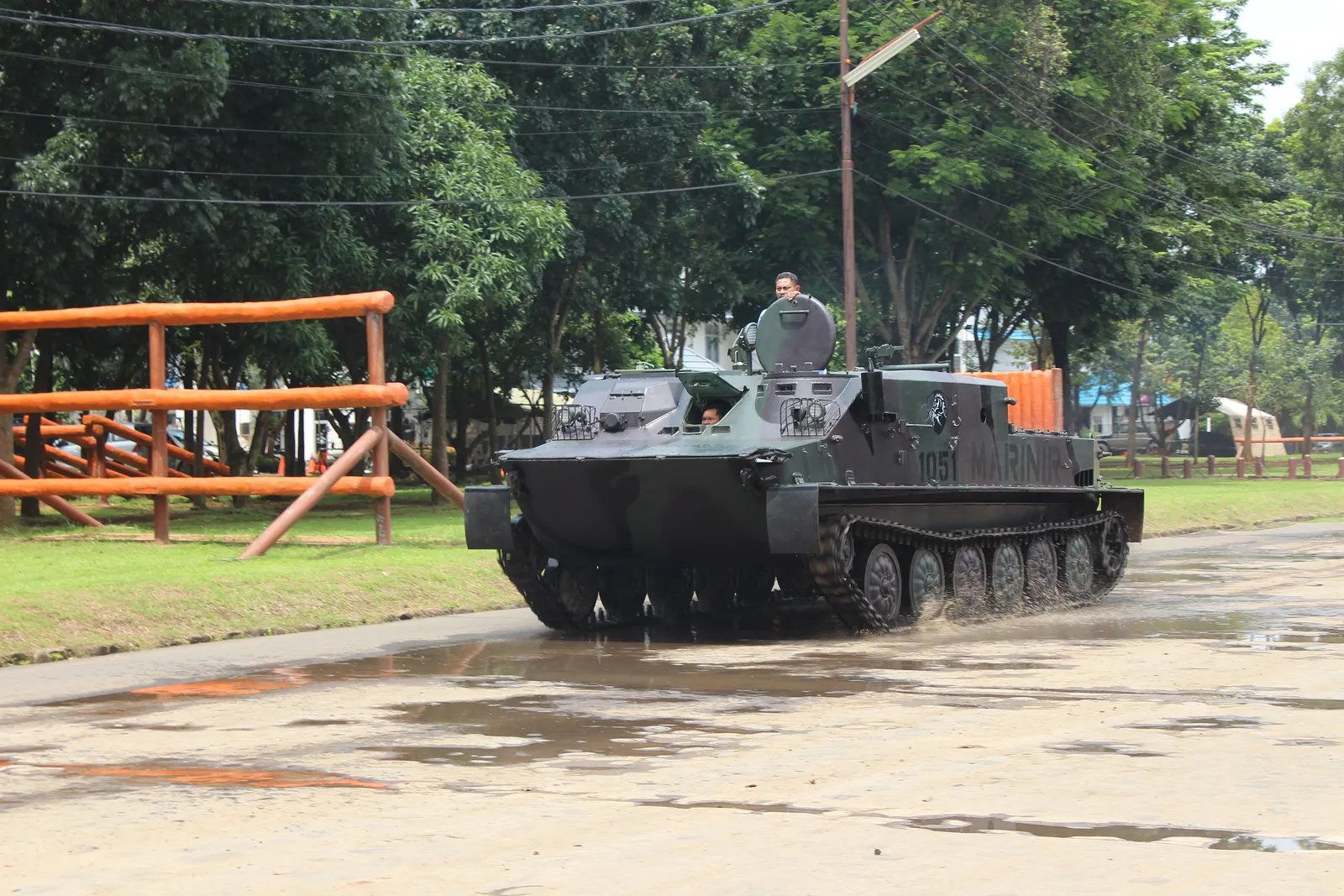

Egyptian and Syrian forces operated BTR-50 armored personnel carriers during the 1967 war, and Israel captured vehicles that later fed its own BTR-50 fleet.
Armored Vehicles
BTR-50
Also known as
- BTR-50P
- BTR-50PA
- BTR-50PK
- BTR-50PU
- BTR-50 with BPU-1 turret
- BTR-50PK with BPU-1 turret
- BTR-50 with 14.5 mm BPU-1 turret
- Object 750
- Bronetransporter-50
The BTR-50 is a Soviet tracked amphibious armored personnel carrier based on the PT-76 light tank chassis. Designed to move infantry and light weapons across rivers and broken terrain, it carried a small crew plus a large troop compartment behind light welded steel armor. Its record spans Arab-Israeli wars, the Iran-Iraq War, Syria, and Russia's Ukraine deployment of stored vehicles, including photographed and loss-documented BTR-50PK carriers fitted with BPU-1 turrets.
Role in Conflicts
Captured Egyptian BTR-50s were used by Israel during Operation Raviv, an amphibious raid across the Gulf of Suez, while Egypt also retained the type in its armored inventory.

BTR-50 carriers appeared with Egypt, Syria, and Israel during the 1973 war, including Egyptian and Syrian vehicles captured or re-used by Israeli forces.


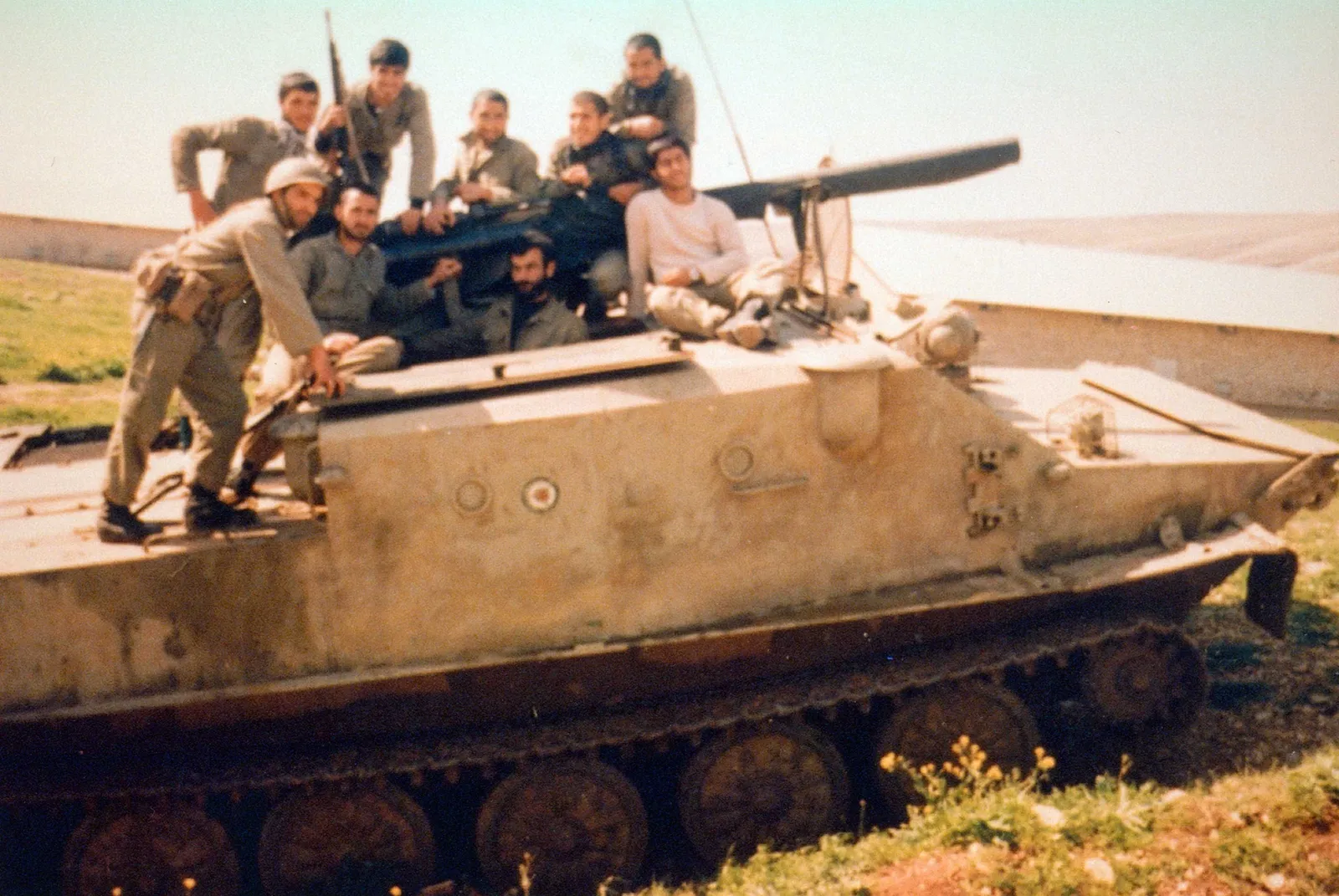
Iran fielded Soviet BTR-40, BTR-50, and BTR-60 APC holdings during the war, while Iraqi BTR-50PKs are documented in 1985-1987 service imagery.
- Side
- Russia

Russian forces deployed BTR-50 armored personnel carriers in Ukraine after heavy armored-vehicle losses; visual loss records separately identify standard BTR-50s and BTR-50s fitted with BPU-1 turrets.
Role detailsSyrian government forces had tracked BTR-50 carriers issued to mechanized infantry during the war, alongside other Soviet-made APCs in the Syrian government inventory.
Role detailsProfile / Specs
Profile
- Origin
- Soviet Union
- Built by
- Volgograd Tractor Plant
- Type
- Tracked amphibious armored personnel carrier
- Service note
- Cold War design reactivated by Russia during the full-scale invasion of Ukraine
- Designed
- 1952
- Produced
- 1954-1970 in Soviet production
- Number built
- About 6,500+ reported by Tank Encyclopedia
Specifications
- Crew and passengers
- 2 crew plus 12 to 20 passengers depending on variant and load
- Combat weight
- About 14.5 tonnes
- Dimensions
- About 7.07 m long, 3.14 m wide, and 2.03 m high for BTR-50PK
- Engine
- V-6 six-cylinder diesel rated at about 240 hp
- Mobility
- About 44 km/h on road and 10-11 km/h in water; amphibious water-jet propulsion
- Armament
- Typically a 7.62 mm SGMB machine gun on BTR-50P/BTR-50PK; BTR-50PA used a 14.5 mm KPV heavy machine gun
- Protection
- Light welded steel armor, about 13 mm front, 10 mm sides/roof, and 7 mm rear
Design And Wartime Adaptations
The BTR-50's usefulness came from combining PT-76-derived tracked amphibious mobility with a large troop and cargo space. That same layout also made the vehicle adaptable as a gun carrier, command vehicle, and improvised weapons platform.
| Configuration | Documented role | Why it matters |
|---|---|---|
| BTR-50P | Open-topped amphibious APC | Could carry infantry or light guns across water obstacles, explaining its repeated use in canal, river, and littoral operations. |
| BTR-50PK | Enclosed troop carrier | The roofed variant improved all-weather troop transport and became the form commonly shown in later export and conflict imagery. |
| BTR-50PU | Command-post carrier | Adapted the same hull for mobile headquarters work instead of direct troop carriage. |
| BTR-50PK with BPU-1 turret | Russian fielded modification | Ukraine-war imagery and loss tracking identify BTR-50PK carriers fitted with the BPU-1 turret, making the added turret a documented wartime configuration rather than a separate baseline Soviet production mark. |
| Recoilless-rifle carrier | Iranian wartime adaptation | Iran-Iraq War imagery shows an Iranian BTR-50PK carrying an M40 recoilless rifle, illustrating how operators used the large roof and troop space for improvised firepower. |
Sources: BTR-50P Amphibious Armored Personnel Carrier; BTR-50 armored personnel carrier; Attack On Europe: Documenting Russian Equipment Losses During The Russian Invasion Of Ukraine; The BTR-50 First Appeared in 2023, and russia Still Deploys These Vehicles on the Battlefield; File:Iranian army BTR-50PK Iran-Iraq war.jpg.
Variants
BTR-50 designations mostly separate the open troop carrier, roofed APC, command-post carrier, and later operator modifications built on the same PT-76-derived tracked hull.
| Variant | Configuration | Designation notes |
|---|---|---|
| BTR-50P | Open-topped amphibious APC | First production carrier with an open troop compartment and loading gear for moving infantry, vehicles, or towed weapons over water obstacles. Sources: BTR-50, BTR-50P Amphibious Armored Personnel Carrier |
| BTR-50PA | Heavy-machine-gun carrier | Variant fitted with a 14.5 mm KPV heavy machine gun instead of the lighter machine-gun installations associated with other early BTR-50 carriers. Sources: BTR-50, BTR-50P Amphibious Armored Personnel Carrier |
| BTR-50PK | Enclosed troop carrier | Roofed Object 750PK upgrade that added all-weather protection and became a common export and later-war configuration. Sources: BTR-50 |
| BTR-50PU | Command-post carrier | Command version with extra radios, antennas, and command workspace in place of the standard troop-carrier layout. Sources: BTR-50, BTR-50P Amphibious Armored Personnel Carrier |
| BTR-50PK with BPU-1 turret | Russian Ukraine-war fielded configuration | Ukrainian reporting identified Russian BTR-50PK vehicles with BPU-1 turrets, while Oryx lists visually documented Russian losses under a separate BTR-50 with BPU-1 turret category. Sources: The BTR-50 First Appeared in 2023, and russia Still Deploys These Vehicles on the Battlefield, Attack On Europe: Documenting Russian Equipment Losses During The Russian Invasion Of Ukraine |
Firing Guns
Prototype BTR-50 trials included mounting towed guns on the vehicle, and the BTR-50P could transport 57 mm and 85 mm guns in the fighting compartment.
| Ammunition | Ammunition type | Firing evidence |
|---|---|---|
 | 57 mm anti-tank gun | Tank Encyclopedia says prototype BTR-50 trials included firing a 57 mm ZiS-2 mounted on top while afloat, and GlobalSecurity says the BTR-50P could transport 57 mm guns in the fighting compartment. Sources: BTR-50, BTR-50P Amphibious Armored Personnel Carrier |
 | 85 mm field gun | Tank Encyclopedia says prototype BTR-50 trials included firing an 85 mm D-44 mounted on top while afloat, and GlobalSecurity says the BTR-50P could transport 85 mm guns in the fighting compartment. Sources: BTR-50, BTR-50P Amphibious Armored Personnel Carrier |
Firing Weapons
The BTR-50 family also carried roof-mounted heavy machine guns in service variants.
| Ammunition | Ammunition type | Firing evidence |
|---|---|---|
 | 12.7 mm heavy machine gun | Tank Encyclopedia says the Object 750 prototype failed firing tests with a 12.7 mm DShK heavy machine gun mounted around the commander's hatch. Sources: BTR-50 |
 | 14.5 mm heavy machine gun | Tank Encyclopedia says the BTR-50PA used a 14.5 mm KPV heavy machine gun instead of the DShK, and GlobalSecurity lists a roof-mounted KPV on the BTR-50PA. Sources: BTR-50, BTR-50P Amphibious Armored Personnel Carrier |
Timeline
BTR-50 Key Events
Object 750 design work
The BTR-50 design originated as Object 750, a tracked APC project derived from the PT-76 amphibious light tank chassis.
Soviet production begins
Soviet production started in the mid-1950s, establishing the BTR-50 as a tracked amphibious carrier for motor rifle formations and export customers.
Arab-Israeli battlefield use
Egyptian and Syrian BTR-50s were used in the Six-Day War, and captured vehicles entered Israeli hands.
Iran-Iraq War service
Iran began the Iran-Iraq War with Soviet-made BTR-40, BTR-50, and BTR-60 APC holdings, and Iraqi BTR-50PKs are documented later in the war.
Reappears in Russian Ukraine losses
Russia's deployment of BTR-50s in Ukraine showed stored Cold War APCs returning to frontline service after heavy armored-vehicle losses.
Related Weapon Systems


Sources
BTR-50P Amphibious Armored Personnel CarrierPublisher: GlobalSecurity.org | Note: Supports chassis, troop compartment, amphibious design, armament, service introduction, and variant background. | Accessed: 2026-06-30BTR-50Publisher: Tank Encyclopedia | Note: Supports Volgograd Tractor Plant production context, design background, specifications, variants, production-count estimate, and direct conflict use: BTR-50s used by Egypt/Syria and captured by Israel in 1967 Six-Day War, used by Israel in 1969 War of Attrition, and used by Egypt, Syria, and Israel in 1973 Yom Kippur War. | Accessed: 2026-06-30BTR-50 armored personnel carrierPublisher: Tank-AFV.com | Note: Supports BTR-50 variant distinctions and direct conflict use: BTR-50s used by Egypt/Syria and captured by Israel in 1967 Six-Day War, used by Israel in 1969 War of Attrition, used by Egypt, Syria, and Israel in 1973 Yom Kippur War, and fielded by Iran and Iraq in 1980 Iran-Iraq War. | Accessed: 2026-06-30The Iran-Iraq War: The Land WarPublisher: Center for Strategic and International Studies | Note: Supports 1980 Iran-Iraq War use context; the chapter describes BTR-50 APC holdings fielded by Iran during the war. | Accessed: 2026-06-30Russia's military and its defence industry are failing in Ukraine: UK statement to the OSCEPublisher: GOV.UK | Note: Supports 2014 Russia-Ukraine War operational use by Russian forces; deployed by Russia in Ukraine after armored-vehicle losses. | Accessed: 2026-06-30Attack On Europe: Documenting Russian Equipment Losses During The Russian Invasion Of UkrainePublisher: Oryx | Note: Supports 2014 Russia-Ukraine War operational exposure by Russian forces through visually documented BTR-50 and BTR-50 with BPU-1 turret losses. | Accessed: 2026-07-02The BTR-50 First Appeared in 2023, and russia Still Deploys These Vehicles on the BattlefieldPublisher: Defense Express | Note: Supports 2014 Russia-Ukraine War context for Russian BTR-50PK vehicles with BPU-1 turrets and BTR-50PU command variants photographed in Russian service. | Accessed: 2026-07-02Soviet-made IFVs and APCs in Syrian conflictPublisher: Army Recognition | Note: Supports 2011 Syrian Civil War use by Syrian government troops; the article states BTR-50 carriers were issued to mechanized infantry. | Accessed: 2026-06-30File:BTR 50 P(M).jpgPublisher: Wikimedia Commons | Note: Image provenance and licensing page for the selected BTR-50 image, published under Creative Commons Attribution-Share Alike 4.0 International. | Accessed: 2026-06-30File:Iranian army BTR-50PK Iran-Iraq war.jpgPublisher: Wikimedia Commons | Note: Image provenance for the Iranian BTR-50PK gallery image; the file documents a BTR-50PK fielded by the Iranian army during 1980 Iran-Iraq War and is marked public domain on Commons. | Accessed: 2026-06-30