

Ukrainian forces have used 85 mm D-44 guns in improvised mobile artillery configurations, including a D-44 mounted on an MT-LB carrier for shoot-and-scoot fire missions against Russian forces. Russian forces have also fielded D-44 guns in Ukraine, with one reported destroyed by a Ukrainian drone in September 2023.
Role detailsArtillery
D-44
Also known as
- 85mm D-44
- 85 mm divisional gun D-44
- M1945 D-44
- M1945 D44
- 52-P-367
- Type 56 85 mm gun
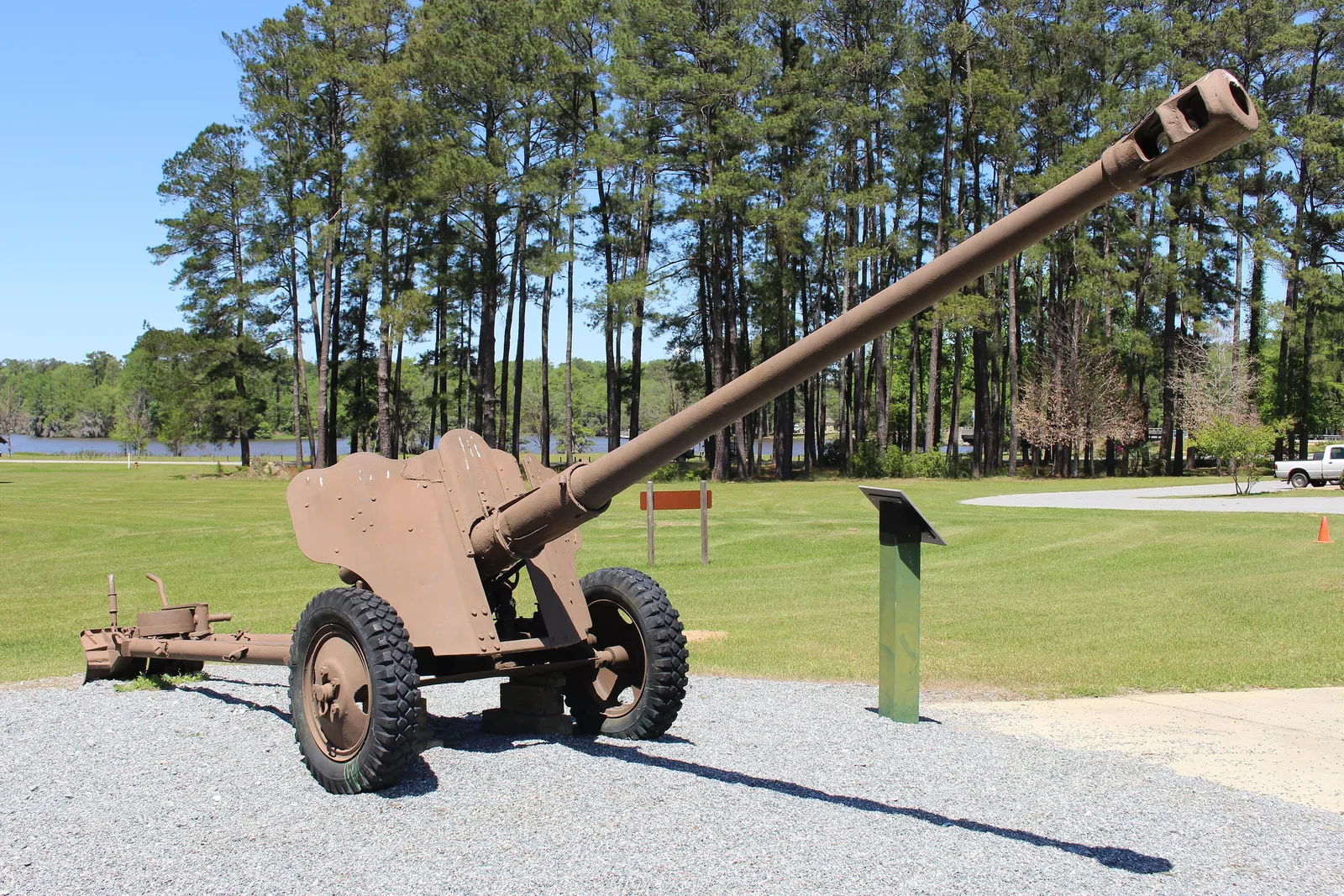
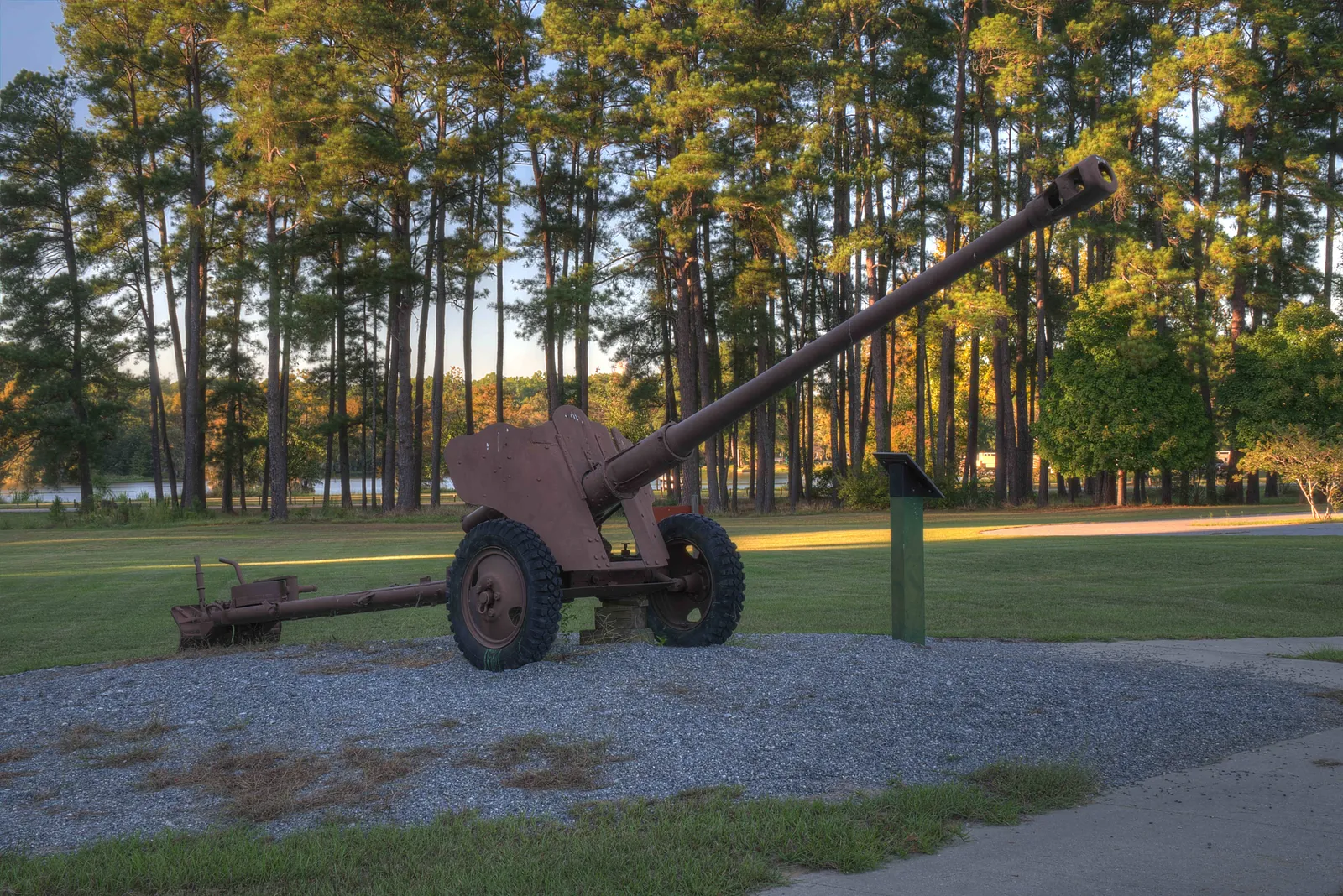
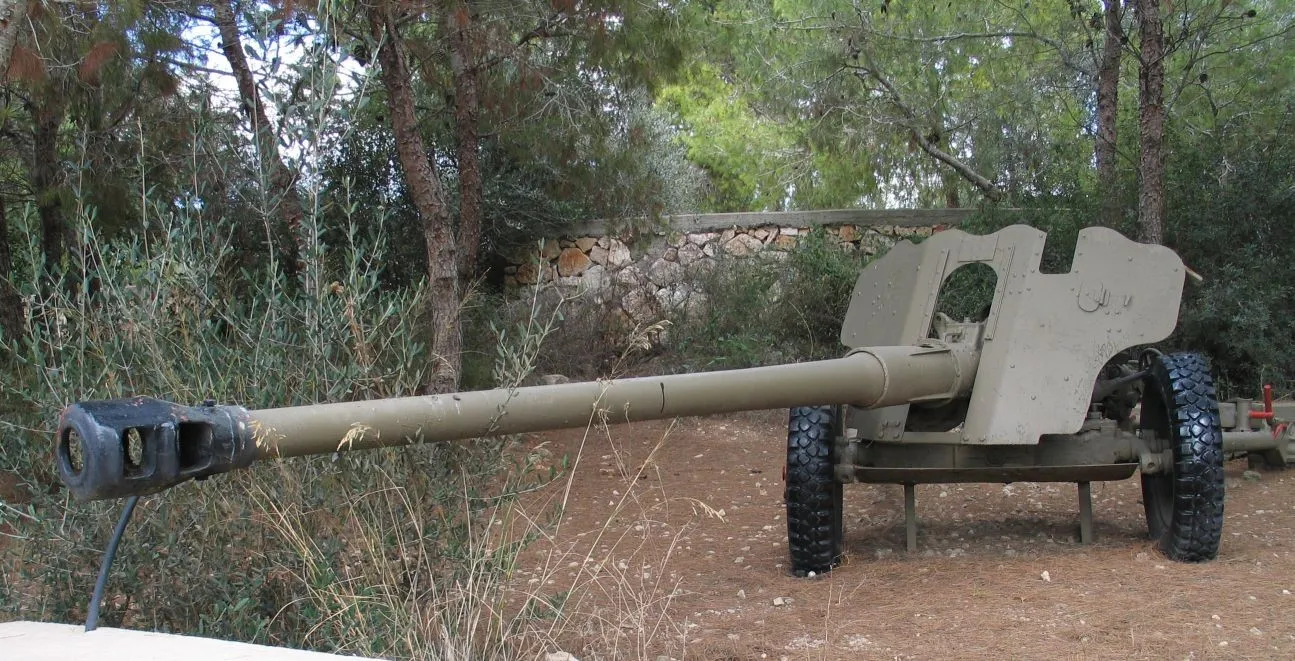
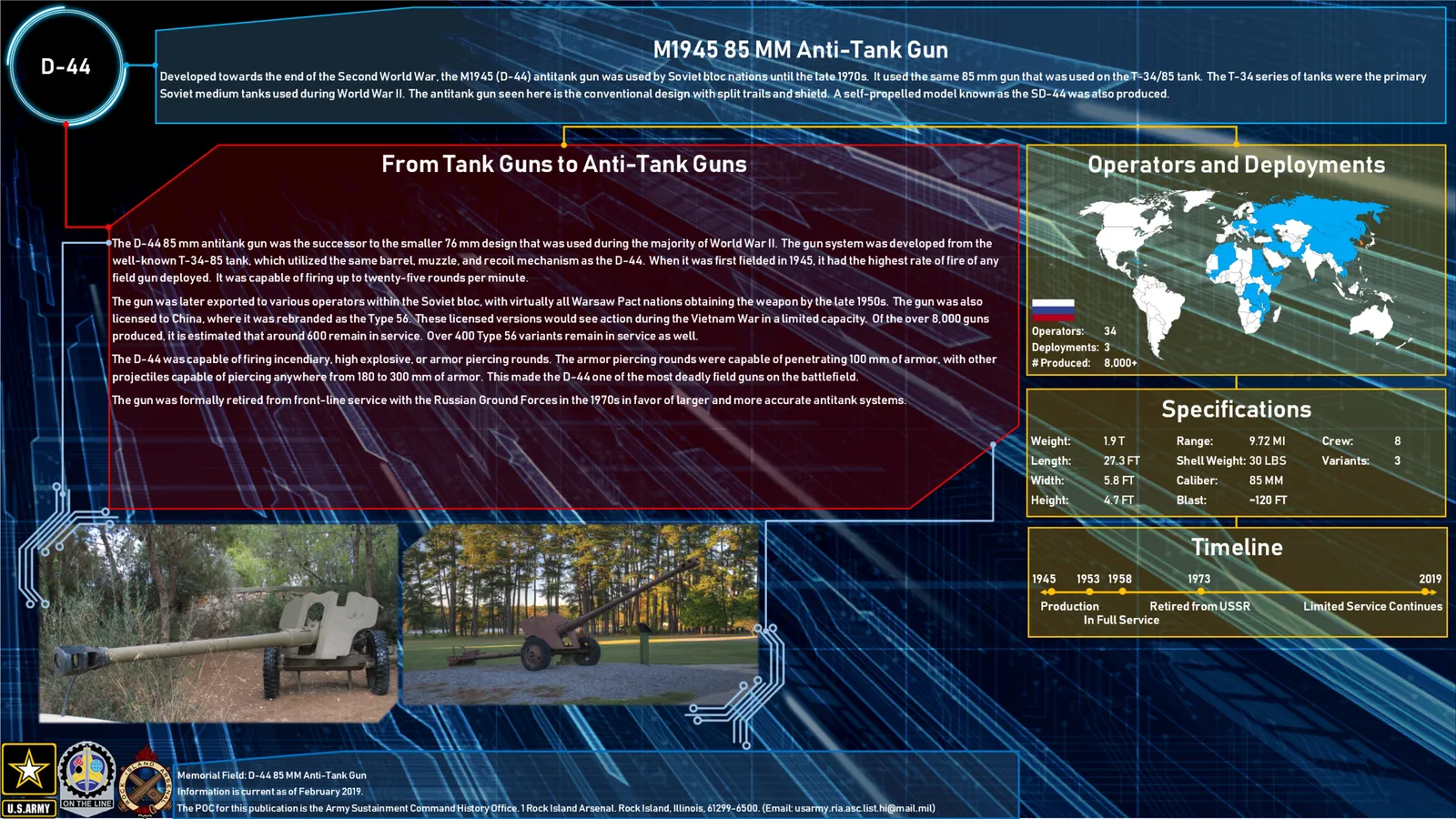
The D-44 is a Soviet 85 mm divisional field gun from the No. 9 Uralmashzavod design line, developed after World War II as a replacement for the 76 mm ZiS-3. Its long postwar life spans Type 56 licensed production, North Vietnamese artillery use in 1972, and modern Russia-Ukraine War appearances as both a towed gun and an improvised MT-LB-mounted fire-support weapon.
Role in Conflicts
- Side
- Tigray forces
- Role in conflict
- Captured towed fire support

Oryx documented an 85 mm D-44 divisional gun among photo-confirmed heavy weapons operated by the Tigray Defence Forces during the 2020 Tigray War.
- Role in conflict
- Towed artillery fire support

Oryx documented nine Armenian 85 mm D-44 divisional guns as destroyed, damaged, or captured during the 2020 Nagorno-Karabakh fighting, indicating fielded towed artillery use by the Armenian side.

Oryx lists the 85 mm D-44 divisional gun in Yemen's pre-war army inventory and describes the list as clarifying equipment available to Yemeni parties on the battlefield during the 2014 Yemen Civil War; the source does not identify a specific wartime operator or firing incident for the gun.
Role details- Side
- North Vietnam and Viet Cong
- Role in conflict
- Enemy tube artillery during the 1972 Nguyen Hue Offensive

Field Artillery Magazine listed the D44 85-mm gun among enemy artillery employed during the 1972 Nguyen Hue Offensive, in the same article section describing North Vietnamese Army artillery operations against South Vietnamese forces.
Profile / Specs
Profile
- Origin
- Soviet Union
- Built by
- No. 9 Uralmashzavod
- Type
- 85 mm towed field gun
- Service note
- Early Cold War design still appearing in the 2014 Russia-Ukraine War
- Designer
- F. F. Petrov design bureau
- Designed
- 1943-1946 development period
- Produced
- 1946-1953
- Number built
- About 10,800 D-44 guns
Specifications
- Caliber
- 85 mm
- Crew
- 8
- Combat weight
- About 1,725 kg
- Maximum range
- About 15.2-15.65 km with high-explosive ammunition
- Rate of fire
- About 15 rounds per minute practical; up to 20-25 rounds per minute short-duration
- Carriage
- Two-wheel split-trail towed carriage
Design And Variant Notes
The D-44 is best read as a postwar Soviet divisional gun family rather than a single static museum piece. Its variants mostly changed mobility, night-fighting equipment, or production origin while keeping the same 85 mm gun-family role.
| Topic | Reader note | Source basis |
|---|---|---|
| Baseline D-44 | Two-wheel split-trail towed field gun with an eight-person crew and 85 mm ammunition set. | 85mm D-44; RIA Self-Guided Tour: M1945 (D44) 85MM Antitank Gun |
| SD-44 mobility | Auxiliary propulsion gave airborne units limited self-movement without making the weapon a true armored self-propelled gun. | 85mm D-44 |
| D-44N night equipment | The D-44N package added APN 3-7 infrared night-vision equipment to existing guns. | 85mm D-44 |
| Type 56 production | China's licensed Type 56 kept the D-44 pattern in wider Cold War and post-Cold War inventories. | RIA Self-Guided Tour: M1945 (D44) 85MM Antitank Gun; 85mm D-44 |
Variants
The D-44 family includes the baseline Soviet gun, an auxiliary-powered airborne variant, a night-fighting update, and Chinese licensed production.
| Variant | Configuration | Designation notes |
|---|---|---|
| SD-44 | Auxiliary-powered airborne variant | WeaponSystems.net describes the SD-44 as a D-44 variant for airborne troops with a 14 hp M-72 auxiliary power unit, steering position, trail-mounted wheel, and 10-round ammunition box. Sources: 85mm D-44 |
| D-44N | Night-fighting upgrade | WeaponSystems.net identifies D-44N as a 1960s night-vision upgrade using the APN 3-7 infrared searchlight, power source, and sight unit. Sources: 85mm D-44 |
| Type 56 | Chinese production model | The U.S. Army article says the D-44 was licensed to China and rebranded as the Type 56; WeaponSystems.net also lists Type 56 as the Chinese production model. Sources: RIA Self-Guided Tour: M1945 (D44) 85MM Antitank Gun, 85mm D-44 |
Gun Carriers
| Firing weapon | Weapon type | Firing evidence |
|---|---|---|
 | Tracked amphibious APC | Tank Encyclopedia says prototype BTR-50 trials included firing an 85 mm D-44 mounted on top while afloat, and GlobalSecurity says the BTR-50P could transport 85 mm guns in the fighting compartment. Sources: BTR-50, BTR-50P Amphibious Armored Personnel Carrier |
Ammunition Fired
Tank Archives' D-44 ballistic tables include BR-365, BR-365P, BR-365K, BR-367, and BR-367PZh among the 85 mm rounds listed for the gun, and a separate Tank Archives note identifies BR-365 as ammunition for Soviet 85 mm tank and SPG weapons. Tank Archives' D-44 ballistic tables list the D-44's standard 85 mm ammunition set, including APCR and high-explosive rounds.
| Ammunition | Ammunition type | Firing evidence |
|---|---|---|
 | 85 mm APBC round | Tank Archives' D-44 ballistic tables list BR-365 in the gun's ammunition set, and a separate Tank Archives note places BR-365 among the ammunition used by Soviet 85 mm tank and SPG guns. Sources: Tank Archives: D-44 Ballistic Tables, Tank Archives: 85 mm for Dummies |
| 85 mm APCR round | The D-44 ballistic tables list BR-365P as an APCR round with a 1050 m/s muzzle velocity and lower precision than the BR-367P APCR round. Sources: Tank Archives: D-44 Ballistic Tables |
 | 85 mm AP-T round | Tank Archives' D-44 ballistic tables list the sharp-tipped BR-365K AP round in the gun's ammunition set, and WW2 Equipment Data identifies the same UBR-365K complete round with an MD-8 fuze. Sources: Tank Archives: D-44 Ballistic Tables, WW2 Equipment Data Soviet Explosive Ordnance - 85mm and 100mm Projectiles |
 | 85 mm APCBC shell | The D-44 ballistic tables list BR-367 in the gun's ammunition set and describe it as ballistically almost identical to BR-365, but slightly faster and more precise. Sources: Tank Archives: D-44 Ballistic Tables |
 | 85 mm APCR round | The D-44 ballistic tables list BR-367PZh as an APCR round with a metallo-ceramic driving band. Sources: Tank Archives: D-44 Ballistic Tables |
| 85 mm APCR round | The D-44 ballistic tables name BR-367P and BR-367PZh as APCR rounds, documenting the D-44 family as a firing weapon for BR-367P. Sources: Tank Archives: D-44 Ballistic Tables |
 | 85 mm HE round | Tank Archives' D-44 ballistic tables include the O-367A round for the D-44. Sources: Tank Archives: D-44 Ballistic Tables |
 | 85 mm HE round | Tank Archives' D-44 ballistic tables include O-365K HE data for the gun. Sources: Tank Archives: D-44 Ballistic Tables |
Timeline
D-44 Key Events
Design work begins
WeaponSystems.net places D-44 development in 1943-1946 at the No. 9 Uralmashzavod design bureau as a more capable successor to the ZiS-3 divisional gun.
Sources: 85mm D-44
Production and service entry
WeaponSystems.net gives 1946 as the D-44's service-entry year and lists Soviet and Chinese production totals across the D-44, SD-44, and Type 56 family.
Sources: 85mm D-44
Nguyen Hue Offensive artillery use
Field Artillery Magazine's 1977 Vietnamization article lists the D44 85-mm gun among enemy artillery employed during the 1972 North Vietnamese Nguyen Hue Offensive.
Sources: Field Artillery Magazine: 1972 Enemy Offensive
Ukrainian MT-LB hybrid documented
Defense Express reported a Ukrainian improvised artillery vehicle combining a D-44 gun with an MT-LB carrier for mobile fire missions against Russian forces.
Sources: D-44 Gun Combined With MT-LB in an Improvised Hybrid for Ukrainian Army
Media
D-44 Videos
Related Weapon Systems


Sources
85mm D-44Publisher: WeaponSystems.net | Note: Supports D-44 origin, developer, production, manufacturer, role, variants, and technical specifications. | Accessed: 2026-06-30RIA Self-Guided Tour: M1945 (D44) 85MM Antitank GunPublisher: The United States Army | Note: Supports D-44 background, SD-44 and Type 56 variant context, rate-of-fire and ammunition notes, and U.S. Army image provenance for the gallery. | Accessed: 2026-06-30Field Artillery Magazine: 1972 Enemy OffensivePublisher: Field Artillery Magazine | Note: Supports 1955 Vietnam War direct conflict use: the D44 85-mm gun was fielded by North Vietnamese enemy artillery during the 1972 Nguyen Hue Offensive. | Accessed: 2026-06-30Tank Archives: D-44 Ballistic TablesPublisher: Tank Archives | Note: Supports the D-44 ballistic-table context for BR-365, BR-365P, BR-365K, BR-367, BR-367PZh, and O-367A, including the 85 mm ammunition set and the table velocity / dispersion figures. | Accessed: 2026-06-27Tank Archives: 85 mm for DummiesPublisher: Tank Archives | Note: Supports the 85 mm ammunition-family context for BR-365. | Accessed: 2026-06-27BTR-50Publisher: Tank Encyclopedia | Note: Supports the BTR-50 prototype trial context for firing an 85 mm D-44 while afloat. | Accessed: 2026-06-27BTR-50P Amphibious Armored Personnel CarrierPublisher: GlobalSecurity.org | Note: Supports the BTR-50P gun-transport role for 85 mm guns in the fighting compartment. | Accessed: 2026-06-27WW2 Equipment Data Soviet Explosive Ordnance - 85mm and 100mm ProjectilesPublisher: WW2 Equipment Data | Note: Supports the UBR-365K complete-round designation, the BR-365K AP-T projectile, and its MD-8 fuze context. | Accessed: 2026-06-27D-44 Gun Combined With MT-LB in an Improvised Hybrid for Ukrainian ArmyPublisher: Defense Express | Note: Supports Ukrainian 2014 Russia-Ukraine War use of a D-44 gun mounted on an MT-LB carrier for mobile fire missions. | Accessed: 2026-06-30Russian World War 2-era D-44 Howitzer Destroyed by Ukrainian DronePublisher: Army Recognition | Note: Supports Russian 2014 Russia-Ukraine War fielding of D-44 guns and Ukrainian adaptation of D-44 guns on MT-LB carriers. | Accessed: 2026-06-20The Tigray Defence Forces - Documenting Its Heavy WeaponryPublisher: Oryx | Note: Supports 2020 Tigray War operation of an 85 mm D-44 divisional gun by the Tigray Defence Forces. | Accessed: 2026-06-20The Fight For Nagorno-Karabakh: Documenting Losses On The Sides Of Armenia And AzerbaijanPublisher: Oryx | Note: Supports 2020 Nagorno-Karabakh Conflict use: 85 mm D-44 divisional guns fielded by Armenia / Artsakh were documented as destroyed, damaged, or captured during the 2020 fighting. | Accessed: 2026-06-20Handbook Of Pre-War Yemeni Fighting VehiclesPublisher: Oryx | Note: 2014 Yemen Civil War source: fielded by the Yemeni Army before the Houthi takeover and documented by Oryx as available to Yemeni parties on the battlefield. | Accessed: 2026-06-20Russian 85mm Divisional Gun D-44, Georgia Veterans State ParkPublisher: Wikimedia Commons | Note: Supports image provenance and CC BY-SA 4.0 licensing for the D-44 photograph used as the primary image. | Accessed: 2026-06-20