Profile
- Origin
- Soviet Union
- Built by
- Soviet munitions industry
- Type
- 85 mm APCR-T projectile
- Service note
- Post-World War II Soviet 85 mm ammunition
- Unit cost
- Not publicly documented
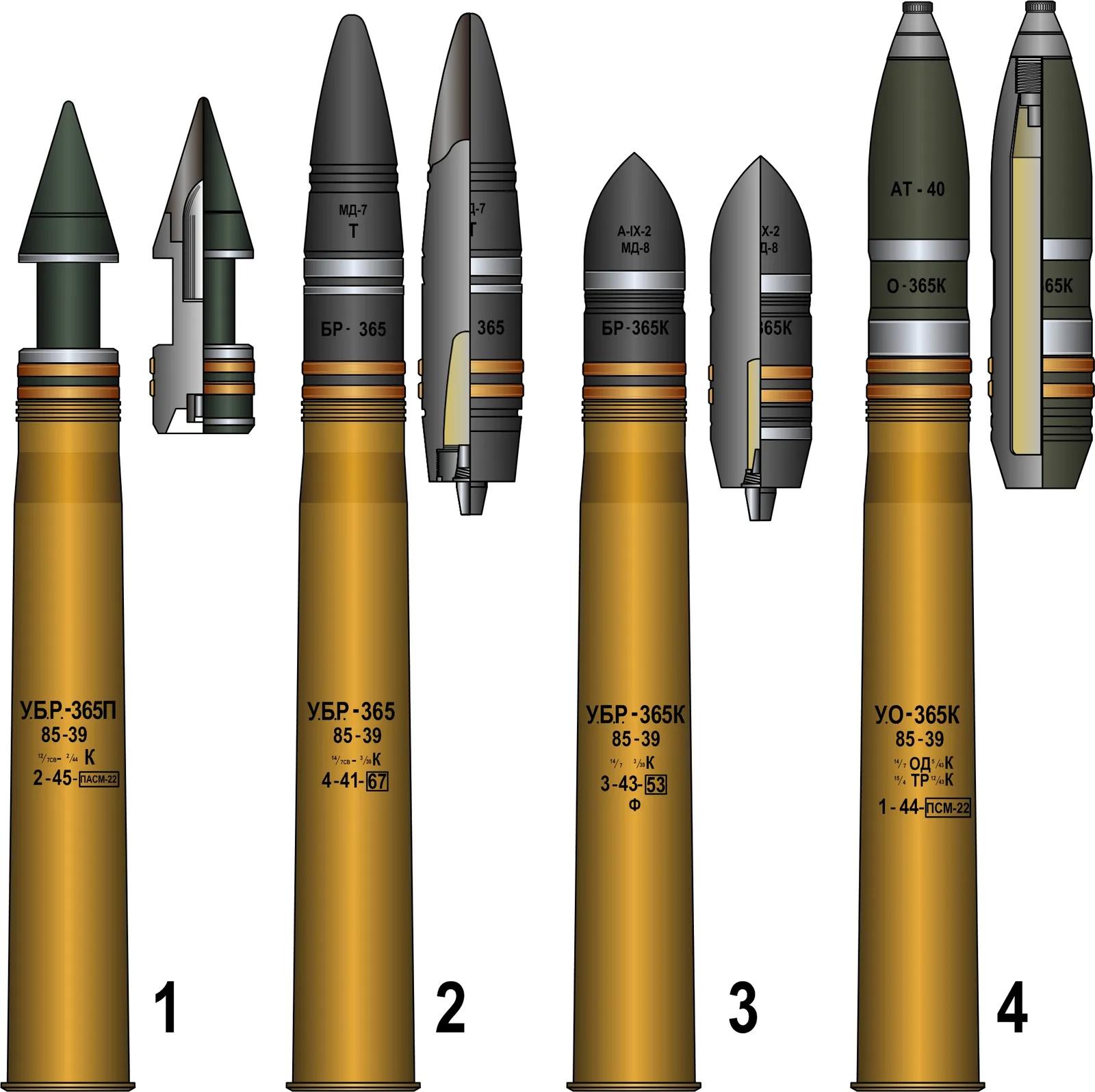
BR-365P is a Soviet 85 mm APCR-T projectile in the BR-365 armor-piercing family. METIS identifies the full 53-BR-365P designation and places it in the 53-UBR-365K round family, while Tank Archives' D-44 ballistic tables list BR-365P as a faster but less precise APCR projectile at 1050 m/s.
Public references use both projectile and complete-round naming. This page keeps BR-365P as the projectile name and records the complete-round family only where the source supports it.
| Topic | Reader note | Source basis |
|---|---|---|
| Full designation | METIS identifies 53-BR-365P and notes that BR-365P is the short form commonly seen on the projectile. | 53-BR-365P on METIS |
| Projectile class | METIS describes the projectile as 85 mm APCR-T, also corresponding to the U.S. HVAP-T terminology. | 53-BR-365P on METIS |
| Complete-round family | METIS places the projectile in the 53-UBR-365K family rather than treating BR-365P as a standalone complete round. | 53-BR-365P on METIS |
| Ballistic tradeoff | Tank Archives lists BR-365P at 1050 m/s and describes it as faster than BR-367P but less precise at 1000 m. | Tank Archives: D-44 Ballistic Tables |
BR-365P sits between the wartime BR-365 armor-piercing family and later BR-367-series 85 mm projectiles in the D-44 ballistic tables.
| Variant | Configuration | Designation notes |
|---|---|---|
 | 85 mm APBC / APHE-T projectile | Tank Archives lists BR-365 at 800 m/s in the same D-44 ballistic-table set, separating it from the faster BR-365P APCR projectile. Sources: Tank Archives: D-44 Ballistic Tables |
 | Sharp-tipped AP-T complete-round family member | Tank Archives lists BR-365K separately from BR-365P in the D-44 table, and METIS places BR-365P in the 53-UBR-365K round family. Sources: Tank Archives: D-44 Ballistic Tables, 53-BR-365P on METIS |
 | Later 85 mm APCBC projectile | Tank Archives presents BR-367 in the same D-44 ballistic-table group, distinguishing it from the BR-365 and BR-365P projectile set. Sources: Tank Archives: D-44 Ballistic Tables |
 | Later 85 mm APCR projectile | Tank Archives lists BR-367P and BR-367PZh as 1020 m/s APCR projectiles, slightly slower but more precise at 1000 m than BR-365P in the same reference. Sources: Tank Archives: D-44 Ballistic Tables |
| APCR projectile with metallo-ceramic driving band | Tank Archives identifies BR-367PZh as the BR-367P-related APCR projectile with a metallo-ceramic driving band. Sources: Tank Archives: D-44 Ballistic Tables |
The direct catalog relationship kept here is the D-44 ballistic-table listing. Other 85 mm gun-family links are treated as context because the available public sources do not independently document BR-365P fired in a named conflict.
| Firing weapon | Weapon type | Firing evidence |
|---|---|---|
 | 85 mm towed field gun | Tank Archives' D-44 ballistic tables list BR-365P as an APCR projectile with a 1050 m/s muzzle velocity and lower precision than the later BR-367P APCR entry. Sources: Tank Archives: D-44 Ballistic Tables |
BR-365P is best read as part of the Soviet 85 mm ammunition family, not as a stand-alone conflict entry. The source-backed catalog link is the D-44 table; related tank-gun context is included here only to explain why the D-44 table is useful for 85 mm research.
| Weapon family | Catalog link | Source-backed note |
|---|---|---|
| D-44 divisional gun | | Tank Archives lists BR-365P directly in the D-44 ballistic tables and gives its 1050 m/s muzzle velocity. |
| S-53 / ZiS-S-53 tank-gun context |  | Tank Archives says the D-44 had the same ballistics as the S-53 and uses the tables as insight into T-34/85 shooting; this is ballistic context, not a direct BR-365P conflict-use claim. |
| D-5 and 52-K lineage | Unlinked | Tankograd describes the broader Soviet 85 mm pattern in which tank, self-propelled, towed, and anti-aircraft guns shared cartridge or ballistic ancestry while remaining distinct weapon designs. |
Source labels used here: Tank Archives: D-44 Ballistic Tables; Tankograd: Soviet Towed Anti-Tank Guns.
The gallery uses a licensed Wikimedia Commons 85 mm ammunition diagram as representative family imagery because clearly reusable exact BR-365P photographs are not available in the cited source set. Credible direct YouTube footage of this exact projectile is not available, so videos are omitted.


