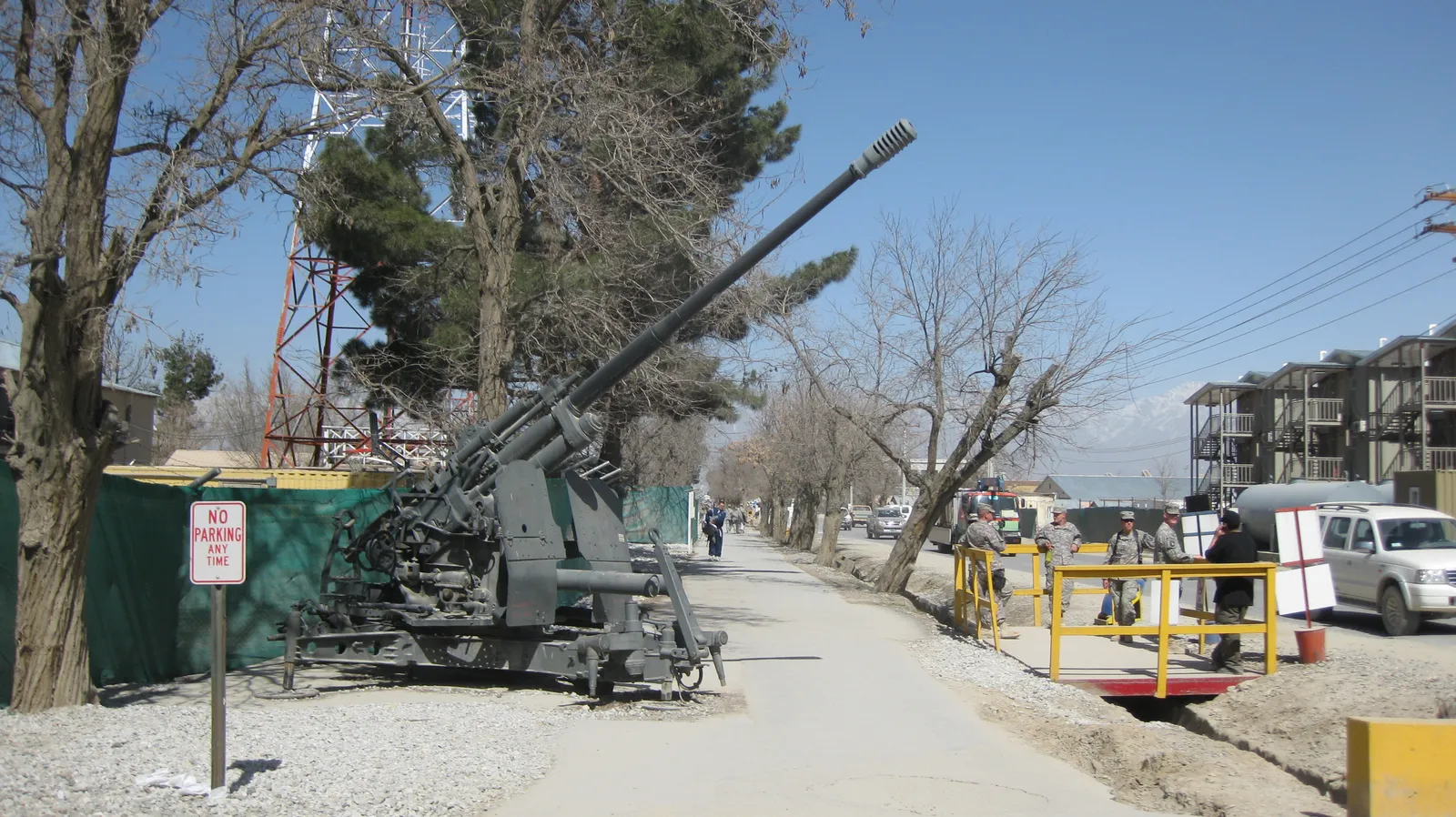
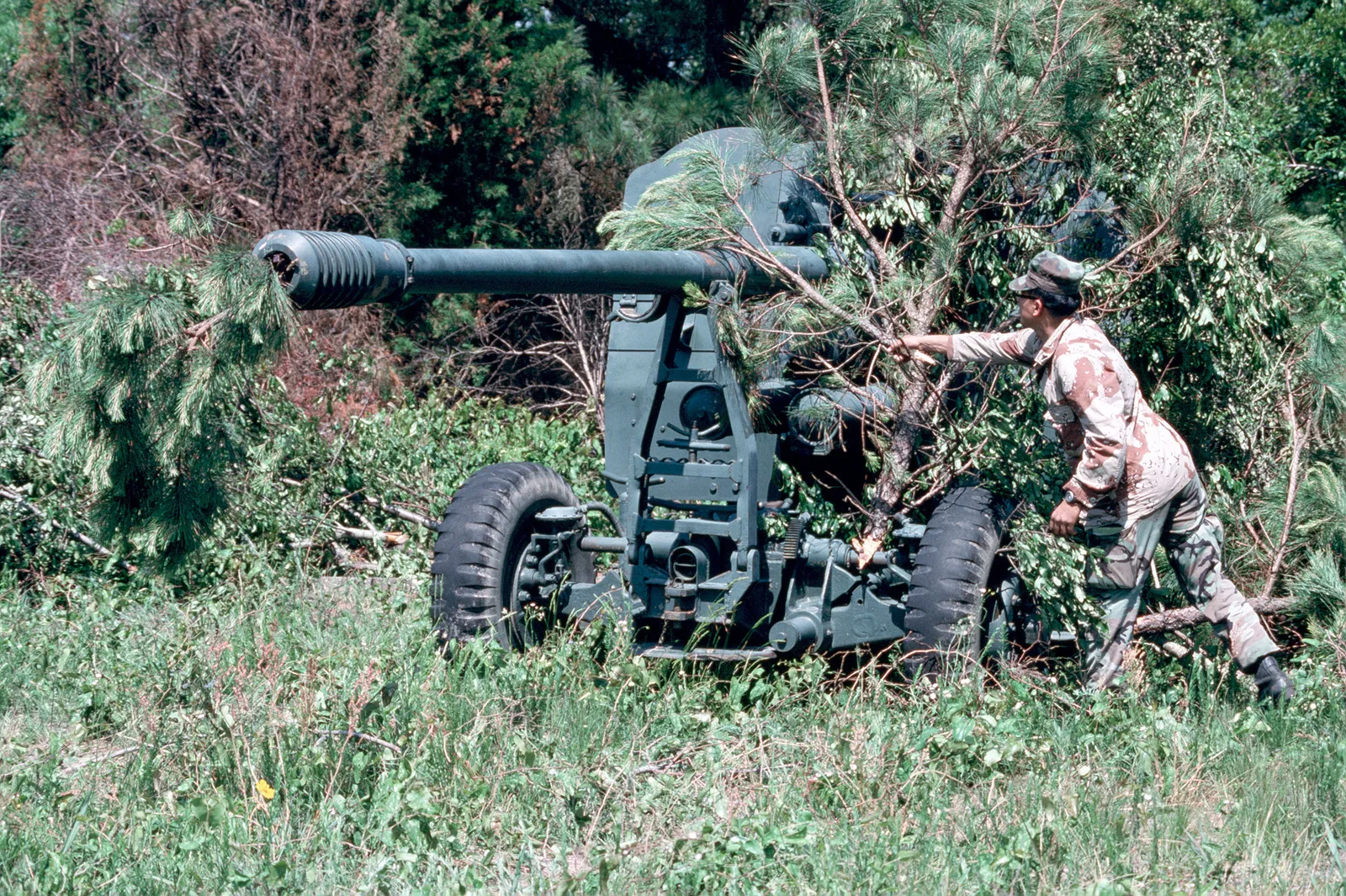
Ukrainian forces reactivated KS-19 guns during the full-scale 2014 Russia-Ukraine War, using them as 100 mm artillery against Russian ground targets and later mounting KS-19 guns on MAN and Tatra trucks for mobile fire support.
Role details100 mm KS-19 anti-aircraft gun
- KS-19
- AZP KS-19
- 52-P-415
- 100 mm automatic anti-aircraft gun AZP KS-19
- M1955 100 mm anti-aircraft gun
- 100 mm air defense gun KS-19
- КС-19
- KSM-65
- Type 55 100 mm anti-aircraft gun
- Type 59 100 mm anti-aircraft gun
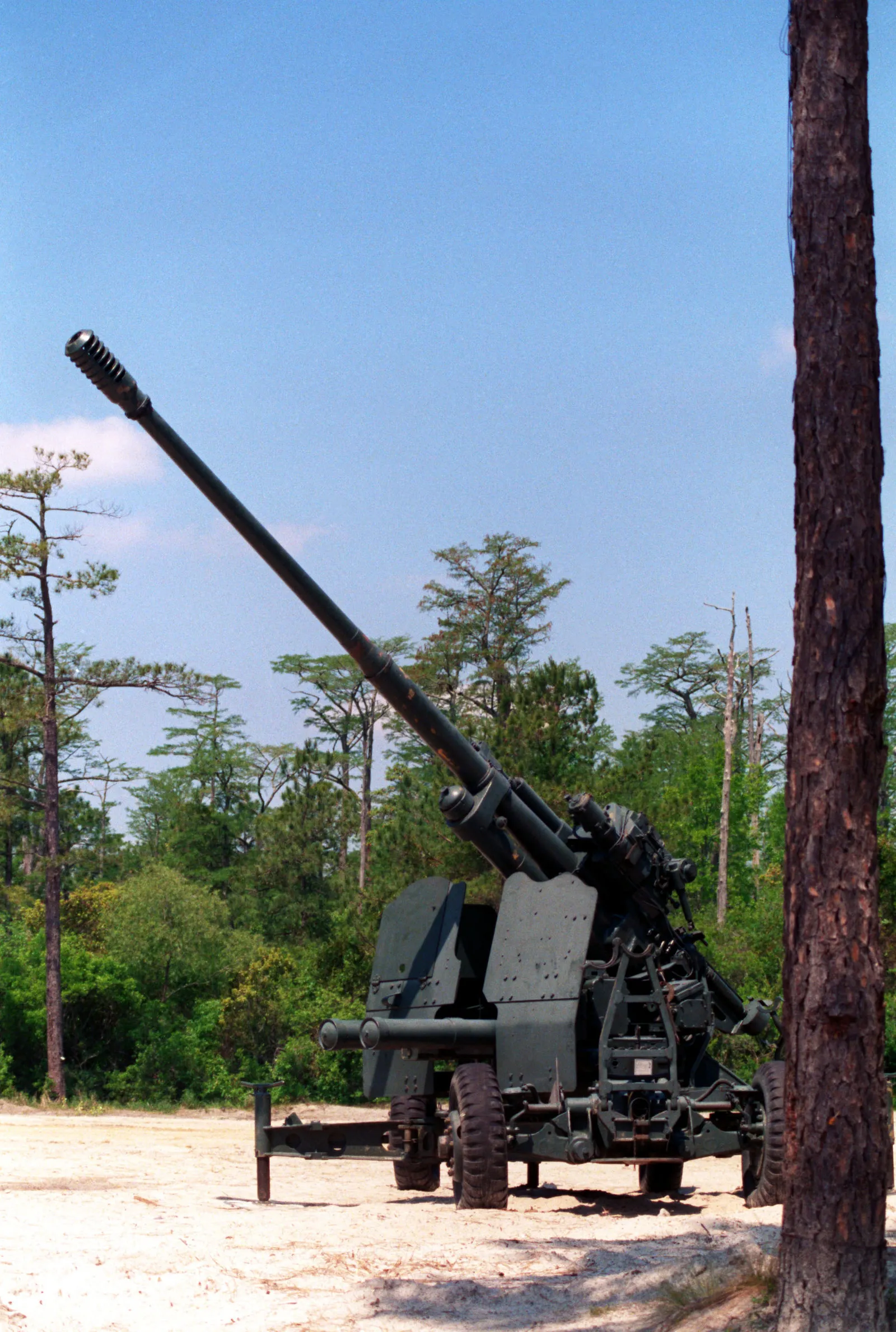
The KS-19 is a Soviet 100 mm towed anti-aircraft gun designed for high-altitude, radar-directed air defense with fixed ammunition, a powered carriage, and PUAZO/SON-9 fire-control support. U.S. studies tied the gun to North Vietnam's heavy AAA network and Iraqi inventories retained it into the 1990 Gulf War, while later conflict records show legacy KS-19s displayed in Houthi air-defense equipment and repurposed as long-range ground-fire weapons in Nagorno-Karabakh and Ukraine.
Role in Conflicts
Houthi-aligned forces controlled legacy Yemeni air-defense equipment during the 2014 Yemen Civil War; air-defense reporting lists KS-19/KS-12 heavy guns in Yemen's older AAA inventory and assesses old 85/100 mm guns as more likely ground-fire weapons than effective modern air defense.
Role detailsIraqi government forces fielded KS-19 100 mm anti-aircraft guns in the 1990 Gulf War air-defense inventory; GlobalSecurity, citing IISS and USCENTCOM estimates, lists the KS-19 among Iraq's 1990 antiaircraft guns.
Role detailsArmenian/Artsakh forces fielded KS-19 guns during the 2020 Nagorno-Karabakh fighting, with Oryx documenting 100 mm KS-19 anti-aircraft guns used as howitzers among Armenian-side losses.
North Vietnamese air-defense forces fielded KS-19 100 mm anti-aircraft guns during the 1955 Vietnam War as part of the heavy AAA network covered in U.S. air-defense studies of North Vietnam.
Fire-Control and Ammunition Links
The KS-19 was not just a stand-alone towed gun: its intended air-defense role depended on off-carriage fire-control equipment, while its fixed 100 mm ammunition also helped make it adaptable for ground fire.
| Linked item | Connection | What the sources support |
|---|---|---|
| PUAZO fire director and SON-9/SON-9A Fire Can radar | Fire-control equipment | FAS describes the anti-aircraft fire-control system as including PUAZO-6/19 directors and SON-9 or SON-9A radar, while NDU notes automated firing from radar-system data. |
| 100 mm fixed ammunition | Ammunition fired | FAS lists fixed ammunition types including Frag-HE, AP-T, and APC-T and says the ammunition was largely interchangeable with other Soviet 100 mm rifled tank and field guns. |
Profile / Specs
Profile
- Origin
- Soviet Union
- Type
- Towed 100 mm anti-aircraft gun
- Service note
- Entered Soviet service in 1948; legacy guns remained in some post-Soviet inventories during the 2020s
- Designer
- OKB-8, with L. V. Lyuliev as chief designer
- Designed
- 1947-1948 design and Soviet state-test period
- Unit cost
- Not publicly reported
- Produced
- 1948-1957 Soviet production, with most KS-19 and KS-19M guns produced through 1955
- Number built
- 10,151 Soviet guns of various modifications reported by NDU; WeaponSystems.net summarizes Soviet production as over 10,500
Specifications
- GRAU index
- 52-P-415
- Caliber
- 100 mm
- Crew
- 7 to 15 personnel depending on source and operating arrangement
- Weight
- About 9.35 t in firing position; FAS lists 11,000 kg combat weight
- Carriage
- Towed two-axle, four-wheel carriage with powered traverse and outriggers
- Maximum ground range
- About 21 km
- Maximum altitude
- About 15 km against air targets, with WeaponSystems.net listing 15.4 km with proximity fuzes
- Muzzle velocity
- About 900 m/s, with FAS listing 900-1,000 m/s depending on ammunition
- Rate of fire
- About 14-15 rounds per minute; FAS lists 10-15 practical rounds per minute
- Target speed
- Designed for airborne targets moving up to about 1,200 km/h
- Elevation and traverse
- -3 to +85 degrees elevation and 360 degrees powered traverse
- Towing vehicles
- AT-S or AT-T tracked prime movers in Soviet service; suitable 6x6 tactical trucks could also tow the gun
- Fire control
- Designed for use with PUAZO fire directors and SON-9/SON-9A Fire Can radar, with on-carriage sights for independent use
- Ammunition
- Fixed 100 mm rounds; FAS lists Frag-HE, AP-T, and APC-T types
Variants
The KS-19 family kept the same 100 mm gun role while Soviet production moved through modernized carriage and production-standard variants; China later produced a local Type 59 version.
| Variant | Configuration | Designation notes |
|---|---|---|
| KS-19M | Modernized Soviet production model | NDU and WeaponSystems.net describe KS-19M production entering military supply in 1951; WeaponSystems.net identifies broadened barrel grooves as a wear-reduction change. |
| KS-19M2 | Late Soviet production update | NDU records small-batch KS-19M2 production beginning in 1955, while WeaponSystems.net describes the KS-19M2 as the final production model on the heavier KZU-28 carriage. |
| KSM-65 | KS-19-derived coastal-defense gun | NDU lists KSM-65 among later KS-19-family modifications, while WeaponSystems.net and KCHF describe it as a 100 mm coastal-defense gun based on the KS-19 with a distinct KMU-65 platform and external coastal fire-control equipment. Sources: NDU Ukraine KS-19 Data, WeaponSystems.net KSM-65, KCHF KSM-65 Coastal Artillery |
| Type 59 | Chinese production variant | WeaponSystems.net identifies Type 59 as the Chinese production variant of the KS-19 family. Sources: WeaponSystems.net KS-19 |
Timeline
100 mm KS-19 anti-aircraft gun Key Events
Design work begins
The KS-19 project was developed in the Soviet Union under chief designer L. V. Lyuliev as a heavy 100 mm gun for high-altitude air defense.
Sources: NDU Ukraine KS-19 Data
Accepted into service
NDU Ukraine records the KS-19 as accepted into Soviet service on December 18, 1948.
Sources: NDU Ukraine KS-19 Data
KS-19M modernization enters supply
The modernized KS-19M began reaching the military in 1951 as the original gun family continued production.
Sources: NDU Ukraine KS-19 Data, WeaponSystems.net KS-19
Final Soviet production variants
Small-batch KS-19M2 production began in 1955, with later KS-19M2 and KSM-65 production continuing until 1957.
Sources: NDU Ukraine KS-19 Data, WeaponSystems.net KS-19
Documented in North Vietnam's air-defense network
The Night Song study of air operations over North Vietnam described KS-19 heavy anti-aircraft guns as part of the North Vietnamese AAA threat during the Vietnam War.
Sources: Night Song North Vietnam Air Defense
Listed in Iraqi Gulf War air-defense inventory
GlobalSecurity's Iraqi air-defense inventory lists 100 mm KS-19 guns among Iraq's antiaircraft-gun equipment for 1990.
Sources: GlobalSecurity Iraqi Air Defense Equipment
Used as howitzers in Nagorno-Karabakh
Oryx documented Armenian-side KS-19 losses in the 2020 Nagorno-Karabakh fighting and identified the guns as 100 mm anti-aircraft guns used as howitzers.
Sources: Oryx Nagorno-Karabakh Losses
Reactivated by Ukraine
Task & Purpose reported that Ukraine was fielding KS-19 guns as artillery during the 2014 Russia-Ukraine War, including footage of guns firing 100 mm rounds at low elevation.
Sources: Task & Purpose Ukraine KS-19
MAN-mounted KS-19 documented near Pokrovsk
Defense Express reported that Ukraine's 111th Territorial Defense Brigade used a MAN-mounted KS-19 on the Pokrovsk axis after receiving four guns from old storage.
Sources: Defense Express MAN-mounted KS-19
Media
100 mm KS-19 anti-aircraft gun Videos
100 mm KS-19 anti-aircraft gun Images
Related Weapon Systems