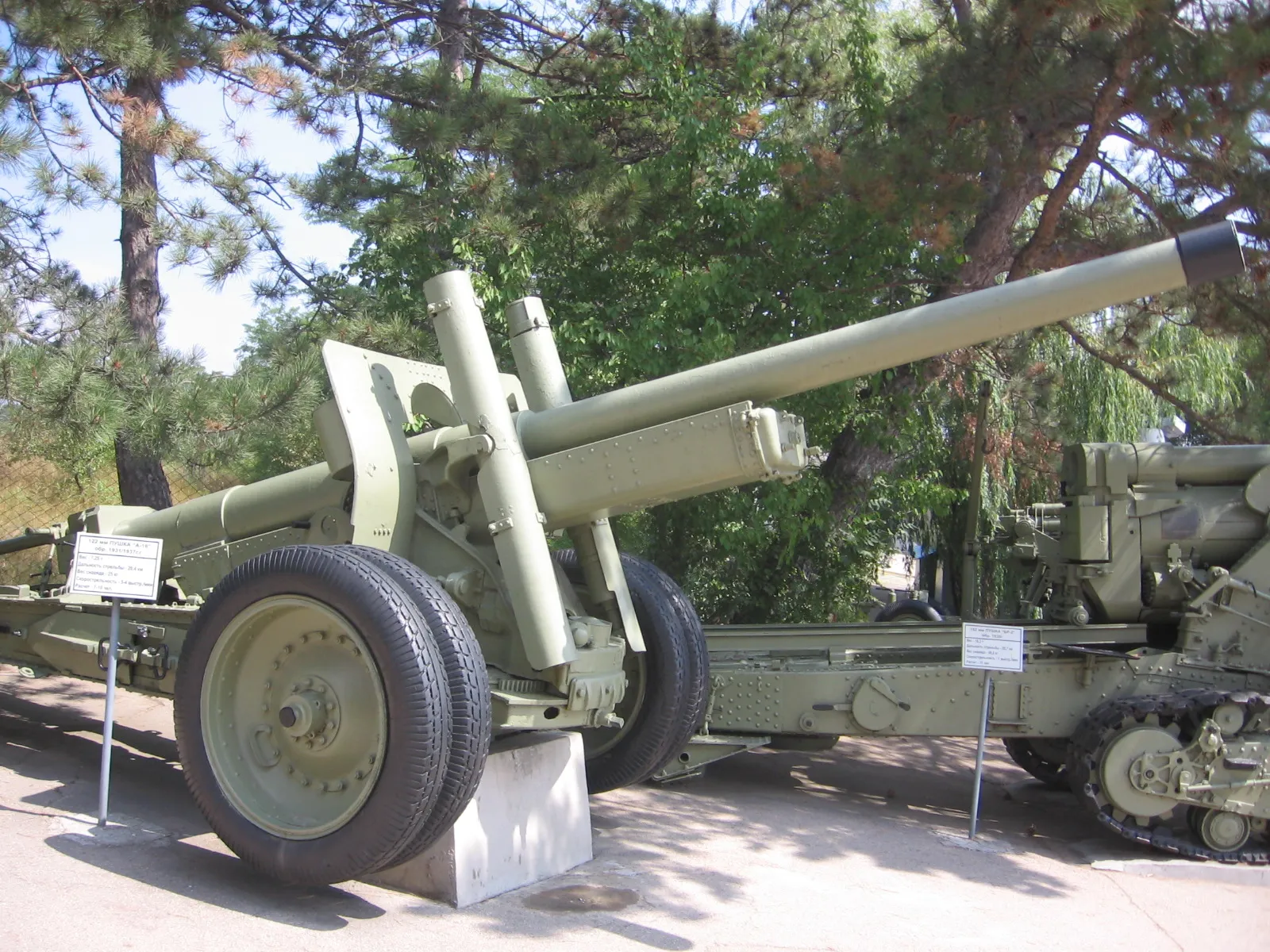
The Victory Museum describes A-19 guns in Soviet wartime service for artillery preparations, counter-battery fire, assaults on fortified areas, and emergency direct-fire anti-armor tasks, including documented Battle of Moscow, Kursk, and Berlin context.
Artillery
A-19 122 mm field gun
Also known as
- 122 mm gun M1931
- 122 mm gun M1931/37
- 122 mm corps gun M1931/37
- 122 mm corps gun M1931/37 (A-19)
- M1931/37 A-19
- A-19 M-1931/37 Field Gun
- 52-P-471
- 52-P-471A
- 122 K/31
The A-19 is a Soviet 122 mm towed corps gun developed for long-range artillery fire, combining a high-velocity barrel, separate-loading ammunition, and an approximately 20 km range. This entry tracks direct Soviet Second World War service along with conservative modern conflict evidence: pre-war Yemeni Army inventory available to Yemen battlefield parties and a photo/video-evidenced YPG/SDF A-19 in northern Syria.
Role in Conflicts

Oryx listed the A-19 among Yemeni Army field guns held before the Houthi takeover and framed the inventory as equipment available to Yemeni battlefield parties; this supports conservative inventory context rather than a documented firing incident.
Role details

Oryx listed one 122 mm A-19 field gun among YPG heavy weapons in northern Syria, in a photo/video-evidenced inventory tied to Syrian Democratic Forces equipment.
Role detailsProfile / Specs
Profile
- Origin
- Soviet Union
- Built by
- BarrikadyNo. 172 Plant
- Type
- 122 mm towed corps gun
- Service note
- Designed in the 1930s; Second World War service and legacy appearances in 2010s conflicts
- Designer
- S. P. Shukalov-led VOAO design group for the original A-19; F. F. Petrov-led No. 172 Plant design bureau for the M1931/37 modernization
- Designed
- 1927-1936 original A-19 program; 1937-1939 M1931/37 modernization
- Produced
- 1933-1946 overall; original M1931 production at Barrikady before M1931/37 production from 1939 to 1946
- Number built
- About 2,926 M1931 and M1931/37 guns overall; about 2,450 M1931/37 guns
Specifications
- Caliber
- 121.92 mm
- Configuration
- Towed field gun; original M1931 on its early split-trail carriage, later M1931/37 on the ML-20 carriage family
- Crew
- 9
- Combat weight
- About 7,117 kg
- Barrel length
- 5.65 m overall; 46.3 calibers
- Maximum range
- About 20.2-20.4 km, depending on projectile/source
- Muzzle velocity
- About 800 m/s with standard gun projectiles
- Rate of fire
- 3-4 rounds per minute in WeaponSystems.net; 5-6 rounds per minute in the Victory Museum technical table
- Traverse and elevation
- 58 degrees traverse; -2 to +65 degrees elevation on the M1931/37
- Ammunition
- Separate-loading 122 mm projectile and propellant charge
Design And Employment Notes
The A-19 family moved from the original M1931 carriage to the M1931/37 duplex arrangement with the ML-20 carriage family. That change improved elevation and standardized major carriage elements while keeping the 122 mm gun role.
Primary role
Corps and reserve artillery for counter-battery fire, rear-area targets, fortified positions, and heavy direct-fire tasks when needed.
Mobility
Towed by medium artillery tractors; the modernized carriage could be moved at road speeds up to about 25 km/h in the Victory Museum profile.
Ammunition
Separate-loading 122 mm ammunition included high-explosive fragmentation, armor-piercing tracer, and concrete-piercing projectiles.
Variants
A-19 covers the original M1931 corps gun and the later M1931/37 modernization, which retained the 122 mm ordnance while adopting the ML-20 carriage family.
| Variant | Configuration | Designation notes |
|---|---|---|
| 122 mm gun M1931 | Original A-19 corps gun | Original production model associated with Barrikady; it used the early A-19 carriage and was replaced in production by the M1931/37 modernization. Sources: Victory Museum A-19 encyclopedia, 122mm A-19 |
| 122 mm gun M1931/37 | Modernized carriage variant | No. 172 Plant's modernization placed the A-19 barrel group on the normalized ML-20 carriage, improving mobility, elevation, and production commonality. Sources: Victory Museum A-19 encyclopedia, 122mm A-19 |
Ammunition Fired
The A-19 ammunition table and related reference plates explicitly list the gun's documented 122 mm projectiles and shells.
| Ammunition | Ammunition type | Firing evidence |
|---|---|---|
 | 122 mm armor-piercing projectile | The A-19 ammunition table lists BR-471 among the gun's armor-piercing shells. Sources: 122 mm gun M1931 (A-19) BR-471 |
| 122 mm armor-piercing capped shell | The ammunition plate for the A-19 and D-25T family explicitly names BR-471B among the listed armor-piercing shells. Sources: D25T shells.svg BR-471B |
| 122 mm high-explosive fragmentation shell | Wikipedia's A-19 ammunition table and the Commons ammunition plate both list OF-471 as the A-19's 122 mm high-explosive fragmentation shell. |
 | 122 mm anti-concrete shell | The A-19 ammunition table lists G-471 as an anti-concrete shell with a 25 kg projectile, 2.2 kg HE filler, 800 m/s muzzle velocity, and 20.4 km range. Sources: 122 mm gun M1931 (A-19) G-471 |
 | 122 mm high-explosive fragmentation howitzer shell | Reference sources state the A-19 could also fire 122 mm howitzer shells, including OF-462, with the limitation that they could not be used with full charge. Sources: 122 mm gun M1931 (A-19) OF-462 |
Timeline
A-19 122 mm field gun Key Events
Red Army requirement
The Red Army sought a more powerful 122 mm corps gun to replace older 107 mm corps artillery.
Sources: Victory Museum A-19 encyclopedia
Original A-19 accepted
The Red Army accepted the original A-19 as the 122 mm gun model 1931 after early development by the Shukalov-led design group.
Sources: Victory Museum A-19 encyclopedia
M1931/37 trials
The modernized gun, combining the A-19 barrel group with the ML-20 carriage, completed proving-ground trials in autumn 1938.
Sources: Victory Museum A-19 encyclopedia
M1931/37 adopted
The modernized version was accepted as the 122 mm corps gun model 1931/37 while retaining the A-19 designation.
Sources: Victory Museum A-19 encyclopedia
No. 172 Plant wartime production
After early Barrikady production, wartime A-19 production was established at Motovilikha / No. 172 Plant in Perm.
Sources: Victory Museum A-19 encyclopedia
Media
A-19 122 mm field gun Videos
Related Weapon Systems


Sources
122mm A-19Publisher: WeaponSystems.net | Note: Supports A-19 background, design lineage, manufacturer, production, ammunition, rate of fire, weight, and range specifications. | Accessed: 2026-07-06Victory Museum A-19 encyclopediaPublisher: Victory Museum / Central Museum of the Great Patriotic War | Note: Supports direct Second World War use by Soviet forces, including A-19 employment in artillery preparations, counter-battery fire, fortified-area assaults, and emergency direct-fire anti-armor tasks, plus designer, modernization, adoption, production, and specification context. | Accessed: 2026-07-06A-19 ammunition tablePublisher: Wikipedia | Note: Supports the OF-471 and G-471 ammunition-table rows, including the high-explosive fragmentation shell, anti-concrete shell, projectile masses, filler values, muzzle velocities, and ranges. | Accessed: 2026-06-23122 mm gun M1931 (A-19)Publisher: Wikipedia | Note: Supports the A-19 ammunition table and the gun's listed armor-piercing and high-explosive shell compatibility. | Accessed: 2026-06-23D25T shells.svg A-19 platePublisher: Wikimedia Commons | Note: Supports the ammunition plate that explicitly lists BR-471, BR-471B, and OF-471 for the A-19 and D-25T family. | Accessed: 2026-06-23D25T shells.svgPublisher: Wikimedia Commons | Note: Supports image provenance and the ammunition plate that explicitly lists OF-471, BR-471, and BR-471B among the A-19 and D-25T shells. | Accessed: 2026-06-23122 mm gun M1931 (A-19) BR-471Publisher: Wikipedia | Note: Supports the A-19 listing of BR-471 as an armor-piercing shell. | Accessed: 2026-06-23D25T shells.svg BR-471BPublisher: Wikimedia Commons | Note: Supports the ammunition plate that explicitly lists BR-471B among the A-19 and D-25T shells. | Accessed: 2026-06-23122 mm gun M1931 (A-19) OF-471Publisher: Wikipedia | Note: Supports the A-19 listing of OF-471 as a high-explosive fragmentation shell. | Accessed: 2026-06-23122 mm gun M1931 (A-19) OF-462Publisher: Wikipedia | Note: Supports the A-19 listing of OF-462 as a howitzer shell that could be fired with charge no. 1. | Accessed: 2026-06-23122 mm gun M1931 (A-19) G-471Publisher: Wikipedia | Note: Supports the A-19 listing of G-471 as an anti-concrete shell. | Accessed: 2026-06-23Pre-War Yemeni Fighting Vehicles And EquipmentPublisher: Oryx | Note: Supports 2014 Yemen Civil War context: the A-19 was listed in Yemeni Army pre-war inventory and framed as equipment available to Yemeni battlefield parties. | Accessed: 2026-07-06Kurdish Armour YPG Equipment in Northern SyriaPublisher: Oryx | Note: Supports 2011 Syrian Civil War context: one 122 mm A-19 field gun is listed in a photo/video-evidenced YPG heavy-weapons inventory in northern Syria. | Accessed: 2026-07-06A-19 gun at Sapun Mountain museum imagePublisher: Wikimedia Commons | Note: Supports image provenance and licensing context for the replacement A-19 image. | Accessed: 2026-06-22