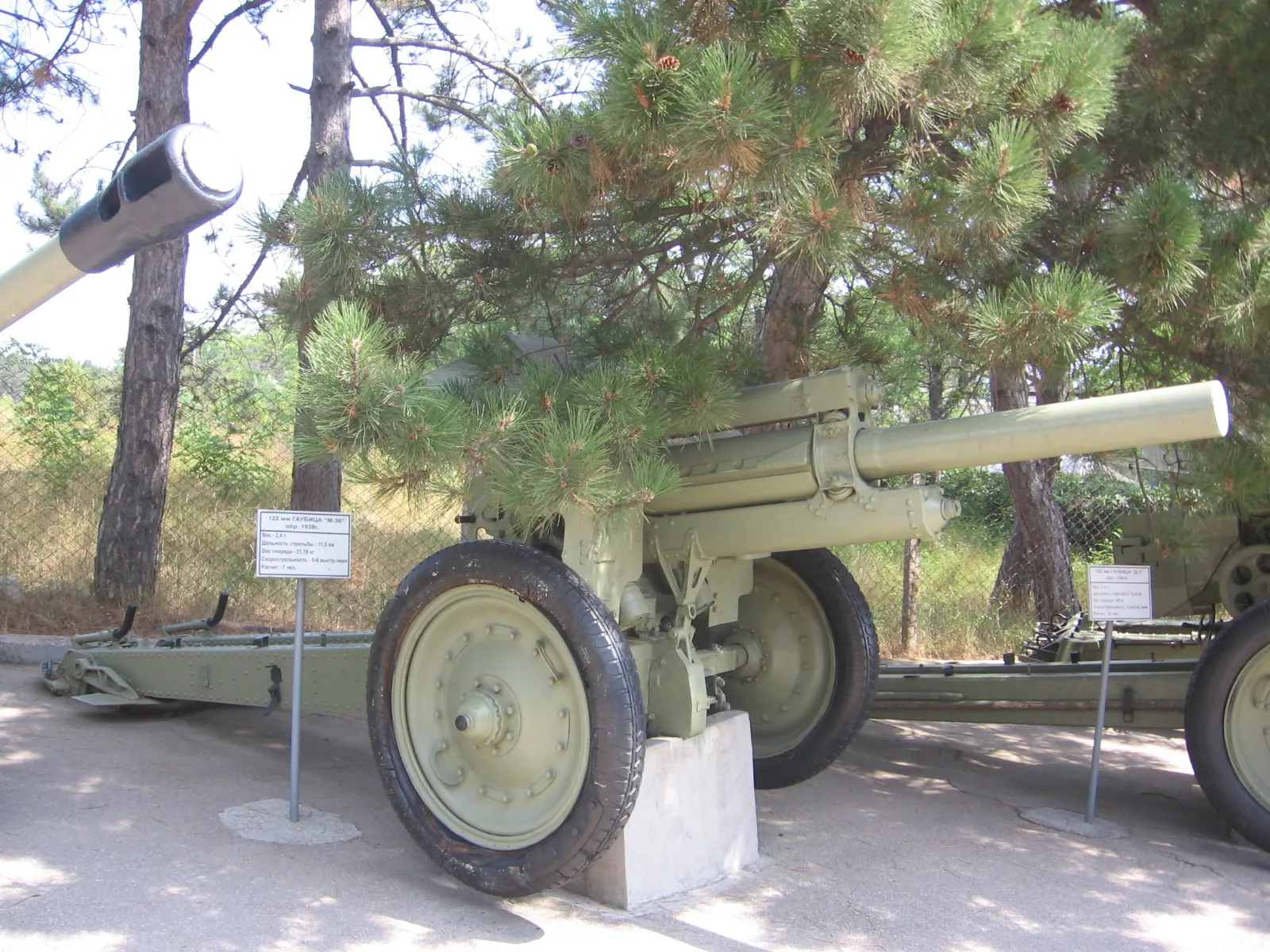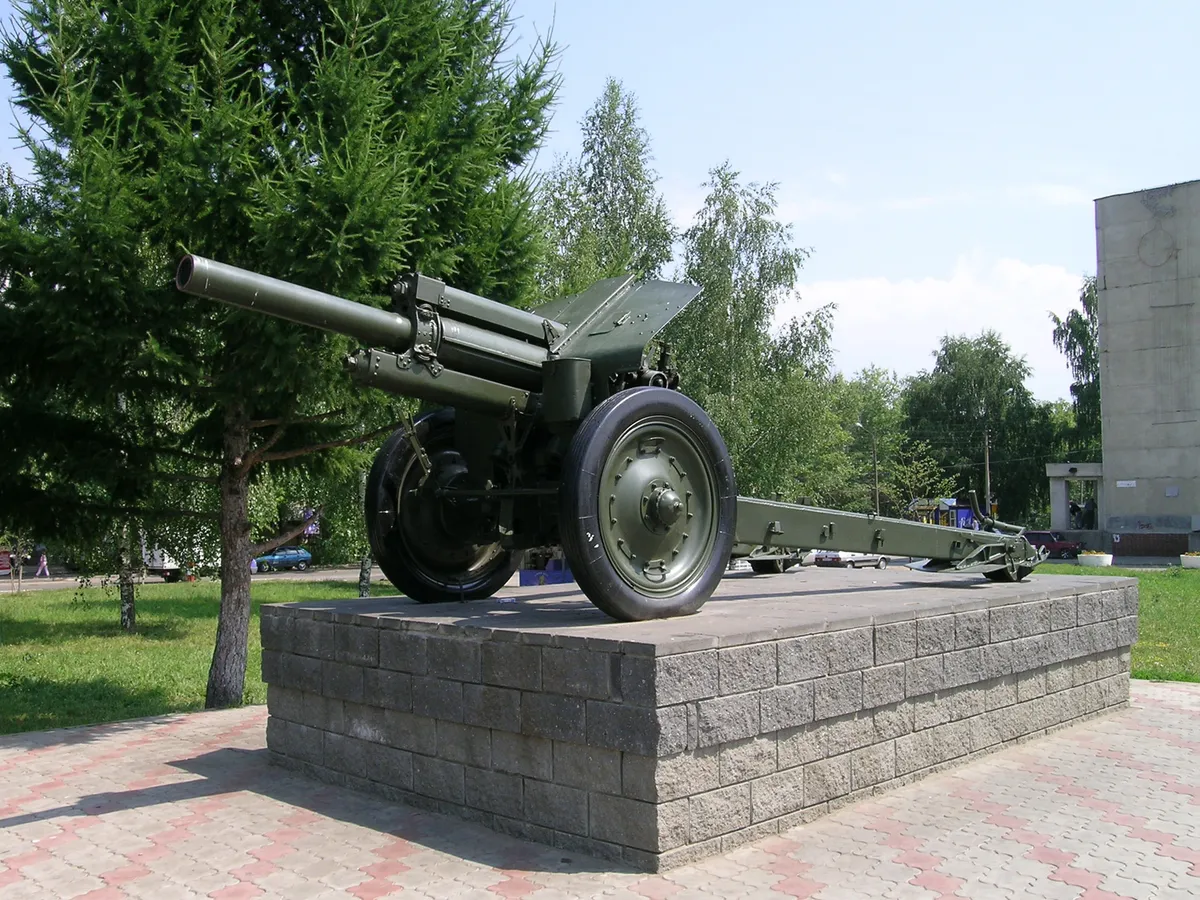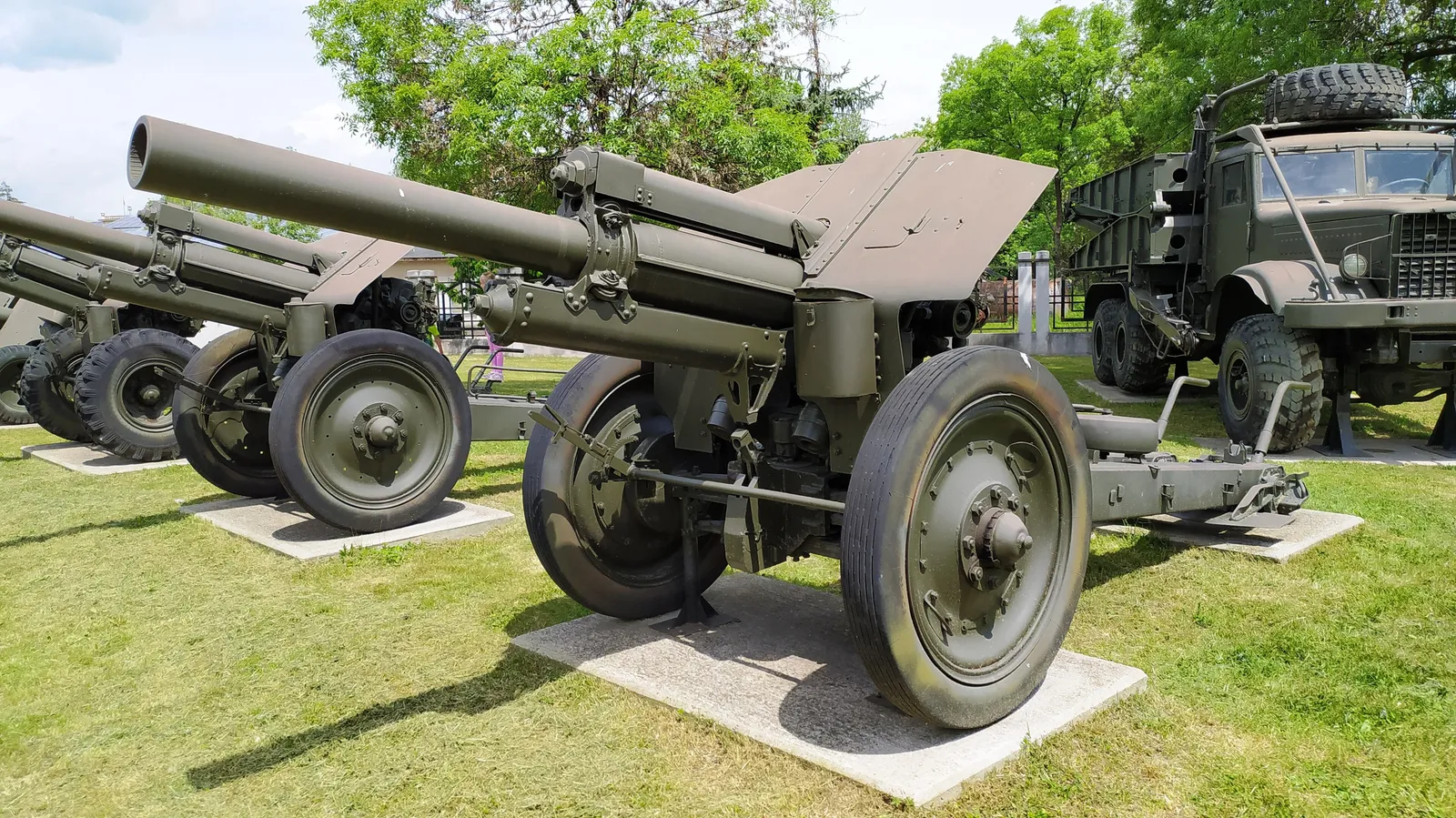
- Side
- Russia

Oryx lists a Russian 122 mm howitzer M1938 (M-30) as damaged during the Russian invasion of Ukraine, and Army Recognition reported later footage and redeployment claims for Russian M-30 use in Ukraine.
Role detailsThe 122 mm M-30 howitzer is a Soviet split-trail towed field howitzer designed by F. F. Petrov's Motovilikha team and serially produced from 1939. Its 11.8 km range, simple carriage, and wide postwar distribution kept it visible long after newer 122 mm guns appeared, with documented recent appearances in Russian, Syrian, YPG, and Armenian/Artsakh conflict records.
Oryx lists a Russian 122 mm howitzer M1938 (M-30) as damaged during the Russian invasion of Ukraine, and Army Recognition reported later footage and redeployment claims for Russian M-30 use in Ukraine.
Role detailsOryx documented Russian deliveries of 122 mm M-30 howitzers to Syrian Arab Army-linked 5th Corps forces, one YPG-held M-30 in northern Syria, and a Wagner/Syrian government M-30 destroyed at the Battle of Conoco Fields.
Role detailsDocumented in Armenian-side equipment losses during the 2020 Nagorno-Karabakh war, with Oryx listing one 122 mm M-30 howitzer as damaged.
The M-30's modern catalog relevance comes from documented residual stocks rather than new production. The strongest recent records identify the exact M-30 designation in loss lists, delivery reporting, photographed inventories, or specialist reporting on reactivated Russian artillery.
Oryx lists a Russian 122 mm howitzer M1938 (M-30) as damaged, while Army Recognition reported later Russian reactivation and redeployment of M-30 guns for the Ukraine war.
Oryx documents Russian M-30 deliveries to Syrian government-linked forces, a YPG-held M-30 in northern Syria, and a Wagner/Syrian government M-30 destroyed at Conoco Fields.
Oryx lists one Armenian-side 122 mm M-30 howitzer as damaged during the 2020 war, supporting the Armenian/Artsakh compact conflict row.
Sources: Attack On Europe: Russian Equipment Losses; Russia Brings Back M-30 Howitzers; Syria Rearms: Russian Deliveries Of BMP-2s And 2S9s Arrive; Kurdish Armour: Inventorising YPG Equipment In Northern Syria; Documenting Equipment Losses During The Battle Of Conoco Fields; The Fight For Nagorno-Karabakh.
The M-30 family includes the baseline towed howitzer, the M-30S barrel installation used on the SU-122, and Chinese Type 54 production derived from the Soviet design.
| Variant | Configuration | Designation notes |
|---|---|---|
| M-30 | Baseline towed field howitzer | The standard 122 mm howitzer model 1938 carried the GAU index 52-G-463 and was serially produced from 1939. Sources: 122 mm howitzer M-30 |
| M-30S | Self-propelled gun barrel installation | National Defence University of Ukraine describes the M-30 as the gun mounted on the SU-122 self-propelled artillery installation. Sources: 122 mm howitzer M-30 |
| Type 54 | Chinese-produced derivative | World War II Database identifies China's Type 54 howitzer as based on the Soviet M-30 design supplied by Russia after World War II. |
The M-30's recent relevance is tied to older 122 mm ammunition stocks as much as to the gun itself.
| Ammunition | Ammunition type | Firing evidence |
|---|---|---|
 | 122 mm HE-fragmentation shell | Army Recognition identifies OF-462 as one of the ammunition types developed for and fired by the M-30 howitzer. Sources: Russia Brings Back M-30 Howitzers |
The D-30 is not an M-30 variant, but sources describe it as the later Soviet 122 mm howitzer that replaced or supplemented M-30-type divisional artillery.
| Compatible item | Item type | Compatibility evidence |
|---|---|---|
 | Later 122 mm towed howitzer | Weaponsystems.net states that the D-30 supplemented the M-30 in Soviet service from 1960, while World War II Database describes the D-30 as the M-30's 1960 replacement. |
National Defence University of Ukraine traces the improved 122 mm howitzer assignment to a Motovilikha design group led by F. F. Petrov in September 1937.
The Ukrainian university reference lists the 122 mm M-30 as entering service in 1938.
The M-30 entered serial production in 1939 and remained in production through the mid-1950s.
Oryx reported that Russian deliveries to Syria included World War II-era 122 mm M-30 howitzers for Syrian Arab Army-linked forces.
Oryx listed one Armenian-side 122 mm M-30 howitzer damaged during the 2020 Nagorno-Karabakh war.
Oryx's 2014 Russia-Ukraine War loss list includes a Russian 122 mm howitzer M1938 (M-30) as damaged.
Army Recognition reported that Russian forces had released M-30 footage in August 2024 and that more guns were confirmed as redeployed in April 2025.