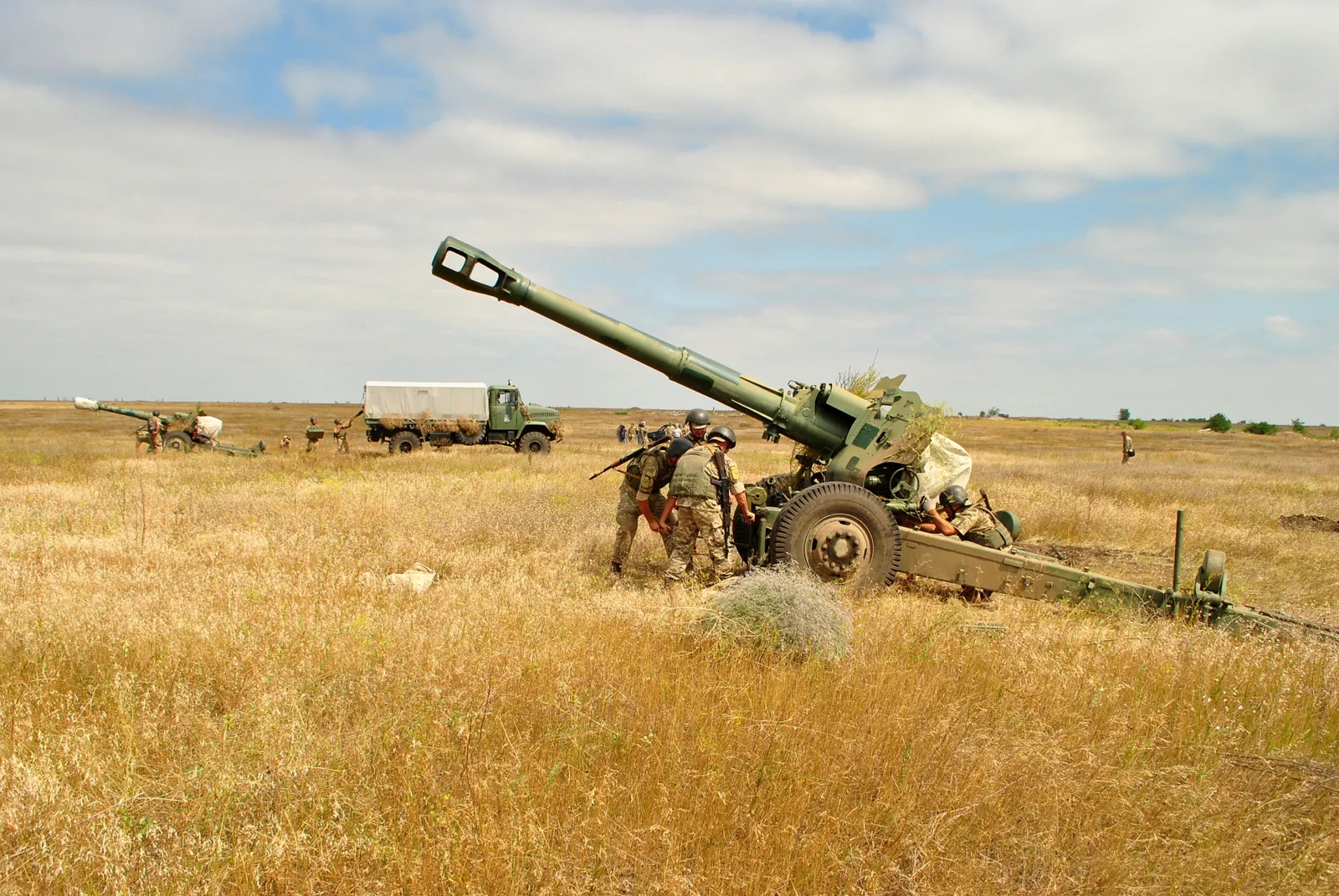


Russian forces fielded D-20 152 mm gun-howitzers during the full-scale invasion, with Oryx documenting Russian D-20 losses and captured examples; Ukrainian forces also used captured D-20s on the Kherson front in 2023.
Role detailsArtillery
D-20
Also known as
- D20
- D-20 152 mm howitzer
- 152mm D-20 gun-howitzer
- 152 mm gun-howitzer M1955
- M1955
- 52-P-546
- D-20 Khitin
- D-72
- Type 66
- PL66
- 152 H 55
- A411
- Tun/Obuzier calibrul 152-mm tractat M1981
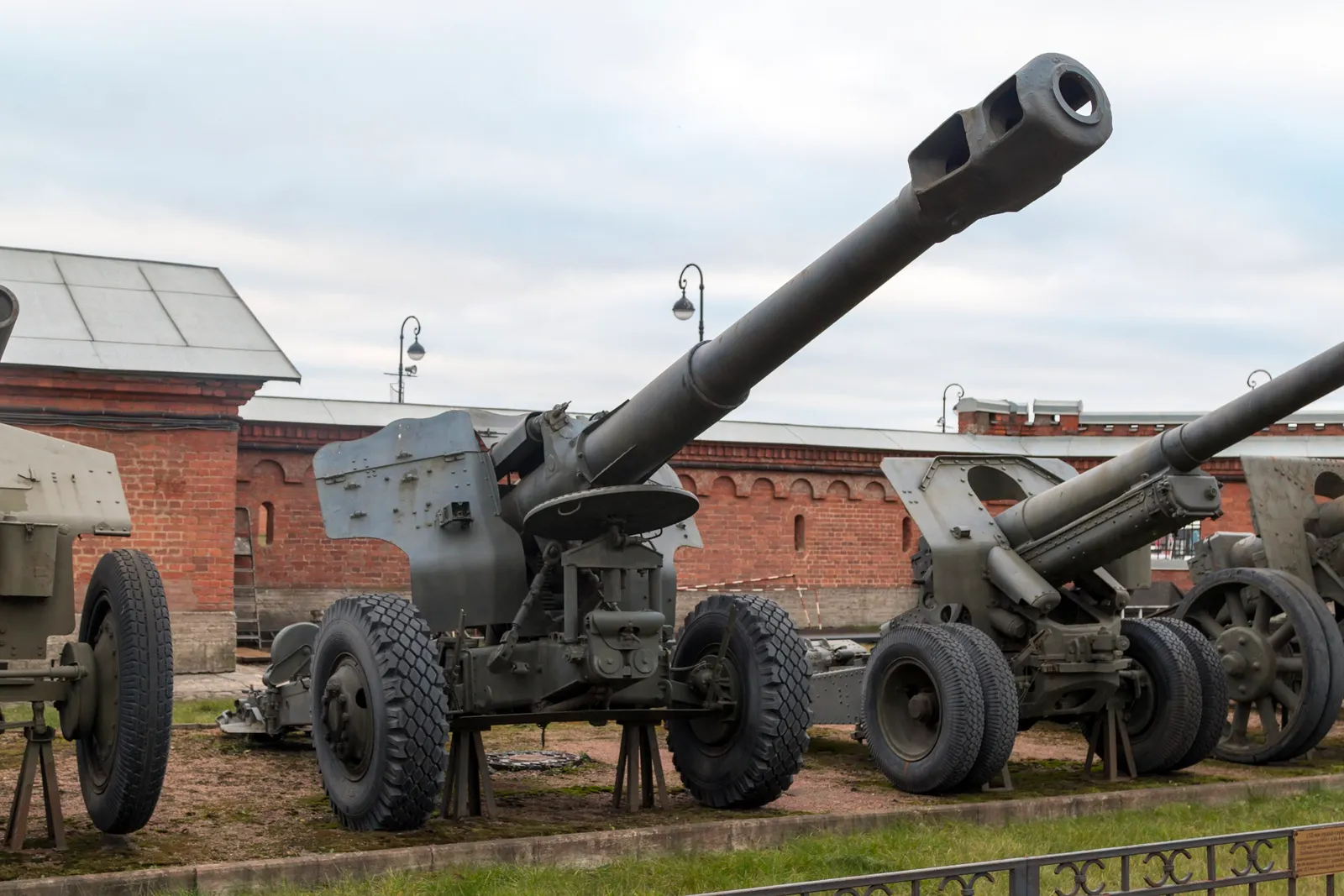
The D-20 is a Soviet 152 mm towed gun-howitzer developed under F. F. Petrov's Plant No. 9 design bureau for divisional and army-level fire support. Its split-trail carriage, 34-caliber ordnance, double-baffle muzzle brake, and 17.4 km standard range kept it useful across Soviet, Warsaw Pact, Chinese Type 66, Romanian, and export inventories, with documented modern use in Ukraine, Nagorno-Karabakh, Yemen, and Iraq.
Role in Conflicts

Armenian-side forces fielded D-20 gun-howitzers during the 2020 Nagorno-Karabakh fighting, where Oryx documented 152 mm D-20s destroyed, damaged, and captured.

Oryx identifies the 152 mm D-20 gun-howitzer as part of the Yemeni Army's pre-war inventory and as equipment available to Yemeni battlefield parties after the 2014-2015 Houthi takeover.
Role details
Amnesty International's ARES-supported review identified D-20 type guns in service with Popular Mobilization Unit militia armed groups from verified visual material covering March 2015 to June 2016 during the anti-IS war period.
Profile / Specs
Profile
- Origin
- Soviet Union
- Built by
- No. 9 Uralmash Plant
- Built in
- Soviet UnionChinaRomania
- Type
- 152 mm towed gun-howitzer
- Service note
- Cold War design still used in the 2014 Russia-Ukraine War
- Designer
- F. F. Petrov design bureau
- Designed
- Early 1950s
- Unit cost
- Not publicly established
- Produced
- Early 1950s onward; licensed production in China and Romania
- Number built
- About 3,000 Soviet D-20 guns, with more than 1,000 Chinese Type 66 guns and Romanian production also reported
Specifications
- Caliber
- 152 mm
- Crew
- 8 to 10
- Combat weight
- 5.7 t
- Barrel
- 152 mm L/34 gun-howitzer with double-baffle muzzle brake
- Maximum range
- 17.4 km with standard ammunition; farther with rocket-assisted projectiles
- Muzzle velocity
- About 650 m/s with standard full-charge firing data
- Elevation and traverse
- -5 to +63 degrees elevation; 58 degrees total traverse
- Rate of fire
- 5 to 6 rounds per minute maximum
- Carriage
- Two-wheel split-trail carriage, normally truck-towed
- Mobility
- Typically towed by a 6x6 truck or artillery tractor in Soviet service; WeaponSystems.net lists 60 km/h road towing speed
Design And Designations
The D-20's catalog identity spans Soviet, NATO, Chinese, Finnish, and Romanian designations, while its engineering lineage connects the towed gun-howitzer to later self-propelled 152 mm systems.
Carriage
Army Guide describes a two-trail carriage with a firing pedestal, full-circle traverse after emplacement, and the same carriage and recoil system as the D-74 field gun.
Firepower
WeaponSystems.net lists a 34-caliber 152 mm ordnance, 17.4 km standard maximum range, and 5 to 6 round-per-minute maximum rate of fire.
Designations
WeaponSystems.net lists M1955, 52-P-546, Type 66, PL66, 152 H 55, A411, and the Romanian M1981 service designation as D-20 family names.
Lineage
FAS and Army Guide connect the D-20 ordnance line to the self-propelled 2S3 Akatsiya family, while Army Guide also identifies the Yugoslav M84 as a long-barrelled D-20 version.
Variants
The Soviet D-20 baseline was produced abroad under Chinese and Romanian designations, while related long-barrel derivatives kept the same 152 mm family context.
| Variant | Configuration | Designation notes |
|---|---|---|
| Type 66 / PL66 | Chinese production copy | WeaponSystems.net describes the Type 66 as Chinese production of the D-20 and a direct copy of the Soviet gun-howitzer. Sources: 152mm D-20 |
| M1981 | Romanian production variant | WeaponSystems.net identifies the M1981 as the Romanian production variant of the D-20, with small detail differences from the Soviet weapon. Sources: 152mm D-20 |
| M1985 | Romanian long-barrel derivative | WeaponSystems.net describes the M1985 as an M1981 derivative with a longer barrel and increased range. Sources: 152mm D-20 |
| M84 | Former Yugoslav long-barrel version | Army Guide describes the M84 as a Yugoslav, now Serbian, long-barrelled version of the D-20. Sources: Army Guide D-20 152mm Gun-howitzer |
Ammunition Fired
The D-20's best-documented munition relationship in the catalog is its use with laser-guided Krasnopol projectiles.
| Ammunition | Ammunition type | Firing evidence |
|---|---|---|
 | 152 mm laser-guided projectile | FAS says the 152 mm Krasnopol projectile is designed to operate with D-20 guns and howitzers. Sources: Threat Update Krasnopol--A Laser-Guided Projectile for Tube Artillery |
Related Artillery Family
The D-20 sits in a small Petrov-designed artillery cluster: its ordnance line connects to the self-propelled 2S3 family, while its carriage is shared with the D-74 field gun.
| Compatible item | Item type | Compatibility evidence |
|---|---|---|
 | Self-propelled 152 mm gun-howitzer family | FAS identifies the 2S3 Akatsiya as a modified version of the D-20, while WeaponSystems.net describes the D-20 ordnance as similar to the gun-howitzer used in the 2S3. Sources: 2S3 M-1973 Akatsiya (Acacia) 152-mm Self-Propelled Gun-Howitzer, 152mm D-20 |
 | 122 mm field gun using the same split-trail carriage | WeaponSystems.net describes the D-20 as using the same two-wheel split-trail carriage as the contemporary D-74 field gun, with a shorter, larger-caliber 152 mm ordnance fitted. Sources: 152mm D-20 |
Timeline
D-20 Key Events
Public appearance in Moscow
Army Guide says the D-20 was first seen publicly in the 1955 Moscow May Day parade, marking its emergence into Soviet service.
Sources: Army Guide D-20 152mm Gun-howitzer
PMU D-20 type guns documented in Iraq
Amnesty International's ARES-supported review of verified visual material from March 2015 to June 2016 identified D-20 type guns in service with Popular Mobilization Unit militia armed groups during the 2013 War in Iraq period.
Sources: Iraq: Turning A Blind Eye
Returned to combat in the 2014 Russia-Ukraine War
Oryx documented Russian D-20 losses and captured examples during the full-scale invasion, while a Defense Express report described Ukrainian use of captured D-20s on the Kherson front.
Sources: Attack On Europe: Documenting Russian Equipment Losses During The Russian Invasion Of Ukraine, The Ukrainian Military Successfully Deploys Trophy D-20 Gun-Howitzer Against Russian Forces
Related Weapon Systems


Sources
D-20 (M1955) Russian 152mm Towed Gun-HowitzerPublisher: U.S. Army ODIN Worldwide Equipment Guide | Note: Supports general identification and background for the D-20 as a 152 mm towed gun-howitzer. | Accessed: 2026-07-06152mm D-20Publisher: WeaponSystems.net | Note: Supports origin, producer, design background, variants, D-74 carriage relationship, service history, and technical specifications. | Accessed: 2026-07-06Army Guide D-20 152mm Gun-howitzerPublisher: Army Guide | Note: Supports the D-20's 1955 public debut in Moscow, Plant No. 9 development context, D-74 carriage relationship, and M84 long-barrel derivative context. | Accessed: 2026-07-06The Ukrainian Military Successfully Deploys Trophy D-20 Gun-Howitzer Against Russian ForcesPublisher: Defense Express | Note: Supports 2014 Russia-Ukraine War use by Ukrainian forces, including captured D-20 gun-howitzers deployed on the Kherson front. | Accessed: 2026-07-06Attack On Europe: Documenting Russian Equipment Losses During The Russian Invasion Of UkrainePublisher: Oryx | Note: Supports 2014 Russia-Ukraine War fielding and loss context for Russian D-20 gun-howitzers, including destroyed, damaged, and captured examples. | Accessed: 2026-07-06The Fight For Nagorno-Karabakh: Documenting Losses On The Sides Of Armenia And AzerbaijanPublisher: Oryx | Note: Supports 2020 Nagorno-Karabakh Conflict use fielded by Armenian-side forces, with D-20 gun-howitzers documented as destroyed, damaged, and captured during the 2020 fighting. | Accessed: 2026-07-06Handbook Of Pre-War Yemeni Fighting VehiclesPublisher: Oryx | Note: Supports 2014 Yemen Civil War context: the D-20 was fielded by the Yemeni Army before the 2014-2015 Houthi takeover and listed as available to Yemeni battlefield parties. | Accessed: 2026-07-062S3 M-1973 Akatsiya (Acacia) 152-mm Self-Propelled Gun-HowitzerPublisher: Federation of American Scientists | Note: Supports the 2S3 Akatsiya's D-20 lineage and shared normal-round range. | Accessed: 2026-07-06Threat Update Krasnopol--A Laser-Guided Projectile for Tube ArtilleryPublisher: Federation of American Scientists | Note: Supports Krasnopol compatibility with D-20 guns and howitzers. | Accessed: 2026-07-06File: D-20 of the Ukrainian NavyPublisher: Wikimedia Commons | Note: Image provenance and licensing record for a Ukrainian Ministry of Defense photo reviewed as CC BY-SA 2.0. | Accessed: 2026-07-06File: 152 mm Gun-howitzer D-20 2017-12-24Publisher: Wikimedia Commons | Note: Gallery image provenance and licensing record for a D-20 photograph under CC BY-SA 4.0. | Accessed: 2026-07-06Iraq: Turning A Blind EyePublisher: Amnesty International | Note: Supports 2013 War in Iraq direct conflict-use context: ARES analysis for Amnesty identified D-20 type guns in service with Popular Mobilization Unit militia armed groups during the anti-IS conflict period. | Accessed: 2026-07-06