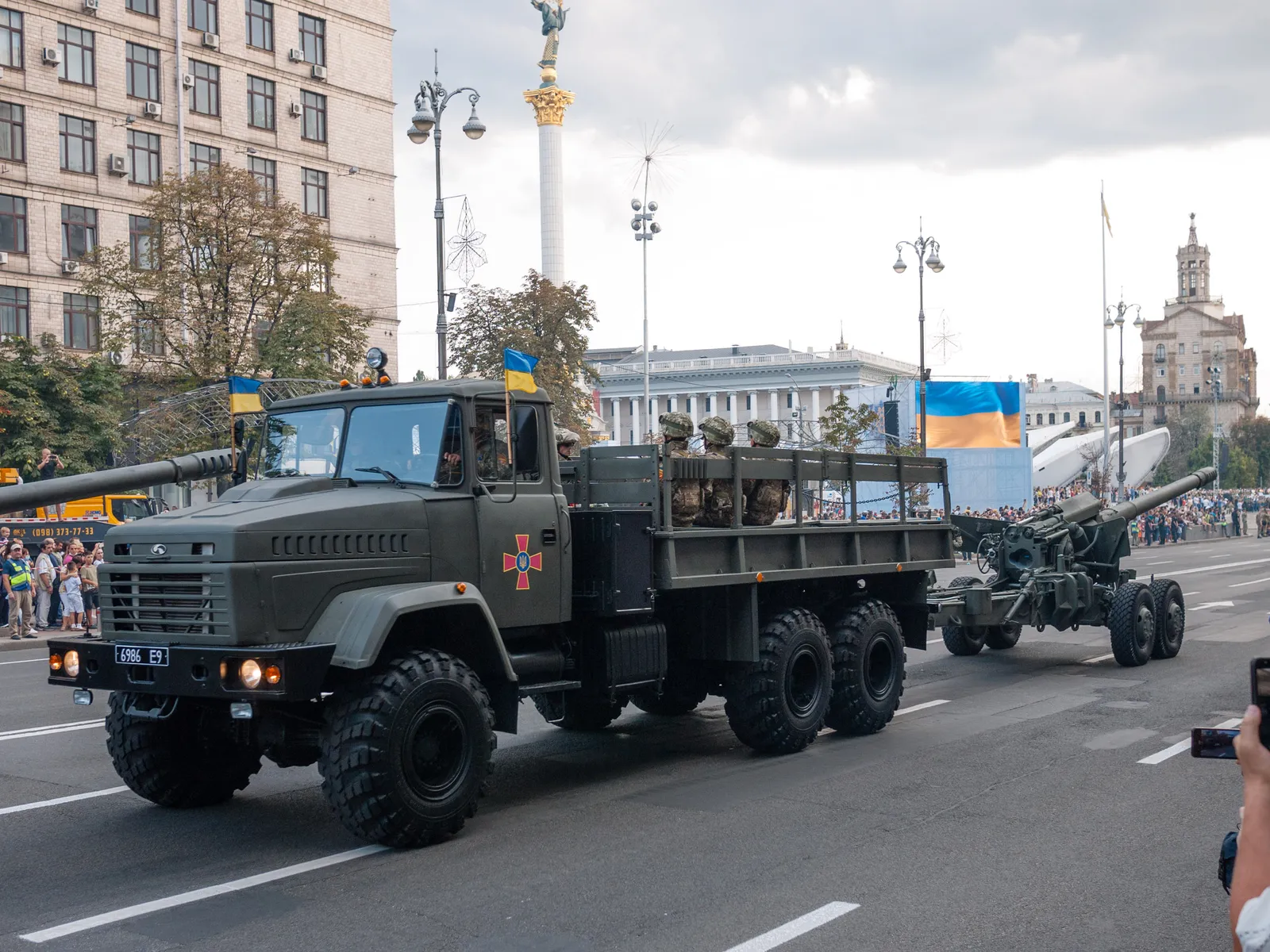


Both Russia and Ukraine have fielded 2A36 Giatsint-B 152 mm guns in the war: RUSI describes Ukrainian Hyacinth-B artillery at the start of the 2014 conflict, Newsweek reported pro-Russian Hyacinth-B fire near Avdiivka, Oryx documents losses on both sides, Ukrainian service includes likely Finnish 152 K 89 examples identified in April 2023, and Ukrinform reported Russian Giatsint-B losses in the Tavria direction in July 2023.
Role detailsArtillery
2A36 Giatsint-B
Also known as
- 2A36
- Giatsint-B
- Hyacinth-B
- M1976
- 152 K 89
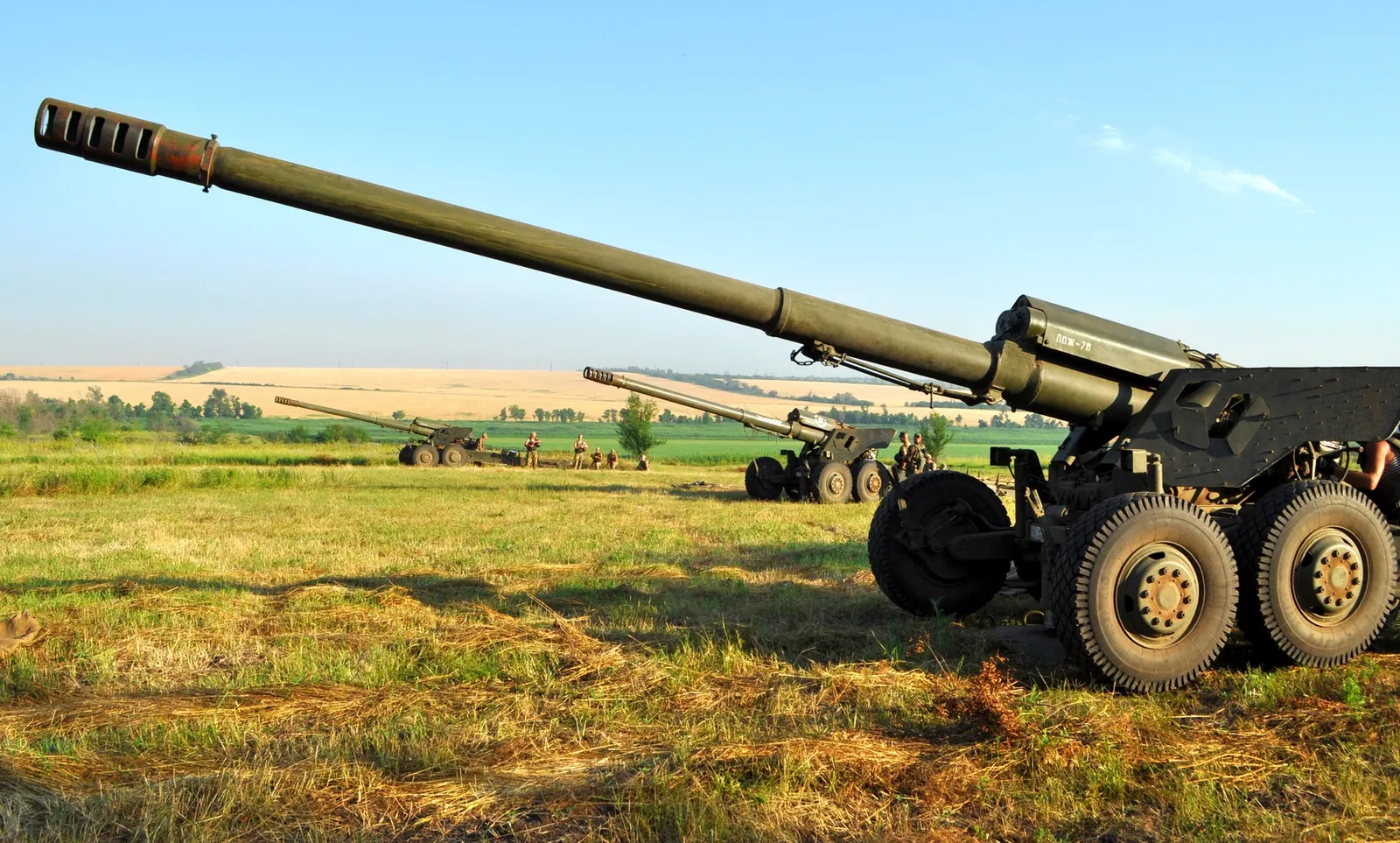
The 2A36 Giatsint-B is a Soviet 152 mm towed field gun built for long-range indirect fire and counter-battery work. Its 49-caliber barrel and separate-loading ammunition give it reach beyond many older Soviet 152 mm systems, and documented wartime use includes Georgian fielding in 2008, Russian and Ukrainian guns in the 2014 Russia-Ukraine War, and Armenian/Artsakh losses in the 2020 Nagorno-Karabakh fighting.
Role in Conflicts
- Side
- Georgia

Georgia fielded a small number of 2A36 Giatsint-B guns during the 2008 Russo-Georgian War; CAST's wartime order-of-battle study lists three 152 mm 2A36 Giatsint-B towed guns in Georgia's artillery inventory, but does not tie them to a specific firing mission.

Armenian/Artsakh forces fielded 152 mm 2A36 Giatsint-B field guns during the 2020 Nagorno-Karabakh fighting; Oryx documented destroyed, damaged, and captured examples among Armenian losses.
Profile / Specs
Profile
- Origin
- Soviet Union; Finnish-supplied examples documented in Ukrainian service
- Built by
- Perm Machine-Building Plant
- Built in
- Soviet Union
- Type
- 152 mm towed field gun
- Service note
- Entered Soviet service in 1976; still used in the 2014 Russia-Ukraine War
- Designer
- Design Bureau of the Machine-Building Plant in Perm; chief designer Yrii Kalachnikov
- Designed
- Development began in November 1968; prototypes were field tested in 1971-1972
- Produced
- 1976-1989
- Number built
- About 2,000 reported by WeaponSystems.net
Specifications
- Crew
- 8
- Caliber
- 152.4 mm
- Barrel
- 152 mm L/49 rifled barrel; 8.197 m including muzzle brake
- Weight
- 9,760-9,800 kg
- Range
- 28.5 km conventional per GlobalSecurity; up to 40 km with rocket-assisted projectiles per National Defence University of Ukraine
- Rate of fire
- 5-6 rounds per minute maximum; 1 round per minute sustained per GlobalSecurity
- Elevation / traverse
- -2.5 to +57 degrees elevation; 25 degrees traverse
- Emplace / displace time
- 5 / 10 minutes
- Ammunition
- Separate-loading 152 mm ammunition; listed types include HE, HE-BB, HE-Frag, ICM, APT, concrete-piercing, chemical, nuclear, and Krasnopol semi-active laser-guided rounds
- Carriage
- Four-wheel split-trail towed carriage with gun shield
- Mobility
- Road towing speed up to 80 km/h; off-road towing speed about 45 km/h
Service And Design Notes
The Giatsint-B was developed by the Machine-Building Plant design bureau in Perm as the towed member of a 152 mm extended-range gun family. The parallel 2A37 ordnance was used for the 2S5 Giatsint-S self-propelled system, while Finnish-service guns are commonly identified by the 152 K 89 designation.
Designations
2A36, M1976, Giatsint-B, Hyacinth-B, and Finnish 152 K 89 all refer to the same towed 152 mm gun family in the cited references.
Industrial Attribution
The strongest weapon-specific source identifies the Perm machine-building plant as manufacturer and its design bureau as the developer; the self-propelled Giatsint-S production line is handled through the linked 2S5 record.
Ammunition
GlobalSecurity lists conventional, extended-range, special-purpose, and Krasnopol semi-active laser-guided ammunition types for the 2A36.
Variants
The Giatsint gun family split into the towed 2A36 Giatsint-B and the related 2A37 ordnance used by the 2S5 Giatsint-S self-propelled system; Finnish 152 K 89 is a service designation for the same towed gun.
| Variant | Configuration | Designation notes |
|---|---|---|
 | Self-propelled Giatsint family system using 2A37 ordnance | National Defence University of Ukraine describes the 2A37 as the self-propelled-system version developed alongside the towed 2A36, while U.S. Army ODIN describes the 2S5 as a 152 mm self-propelled gun in the same Giatsint family. Sources: 152-mm cannon 2A36 Giatsint-B, 2S5 Giatsint-S Russian 152mm Self-Propelled Gun |
Ammunition Fired
The Giatsint-B family uses several 152 mm rounds; this entry documents rounds published by Transmobile and FAS.
| Ammunition | Ammunition type | Firing evidence |
|---|---|---|
 | 152 mm Frag-HE artillery round | Transmobile identifies its 152 mm round for Giatsint howitzer as ammunition for the 2A36 Giatsint-B and 2A37 Giatsint-S guns. |
 | 152 mm laser-guided artillery shell | FAS lists Krasnopol semi-active laser-guided ammunition among the 2A36 Giatsint-B's ammunition types. Sources: FAS 2A36 Giatsint-B |
Shared Ordnance
| Compatible item | Item type | Compatibility evidence |
|---|---|---|
| 152 mm self-propelled gun | National Defence University of Ukraine describes the 2A37 as the self-propelled-system version developed alongside the towed 2A36, and U.S. Army ODIN identifies the 2S5 as the related Giatsint-S self-propelled gun. Sources: 152-mm cannon 2A36 Giatsint-B, 2S5 Giatsint-S Russian 152mm Self-Propelled Gun |
Timeline
2A36 Giatsint-B Key Events
Development begins
WeaponSystems.net places the 2A36 design project in 1968-1972, with state trials in 1971-1972.
Sources: 152mm 2A36 Giatsint-B
Production and Soviet service
National Defence University of Ukraine and WeaponSystems.net place service entry and production in the mid-1970s, with production running into 1989.
Sources: 152-mm cannon 2A36 Giatsint-B, 152mm 2A36 Giatsint-B
Georgian inventory recorded
CAST's study of the 2008 Russo-Georgian War lists three 2A36 Giatsint-B towed guns in Georgia's wartime artillery inventory.
Sources: The Tanks of August
Nagorno-Karabakh losses documented
Oryx lists Armenian/Artsakh 2A36 Giatsint-B field guns among destroyed, damaged, and captured artillery in the 2020 Nagorno-Karabakh fighting.
Sources: The Fight For Nagorno-Karabakh: Documenting Losses On The Sides Of Armenia And Azerbaijan
Finnish-designation guns appear in Ukraine
Defense Express reported likely Finnish 152 K 89 Giatsint-B guns in Ukrainian hands, while noting that Finland had not publicly disclosed the transferred quantity.
Sources: The Finnish Giatsint-B Gun Was Spotted in the Hands of the Ukrainian Forces
Tavria-sector Russian losses include Giatsint-B guns
Ukrinform, citing General Oleksandr Tarnavskyi, reported that Ukrainian defenders destroyed two Russian 2A36 Giatsint-B guns among Russian equipment losses in the Tavria direction.
Sources: Ukrinform Tavria Giatsint-B Losses
Russian Giatsint-B struck near Novopavlivka
Defense Express reported that Ukrainian airborne drone operators identified and struck a Russian 2A36 Giatsint-B towed gun on the Novopavlivka axis.
Sources: Ukrainian Drones Hunt Down Rare Giatsint-B Gun Near Novopavlivka
Media
2A36 Giatsint-B Videos
2A36 Giatsint-B Images
Related Weapon Systems


Sources
152-mm cannon 2A36 Giatsint-BPublisher: National Defence University of Ukraine | Note: Supports manufacturer, service-entry, design, role, and core specification details. | Accessed: 2026-07-052A36 Giatsint-B (M1976) 152-mm Towed GunPublisher: GlobalSecurity.org | Note: Supports range, rate-of-fire, traverse, towing speed, weight, and ammunition specification details. | Accessed: 2026-07-05152mm 2A36 Giatsint-BPublisher: WeaponSystems.net | Note: Supports system background, M1976 and 152 K 89 designations, development and production dates, about 2,000 produced, the Perm developer context, shared 2S5 ordnance context, and specification cross-checks. | Accessed: 2026-07-05FAS 2A36 Giatsint-BPublisher: Foreign Military Studies Office | Note: Supports the 2A36 Giatsint-B ammunition list, including Krasnopol semi-active laser-guided rounds, and core specs/background. | Accessed: 2026-07-05The Finnish Giatsint-B Gun Was Spotted in the Hands of the Ukrainian ForcesPublisher: Defense Express | Note: Supports direct 2014 Russia-Ukraine War context for Ukrainian use and likely Finnish 152 K 89 supply, while noting the number sent was not disclosed. | Accessed: 2026-07-05Joining NATO, Joining The Cause: Finnish Aid To UkrainePublisher: Oryx | Note: Supports direct 2014 Russia-Ukraine War transfer and Ukrainian-service context by listing 152 mm 152 K89s, the Finnish designation for 2A36 Giatsint-B guns, among towed artillery delivered or documented for Ukraine. | Accessed: 2026-07-05Attack On Europe: Documenting Russian Equipment Losses During The 2022 Russian Invasion Of UkrainePublisher: Oryx | Note: Supports direct 2014 Russia-Ukraine War Russian-side use by listing 152 mm 2A36 Giatsint-B field guns among documented Russian equipment losses. | Accessed: 2026-07-05Pro-Russian Troops Use Hyacinth Field Gun to Blast Ukrainian City DefensesPublisher: Newsweek | Note: Supports direct 2014 Russia-Ukraine War Russian-side use by reporting pro-Russian troops using Hyacinth-B towed field guns near Avdiivka. | Accessed: 2026-07-05Ukrainian Drones Hunt Down Rare Giatsint-B Gun Near NovopavlivkaPublisher: Defense Express | Note: Supports direct 2014 Russia-Ukraine War Russian-side use by reporting Ukrainian airborne drone operators identifying and striking a Russian 2A36 Giatsint-B towed gun near Novopavlivka on April 12, 2026. | Accessed: 2026-07-06Attack On Europe: Documenting Ukrainian Equipment Losses During The 2022 Russian Invasion Of UkrainePublisher: Oryx | Note: Supports direct 2014 Russia-Ukraine War Ukrainian-side use by listing 152 mm 2A36 Giatsint-B field guns among documented Ukrainian equipment losses. | Accessed: 2026-07-05Ukrinform Tavria Giatsint-B LossesPublisher: Ukrinform | Note: Supports direct 2014 Russia-Ukraine War Russian-side fielding and loss context by reporting two Russian 2A36 Giatsint-B guns destroyed in the Tavria direction. | Accessed: 2026-07-07Preliminary Lessons in Conventional Warfighting from Russia's Invasion of UkrainePublisher: Royal United Services Institute | Note: Supports Ukrainian 2014 Russia-Ukraine War fielding context by stating Ukrainian Ground Forces had artillery brigades equipped with 152 mm self-propelled and towed Hyacinth-S and Hyacinth-B guns at the time of Russia's invasion of Crimea. | Accessed: 2026-07-05The Fight For Nagorno-Karabakh: Documenting Losses On The Sides Of Armenia And AzerbaijanPublisher: Oryx | Note: Supports 2020 Nagorno-Karabakh Conflict use: 152 mm 2A36 Giatsint-B field guns fielded by Armenia / Artsakh are listed among Armenian losses, including guns destroyed, damaged, and captured. | Accessed: 2026-07-05The Tanks of AugustPublisher: Centre for Analysis of Strategies and Technologies | Note: Supports 2008 Russo-Georgian War Georgian fielding context by listing three 152 mm 2A36 Giatsint-B towed guns in Georgia's wartime artillery inventory. | Accessed: 2026-07-05KrAZ-6322 and 2A36 Giatsint-B, Kyiv 2021Publisher: Wikimedia Commons | Note: Image provenance and licensing source; the file depicts a Ukrainian-service 2A36 Giatsint-B and is licensed CC BY-SA 4.0. | Accessed: 2026-07-05Ukrainian Navy Giatsint-B live fire training imagePublisher: Wikimedia Commons | Note: Image provenance and licensing source; Commons credits Ministry of Defense of Ukraine / Flickr and lists the file as CC BY-SA 2.0. | Accessed: 2026-07-05Transmobile 152 mm round for Giatsint howitzerPublisher: Transmobile Ltd. | Note: Supports the 2A36 Giatsint-B ammunition compatibility claim with Transmobile's Giatsint round product page. | Accessed: 2026-07-052S5 152-mm Self-Propelled GunPublisher: Foreign Military Studies Office | Note: Supports the shared 152 mm ordnance relationship between the 2A36 Giatsint-B and 2S5 Giatsint-S. | Accessed: 2026-07-052S5 Giatsint-S Russian 152mm Self-Propelled GunPublisher: U.S. Army ODIN / Worldwide Equipment Guide | Note: Supports the Giatsint-S relationship by identifying the 2S5 as a 152 mm self-propelled gun in the Giatsint family. | Accessed: 2026-07-05