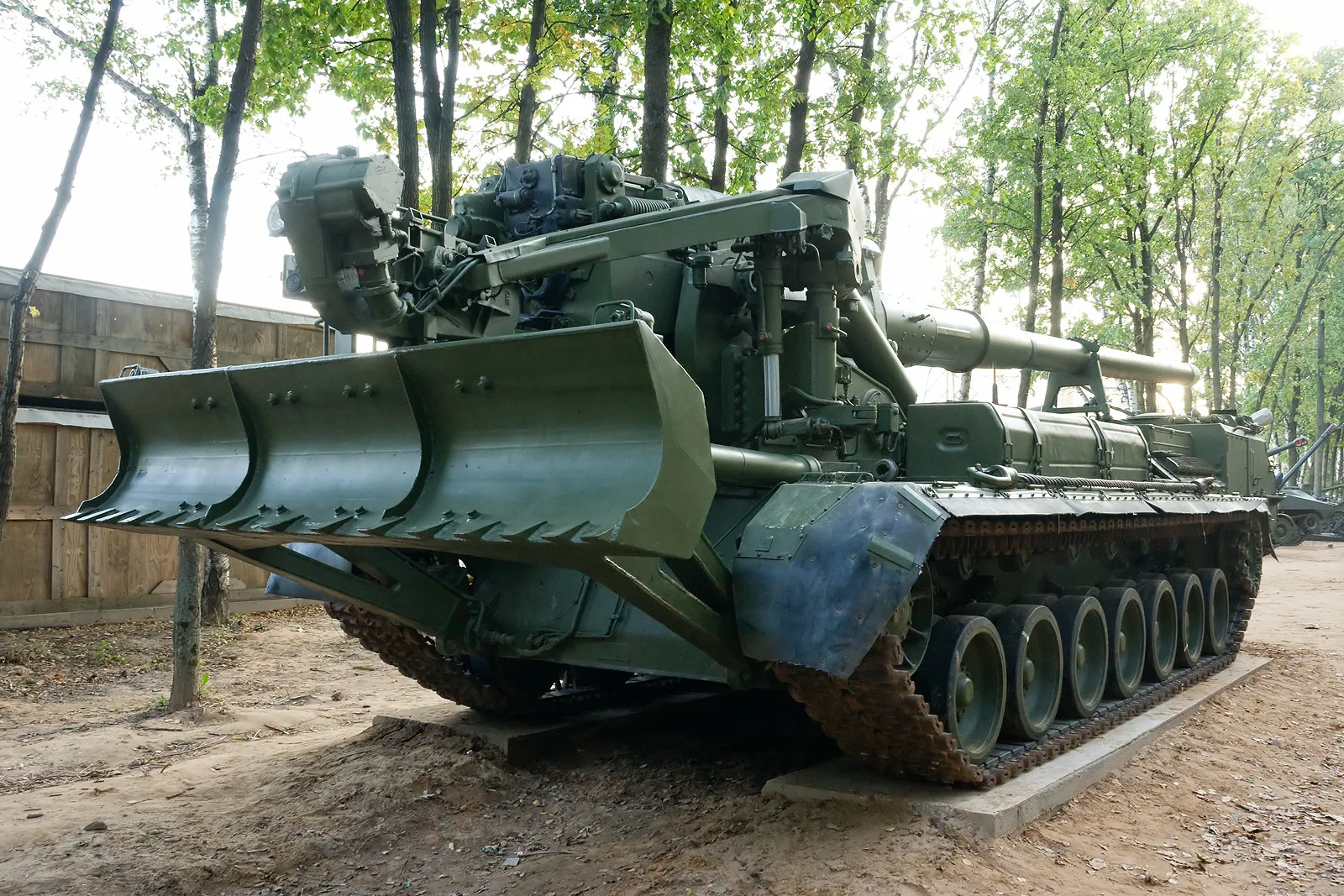


Operated by both Russian and Ukrainian forces: Russia has reactivated and fielded 2S7/2S7M guns for long-range fire support and counterbattery work, while Ukrainian 43rd Artillery Brigade reporting documents 2S7 Pion guns in Ukrainian service using scarce 203 mm ammunition.
Role detailsArtillery
2S7 Pion
Also known as
- SO-203
- M1975
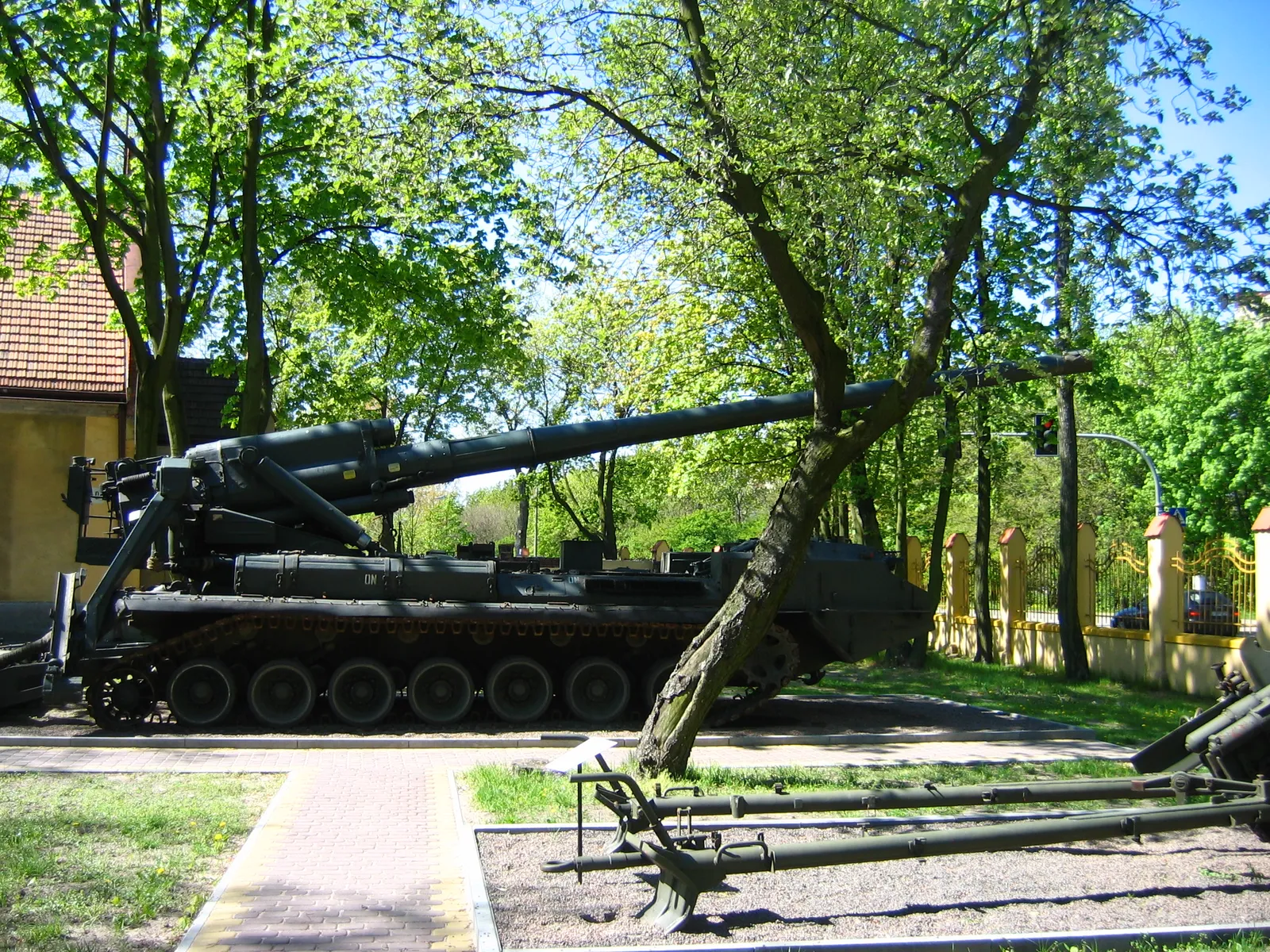
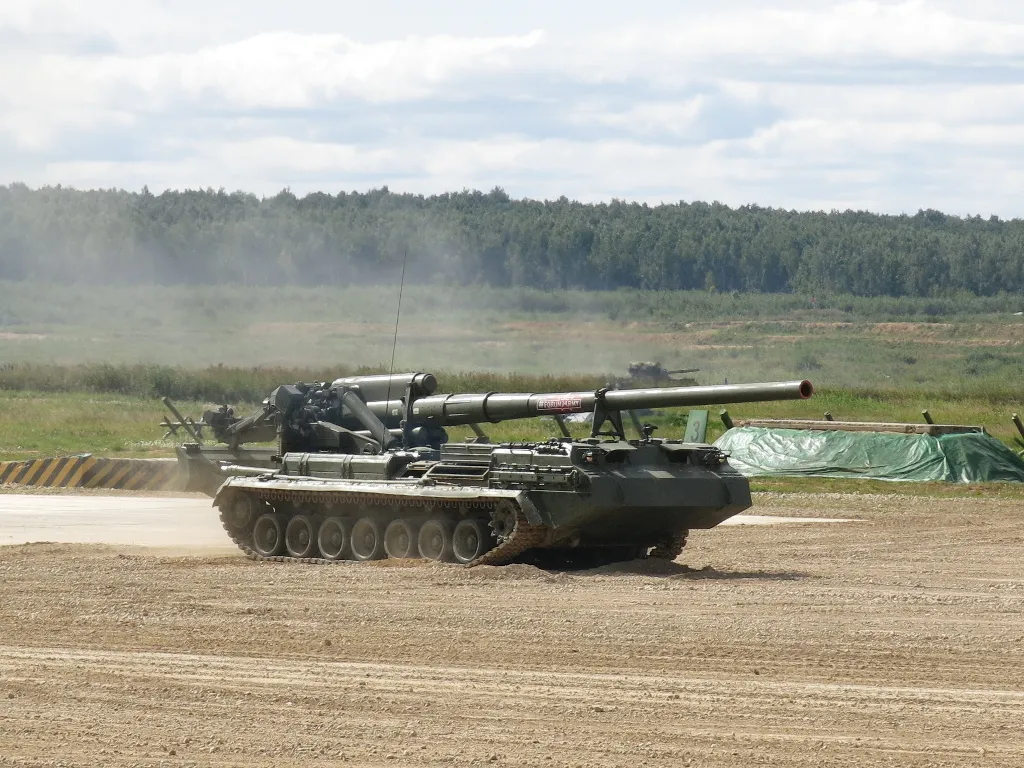
The 2S7 Pion is a Soviet 203 mm tracked self-propelled gun built for long-range, high-power fires against important rear-area targets. Its 2A44 gun, T-80-derived tracked chassis, and rocket-assisted projectile range kept the Pion and Malka family visible in several post-Soviet wars, including documented Georgian losses in 2008, Azerbaijani 2020 use, and Russian and Ukrainian operation during the 2014 Russia-Ukraine War.
Role in Conflicts
- Side
- Georgia
- Role in conflict
- Heavy artillery fire support

Documented on the Georgian side through visually confirmed 2008 war losses: Oryx lists Georgian 203 mm 2S7 Pion self-propelled guns among equipment lost during the conflict.
- Side
- Azerbaijan
- Role in conflict
- Heavy long-range artillery fires

Documented in Azerbaijani use during the 2020 Nagorno-Karabakh fighting, where operational analysis described Azerbaijan employing heavy 2S7 artillery as part of its fires and counterbattery effort.
Documented Combat Use
The 2S7 appears in these conflicts as a scarce, high-power artillery asset rather than as a routine divisional howitzer.
| Conflict | Documented side | Documented context |
|---|---|---|
| 2008 Russo-Georgian War | Georgia | Georgian 203 mm 2S7 Pion losses are listed among visually confirmed equipment losses after the conflict. |
| 2020 Nagorno-Karabakh Conflict | Azerbaijan | Operational analysis described Azerbaijani 2S7 use within the 2020 fires and counterbattery campaign. |
| 2014 Russia-Ukraine War | Russia and Ukraine | Russian fielding and Ukrainian 43rd Artillery Brigade operation are documented, including the ammunition burden of keeping 203 mm guns active. |
Profile / Specs
Profile
- Origin
- Soviet Union
- Type
- 203 mm tracked self-propelled gun
- Service note
- Cold War design, retained and reactivated for contemporary long-range artillery roles
- Designer
- Kirov Factory and Barrikady Arsenal
- Designed
- 1967-1975
- Produced
- 1976-1990
- Number built
- 500+
Specifications
- Caliber
- 203 mm 2A44 gun, L/56
- Maximum range
- About 37.4-37.5 km with standard ammunition; about 47.5 km with rocket-assisted projectiles
- Rate of fire
- About 1.5 rounds per minute for 2S7 Pion; up to 2.5 rounds per minute for 2S7M Malka
- Crew
- Seven carried on the vehicle, with a larger gun detachment and support vehicle for remaining crew and ammunition
- On-vehicle ammunition
- Base 2S7 vehicles carry only a small ready supply, with additional rounds and crew normally supported by a separate vehicle
- Emplace/displace time
- About 5-6 minutes to prepare for firing and about 3-5 minutes to leave the firing position
- Combat weight
- About 45-46.5 tonnes
- Mobility
- Tracked chassis; about 50 km/h road speed and up to 650 km road range
- Protection
- Steel armor up to about 10 mm; gun crew is exposed when operating the rear-mounted weapon
Variants
The Pion family separates the original 2S7 from the modernized 2S7M Malka, which is tracked as its own public catalog record.
| Variant | Configuration | Designation notes |
|---|---|---|
 | Modernized 203 mm self-propelled gun | The 2S7M Malka modernization is documented with a higher maximum rate of fire and greater carried ammunition capacity than the original 2S7 Pion. Sources: 2S7 Pion, 2S7 Pion - The World Wars.net |
Ammunition Fired
The 2S7 Pion fires standard 203 mm ammunition from its Soviet family and has also been documented in Ukrainian service with U.S.-made M106 rounds.
| Ammunition | Ammunition type | Firing evidence |
|---|---|---|
 | 203 mm high-explosive projectile | Armament Research explicitly states that the 2S7 fires 3OF43 high-explosive projectiles, with a range of up to 37.4 km. Sources: Ukrainian government returns 2S7 Pion self-propelled artillery to service |
 | 203 mm rocket-assisted high-explosive projectile | Armament Research states that 3OF44 rocket-assisted HE projectiles are available for the 2S7 Pion system with a maximum range of 47.5 km. Sources: Ukrainian government returns 2S7 Pion self-propelled artillery to service |
 | 203 mm high-explosive fragmentation projectile | Army Recognition documents Ukrainian 2S7 Pion crews using U.S.-made M106 ammunition, describing the compatibility as possible because both are 203 mm rounds and showing the shell in service with the 2S7's 203 mm gun. Sources: Ukrainian Forces Use 203mm US Ammunition with Russian 2S7 Self-Propelled Howitzer |
Timeline
2S7 Pion Key Events
Program start, 1967
Development of the 2S7 program began as the Soviet Army sought a new 203 mm self-propelled gun.
Sources: 2S7 Pion - The World Wars.net
Adopted for Soviet service, 1975
The system was adopted for Soviet Army service and identified as M-1975 in NATO usage.
Sources: 2S7 Pion - The World Wars.net, 2S7 Pion
Service entry, 1976
Reference sources list 1976 as the base 2S7 Pion service-entry year.
Sources: 2S7 Pion, Category:2S7 Pion - Wikimedia Commons
2S7M Malka enters service, 1986
The upgraded 2S7M Malka variant entered service with higher ammunition capacity and a faster rate of fire.
Sources: 2S7 Pion, 2S7 Pion - The World Wars.net
Georgian losses documented, 2008
The 2S7 appeared in the Russo-Georgian War through documented Georgian losses listed after the conflict.
Sources: Russia's Wars: Listing Equipment Losses During The 2008 Russo-Georgian War
Ukrainian Pions returned to service, 2014
Armament Research Services documented the Ukrainian government's return of 2S7 Pion guns to service during the early Russia-Ukraine War period.
Sources: Ukrainian government returns 2S7 Pion self-propelled artillery to service
Nagorno-Karabakh use documented, 2020
Operational analysis of the 2020 Nagorno-Karabakh fighting described Azerbaijani use of 2S7 artillery as part of its fires effort.
Sources: Les enseignements operationnels de la guerre du Haut-Karabakh
Wartime use visible on both sides, 2022
U.S. Army operational-environment reporting and Ukrainian media coverage documented Russian fielding and Ukrainian operation of Pion-family guns during the full-scale phase of the Russia-Ukraine War.
Sources: Russia Fielding 2S7 Pion Heavy Artillery in Ukraine Conflict, American 203mm Married to Soviet Powders, or How 2S7 Pion Gun Still Keeps Firing in Ukraine
Related Weapon Systems


Sources
Ukrainian Forces Use 203mm US Ammunition with Russian 2S7 Self-Propelled HowitzerPublisher: Army Recognition | Note: Supports the Ukrainian 2S7/M106 relationship and the published article images showing U.S.-made 203 mm ammunition with the 2S7 Pion. | Accessed: 2026-06-232S7 PionPublisher: WeaponSystems.net | Note: Supports origin, developer/producer background, variants, armament, range, rate-of-fire, mobility, protection, and production context. | Accessed: 2026-06-202S7 Pion - The World Wars.netPublisher: The World Wars | Note: Supports the 1967 development start, 1975 adoption, and 1986 2S7M service-entry timeline claims. | Accessed: 2026-06-24Soviet 2s7 Pion SPG (1975) - Tank-AFVPublisher: Tank-AFV | Note: Supports the 500+ built estimate and the 1975 adoption timeline context. | Accessed: 2026-06-24Category:2S7 Pion - Wikimedia CommonsPublisher: Wikimedia Commons | Note: Supports the 1976 service-entry listing in the category metadata. | Accessed: 2026-06-242S7 Pion, Self-propelled gunPublisher: Army Guide | Note: Supports technical details for the 2A44 gun, ammunition handling, range, crew, weight, speed, and vehicle layout. | Accessed: 2026-06-202S7 Pion M1975 203mm Self-Propelled GunPublisher: Federation of American Scientists | Note: Supports technical background for firing-position preparation, displacement timing, mobility, and crew/ammunition handling context. | Accessed: 2026-06-30Ukrainian government returns 2S7 Pion self-propelled artillery to servicePublisher: Armament Research Services | Note: Supports the 2S7 firing relationship to 3OF43 high-explosive projectiles, the ammunition family context, and Ukraine returning 2S7 Pion guns to service during the 2014 Russia-Ukraine War. | Accessed: 2026-06-30203mm shells for 2A44 howitzerPublisher: WeaponSystems.net | Note: Supports the 3OF43 ammunition-family context for the 2S7 2A44 gun. | Accessed: 2026-06-23Russia Fielding 2S7 Pion Heavy Artillery in Ukraine ConflictPublisher: T2COM G2 Operational Environment Enterprise | Note: Supports Russian 2S7/2S7M fielding and operational context in the 2014 Russia-Ukraine War. | Accessed: 2026-06-20Big Guns: Ukrainian Long-Range Artillery Targets Russian Command Posts, Ammo DepotsPublisher: Radio Free Europe/Radio Liberty | Note: Supports direct 2014 Russia-Ukraine War use by documenting Ukrainian 2S7 Pion crews firing long-range artillery in Donetsk region. | Accessed: 2026-06-30American 203mm Married to Soviet Powders, or How 2S7 Pion Gun Still Keeps Firing in UkrainePublisher: Defense Express | Note: Supports direct 2014 Russia-Ukraine War conflict use by documenting Ukrainian 2S7 Pion operation by the 43rd Artillery Brigade and wartime 203 mm ammunition context. | Accessed: 2026-06-2043rd Artillery Brigade Hints at Receiving Additional Shells for 2S7 Pion Cannon and MorePublisher: Defense Express | Note: Additional support for direct 2014 Russia-Ukraine War conflict use by documenting Ukrainian 43rd Artillery Brigade 2S7 Pion service and 203 mm ammunition context. | Accessed: 2026-06-20Russia's Wars: Listing Equipment Losses During The 2008 Russo-Georgian WarPublisher: Oryx | Note: Supports 2008 Russo-Georgian War use by listing Georgian 203 mm 2S7 Pion self-propelled guns among documented wartime equipment losses. | Accessed: 2026-06-30Les enseignements operationnels de la guerre du Haut-KarabakhPublisher: Le Grand Continent | Note: Supports 2020 Nagorno-Karabakh Conflict use by describing Azerbaijani employment of 2S7 artillery during the 2020 fighting. | Accessed: 2026-06-30File:2S7 Pion.jpgPublisher: Wikimedia Commons | Note: Primary image source; page identifies the system and lists CC BY-SA 3.0/GFDL licensing options. | Accessed: 2026-06-20File:Armata samobiezna 2S7 Pion.jpgPublisher: Wikimedia Commons | Note: Gallery image source for a 2S7 Pion at the Torun Artillery Museum with reusable licensing listed on the file page. | Accessed: 2026-06-20File:2S7 Pion at ARMY-2018.jpgPublisher: Wikimedia Commons | Note: Gallery image source for a Pion/Malka-family vehicle at Army-2018 under CC BY-SA 4.0. | Accessed: 2026-06-20