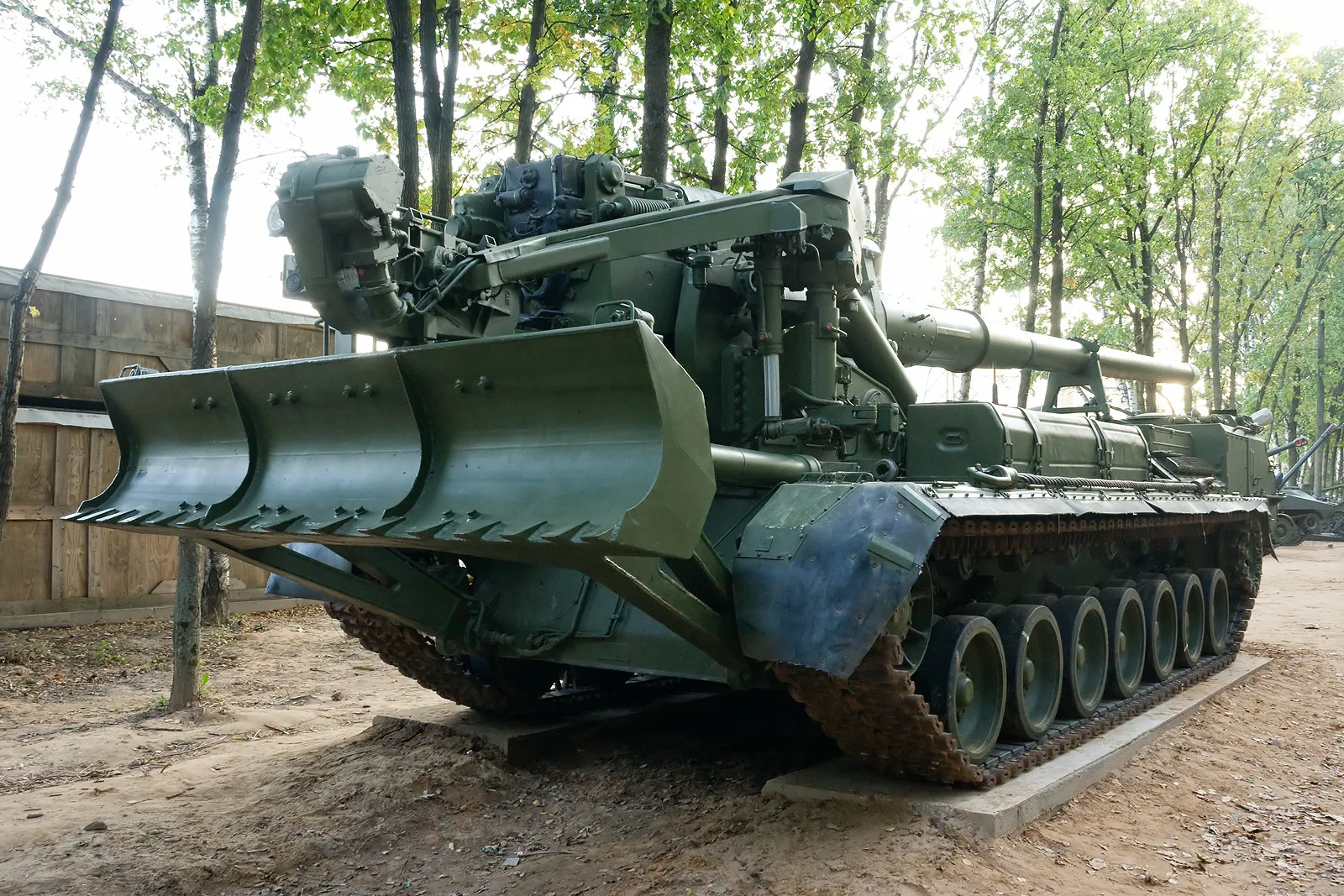


Defense Express reported in May 2026 that Russian occupation forces were using OF43 high-explosive fragmentation shells and OF44/ZVOF35 rocket-assisted rounds with 203 mm 2S7 Pion guns in Ukraine, while separate reporting documented Ukrainian 2S7 combat use and 203 mm ammunition in 43rd Artillery Brigade service. Ukrainian OF44 firing was not directly confirmed in the sources checked.
Role detailsMunitions
203 mm shells for 2A44 howitzer
Also known as
- 203mm shells for 2A44 howitzer
- 2A44 ammunition
- 203 mm 2A44 ammunition
- 203mm Soviet artillery shells
- 3OF43
- 3OF44
- 3O14
- 3G3 Galyan
- 3BV2 Kleshchevina
- Sazhenets
- 3VOF34
- 3VOF42
- 3VOF35
- 3VO15
- 3VO16
- 3VG11
- 3O14 Sklad
- 3OF43 Albatros
- 3OF44 Burevestnik-2
The 203 mm shells for the 2A44 howitzer are the Soviet separate-loading ammunition family for 2S7 Pion and 2S7M Malka heavy guns. Public references distinguish standard 3OF43 high-explosive fragmentation projectiles, 3OF44 rocket-assisted projectiles, 3O14 cluster shells, concrete-piercing and special-shell designs, plus current Russian OF43/OF44 use and Ukrainian 203 mm ammunition use in the Russia-Ukraine War.
Role in Conflicts
Profile / Specs
Profile
- Origin
- Soviet Union
- Built in
- Soviet UnionRussian Federation
- Type
- 203 mm separate-loading artillery ammunition family
- Service note
- Cold War Soviet ammunition family retained in 2S7 and 2S7M service
- Designer
- Barrikady arsenal for conventional shells; VNIITF for Kleshchevina nuclear-shell work
- Designed
- Mid-1960s to mid-1970s for the 2S7 ammunition family
- Produced
- Mid-1970s-present for conventional 203 mm rounds
Specifications
- Caliber
- 203 mm
- Ammunition class
- Separate-loading bagged-charge artillery ammunition for the 2A44 gun
- Firing systems
- 2S7 Pion and 2S7M Malka
- Standard HE projectile
- 3OF43 / 3VOF34 long-range round with full 4-Z-2 charge; 3VOF42 reduced-charge round; 110 kg projectile with 17.8 kg A-IX-2 explosive filler
- Rocket-assisted HE projectile
- 3OF44 Burevestnik-2 / 3VOF35 round; about 102 kg projectile with about 13.3 kg A-IX-2 filler and full 4-Z-2 charge
- Cluster projectile
- 3O14 Sklad shell for 3VO15 and 3VO16 rounds with 24 3O16 fragmentation submunitions
- Concrete-piercing projectile
- 3G3 Galyan in the 3VG11 round for highly protected targets
- Special shell entries
- 3BV2 Kleshchevina, Sazhenets, and the reportedly unadopted Perforator design
- Maximum conventional range
- About 37.4 km with 3OF43 in 3VOF34; about 47.5 km with 3OF44 rocket-assisted ammunition
- Common fuze listed for HE shells
- V-491 point-detonating fuze on 3OF43 and 3OF44 ammunition references; DTM-75 distance tube listed for 3O14 cluster rounds
- Service temperature envelope
- About -50 to +50 degrees C for the conventional projectile entries listed by WeaponSystems.net
Variants
The family combines conventional and special 203 mm projectiles for the 2A44 gun. The catalog tracks the standard 3OF43, rocket-assisted 3OF44, and Sazhenets shell as separate linked records where enough source detail exists.
| Variant | Configuration | Designation notes |
|---|---|---|
 | Standard high-explosive fragmentation projectile | WeaponSystems.net and ARES identify 3OF43 as the HE-fragmentation projectile used in the 3VOF34 long-range and 3VOF42 short-range rounds; Боеприпасник lists the full-charge and reduced-charge round combinations, and CAT-UXO also distinguishes 3OF43 as the projectile rather than the complete round. Sources: 203mm shells for 2A44 howitzer, Ukrainian government returns 2S7 Pion self-propelled artillery to service, Боеприпасник 203 - OF43, CAT-UXO 203mm OF43 projectile |
 | Rocket-assisted high-explosive fragmentation projectile | WeaponSystems.net and ARES identify 3OF44 as the rocket-assisted HE projectile used in the 3VOF35 round, and the specialist ammunition reference lists the Burevestnik-2 name, full-charge configuration, and about 47.5 km maximum range. Sources: 203mm shells for 2A44 howitzer, Ukrainian government returns 2S7 Pion self-propelled artillery to service, 203 mm 3VOF35 round with 3OF44 projectile |
 | Special nuclear shell | WeaponSystems.net lists Sazhenets as an improved nuclear-shell design in the 203 mm 2A44 family; the linked catalog record separately covers its narrow public-source trail. Sources: 203mm shells for 2A44 howitzer |
| 3O14 | Cluster munition shell | WeaponSystems.net lists 3O14 as the cluster shell used in 3VO15 and 3VO16 rounds, ARES describes the pictured 3-O-14 cargo projectile as carrying 24 fragmentation submunitions, and Боеприпасник identifies the Sklad name and 3O16 fragmentation elements. Sources: 203mm shells for 2A44 howitzer, Ukrainian government returns 2S7 Pion self-propelled artillery to service, Боеприпасник 203 - O14 |
| 3G3 Galyan | Concrete-piercing shell | WeaponSystems.net describes 3G3 Galyan as a concrete-piercing shell for the 2VG11 round, and Техника и вооружение describes the 3VG11/3G3 round as intended for highly protected targets such as command posts and fortifications. Sources: 203mm shells for 2A44 howitzer, Техника и вооружение №2/2019: Самоходная пушка 2С7 Пион |
| 3BV2 Kleshchevina | Special nuclear shell | WeaponSystems.net lists Kleshchevina as a plutonium-based nuclear shell introduced in 1977 and states that it could be fired from the B-4M and 2S7 Pion; Техника и вооружение separately describes the 3BV2 special-shell entry as a VNIITF design accepted in 1977. Sources: 203mm shells for 2A44 howitzer, Техника и вооружение №2/2019: Самоходная пушка 2С7 Пион |
Firing Weapons
The 203 mm shell family is tied to the 2A44 gun carried by the 2S7 heavy artillery line.
| Firing weapon | Weapon type | Firing evidence |
|---|---|---|
 | 203 mm tracked self-propelled gun | WeaponSystems.net states that the 2S7 Pion and improved 2S7M Malka are the only weapon systems using this ammunition range, and ARES describes the 2S7 firing 3OF43 while also listing 3OF44 and 3-O-14 projectiles for the system. Sources: 203mm shells for 2A44 howitzer, Ukrainian government returns 2S7 Pion self-propelled artillery to service |
 | Modernized 203 mm tracked self-propelled gun | WeaponSystems.net treats the improved 2S7M Malka as part of the same 2A44 ammunition family, and the specialist 3OF44 reference says the 3VOF35 round is used from both 2S7 Pion and 2S7M Malka guns. Sources: 203mm shells for 2A44 howitzer, 203 mm 3VOF35 round with 3OF44 projectile |
Conventional Projectile Comparison
The conventional 2A44 ammunition set separates projectile designations from complete round designations. That distinction matters because shorthand references often mix 3OF43, 3OF44, or 3O14 projectiles with 3VOF- and 3VO-series complete rounds.
| Projectile | Complete round | Source-backed distinction |
|---|---|---|
| 3VOF34 / 3VOF42 | Standard HE-fragmentation projectile. The 3VOF34 round uses a full charge and is listed at about 37.4 km, while 3VOF42 uses a reduced variable charge and is listed at about 25.4 km. |
| 3VOF35 | Rocket-assisted HE-fragmentation projectile. The cited range is about 47.5 km, trading a smaller explosive fill for longer reach. |
| 3O14 | 3VO15 / 3VO16 | Cluster shell entry. ARES identifies the cargo projectile with 24 fragmentation submunitions, while Боеприпасник lists the Sklad name, DTM-75 distance tube, and 3O16 submunition details. |
Complete Round And Charge Notes
The projectile and round labels describe different parts of the ammunition package. In the sources used here, 3OF43 and 3OF44 are projectile designations, while 3VOF34, 3VOF42, and 3VOF35 identify complete rounds built around those projectiles and their charges.
Full-charge HE
3VOF34 combines the 3OF43 projectile with the full 4-Z-2 charge for the longer-range conventional HE entry.
Reduced-charge HE
3VOF42 uses the same 3OF43 projectile with a reduced variable 4-Z-3 charge for a shorter listed range.
Rocket-assisted HE
3VOF35 combines the 3OF44 rocket-assisted projectile with the full 4-Z-2 charge and a published range of about 47.5 km.
Compatibility Notes
The 203 mm bore diameter can be misleading when comparing Soviet 2A44 ammunition with older 203 mm artillery. WeaponSystems.net states that the 2A44 used the same broad bore class as the earlier B-4, but that the World War II-era and modern ammunition ranges are not interchangeable because the later shells are larger and built for much higher pressures.
Firing family
2S7 Pion and 2S7M Malka are the documented 2A44-family firing systems.
Loading method
Separate-loading shells and bagged charges, assisted by the 2S7 mechanized loading tray.
Conflict evidence
The compact conflict row covers Russian OF43/OF44 use and Ukrainian 203 mm 2S7 ammunition use in Ukraine; Ukrainian OF44 firing remains source-limited.
Timeline
203 mm shells for 2A44 howitzer Key Events
Ammunition-family development window opens
WeaponSystems.net places development of the 2A44 ammunition family in the mid-1960s to mid-1970s, aligned with the 2S7 Pion program.
Sources: 203mm shells for 2A44 howitzer
2A44 ammunition family enters service
WeaponSystems.net lists 1976 service entry for the 203 mm ammunition family for the 2A44 howitzer.
Sources: 203mm shells for 2A44 howitzer
Kleshchevina nuclear shell introduced
WeaponSystems.net dates the 3BV2 Kleshchevina nuclear shell to 1977 and describes it as part of the 203 mm family that could be fired from the 2S7 Pion.
Sources: 203mm shells for 2A44 howitzer
ARES documents Ukrainian 2S7 ammunition context
ARES identified the 3OF43, 3OF44, and 3-O-14 projectiles in its report on Ukraine returning 2S7 Pion guns to service.
Sources: Ukrainian government returns 2S7 Pion self-propelled artillery to service
Russian OF43 and OF44 use reported in Ukraine
Defense Express reported Russian use of OF43 and OF44 rounds with 2S7 Pion guns in Ukraine and discussed Russian procurement pressure around 203 mm ammunition.
Sources: Russian Army Uses Rare OF44 Shells For 2S7 Pion SPGs
Russian 203 mm order details summarized
Militarnyi summarized public procurement data naming Russian 3VOF34/OF43, 3VOF35/OF44, and 3VO15/3O14 orders for 2S7 and 2S7M ammunition, while noting that the 2025 plan it reviewed listed OF43 only.
Sources: Secrets of the State Defense Order
Media
203 mm shells for 2A44 howitzer Videos
Related Weapon Systems


Sources
203mm shells for 2A44 howitzerPublisher: WeaponSystems.net | Note: Supports family identity, Soviet origin, development and service dates, producer countries, 2S7/2S7M compatibility, projectile list, non-interchangeability with earlier 203 mm ammunition, separate-loading charge context, conventional projectile specifications, and the Kleshchevina/Sazhenets/Perforator family notes. | Accessed: 2026-07-13Ukrainian government returns 2S7 Pion self-propelled artillery to servicePublisher: Armament Research Services | Note: Supports 2S7-family ammunition context, including 3OF43 range and filler, 3OF44 rocket-assisted availability and range, 3-O-14 cargo projectile context, and projectile-versus-round nomenclature. | Accessed: 2026-07-13Russian Army Uses Rare OF44 Shells For 2S7 Pion SPGsPublisher: Defense Express | Note: Supports 2014 Russia-Ukraine War direct conflict-use context by reporting Russian occupation-force use of OF43 high-explosive fragmentation shells and OF44/ZVOF35 rocket-assisted rounds with 203 mm 2S7 Pion guns in Ukraine, plus Russian 203 mm ammunition procurement and stockpile-pressure context. | Accessed: 2026-07-13Role of 2S7 Pion in battle for UkrainePublisher: Militarnyi | Note: Supports 2014 Russia-Ukraine War direct conflict-use context for Ukrainian 2S7 Pion combat use and OF43 projectile context in 43rd Artillery Brigade service; it does not directly confirm Ukrainian OF44 firing. | Accessed: 2026-07-13Secrets of the State Defense OrderPublisher: Militarnyi | Note: Supports Russian procurement and production context for 3VOF34/OF43, 3VOF35/OF44, and 3VO15/3O14 ammunition for 2S7 and 2S7M guns; procurement context is not treated as firing evidence by itself. | Accessed: 2026-07-13CAT-UXO 203mm OF43 projectilePublisher: CAT-UXO | Note: Supports the OF43 projectile designation, 3VOF34 complete-round terminology, high-explosive fragmentation role, and 2S7/2S7M compatibility context. | Accessed: 2026-07-13Боеприпасник 203 - OF43Publisher: Боеприпасник | Note: Supports 3VOF34 and 3VOF42 round composition, 3OF43/Albatros identity, V-491 fuze, 4-Z-2 full charge, 4-Z-3 reduced variable charge, projectile mass and filler, ranges, and 2S7/2S7M use. | Accessed: 2026-07-13203 mm 3VOF35 round with 3OF44 projectilePublisher: Боеприпасник | Note: Supports 3VOF35 and 3OF44 identity, the 2S7/2S7M firing-system relationship, projectile mass and filler, V-491 fuze, full 4-Z-2 charge, and approximately 47.5 km maximum range for the rocket-assisted round. | Accessed: 2026-07-13Боеприпасник 203 - O14Publisher: Боеприпасник | Note: Supports 3O14/Sklad identity, 3VO15 and 3VO16 round entries, DTM-75 distance tube, 24 3O16 fragmentation elements, projectile and submunition masses, filler, and listed ranges. | Accessed: 2026-07-13Техника и вооружение №2/2019: Самоходная пушка 2С7 ПионPublisher: Техника и вооружение вчера, сегодня, завтра / ООО Издательство ТЕХИНФОРМ | Note: Supports 2A44 development context, 3G3 Galyan concrete-piercing role and adoption, 3O14 and 3O16 submunition structure, 3BV2 special-shell adoption by VNIITF, and special-ammunition range limits. | Accessed: 2026-07-13File:2S7 Pion.jpgPublisher: Wikimedia Commons | Note: Supports image provenance for the contextual 2S7 Pion image used because the 2A44 ammunition family is documented through the firing gun family and reusable shell imagery was not available with clear rights. | Accessed: 2026-07-13