Profile
- Origin
- Soviet Union
- Built by
- Soviet munitions industry
- Type
- 122 mm anti-concrete shell
- Service note
- World War II Soviet artillery ammunition
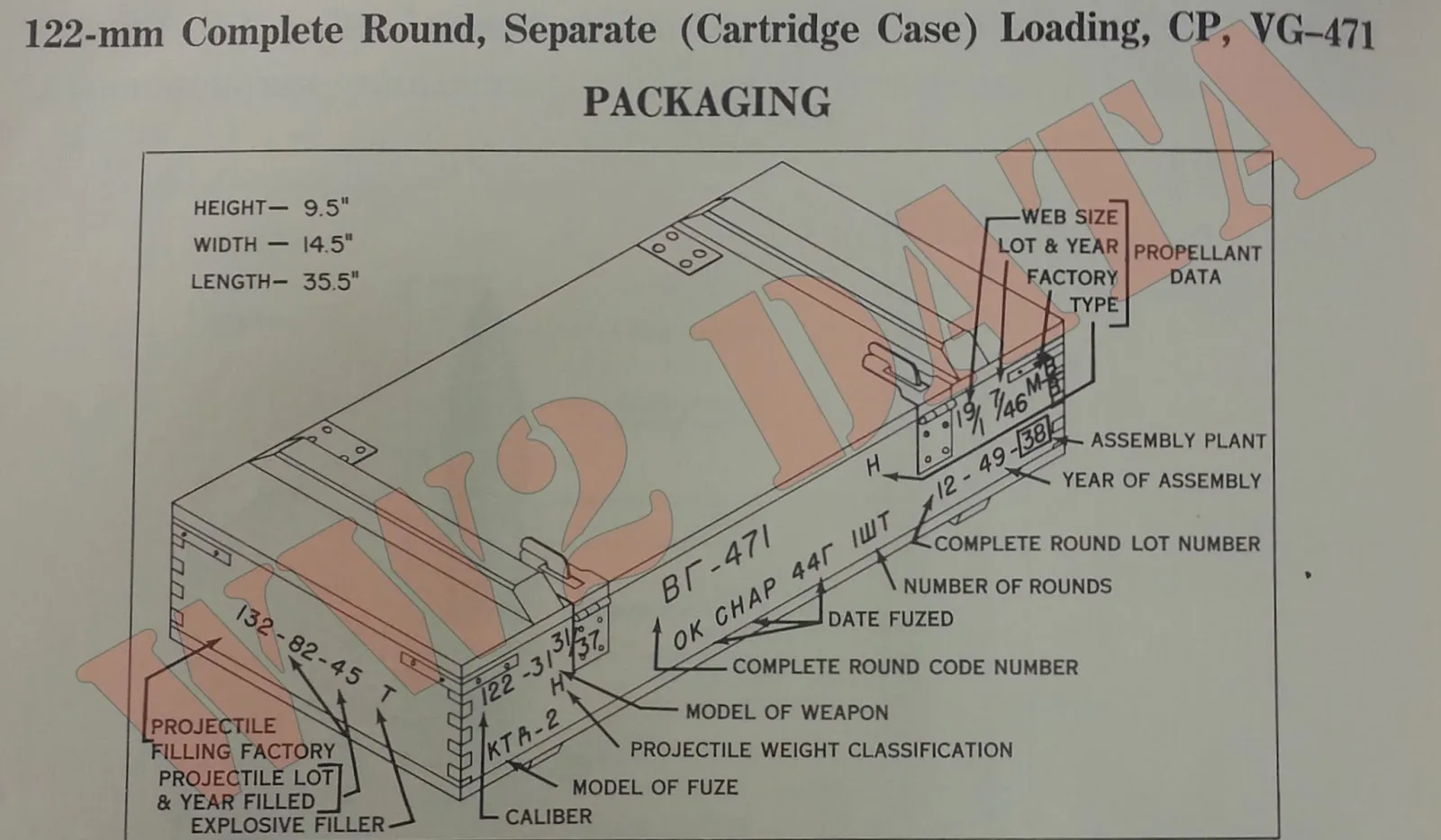
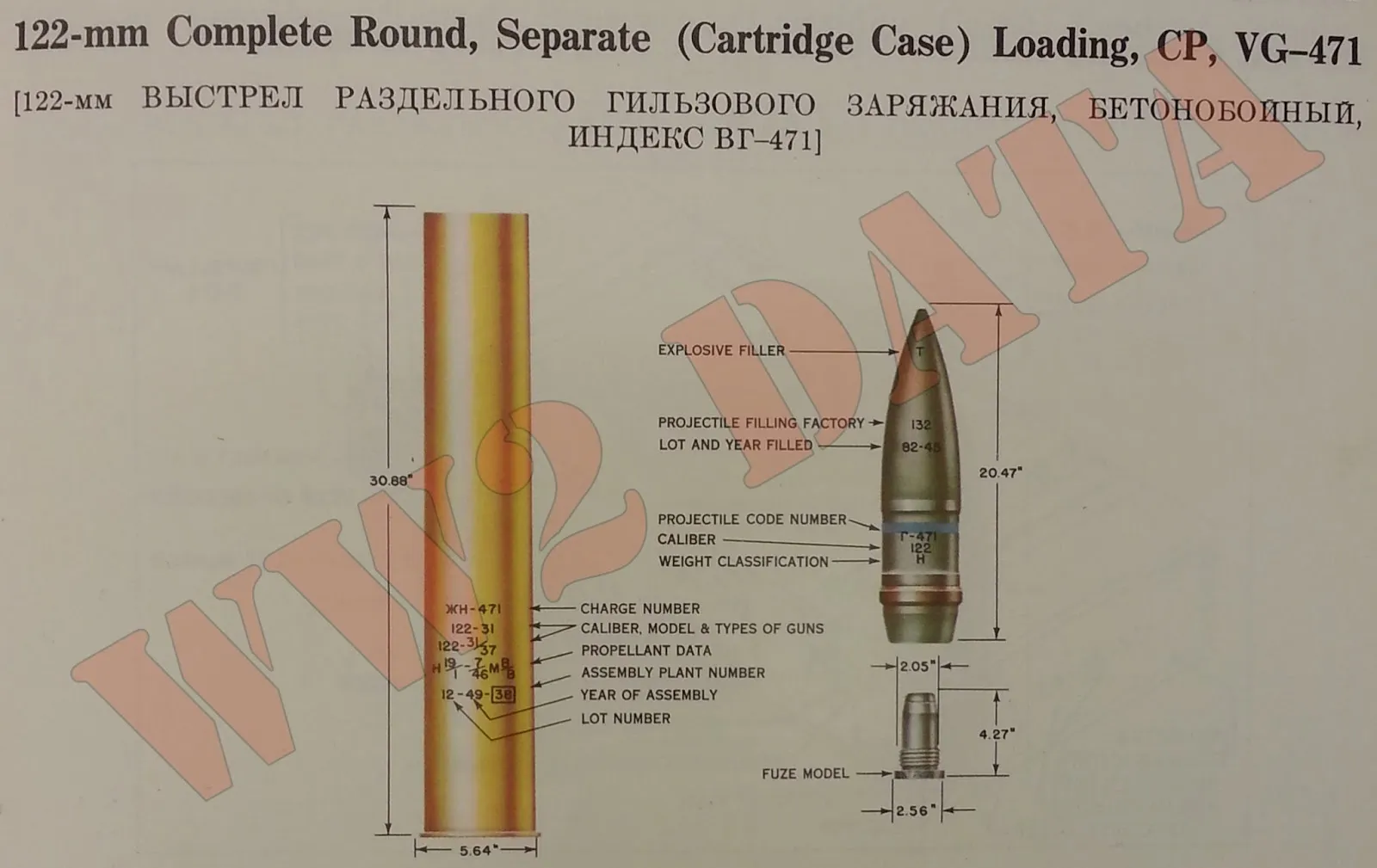
G-471 is a Soviet 122 mm high-explosive concrete-piercing projectile for the A-19 gun line and related D-25-family self-propelled guns. Ammunition references and a Polish postwar A-19 instruction identify the G-471/VG-471 round as a reinforced-target projectile using a KTD-2 fuze, a 25 kg projectile, a 2.2 kg TNT filler, and A-19-family separate-loading charges.
A-19 ammunition references and the VG-471 round description place G-471 in the A-19 gun line and related self-propelled-gun family.
| Firing weapon | Weapon type | Firing evidence |
|---|---|---|
 | 122 mm corps gun | A-19 ammunition tables list G-471 as an anti-concrete shell, and the Polish 122 mm wz. 1931/37 instruction identifies G-471 as the concrete-piercing projectile used with KTD-2 fuze settings. Sources: A-19 ammunition table, Polish 122 mm A-19 artillery instruction |
 | 122 mm self-propelled and tank gun family | WW2 Equipment Data describes the VG-471 concrete-piercing round as fired from A-19 corps guns and from A-19S/D-25S self-propelled-gun weapons mounted in JSU-122 vehicles; the catalog links that relationship through the published D-25 family record. Sources: WW2 Equipment Data G-471 article |
The same A-19 ammunition tables and related catalog records place G-471 beside other 122 mm projectiles already represented as linked ammunition pages.
| Compatible item | Item type | Compatibility evidence |
|---|---|---|
 | 122 mm high-explosive fragmentation shell | The A-19 and Ruwiki ammunition tables list OF-471 and G-471 in the same 122 mm A-19 ammunition set, with OF-471 covering the high-explosive fragmentation role and G-471 the concrete-piercing role. Sources: A-19 ammunition table, Ruwiki A-19 ammunition table |
| 122 mm armor-piercing projectile | The A-19 and Ruwiki ammunition tables list BR-471 as an armor-piercing projectile in the same 122 mm gun-family ammunition context as G-471. Sources: A-19 ammunition table, Ruwiki A-19 ammunition table |
| 122 mm armor-piercing capped shell | The A-19 and Ruwiki ammunition tables list BR-471B as the improved armor-piercing capped shell alongside the broader A-19 ammunition family that includes G-471. Sources: A-19 ammunition table, Ruwiki A-19 ammunition table |
The sources describe G-471 as a separate-loading concrete-piercing round rather than a general high-explosive shell. They agree on the core A-19-family ballistic figures while adding handling and identification details.
G-471 is the projectile designation; VG-471 is used for the complete separate-loading round context, and Russian tables also show 53-Г-471.
Bullet Picker and WW2 Equipment Data describe the projectile as a gun-fired concrete-piercing round with a high-explosive charge for hardened or reinforced targets.
The Polish A-19 instruction lists G-471 with the KTD-2 fuze, while WW2 Equipment Data identifies KTD-2 as the fuze used in the VG-471 round.
The available sources support firing compatibility and projectile characteristics, so this page remains a linked ammunition profile without conflict rows.
Source labels: A-19 ammunition table, Ruwiki A-19 ammunition table, WW2 Equipment Data G-471 article, Bullet Picker G-471 projectile, Polish 122 mm A-19 artillery instruction.
A Polish Ministry of National Defence artillery instruction for the 122 mm wz. 1931/37 gun lists G-471 as the concrete-piercing projectile and gives KTD-2 fuze context for that ammunition.
Sources: Polish 122 mm A-19 artillery instruction
The printed 1949 instruction shows the G-471 round remained part of the documented A-19-family ammunition set in postwar Polish service manuals.
Sources: Polish 122 mm A-19 artillery instruction