Artillery

M107 155 mm high-explosive projectile

Also known as
  • M107 HE
  • 155mm M107 HE
  • M107 high-explosive projectile
  • M107 155mm HE projectile
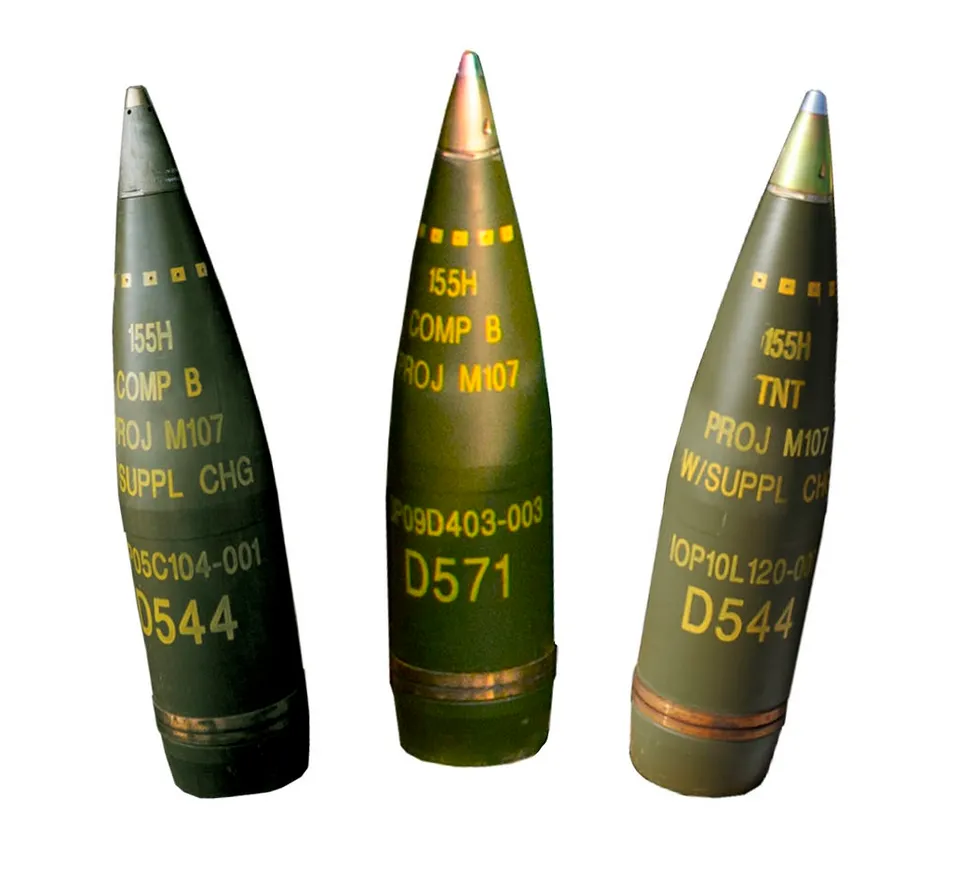
  • D544 deep-cavity M107
  • D571 normal-cavity M107

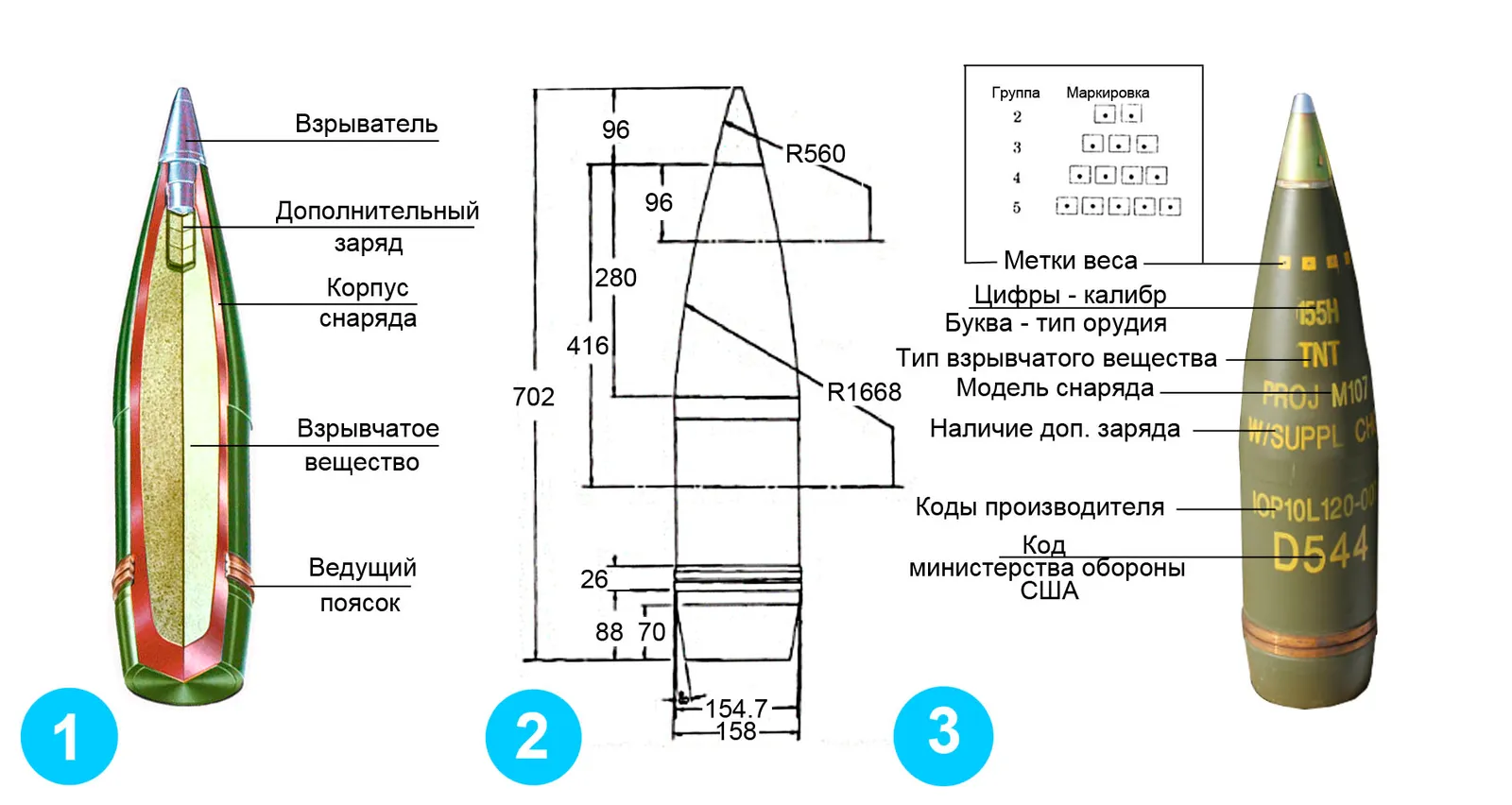
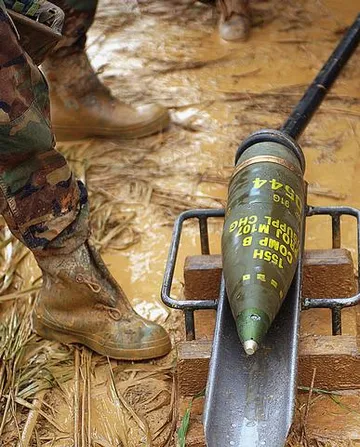
The M107 is a conventional 155 mm high-explosive projectile with a forged-steel body, TNT or Composition B fill, and deep- or normal-cavity variants for different fuze fits. U.S. Army ammunition records list it as an operations-and-sustainment item, Modern War Institute reporting places the M107 family in Ukraine's 155 mm ammunition mix, and U.S. emergency-sale notices document M107 deliveries to Israel during the 2023 Israel-Hamas War.

Role in Conflicts

Documented in Ukrainian 155 mm artillery service: a Modern War Institute article says Ukrainian forces operate many NATO and non-NATO 155 mm howitzers and identifies the U.S. M107 high-explosive family as a core shell family in Ukraine's ammunition mix.

Role details
Side
Israel

Supplied to Israel during the 2023 Israel-Hamas War: the Federal Register notice for the emergency sale says Israel requested 4,792 M107 155 mm HE projectiles, that the M107 and M795 projectile quantities had subsequently been delivered, and that the urgent 155 mm requirement was tied to Israel's war with Hamas and near-term operations in Gaza.

Role details
Profile / Specs

Profile

Origin
United States
Type
155 mm high-explosive projectile
Service note
Cold War-era 155 mm artillery ammunition still retained in the U.S. portfolio
Produced
Not in production as of 2017

Specifications

Caliber
155 mm
Weight
95 lb (43.2 kg)
Length
605.3 mm
Body
Forged steel shell
Explosive fill
14.6 lb TNT or 15.4 lb Composition B
Fuze compatibility
Deep fuze cavity variant permits the M782 Multi-Option Fuze; the normal cavity excludes deep intrusion proximity fuzes
Propelling charge
M119A2
Maximum range
18.1 km
Employment
Blast effect, fragmentation, and mining in support of ground troops and armored columns
Variants

U.S. Army ammunition records distinguish M107 fuze-cavity configurations, while the later M795 is an adjacent 155 mm HE projectile selected to replace the standard M107 over time.

VariantConfigurationDesignation notes
D544 deep fuze cavitydeep-cavity M107 configuration

The Army portfolio lists D544 as the deep fuze-cavity M107 variant, allowing the M782 Multi-Option Fuze with supplementary charge handling for other fuzes.

Sources: PEO Ammunition Portfolio Book 2017

D571 normal cavitynormal-cavity M107 configuration

The Army portfolio lists D571 as the normal-cavity M107 variant and notes that it uses all fuzes except deep-intrusion proximity fuzes.

Sources: PEO Ammunition Portfolio Book 2017

M795 155 mm high-explosive projectile, 155 mm high-explosive projectile, MunitionsM795 155 mm high-explosive projectilesuccessor 155 mm HE projectile

GlobalSecurity summarizes the Army's selection of M795 as the eventual replacement for the standard M107, with greater range and lethality while remaining a conventional high-explosive projectile.

Sources: GlobalSecurity M795 Projectile

Compatible Artillery Systems

These artillery systems are documented as able to fire the M107 projectile.

Compatible itemItem typeCompatibility evidence
AS-90, 155 mm tracked self-propelled howitzer, ArtilleryAS-90155 mm tracked self-propelled howitzer

The AS-90 source says the gun uses the M107 with Green and White propelling charges in training.

Sources: AS90

Firing Weapons

The 2017 Army ammunition portfolio lists these 155 mm howitzers under the M107 projectile entry.

Firing weaponWeapon typeFiring evidence
M777, 155 mm towed howitzer, ArtilleryM777155 mm towed howitzer

The portfolio book lists the Lightweight M777A2 Towed Howitzer as a weapon system for the M107 projectile.

Sources: PEO Ammunition Portfolio Book 2017

M198 155 mm howitzer, 155 mm towed howitzer, ArtilleryM198 155 mm howitzer155 mm towed howitzer

The portfolio book also lists the M198 series howitzers as a weapon system for the M107 projectile.

Sources: PEO Ammunition Portfolio Book 2017

2S22 Bohdana, 155 mm wheeled self-propelled howitzer, Artillery2S22 Bohdana155 mm wheeled self-propelled howitzer

Army Recognition explicitly names the M107 high-explosive shell among the NATO-standard rounds compatible with Bohdana.

Sources: Army Recognition Bohdana M107 and Excalibur compatibility

Fuze, Charge, and Range

The Army portfolio treats the M107 as a general-purpose 155 mm HE projectile with distinct fuze-cavity variants.

ItemDocumented detail
D544 deep cavityPermits the M782 Multi-Option Fuze; when other fuzes are used, a supplementary pressed-TNT charge keeps initiation continuous.
D571 normal cavityUses all fuzes except deep intrusion proximity fuzes.
EmploymentUsed for blast effect, fragmentation, and mining in support of ground troops and armored columns.
Range18.1 kilometers in the 2017 Army portfolio listing.
Ukraine interoperabilityModern War Institute describes M107-family HE rounds as central to Ukraine's 155 mm ammunition mix but cautions that the older family is limited with some modern high-zone charges.
Successor contextGlobalSecurity summarizes the M795 as the Army-selected eventual replacement for the standard M107, with greater range and lethality.
Timeline

M107 155 mm high-explosive projectile Key Events

  1. Army procures M107 rounds in FY83

    The Army's Special Defense Acquisition Fund bought 81,000 rounds of 155-mm HE (M107) projectiles during fiscal year 1983.

    Sources: Department of the Army Historical Summary, Fiscal Year 1983

  2. Army portfolio keeps M107 in operations and sustainment

    The Army ammunition portfolio lists the M107 as an operations-and-sustainment item and names the Lightweight M777A2 Towed Howitzer and M198 series howitzers as its weapon systems.

    Sources: PEO Ammunition Portfolio Book 2017

  3. Federal Register notice details Israel M107 delivery

    The published arms-sales notice identified 4,792 M107 155 mm high-explosive projectiles for Israel and said the M107 and M795 projectile quantities in the cases had subsequently been delivered.

    Sources: Federal Register Israel 155mm Artillery Ammunition

  4. Ukraine interoperability article highlights M107 limits

    Modern War Institute described the U.S. M107 HE family as a central part of Ukraine's 155 mm artillery ammunition while warning that older M107-family rounds have restrictions with modern high-zone charges.

    Sources: Modern War Institute Ukraine 155 mm interoperability

Media
Related Weapon Systems
M106 203 mm high-explosive fragmentation projectile, 203 mm high-explosive fragmentation projectile, MunitionsMunitionsM106 203 mm high-explosive fragmentation projectile203 mm high-explosive fragmentation projectileThe M106 is a U.S. 8-inch, or roughly 203 mm, high-explosive fragmentation projectile built for American heavy artillery such as the M110. Open munition references describe a nose-fuzed, boat-tailed steel shell with TNT or Composition B filling, while Ukrainian and defense-reporting sources document M106 projectiles being adapted to Ukrainian 2S7 Pion guns during the 2014 Russia-Ukraine War as Soviet-pattern 203 mm stocks became scarce.
155 mm NATO ammunition, 155 mm NATO-standard artillery ammunition family for 39-, 45-, and 52-caliber howitzers, MunitionsMunitions155 mm NATO ammunition155 mm NATO-standard artillery ammunition family for 39-, 45-, and 52-caliber howitzers155 mm NATO ammunition is a family of separately loaded artillery projectiles, fuzes, primers, and propelling charges built around NATO and JBMoU interoperability standards rather than a single shell. Official records document 155 mm artillery rounds in Ukraine's wartime ammunition supply and in coalition M777A2 fire missions against ISIS, while manufacturer lines show high-explosive, extended-range, training, modular-charge, and specialty projectile examples.
M549A1 rocket-assisted projectile, 155 mm high-explosive rocket-assisted projectile, MunitionsMunitionsM549A1 rocket-assisted projectile155 mm high-explosive rocket-assisted projectileThe M549A1 is a U.S. 155 mm high-explosive rocket-assisted projectile and the TNT-filled follow-on to the earlier Composition-B-filled M549. Army references describe it as a two-piece round with a high-fragmentation steel warhead and integral rocket motor, built to extend howitzer range to about 30 km and later treated as a legacy munition for replacement by XM1113. Conflict reporting also places M549A1 RAP in Ukrainian Bohdana howitzer combat use during the 2014 Russia-Ukraine War.
155 mm artillery round, 155 mm artillery ammunition family, MunitionsMunitions155 mm artillery round155 mm artillery ammunition familyThe 155 mm artillery round is a family-level label for complete 155 mm howitzer shots rather than one projectile model. U.S. Army sources define a complete shot as fuze, primer, projectile, and propelling charge, while manufacturer and conflict records show high-explosive, extended-range, inert, precision-guided, smoke, illumination, cluster, white-phosphorus, and charge-system variants across NATO and NATO-compatible artillery use.
Cartridge, 105 mm, High-Explosive, M1, 105 mm semi-fixed high-explosive artillery cartridge for 105 mm howitzers, MunitionsMunitionsCartridge, 105 mm, High-Explosive, M1105 mm semi-fixed high-explosive artillery cartridge for 105 mm howitzersThe Cartridge, 105 mm, High-Explosive, M1 is a semi-fixed 105 mm HE artillery cartridge built around an M14-family case, percussion primer, M67 propelling charge, and forged-steel HE projectile. MSM Group and JPEO ammunition data describe the round's personnel-and-materiel fragmentation role, fuze compatibility, and roughly 11-11.5 km range class, while current catalog sources tie the M1 designation to M101-family and M119-series 105 mm howitzers.

Sources