Munitions

155 mm artillery round

Also known as
  • 155mm artillery round
  • 155 mm artillery rounds
  • 155mm artillery rounds
  • 155 mm shell
  • 155mm shell
  • 155 mm artillery shell
  • 155mm artillery shell
  • 155 mm howitzer round
  • 155mm howitzer round

The 155 mm artillery round is a family-level label for complete 155 mm howitzer shots rather than one projectile model. U.S. Army sources define a complete shot as fuze, primer, projectile, and propelling charge, while manufacturer and conflict records show high-explosive, extended-range, inert, precision-guided, smoke, illumination, cluster, white-phosphorus, and charge-system variants across NATO and NATO-compatible artillery use.

Role in Conflicts

Side
Israel

Human Rights Watch documented Israeli cluster-munition use in Lebanon and identified 155 mm artillery projectile types including M483A1 and M395/M396 projectiles that carried DPICM or M85 submunitions.

Ukraine Supply Context

Official records support the Ukraine row at the ammunition-family level. The U.S. Army describes Joint Munitions Command contributions to Ukraine as mainly 155 mm artillery rounds, NATO described 155 mm ammunition as heavily used by Ukrainian forces, and the Council of the EU financed 155-mm-calibre artillery rounds for the Ukrainian Armed Forces.

Operation Inherent Resolve Firing

U.S. Army reporting gives direct combat-use evidence for the anti-ISIS row. In December 2018, Army articles described a 155 mm artillery round leaving an M777A2 during Operation Swift and a separate Firebase Saham report described M777A2 crews firing volleys of 155 mm high-explosive shells against ISIS-related movement and targets near the Iraq-Syria border.

Specific Projectile Boundaries

The Afghanistan, Lebanon 2006, and Israel-Hezbollah rows are intentionally narrow. They document specific 155 mm projectile types: Excalibur precision rounds in Afghanistan, 155 mm cluster-munition projectiles in the 2006 Lebanon War, and 155 mm white-phosphorus projectiles in southern Lebanon during the 2023 Israel-Hezbollah conflict. They should not be read as general evidence for every 155 mm shell type in those conflicts.

Profile / Specs

Specifications

Caliber
155 mm
Complete shot components
Fuze, primer, explosively loaded projectile, and propelling charge
Ammunition family
High-explosive, extended-range, inert training, smoke, illumination, precision-guided, cluster, white-phosphorus, and propelling-charge elements depending on the round
Representative gun class
Modern 155 mm howitzers including M777, M109 Paladin, CAESAR, Archer, PzH 2000, Zuzana 2, FH70, and other compatible systems
Representative HE projectile
M795-class 155 mm high-explosive projectile; GD-OTS lists a 103 lb high-fragmentation steel projectile with TNT or IMX-101 fill
NATO-standard lane
NATO/JBMoU and STANAG-qualified ammunition lines are covered in the linked 155 mm NATO ammunition record
Conflict supply context
U.S., NATO, and EU sources document 155 mm rounds supplied to Ukraine during the 2014 Russia-Ukraine War
Combat firing context
Open sources document 155 mm rounds, Excalibur precision projectiles, cluster-munition projectiles, high-explosive shells, and white-phosphorus projectiles in specific conflicts
Round Structure

Public sources separate the broad 155 mm round from a single shell body. The U.S. Army defines a complete shot as the assembled ammunition package, while manufacturer pages distinguish projectiles, fuzes, primers, and propelling charges that vary by mission and gun qualification.

Complete shot

Fuze, primer, projectile, and propelling charge.

Source: Army seeks to expand and accelerate 155 mm production.

Projectile lane

High-explosive, extended-range, inert training, smoke, illumination, and precision-guided examples appear in public U.S. Army and manufacturer descriptions.

Sources: Army seeks to expand and accelerate 155 mm production; 155mm Artillery Ammunition.

Compatibility limit

A common caliber does not make every projectile, charge, fuze, and gun combination interchangeable.

Use the linked NATO ammunition page for the detailed interoperability lane.

Variants

Open sources use 155 mm artillery round as a broad shot or shell family. The useful catalog distinction is between the complete shot, individual projectile bodies, and NATO-standard interoperability records.

VariantConfigurationDesignation notes
155 mm NATO ammunition, 155 mm NATO-standard artillery ammunition family for 39-, 45-, and 52-caliber howitzers, Munitions155 mm NATO ammunitionNATO-standard ammunition family

This linked record covers the interoperability lane for NATO and NATO-compatible 155 mm ammunition, including JBMoU/STANAG context and firing-system compatibility.

Sources: 155mm Artillery Ammunition, Army seeks to expand and accelerate 155 mm production

M795 155 mm high-explosive projectile, 155 mm high-explosive projectile, MunitionsM795 155 mm high-explosive projectileRepresentative high-explosive projectile

GD-OTS describes the M795 as a 155 mm high-explosive projectile with a high-fragmentation steel body and TNT or IMX-101 fill.

Sources: GD-OTS Artillery

M982 Excalibur guided artillery projectile, 155 mm GPS/INS-guided artillery projectile, MunitionsM982 ExcaliburRepresentative precision-guided projectile

The Army production overview identifies precision-guided variants as part of the 155 mm round family, making Excalibur a linked representative precision projectile rather than the baseline shell.

Sources: Army seeks to expand and accelerate 155 mm production

Firing Weapons

The broad 155 mm round family is fired by compatible 155 mm howitzers; the linked NATO ammunition record carries the detailed interoperability matrix.

Firing weaponWeapon typeFiring evidence
M777, 155 mm towed howitzer, ArtilleryM777155 mm lightweight towed howitzer

U.S. Army combat reporting documents 155 mm artillery rounds and 155 mm high-explosive shells fired from M777A2 howitzers in Iraq, while Army production reporting identifies the M777 as a representative platform for the 155 mm round family.

Sources: Troopers Conduct Powerful Gun Raid Against ISIS, Firebase Saham: A Day in the Life of Joint-Artillerymen Securing the Iraq Border, Army seeks to expand and accelerate 155 mm production

155 mm NATO ammunition, 155 mm NATO-standard artillery ammunition family for 39-, 45-, and 52-caliber howitzers, Munitions155 mm NATO ammunitionNATO-standard ammunition family

The NATO ammunition entry is the detailed compatibility record for 155 mm rounds built around NATO, JBMoU, and STANAG-qualified ammunition lanes.

Sources: 155mm Artillery Ammunition

Timeline

155 mm artillery round Key Events

  1. M777A2 round fired in Iraq

    U.S. Army reporting described a 155 mm artillery round fired from an M777A2 during Operation Swift, a coalition raid against ISIS targets in Iraq's Makhmour Mountains.

    Sources: Troopers Conduct Powerful Gun Raid Against ISIS

  2. Excalibur fired in Afghanistan

    DVIDS reported that U.S. soldiers fired a 155 mm GPS-guided Excalibur artillery round from an M777A2 in Kunar Province, Afghanistan.

    Sources: Excalibur round debuts in Afghanistan

  3. EU joint procurement measure

    The Council of the EU approved an EPF assistance measure to finance jointly procured 155-mm-calibre artillery rounds for the Ukrainian Armed Forces.

    Sources: EU Joint Procurement of Ammunition and Missiles for Ukraine

  4. U.S. Army munitions support report

    U.S. Army reporting described Joint Munitions Command support to Ukraine as centered mainly on 155 mm artillery rounds and linked production growth to wartime demand.

    Sources: DELIVERING AT SPEED

  5. Army production expansion article

    The U.S. Army described the 155 mm artillery round as a complete shot and outlined industrial-base work toward a 100,000-shot-per-month production goal by 2026.

    Sources: Army seeks to expand and accelerate 155 mm production

Media
Image Notes

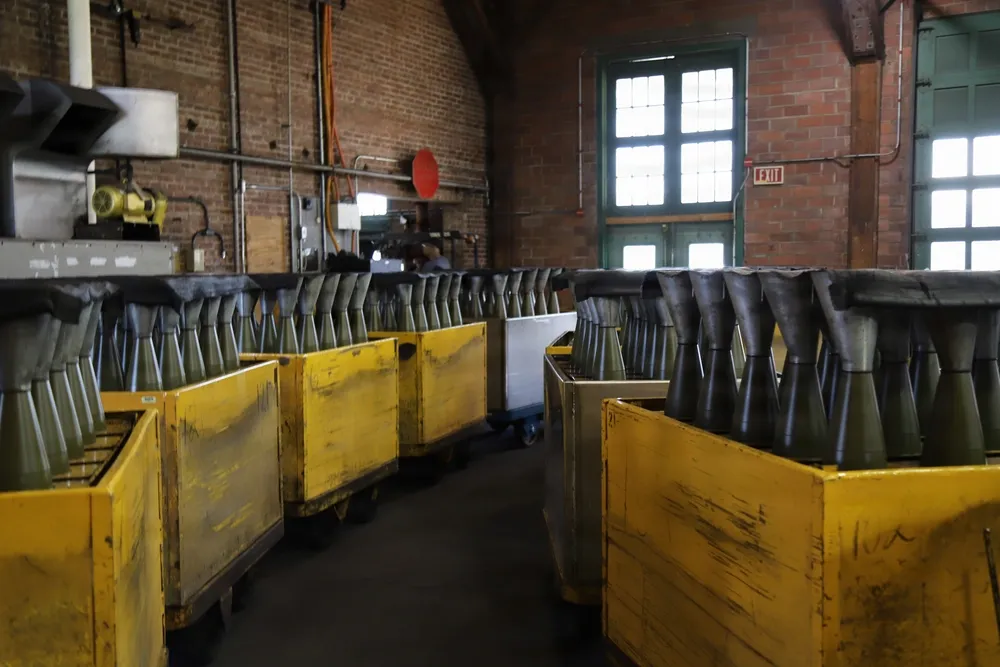
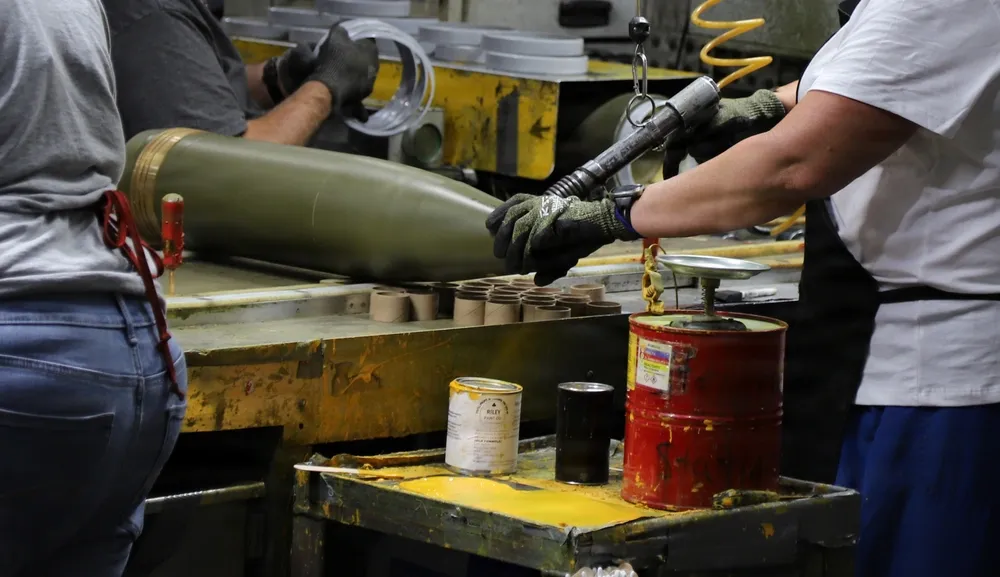
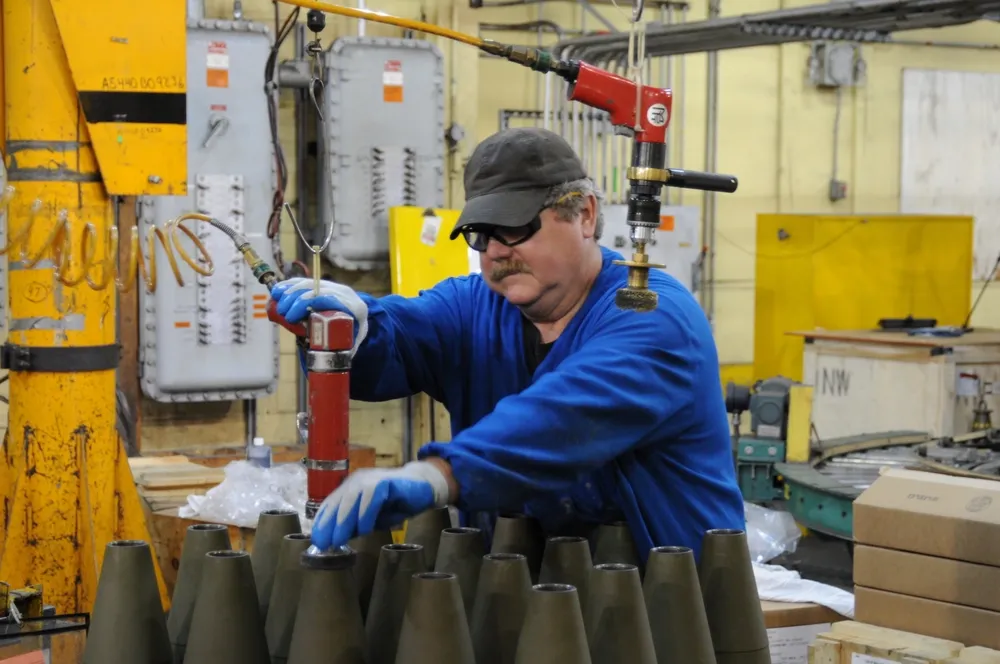
The gallery uses public-domain DVIDS imagery from Iowa Army Ammunition Plant, showing 155 mm artillery-round load, assemble, and pack work and M795 projectile handling.

Related Weapon Systems
155 mm NATO ammunition, 155 mm NATO-standard artillery ammunition family for 39-, 45-, and 52-caliber howitzers, MunitionsMunitions155 mm NATO ammunition155 mm NATO-standard artillery ammunition family for 39-, 45-, and 52-caliber howitzers155 mm NATO ammunition is a family of separately loaded artillery projectiles, fuzes, primers, and propelling charges built around NATO and JBMoU interoperability standards rather than a single shell. Official records document 155 mm artillery rounds in Ukraine's wartime ammunition supply and in coalition M777A2 fire missions against ISIS, while manufacturer lines show high-explosive, extended-range, training, modular-charge, and specialty projectile examples.
155 mm NATO-standard ammunition, 155 mm NATO-standard artillery ammunition family, MunitionsMunitions155 mm NATO-standard ammunition155 mm NATO-standard artillery ammunition family155 mm NATO-standard ammunition is the shared Western artillery ammunition family organized around NATO JBMOU and STANAG requirements, with separate projectile, fuze, primer, and propelling-charge elements depending on the round. The family matters in conflict records because official sources document 155 mm rounds in Ukrainian artillery supply and coalition M777A2 fire missions during Operation Inherent Resolve.
M107 155 mm high-explosive projectile, 155 mm high-explosive projectile, ArtilleryArtilleryM107 155 mm high-explosive projectile155 mm high-explosive projectileThe M107 is a conventional 155 mm high-explosive projectile with a forged-steel body, TNT or Composition B fill, and deep- or normal-cavity variants for different fuze fits. U.S. Army ammunition records list it as an operations-and-sustainment item, Modern War Institute reporting places the M107 family in Ukraine's 155 mm ammunition mix, and U.S. emergency-sale notices document M107 deliveries to Israel during the 2023 Israel-Hamas War.
122 mm artillery round, 122 mm artillery ammunition, MunitionsMunitions122 mm artillery round122 mm artillery ammunitionThe 122 mm artillery round is a family-level label for Soviet-origin medium-caliber artillery ammunition used by D-30-type towed howitzers and 2S1 Gvozdika self-propelled howitzers. Manufacturer and military references describe separate-loading HE projectiles with full or reduced propelling charges, while U.S. security-assistance reporting documents 122 mm artillery rounds among ammunition committed to Ukraine and TWZ reporting describes a pair of 122 mm rounds as a standard AQ-400 Scythe payload.
Cartridge, 105 mm, Smoke, WP, M60, 105 mm white-phosphorus smoke artillery cartridge, MunitionsMunitionsCartridge, 105 mm, Smoke, WP, M60105 mm white-phosphorus smoke artillery cartridgeThe Cartridge, 105 mm, Smoke, WP, M60 is a U.S. semi-fixed 105 mm white-phosphorus smoke cartridge family for 105 mm howitzers. Army ammunition data sheets describe the M60 series as a screening round with a cast-WP projectile filler, a seven-increment M67 propelling charge, and model differences centered on burster construction and fuze compatibility. Army rigging and ordnance-identification references also list the family by DODIC C454 and C477.
Cartridge, 105 mm, High-Explosive, M1, 105 mm semi-fixed high-explosive artillery cartridge for 105 mm howitzers, MunitionsMunitionsCartridge, 105 mm, High-Explosive, M1105 mm semi-fixed high-explosive artillery cartridge for 105 mm howitzersThe Cartridge, 105 mm, High-Explosive, M1 is a semi-fixed 105 mm HE artillery cartridge built around an M14-family case, percussion primer, M67 propelling charge, and forged-steel HE projectile. MSM Group and JPEO ammunition data describe the round's personnel-and-materiel fragmentation role, fuze compatibility, and roughly 11-11.5 km range class, while current catalog sources tie the M1 designation to M101-family and M119-series 105 mm howitzers.

Sources