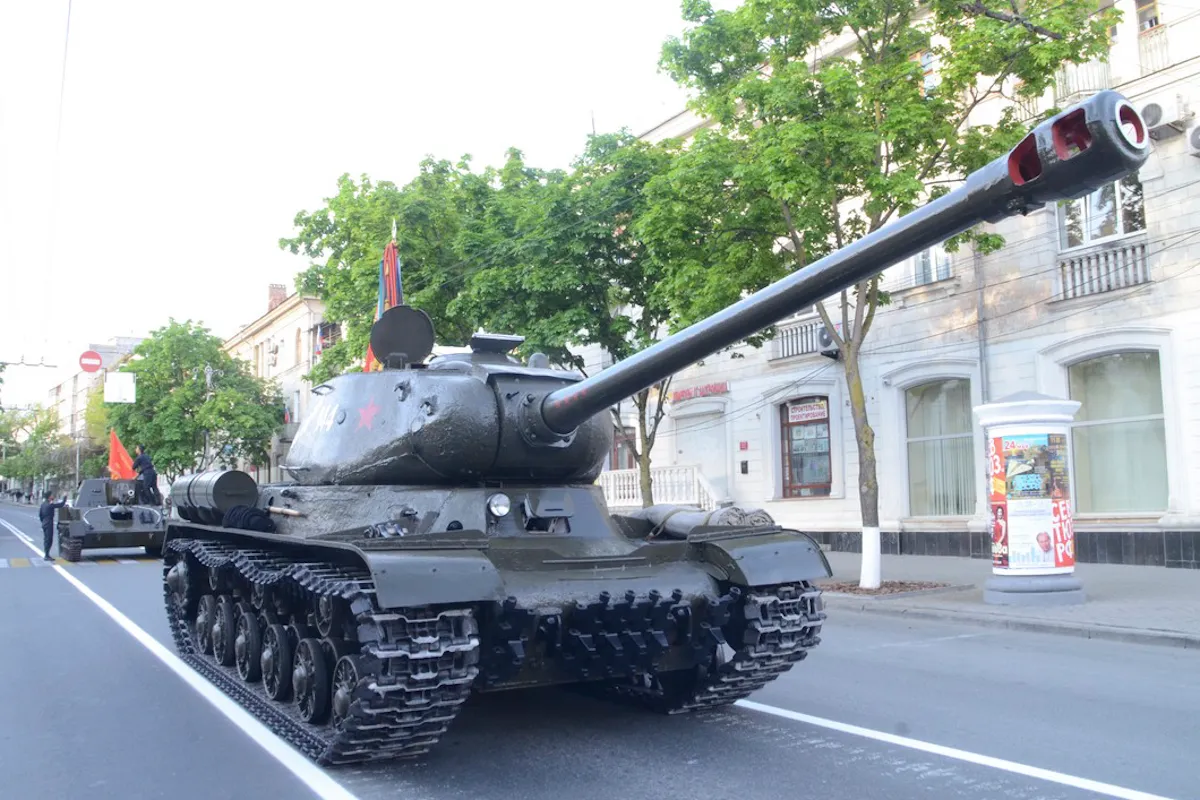
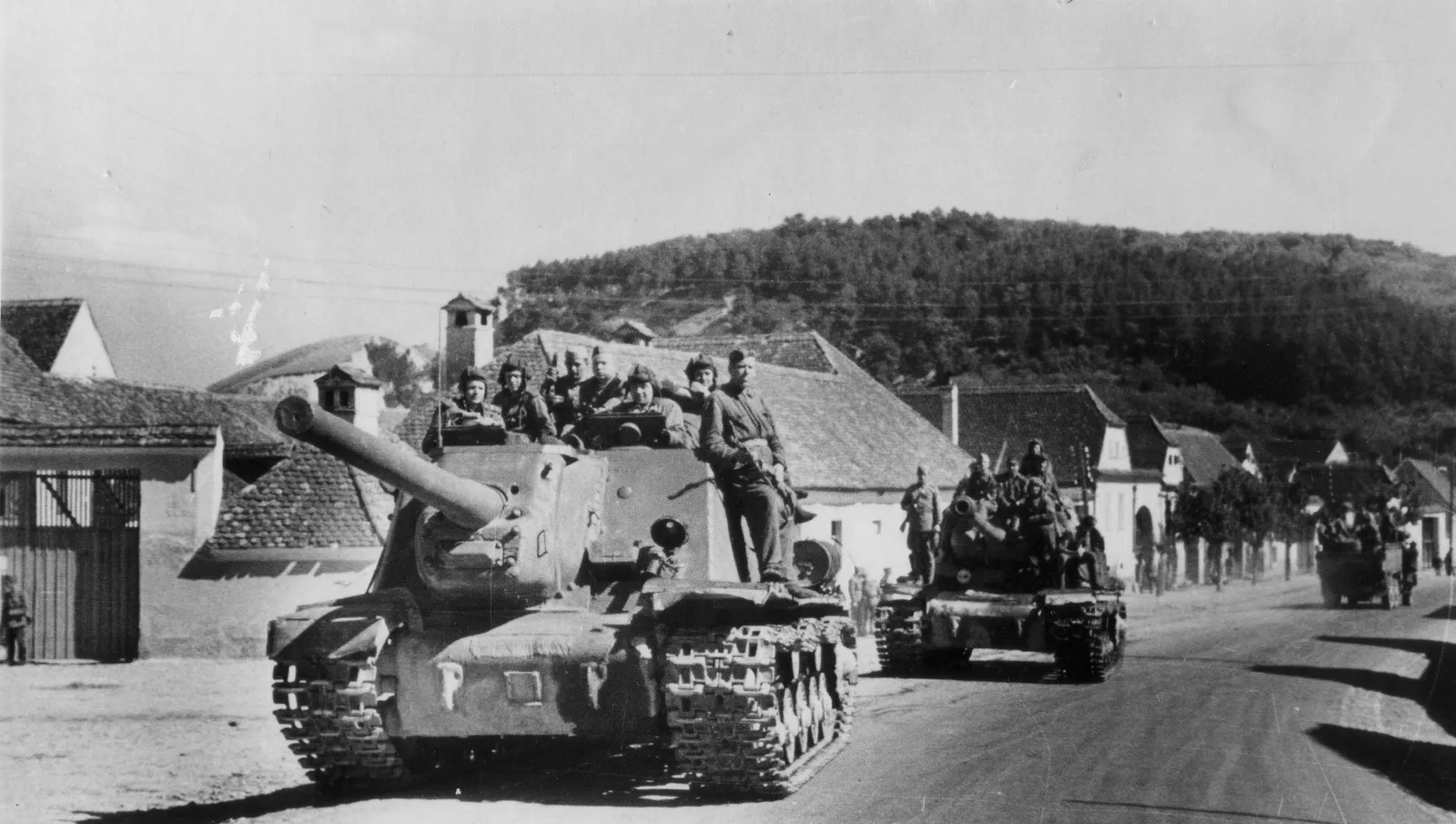
D-25T-armed IS-2 heavy tanks entered Soviet service in 1944 and were fielded by Allied Soviet forces in late-war heavy-tank combat.
Artillery
D-25 122 mm tank gun
Also known as
- D-25
- D-25T
- D25T
- D25-T
- D-25S
- D-25TA
- D-25TS
- 122 mm D-25
- 122mm D-25T
- 122-mm D-25T
- D-25T 122 mm tank gun
- 122 mm D-25S
- 122mm D-25S
- D-25S 122 mm self-propelled gun
- 122 mm D-25TA
- 122mm D-25TA
- 122 mm D-25TS
- 122mm D-25TS
- 122 mm gun D-25T
- 122 mm tank gun model 1943
- 122 mm self-propelled gun model 1943
The D-25 was a Soviet 122 mm gun family adapted from A-19-line ballistics for heavy tanks and self-propelled guns. D-25T armed the wartime IS-2 heavy tank and later IS-series vehicles, with directly sourced use on Soviet IS-2s in the Second World War, Egyptian IS-3M tanks in the 1967 Six-Day War, and captured Israeli IS-3 fixed bunkers in the 1969 War of Attrition. D-25S was the semi-automatic self-propelled-gun variant associated with ISU-122S, and the family used separate-loading A-19/D-25 ammunition including OF-471 high-explosive fragmentation and BR-471 armor-piercing projectiles.
Role in Conflicts
Egyptian IS-3M heavy tanks armed with 122 mm D-25T guns were fielded in Sinai during the 1967 Six-Day War.
- Side
- Israel

Israel fielded captured IS-3 tanks as fixed bunkers on Bar Lev Line positions during the 1969-1970 War of Attrition; the source does not establish mobile tank or main-gun firing use.
Profile / Specs
Profile
- Origin
- Soviet Union
- Built by
- Artillery Plant No. 9
- Type
- 122 mm tank and self-propelled gun family
- Service note
- World War II Soviet heavy-tank and self-propelled-gun armament
- Designer
- F. F. Petrov-led Artillery Plant No. 9 design bureau
- Designed
- 1943
- Produced
- From 1943 for D-25T; 1944 for D-25S / A-19S service context; 1952-1956 for D-25TA and 1956-1957 for D-25TS in WeaponSystems.net's compiled production data
- Number built
- WeaponSystems.net lists at least 6,000 D-25T, 675 D-25S, 205 D-25TA, and 160 D-25TS guns, with 1,735 or more A-19S guns in the related table set
- Developed from
- A-19 122 mm field gun
Specifications
- Caliber
- 121.92 mm / 122 mm class
- Barrel
- 5,933 mm overall with muzzle brake in the D-25T/D-25S service manual
- Breech
- Early IS-2 guns used a piston breech; later D-25T and D-25S guns used a horizontal sliding-wedge breech with mechanical semiautomatic action
- Ammunition
- Separate-loading 122 mm A-19-family ammunition
- Projectile family
- BR-471 and BR-471B armor-piercing projectiles plus OF-471 / OF-471N high-explosive fragmentation projectiles in the service-manual table
- D-25T rate of fire
- 2-3 rounds/minute in the service manual and Victory Museum IS-3 gun data; earlier piston-breech IS-2 context was lower
- IS-2 ammunition stowage
- 28 separate-loading 122 mm rounds in IS-2 / IS-3 platform references
- Muzzle velocity
- 795 m/s in the D-25T/D-25S service manual; 781 m/s appears in IS-2/IS-3 platform histories for armor-piercing projectile context
- Range
- 5,000 m with TSh-17 sight; about 15,000 m from closed positions with lateral-level fire in IS-3 gun data
- Traverse
- 360 degrees in tank-turret mounts; 10 degrees in the D-25S self-propelled mount
- Known platforms
- IS-2, IS-3, and IS-4 tanks for D-25T; ISU-122S/Object 249 for D-25S; T-10 for D-25TA; T-10A/T-10B for D-25TS in WeaponSystems.net platform listings
- A-19 relationship
- D-25 retained A-19-line 122 mm ballistics and fired overlapping separate-loading projectile families, while the D-25S self-propelled mount was closely tied to the A-19S table set
- Successor gun
- The T-10M moved from the D-25TA/D-25TS line to the 122 mm M-62T2 / 2A17, described by specialist sources as the D-25T successor with newer ammunition and improved ballistic characteristics
- Fixed-ammunition experiments
- 1944-1945 Soviet work explored fixed rounds for special D-25 variants, but standard service context remained separate-loading ammunition
Variants
D-25 designations distinguish the tank-gun installation from the self-propelled-gun installation while retaining the same 122 mm A-19-derived ammunition family.
| Variant | Configuration | Designation notes |
|---|---|---|
| D-25T | Tank-gun variant | Mounted in IS-2 and IS-3 heavy tanks; Victory Museum material describes the early IS-2 piston-breech transition, later semi-automatic horizontal wedge-breech production, and 28-round separate-loading ammunition stowage. Sources: Victory Museum IS-2M Model 1944, Victory Museum IS-3 |
| D-25S | Self-propelled-gun variant | Mounted in ISU-122S/Object 249 with a semi-automatic wedge breech, muzzle brake, and self-propelled-gun-specific recoil, cradle, and mount changes. Sources: D-25T/D-25S Service Manual, Victory Museum ISU-152 / ISU-122 Production Context |
| D-25TA | Postwar T-10 tank-gun variant | WeaponSystems.net describes D-25TA as a modified D-25T with a new breech block, compressed-air bore evacuation, and a loading-tray rammer for the T-10. Sources: 122mm D-25T |
| D-25TS | Stabilized T-10A/T-10B variant | WeaponSystems.net describes D-25TS as a D-25TA development for PUOT-1 or PUOT-2 stabilized mounts, with a bore evacuator moved toward the muzzle brake. Sources: 122mm D-25T |
 | T-10M successor gun | Weaponsystems.net treats M-62T2 / 2A17 as the D-25T successor for the T-10M, while GlobalSecurity describes the T-10M modernization as replacing the D-25-line armament with a gun of improved ballistic characteristics. Sources: Weaponsystems.net M-62T2, GlobalSecurity T-10 |
Ammunition Fired
Firing-table and ammunition-plate sources identify D-25-family guns with 122 mm A-19-family separate-loading ammunition.
| Ammunition | Ammunition type | Firing evidence |
|---|---|---|
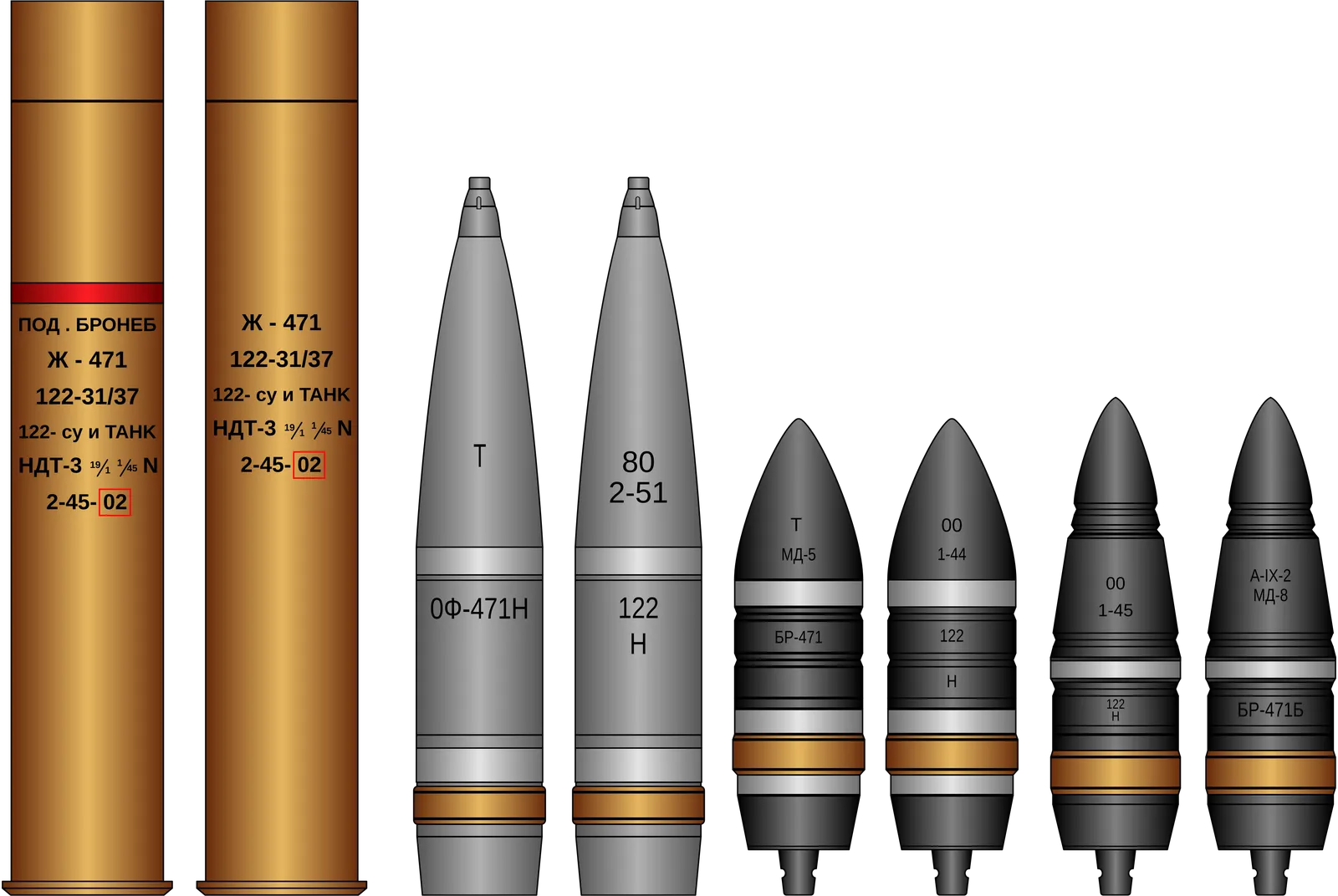
 | 122 mm HE-fragmentation projectile | The 1951 U.S. Ordnance Intelligence firing table names OF-471 and OF-471H in the table set for A-19S, D-25S, and D-25 guns; the Commons ammunition plate also identifies OF-471 among D-25T and A-19 ammunition. |
| 122 mm armor-piercing projectile | The same firing table names BR-471 as the armor-piercing tracer projectile in the A-19S, D-25S, and D-25 table set. Sources: Foreign Firing Table FT-F-122-2 |
| 122 mm armor-piercing capped projectile | The Commons D-25T ammunition plate identifies BR-471B among the A-19 and D-25T ammunition family. Sources: D25T shells.svg |
 | 122 mm concrete-piercing projectile | WW2 Equipment Data describes VG-471 as a concrete-piercing round fired from A-19, A-19S, and D-25S weapons, placing G-471 in the D-25S self-propelled-gun ammunition context rather than the tank-only D-25T plate. Sources: WW2 Equipment Data G-471 article |
Gun Family Context
The D-25 family links a tank-gun installation, a self-propelled-gun installation, postwar T-10 derivatives, and a 122 mm ammunition set inherited from A-19-family ballistics. Conflict rows are limited to directly sourced carrier-vehicle use where the sources also identify the D-25T armament.
D-25T
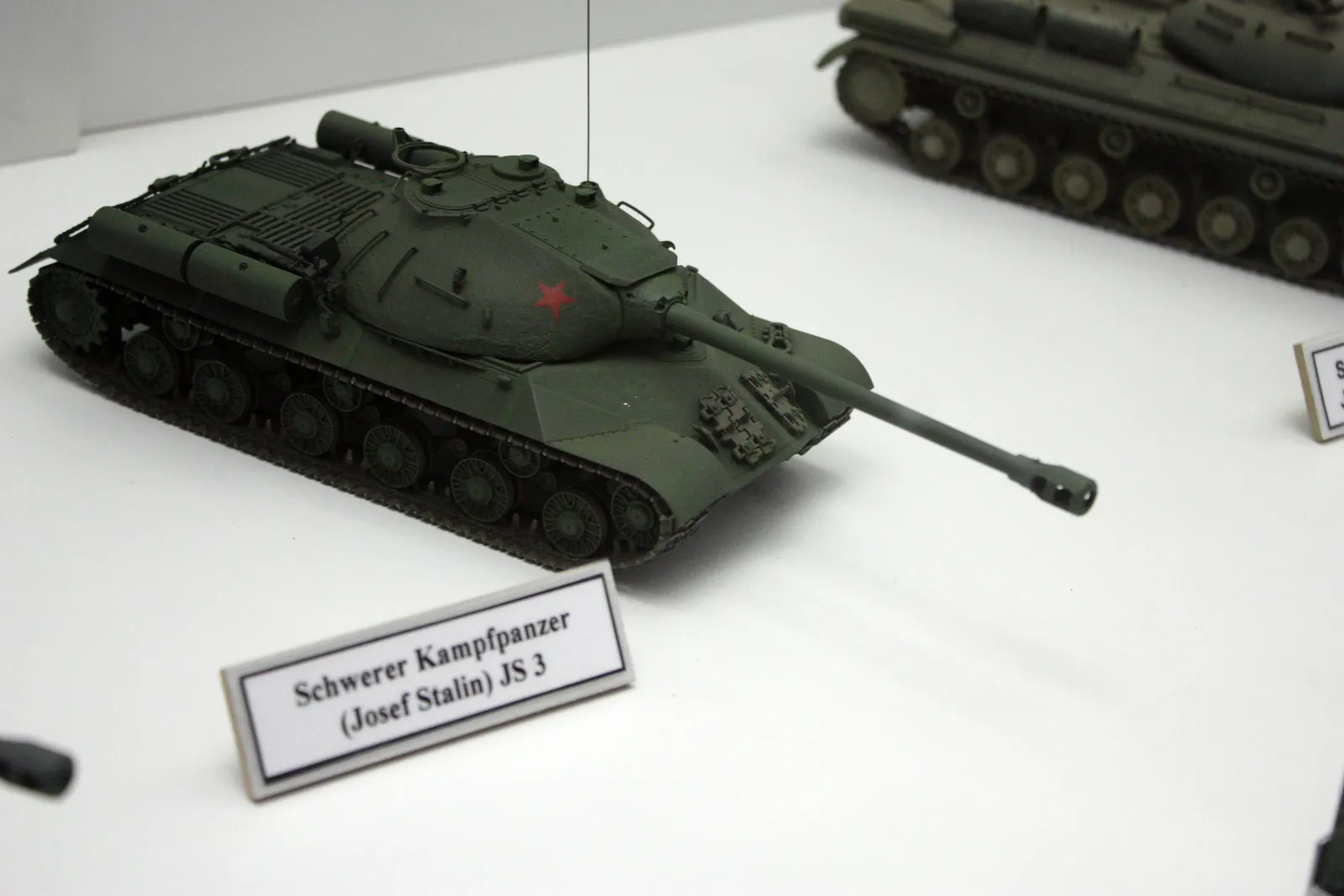
Tank-gun variant mounted in IS-series heavy tanks. Victory Museum material describes the IS-2 transition from early piston-breech guns to semi-automatic wedge-breech D-25T production and the IS-3's retained D-25T armament.
D-25S
Self-propelled-gun variant tied to ISU-122S/Object 249, with the service manual and Victory Museum source identifying the D-25S installation and self-propelled-gun mount context.
D-25TA / D-25TS
WeaponSystems.net extends the family into T-10 service: D-25TA adds a revised breech, compressed-air bore evacuation, and loading-tray rammer, while D-25TS adapts the gun to stabilized T-10A/T-10B mounts.
Successor line
The public catalog has a linked 122 mm M-62T2 record for the later T-10M gun. Sources describe it as the D-25T successor with newer ammunition and improved ballistic characteristics.
Ammunition
The firing table, service manual, and Commons plate tie the family to OF-471, OF-471N/OF-471H, BR-471, and BR-471B ammunition; a separate ordnance reference adds G-471 concrete-piercing rounds for the A-19S/D-25S self-propelled-gun context.
Loading experiments
Tank Archives describes 1944-1945 fixed-ammunition trials for special D-25 variants, while the service gun context remained separate-loading ammunition.
Source labels: D-25T/D-25S Service Manual; Victory Museum IS-2M Model 1944; Victory Museum IS-3; Victory Museum ISU-152 / ISU-122 Production Context; Foreign Firing Table FT-F-122-2; A Round Too Long - Tank Archives; 122mm D-25T; D25T shells.svg; WW2 Equipment Data G-471 article; Weaponsystems.net M-62T2; GlobalSecurity T-10.
Timeline
D-25 122 mm tank gun Key Events
D-25 tank-gun development
The Russian Battlefield describes the D-25 as a 122 mm gun adopted for heavy-tank armament after development work in 1943.
Sources: 122-mm tank gun D-25
D-25 table set in Soviet service
The translated firing-table cover identifies the A-19S, D-25S, and D-25 guns with high-explosive fragmentation and armor-piercing tracer shell tables from a 1944 Soviet war publication.
Sources: Foreign Firing Table FT-F-122-2
ISU-122S accepted with D-25S
Tank Archives describes ISU-122S/Object 249 as accepted into service with the D-25S gun after the self-propelled-gun installation improved the 122 mm rate-of-fire problem; Victory Museum production context identifies the ISU-122S as the D-25S-equipped variant.
Sources: A Round Too Long - Tank Archives, Victory Museum ISU-152 / ISU-122 Production Context
U.S. foreign firing table prepared
U.S. Ordnance Intelligence prepared FT-F-122-2 for captured-equipment test firing, covering A-19S, D-25S, and D-25 guns with BR-471, OF-471, and OF-471H projectiles.
Sources: Foreign Firing Table FT-F-122-2
D-25TA production window begins
WeaponSystems.net places D-25TA production in 1952-1956 and describes the variant as the T-10 gun with revised breech, compressed-air bore evacuation, and a loading-tray rammer.
Sources: 122mm D-25T
D-25TS stabilized variant
WeaponSystems.net places D-25TS production in 1956-1957 and links the stabilized-gun variant to T-10A and T-10B mounts.
Sources: 122mm D-25T
T-10M moves to M-62T2
Weaponsystems.net and GlobalSecurity describe M-62T2 / 2A17 as the T-10M successor to the D-25T/D-25TS line, adding newer ammunition and improved ballistic characteristics.
Sources: Weaponsystems.net M-62T2, GlobalSecurity T-10
Captured IS-3 fixed-bunker use
Tank Archives states that Israel used captured IS-3 tanks as bunkers at Bar Lev Line positions during the War of Attrition, while noting the vehicles were fixed emplacements rather than mobile tank use.
Sources: IS-3 in Combat - Tank Archives
Media
D-25 122 mm tank gun Videos
Related Weapon Systems


Sources
Foreign Firing Table FT-F-122-2Publisher: U.S. Army Ordnance Intelligence / University of Nebraska-Lincoln DigitalCommons | Note: Supports D-25, D-25S, and A-19S firing-table context, OF-471 / OF-471H / BR-471 ammunition compatibility, and the 1944 Soviet table basis translated by U.S. Ordnance Intelligence in March 1951. | Accessed: 2026-07-13122-mm tank gun D-25Publisher: The Russian Battlefield | Note: Supports D-25T and D-25S development context, ammunition overlap with A-19, breech/rate-of-fire details, caliber, and OF-471 ammunition-table data. | Accessed: 2026-07-13122mm D-25TPublisher: WeaponSystems.net | Note: Supports D-25T/D-25S/D-25TA/D-25TS variant descriptions, production/manufacturer context, platform examples, barrel length, muzzle velocity, breech, rate-of-fire details, and compiled production-count context. | Accessed: 2026-07-13D-25T/D-25S Service ManualPublisher: USSR Ministry of Defense / Voenizdat | Note: Supports D-25T and D-25S service-manual context, caliber, barrel length, sliding-wedge semiautomatic breech description, ammunition table, muzzle velocity, rate of fire, range, and tank/self-propelled mount distinctions. | Accessed: 2026-07-13Victory Museum IS-2M Model 1944Publisher: Victory Museum | Note: Supports Second World War direct conflict use: D-25T-armed IS-122/IS-2 heavy tanks were fielded by Soviet Allied forces in 1944-1945, alongside early piston-breech and later wedge-breech D-25T production, muzzle-brake, ammunition-stowage, and platform-integration context. | Accessed: 2026-07-13Victory Museum IS-3Publisher: Victory Museum | Note: Supports IS-3 platform integration for the 122 mm D-25T, wedge-breech and muzzle-brake description, 28-round separate-loading ammunition stowage, 2-3 rounds/minute practical rate of fire, and 5,000 m / 15,000 m range context. | Accessed: 2026-07-13National Defence University IS-2Publisher: National Defence University of Ukraine | Note: Supports Second World War direct conflict use: the 122 mm D-25T was fielded by Soviet Allied forces on IS-2 heavy tanks in wartime service, with supporting platform context for breech type, muzzle velocity, ammunition stowage, and service chronology. | Accessed: 2026-07-13Victory Museum ISU-152 / ISU-122 Production ContextPublisher: Victory Museum | Note: Supports ISU-122S/Object 249 as the D-25S-equipped self-propelled-gun variant, its semi-automatic wedge breech and muzzle brake, mount/recoil/cradle distinctions, and ISU-122 / ISU-122S production totals. | Accessed: 2026-07-13A Round Too Long - Tank ArchivesPublisher: Tank Archives | Note: Supports D-25 development background, D-25T rate-of-fire context, 1944-1945 fixed-ammunition trial context, and ISU-122S/Object 249 acceptance with the D-25S gun. | Accessed: 2026-07-13WeaponSystems.net IS-3Publisher: WeaponSystems.net | Note: Supports 1967 Six-Day War direct conflict-use context by identifying the IS-3 main armament as the 122 mm D-25T and stating that Egyptian IS-3M tanks were used during the 1967 Six-Day War. | Accessed: 2026-07-13IS-3 in Combat - Tank ArchivesPublisher: Tank Archives | Note: Supports 1967 Six-Day War direct conflict-use context for Egyptian IS-3 tanks in Sinai and 1969 War of Attrition direct conflict-use context for captured IS-3 tanks fielded by Israel as fixed Bar Lev Line bunkers. | Accessed: 2026-07-13IS-2_01.jpgPublisher: Wikimedia Commons / Ministry of Defence of the Russian Federation | Note: Supports image provenance for the IS-2_01.jpg gallery and hero image. The Commons file page identifies an IS-2 heavy tank in Sevastopol, sourced to the Russian Ministry of Defence, licensed CC BY 4.0 with Mil.ru attribution. | Accessed: 2026-07-13SAU ISU-122 and IS-2 in Transylvania.jpgPublisher: Wikimedia Commons | Note: Supports image provenance for the gallery image of Soviet ISU-122 and IS-2 vehicles on a road in Transylvania in September 1944; the Commons file page lists public-domain status in Russia. | Accessed: 2026-07-13Panzermuseum Munster 2010 0329.JPGPublisher: Wikimedia Commons | Note: Supports image provenance for the IS-3 gallery image Panzermuseum_Munster_2010_0329.JPG; the Commons file page identifies the German Tank Museum photo as own work licensed CC BY-SA 3.0. | Accessed: 2026-07-13D25T shells.svgPublisher: Wikimedia Commons | Note: Supports image provenance and the ammunition plate that identifies OF-471, BR-471, and BR-471B among the A-19 and D-25T ammunition family. | Accessed: 2026-07-13WW2 Equipment Data G-471 articlePublisher: WW2 Equipment Data | Note: Supports G-471 / VG-471 concrete-piercing ammunition context and the stated A-19, A-19S, and D-25S firing compatibility for the 122 mm self-propelled-gun ammunition relationship. | Accessed: 2026-07-13Weaponsystems.net M-62T2Publisher: Weaponsystems.net | Note: Supports M-62T2 / 2A17 identity, T-10M platform relationship, D-25T successor context, newer 122 mm ammunition family, production period, and technical specifications. | Accessed: 2026-07-13GlobalSecurity T-10Publisher: GlobalSecurity.org | Note: Supports T-10M modernization context, including replacement of D-25-line armament with M-62-T2 / 2A17, improved ballistic-characteristics wording, T2S-29-14 sight, and 2E12 stabilizer context. | Accessed: 2026-07-13