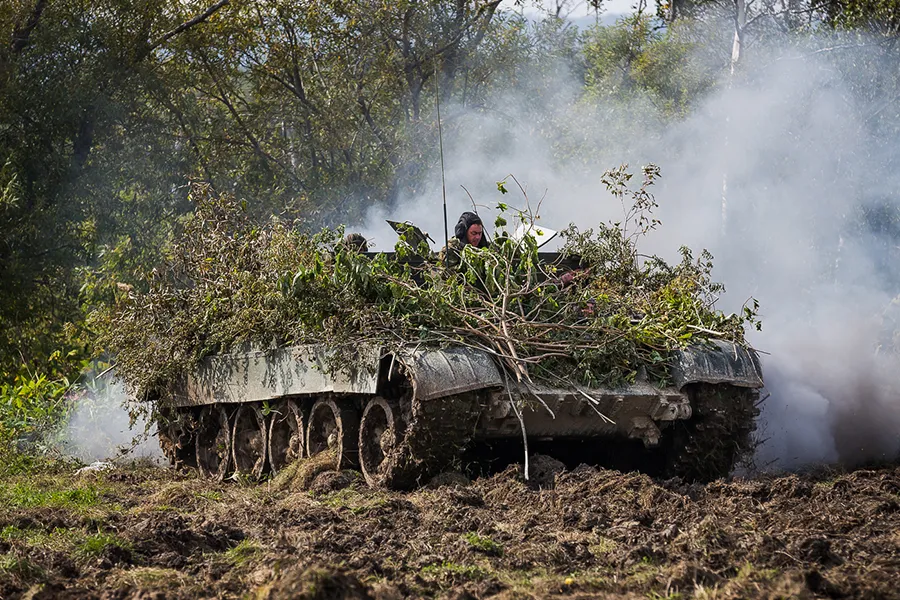


Oryx's visually documented equipment-loss lists record Russian BTS-4A and BTS-4V armored recovery vehicles and Ukrainian BTS-4A armored recovery vehicles in the full-scale invasion, including destroyed, damaged, abandoned, and captured examples.
Role detailsSupport Equipment
BTS-4
Also known as
- BTS-4A
- BTS-4V
- BTS-4G
- BTS-4AM
- BTS-4M
- BTS-4D
- BTS-4AD
- BTS-4 ARV
- T-54T
- Bronirovannyi tyagach sredniy
- БТС-4
The BTS-4 is a Soviet tracked armored recovery vehicle family built around tank-hull recovery work: towing disabled armor, winching stuck vehicles, lifting heavy components, and supporting field repair teams. Ukrainian and Western reporting describes upgraded BTS-4 vehicles with T-54/T-55 hull lineage, a front crane, dozer blade, and heavy winch package, while visual-loss records document BTS-4-family vehicles on both sides of the Russia-Ukraine War and one BTS-4 captured from Syrian regime forces in 2024.
Role in Conflicts


Oryx's 2024 Syrian rebel offensive loss list records one BTS-4 captured from Syrian regime forces; the source supports capture during the offensive, not confirmed later rebel operation.
Profile / Specs
Profile
- Origin
- Soviet Union
- Built by
- Soviet defense industry
- Type
- Tracked armored recovery vehicle
- Service note
- Cold War Soviet armored recovery vehicle family with documented full-scale-war losses in Ukraine
- Designer
- Soviet armored-vehicle design and production system
- Designed
- 1965
- Produced
- Accepted for Soviet service in 1967; later restored or upgraded from existing tank chassis
- Developed from
- Base BTS-4 on T-44M chassis; later family variants used T-54, T-55, T-55A, or IT-1-derived chassis
Specifications
- Role
- Tracked armored recovery vehicle for towing, recovery, and field support of armored vehicles
- Base chassis
- BTVT describes the original BTS-4 as developed on the T-44M chassis, with BTS-4A on T-54 and BTS-4V on IT-1 chassis
- Crew
- BTVT lists a two-person crew for the base BTS-4; Ukrainian restored or upgraded examples are reported with three crew
- Base recovery equipment
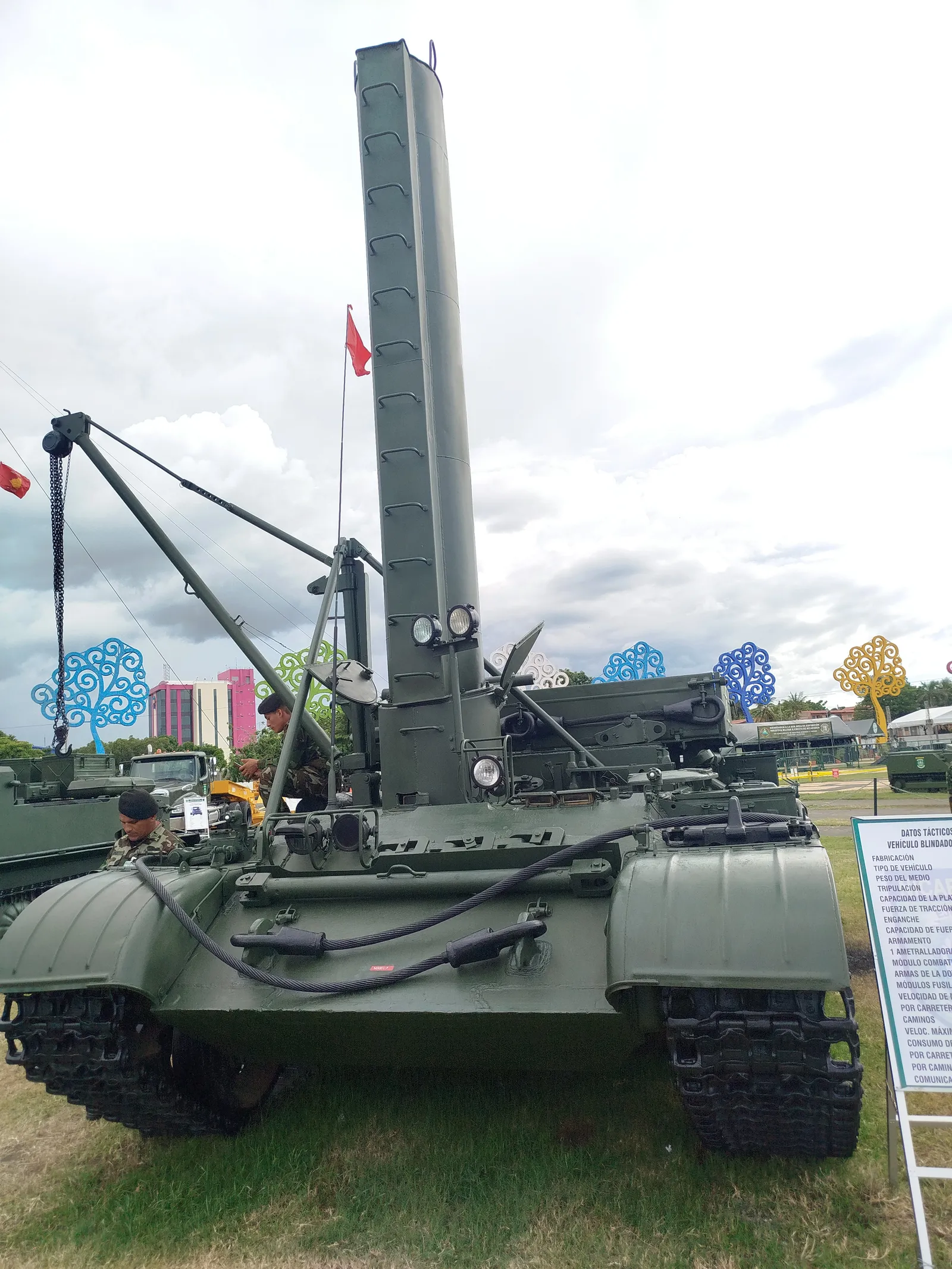
- BTVT describes a traction winch, cargo platform, removable crane boom, rear spade, and underwater-driving equipment on the base BTS-4
- Modernized Ukrainian crane
- Upgraded Ukrainian BTS-4 examples were reported with a 12-tonne hydraulic crane
- Modernized Ukrainian winch
- Defense Express reported a 100-tonne traction winch with 200 m of cable plus an auxiliary winch on the upgraded vehicle
- Modernized Ukrainian blade
- Janes and Defense Express both describe a large front dozer or stabilizing blade added to the upgraded vehicle
- Distinctive feature
- Janes notes the roof-mounted snorkel as a distinctive BTS-4 feature retained on the upgraded Ukrainian vehicle
- Conflict evidence
- Oryx lists Russian BTS-4A/BTS-4V and Ukrainian BTS-4A losses in the 2014 Russia-Ukraine War, plus one BTS-4 captured from Syrian regime forces in 2024
Recovery Equipment
The upgraded Ukrainian BTS-4 reporting gives a useful snapshot of the family role: a tank-hull recovery vehicle intended to pull, lift, clear, weld, and support armored units in the field.
Lifting
A front-left hydraulic crane was reported with a 12-tonne lift capacity for heavy armored-vehicle components.
Recovery Pull
The upgraded package was reported with a 100-tonne traction winch, 200 m of cable, and an auxiliary winch for cable handling.
Clearing And Support
A front dozer or stabilizing blade, towing equipment, welding gear, and field tools support vehicle extraction and repair tasks.
Variants
Public sources use BTS-4 as both a base vehicle and a family label; several suffixes identify donor chassis or later modernization packages.
| Variant | Configuration | Designation notes |
|---|---|---|
| BTS-4A | T-54-chassis armored recovery variant | BTVT identifies BTS-4A as the T-54-chassis modification, and Oryx lists Russian BTS-4A losses in Ukraine. Sources: Oryx Russian Equipment Losses, BTVT BTS-4 Tracked Armored Tractor |
| BTS-4V | IT-1-chassis armored recovery variant | BTVT identifies BTS-4V as built on the IT-1 tank-destroyer chassis, and Oryx separately lists Russian BTS-4V losses in Ukraine. Sources: Oryx Russian Equipment Losses, BTVT BTS-4 Tracked Armored Tractor |
| BTS-4G | T-55-chassis armored recovery variant | VPK.name lists BTS-4G as the T-55-chassis modification in the BTS-4 family. Sources: VPK.name BTS-4 Reference |
| BTS-4AM | T-55A-chassis armored recovery variant | VPK.name lists BTS-4AM, also named BTS-4M, as a T-55A-chassis modification. Sources: VPK.name BTS-4 Reference |
| BTS-4D | Post-Afghanistan modernization | VPK.name lists BTS-4D, also named BTS-4AD, as a modernization associated with Afghanistan combat experience. Sources: VPK.name BTS-4 Reference |
Timeline
BTS-4 Key Events
BTS-4 developed
BTVT describes the BTS-4 as developed in 1965 on the T-44M tank chassis.
Accepted for Soviet service
BTVT gives a Soviet Ministry of Defense acceptance order date of 22 November 1967.
Ukrainian upgraded BTS-4 reported delivered
Janes reported that UkrOboronProm said Lviv Armored Plant had upgraded and delivered an improved BTS-4 to Ukraine's armed forces.
Russian BTS-4 losses tracked in Ukraine
Oryx's full-scale-invasion loss list records Russian BTS-4A and BTS-4V armored recovery vehicles among visually documented engineering-equipment losses.
Related Weapon Systems


Sources
Oryx Russian Equipment LossesPublisher: Oryx | Note: Supports 2014 Russia-Ukraine War direct conflict-use context by listing Russian BTS-4A and BTS-4V armored recovery vehicle losses with visual evidence in the full-scale invasion. | Accessed: 2026-07-13Oryx Ukrainian Equipment LossesPublisher: Oryx | Note: Supports 2014 Russia-Ukraine War direct conflict-use context by listing Ukrainian BTS-4A armored recovery vehicle losses with visual evidence in the full-scale invasion. | Accessed: 2026-07-13Oryx 2024 Syrian Rebel Offensive LossesPublisher: Oryx | Note: Supports 2011 Syrian Civil War direct conflict-use context by listing one BTS-4 captured from Syrian regime forces during the 2024 rebel offensive. | Accessed: 2026-07-13BTVT BTS-4 Tracked Armored TractorPublisher: BTVT.info | Note: Supports BTS-4 design history, 1965 development on the T-44M chassis, 1967 acceptance date, base recovery layout, underwater-driving equipment, and BTS-4A/BTS-4V donor chassis distinctions. | Accessed: 2026-07-13VPK.name BTS-4 ReferencePublisher: VPK.name | Note: Supports BTS-4 family variant designations including BTS-4G, BTS-4AM/BTS-4M, and BTS-4D/BTS-4AD. | Accessed: 2026-07-13Janes Ukraine BTS-4 UpgradePublisher: Janes | Note: Supports BTS-4 background and specifications for an upgraded Ukrainian BTS-4, including T-54/T-55 hull basis, hydraulic crane, dozer blade, traction winch, auxiliary winch, and recovery role. | Accessed: 2026-07-13VPK.name Restored Ukrainian BTS-4Publisher: VPK.name | Note: Supports restored Ukrainian BTS-4 context and modernization-specific crew, power, track, crane, welding, winch, and bulldozer-blade details. | Accessed: 2026-07-13Defense Express BTS-4 UpgradePublisher: Defense Express | Note: Supports upgraded BTS-4 equipment details attributed to UkrOboronProm, including the T-54/T-55 hull basis, crane, winch, dozer/stabilizing blade, towing equipment, and field-support role. | Accessed: 2026-07-13Defense Express Rare BTS-4 In UkrainePublisher: Defense Express | Note: Supports 2014 Russia-Ukraine War direct conflict-use context by reporting a Russian BTS-4-type armored recovery vehicle captured by Ukrainian forces in March 2022, plus background on the T-44-chassis variant and 1963 production start. | Accessed: 2026-07-13WarSpotting BTS-4A Poltavka LossPublisher: WarSpotting | Note: Supports 2014 Russia-Ukraine War direct conflict-use context with a geolocated abandoned Russian BTS-4(A) armored recovery vehicle near Poltavka in Kramatorsk raion. | Accessed: 2026-07-13WarSpotting BTS-4V Torske LossPublisher: WarSpotting | Note: Supports 2014 Russia-Ukraine War direct conflict-use context with a geolocated destroyed Russian BTS-4V armored recovery vehicle near Torske in Kramatorsk raion. | Accessed: 2026-07-13Wikimedia Commons BTS-4Publisher: Wikimedia Commons | Note: Supports BTS-4 identity, armored recovery vehicle classification, alternate Cyrillic designation, and image provenance for Commons-hosted BTS-4 media. | Accessed: 2026-07-13Wikimedia Commons Vostok BTS-4Publisher: Wikimedia Commons | Note: Supports image provenance for the primary BTS-4 image, a Russian Ministry of Defence media file under CC BY 4.0. | Accessed: 2026-07-13Wikimedia Commons BTS-4 NicaraguaPublisher: Wikimedia Commons | Note: Supports image provenance for the Nicaragua BTS-4 gallery image, an uploader-owned Commons file released under CC0 1.0. | Accessed: 2026-07-13Wikimedia Commons Ukrainian Rail BTS-4Publisher: Wikimedia Commons | Note: Supports image provenance for a Ukrainian military rail-transport gallery image categorized under BTS-4 and licensed CC BY-SA 4.0. | Accessed: 2026-07-13