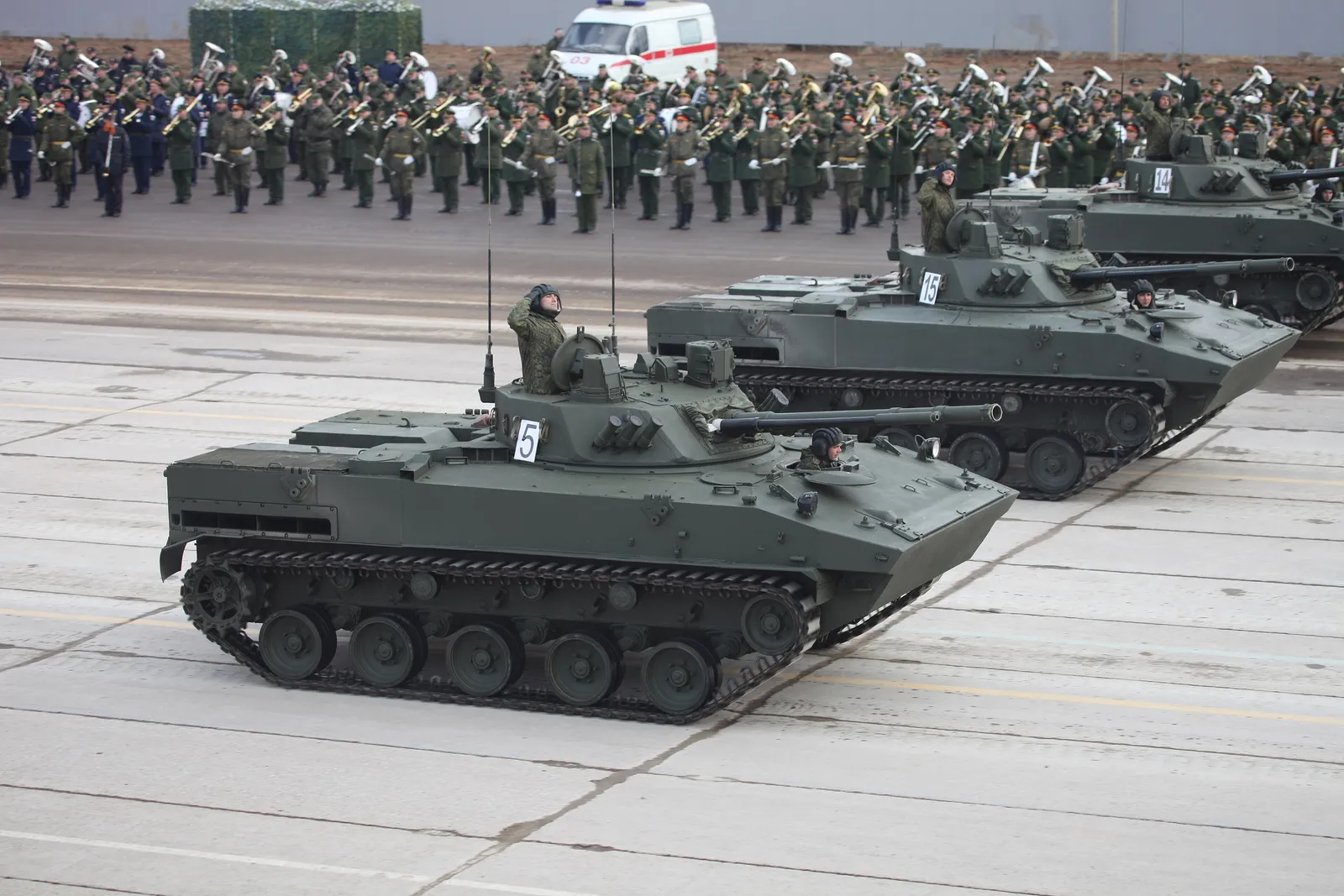


Russian airborne forces have used the BMD-4M family during the full-scale invasion; Oryx documented BMD-4M infantry fighting vehicles among VDV equipment lost at Hostomel and in wider Russian loss lists, and Ukraine's National Defence University describes captured BMD-4M vehicles including a 24th Mechanized Brigade seizure in Luhansk Oblast in early June 2022.
Role detailsArmored Vehicles
BMD-4/BMD-4M
Also known as
- BMD-4
- BMD-4M
- BMD-3M
- BMD-4M airborne assault vehicle
- BMD-4M airborne IFV
The BMD-4/BMD-4M is a Russian airborne amphibious infantry fighting vehicle built for VDV units, combining a light parachutable tracked chassis with the Bakhcha-U turret's 100 mm 2A70 gun-launcher, 30 mm 2A72 autocannon, and coaxial machine gun. In the 2014 Russia-Ukraine War it appears as a Russian airborne assault vehicle, with visually documented losses at Hostomel and later BMD-4M deliveries showing factory add-on armor, slat armor, and Nakidka signature-reduction kits shaped by the Ukraine battlefield.
Role in Conflicts
Profile / Specs
Profile
- Origin
- Russia
- Type
- Airborne amphibious infantry fighting vehicle
- Service note
- Post-Cold War; BMD-4 entered service in the 2000s and BMD-4M remains in Russian service
- Designer
- Volgograd Tractor Plant and KBP Instrument Design Bureau
- Designed
- 1990s for BMD-4; BMD-4M prototypes tested from 2008
- Produced
- 2004-present for the BMD-4 family
Specifications
- Crew and dismounts
- Commander, gunner, driver, and six infantrymen
- Primary armament
- 100 mm 2A70 gun-launcher, 30 mm 2A72 autocannon, and 7.62 mm PKT coaxial machine gun
- Missile armament
- 100 mm gun can fire Arkan 9M117M1 laser-guided ammunition; eight missiles carried according to Army Recognition
- Engine
- UTD-29 multi-fuel diesel rated at about 500 hp on BMD-4M
- Mobility
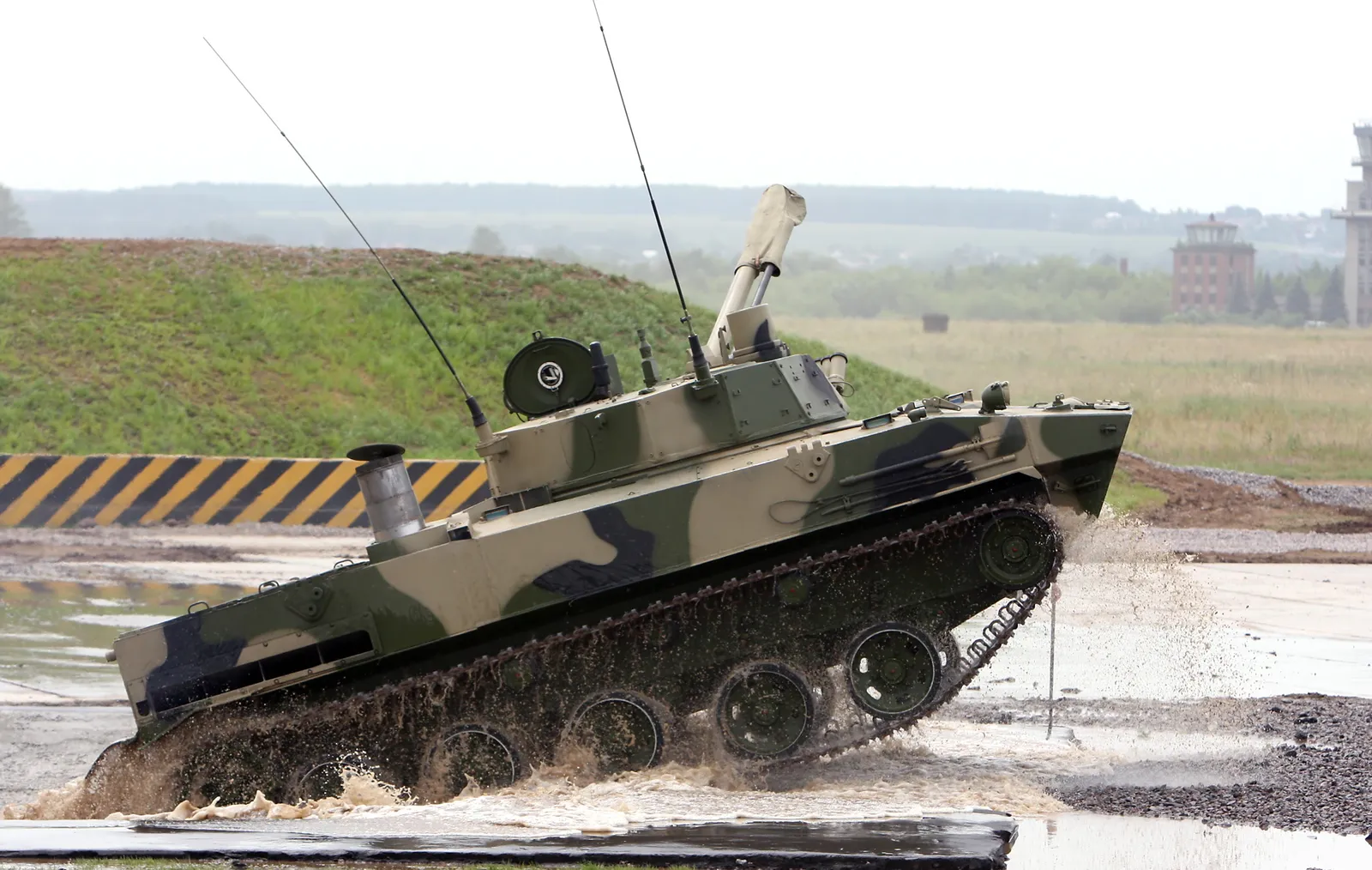
- About 70 km/h road speed, 500 km cruising range, and 10 km/h swimming speed using rear water jets
- Combat weight
- About 13,500 kg in Army Recognition specifications
- Protection
- All-welded aluminum hull and turret; later wartime deliveries have included add-on protection, slat armor, and signature-reduction kits
- Designation structure
- BMD-4 covers the original BMD-3M/BMD-4 lineage; BMD-4M/Sadovnitsa is the modernized redesign with new hull, engine, running gear, and BMP-3-family commonality
- Chassis commonality
- Army Guide describes BMD-4M as roughly 80 percent unified with the BMP-3 to simplify production, operation, and maintenance
Variants
The BMD-4 designation covers the original BMD-3M/BMD-4 airborne IFV lineage and the BMD-4M/Sadovnitsa redesign, which retained the heavy gun-missile module while changing the hull, engine, running gear, and BMP-3-family commonality. The rows below distinguish trial combat-module fits and wartime protection configurations rather than separate export families.
| Variant | Configuration | Designation notes |
|---|---|---|
| BMD-4M2 / Sinitsa combat module | Trial combat-module configuration | Army Recognition reported a Kurganmashzavod trial BMD-4M2 configuration with the Sinitsa combat module, amphibious and air-droppable characteristics, and maximum armament/system/device unification with the BMP-3. |
| Add-on protection kit configuration | Wartime survivability configuration | Rostec and EDR describe 2024 BMD-4M deliveries with enhanced armor kits, slat armor, upper-hemisphere cage protection, and Nakidka thermal/radar-signature reduction. Sources: Rostec has Delivered a New Batch of the BMD-4M and BMP-3 to the Army, Kurganmashzavod delivers BMD-4M and BMP-3 upgraded for war in Ukraine |
Ammunition Fired
The BMD-4M's 100 mm 2A70 gun-launcher gives the vehicle a guided-round option in addition to conventional 100 mm ammunition.
| Ammunition | Ammunition type | Firing evidence |
|---|---|---|
 | 100 mm high-explosive fragmentation round | Fenix Insight identifies 3UOF17 as a 100 mm HE-Frag round used by the 2A70 gun and BMD-4 infantry fighting vehicles, while Army Guide says the BMD-4M carries 34 high-explosive 100 mm rounds. Sources: 3UOF17 projectile, BMD-4M Sadovnitsa |
 | 100 mm guided round | Army Recognition says the BMD-4M's 2A70 100 mm cannon can fire 9M117M1 Arkan laser-guided ammunition at up to 5,500 m. Sources: BMD-4M |
 | 30x165 mm autocannon ammunition family | Army Guide lists the BMD-4M's 30 mm armament as a 2A72 automatic cannon with 500 rounds, and STV GROUP documents 30x165 mm ammunition compatibility with 2A72 automatic guns. Sources: BMD-4M Sadovnitsa, Ammunition 30x165 mm - STV GROUP |
Launched Anti-Tank Missiles
One specialist reference describes a BMD-4M turret launcher connection to the 9M113/9M113M Konkurs family; the vehicle's better-documented guided ammunition path remains the 2A70-fired Arkan round.
| Launched item | Item type | Launch evidence |
|---|---|---|
 | Wire-guided anti-tank missile | Forecast International says the BMD-4M turret mounts a launcher for the 9M113/9M113M Konkurs wire-guided anti-tank missile. |
Armament And Battlefield Fit
The BMD-4M is unusually heavily armed for an airborne IFV: its Bakhcha-U turret combines a 100 mm gun-launcher, a 30 mm autocannon, and a coaxial machine gun on a light amphibious chassis. That combination gives VDV units troop movement, direct fire, and a gun-launched anti-tank option in one parachutable vehicle, but the same light aluminum hull makes later add-on protection a prominent part of the Ukraine-war record.
| Element | Documented detail | Reader context |
|---|---|---|
| Bakhcha-U turret | 100 mm 2A70 gun-launcher, 30 mm 2A72 autocannon, and 7.62 mm PKT coaxial machine gun | Combines infantry support fire and guided-round capability on an airborne vehicle. |
| 100 mm HE fire | Fenix Insight identifies 3UOF17 as a 100 mm HE-Frag round used by the 2A70 gun and BMD-4 vehicles | Explains the linked unguided 100 mm ammunition record alongside the guided-round entry. |
| 30 mm cannon ammunition | STV GROUP lists 30x165 mm ammunition compatibility with 2A72 automatic guns | Connects the BMD-4M's 30 mm coaxial autocannon to the catalog's 30x165 mm ammunition-family record. |
| Arkan guided round | Army Recognition lists 9M117M1 Arkan laser-guided ammunition fired from the 100 mm gun at up to 5,500 m | Explains the anti-tank tag and the linked guided-round support page. |
| Amphibious mobility | Rear water jets provide a listed 10 km/h swimming speed | Preserves BMD-family river-crossing and assault mobility despite the heavier turret fit. |
| Wartime protection kits | Rostec and EDR describe enhanced armoring, slat armor, cage protection, and Nakidka signature-reduction kits on 2024 BMD-4M deliveries | Shows factory adaptation to Ukraine-war drone, RPG, and detection threats rather than a baseline armor redesign. |
Sources: BMD-4M; BMD-4M Sadovnitsa; 3UOF17 projectile; Ammunition 30x165 mm - STV GROUP; Rostec has Delivered a New Batch of the BMD-4M and BMP-3 to the Army; Kurganmashzavod delivers BMD-4M and BMP-3 upgraded for war in Ukraine.
Timeline
BMD-4/BMD-4M Key Events
BMD-4M prototypes tested
Kurganmashzavod produced upgraded BMD-4M prototypes and tested changes intended to share more components with the BMP-3 family.
Sources: BMD-4M
Russian airborne adoption decision
Army Recognition reports that Russia's Defense Ministry decided in December 2012 to adopt the BMD-4M for airborne forces.
Sources: BMD-4M
BMD-4M batch sent to 106th Airborne Division
Army Guide says Russia's airborne troops received 12 BMD-4M vehicles for the 106th Airborne Division ahead of state-test completion in May 2015.
Sources: BMD-4M Sadovnitsa
BMD-4M2 Sinitsa configuration reported
Army Recognition reported Kurganmashzavod trial vehicles including a BMD-4M with the Sinitsa combat module, named BMD-4M2, ahead of an expected Army-2017 display.
Sources: Kurganmashzavod presents BMD-4M2 variant
BMD-4M vehicles committed around Hostomel
Oryx documented BMD-4M infantry fighting vehicles among Russian VDV equipment lost during the Hostomel Airport fighting near Kyiv.
Sources: Destination Disaster: Russia's Failure At Hostomel Airport
Factory-protected Ukraine-war fit reported
EDR reported BMD-4M deliveries with bar armor, upper-hemisphere cage protection, and Nakidka camouflage as survivability changes tied to the war in Ukraine.
Sources: Kurganmashzavod delivers BMD-4M and BMP-3 upgraded for war in Ukraine
Rostec reports another BMD-4M delivery
Rostec announced a further BMD-4M and BMP-3 batch with enhanced armoring, slat armor, and Nakidka signature-reduction kits.
Sources: Rostec has Delivered a New Batch of the BMD-4M and BMP-3 to the Army
Media
BMD-4/BMD-4M Videos
BMD-4/BMD-4M Images
Related Weapon Systems


Sources
BMD-4MPublisher: Army Recognition | Note: Supports BMD-4M development background, Kurganmashzavod manufacturer attribution, armament, crew, mobility, amphibious capability, and protection details. | Accessed: 2026-06-30BMD-4 Russian Airborne Amphibious Infantry Fighting VehiclePublisher: U.S. Army Training and Doctrine Command ODIN | Note: Supports general identification of the BMD-4 as a Russian airborne amphibious IFV and corroborates the Bakhcha-U armament fit. | Accessed: 2026-06-30BMD-4M SadovnitsaPublisher: Army Guide | Note: Supports BMD-4M modernization context, BMP-3 commonality, UTD-29 engine, amphibious and airdrop capability, 2015 airborne-force test deliveries, armament, ammunition loads, and basic specifications. | Accessed: 2026-07-022A70 - Army GuidePublisher: Army Guide | Note: Supports the 2A70 gun's 3UOF17 HE fragmentation projectile, 3UBK-10-3 / 9M117 guided-round context, 100 mm caliber, and associated ammunition-load details. | Accessed: 2026-07-023UOF17 projectilePublisher: Fenix Insight | Note: Supports 3UOF17 as a 100 mm HE-Frag round used by the 2A70 gun and BMD-4-family vehicles. | Accessed: 2026-07-02Ammunition 30x165 mm - STV GROUPPublisher: STV GROUP | Note: Supports 30x165 mm ammunition compatibility with 2A72 automatic guns and related BMP/BMD-family 30 mm automatic-gun platforms. | Accessed: 2026-07-02Attack On Europe: Documenting Russian Equipment Losses During The Russian Invasion Of UkrainePublisher: Oryx | Note: Directly supports 2014 Russia-Ukraine War use through visually documented Russian BMD-4M losses, including destroyed, damaged, abandoned, and captured vehicles. | Accessed: 2026-06-30Destination Disaster: Russia's Failure At Hostomel AirportPublisher: Oryx | Note: Directly supports 2014 Russia-Ukraine War battlefield presence by documenting BMD-4M infantry fighting vehicles among Russian VDV equipment destroyed at Hostomel Airport. | Accessed: 2026-06-30BMD-4 SadovnytsiaPublisher: National Defence University of Ukraine | Note: Directly supports 2014 Russia-Ukraine War use and captured-equipment context by describing Russian BMD-4M use during the invasion, captured vehicles transferred to Ukrainian forces after inspection, and a 24th Mechanized Brigade capture in Luhansk Oblast in early June 2022; also supports basic BMD-4M specifications. | Accessed: 2026-07-02Kurganmashzavod delivers BMD-4M and BMP-3 upgraded for war in UkrainePublisher: EDR Magazine | Note: Directly supports 2014 Russia-Ukraine War conflict-use context by reporting BMD-4M deliveries upgraded for the war in Ukraine. | Accessed: 2026-06-30Kurganmashzavod presents BMD-4M2 variantPublisher: Army Recognition | Note: Supports the BMD-4M2 / Sinitsa combat-module configuration and its reported amphibious, air-droppable, fire-support, and BMP-3 unification context. | Accessed: 2026-07-02Rostec has Delivered a New Batch of the BMD-4M and BMP-3 to the ArmyPublisher: Rostec | Note: Directly supports 2014 Russia-Ukraine War context by describing BMD-4M delivery and survivability changes tied to vehicles used in the special military operation zone. | Accessed: 2026-06-30File:BMD-4M - 0-12.jpgPublisher: Wikimedia Commons | Note: Primary image provenance and licensing page; the file is listed under Creative Commons Attribution-ShareAlike 3.0. | Accessed: 2026-06-30File:BMD-4M 0004 copy.jpgPublisher: Wikimedia Commons | Note: Gallery image provenance and licensing page; the file is listed under Creative Commons Attribution-ShareAlike 4.0. | Accessed: 2026-06-30Forecast International BMD-3 / BMD-4 / BMD-4M PDFPublisher: Forecast International | Note: Supports the BMD-4M turret launcher for the 9M113/9M113M Konkurs wire-guided anti-tank missile. | Accessed: 2026-06-30