
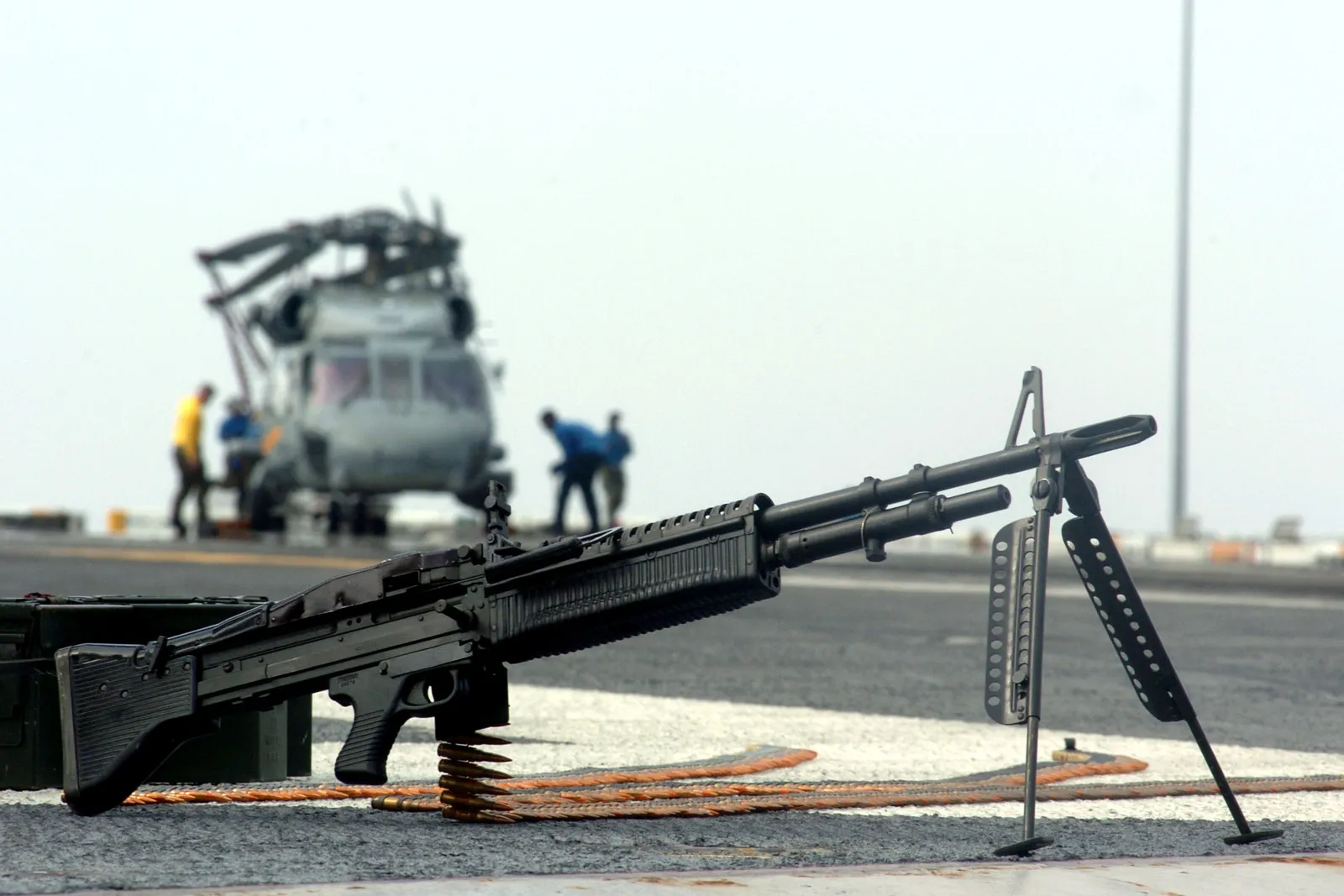
Colombian police reported seizing an arsenal belonging to FARC dissidents in Narino province that included an M60 machine gun, grenades, uniforms, and more than 30,000 rounds of ammunition.
Infantry Weapons
Machine gun
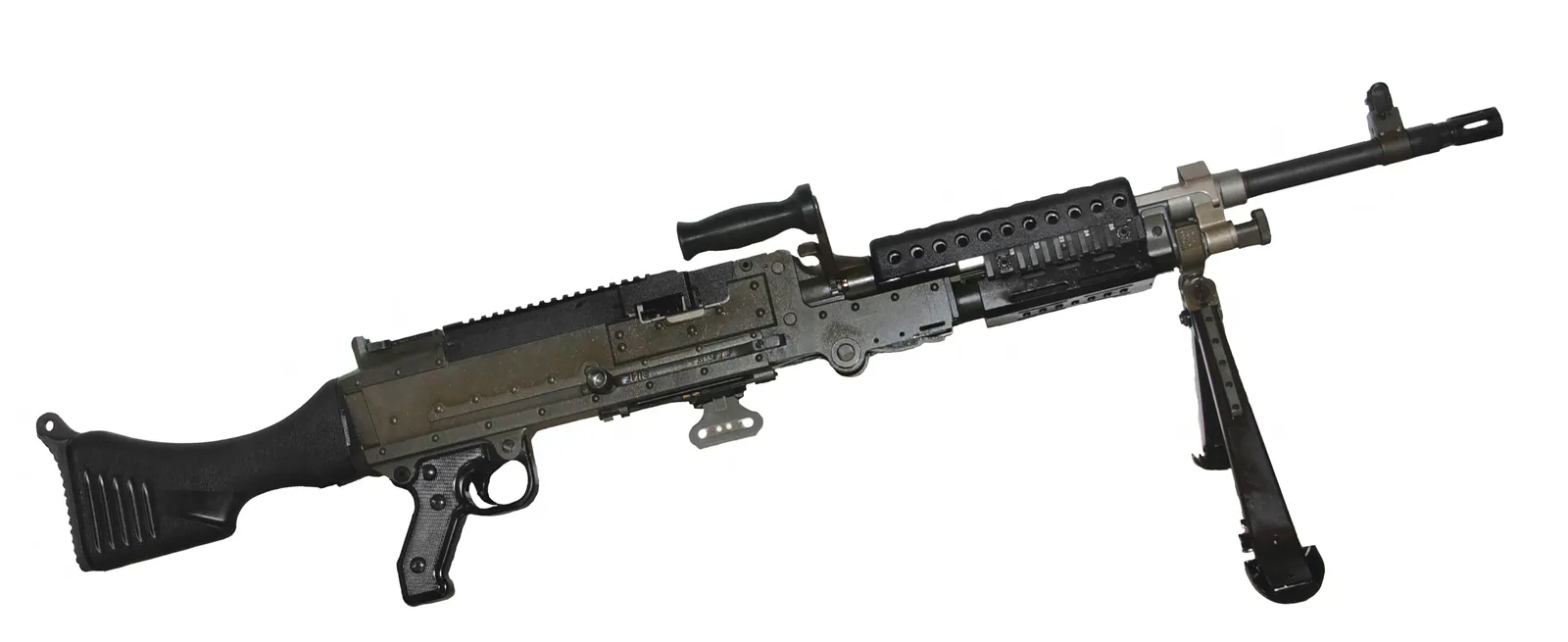
Machine guns are automatic small arms built for sustained rapid fire, with roles spanning light squad automatic weapons, medium or general-purpose guns, and heavy crew-served weapons. This broad catalog entry tracks source-backed machine-gun use, possession, or capture in recent conflicts while treating model-specific facts such as M60, Type 80/PKM-T80, M240, and M2 details as examples rather than universal traits.
Role in Conflicts

AP-reviewed imagery from the first three months of the war showed Hamas fighters with Type 80 machine guns, a Chinese PKM-pattern weapon also reported as an Iranian PKM-T80 copy.
- Side
- Hezbollah

Israeli ground operations and later reporting documented Hezbollah machine guns among captured weapons in southern Lebanon, including vehicles fitted with mounted machine guns.
Profile / Specs
Profile
- Origin
- Multiple countries
- Built by
- Various manufacturers
- Type
- Automatic small arm / crew-served firearm
- Service note
- Late 19th century to present; this entry covers post-2015 conflict documentation
- Designer
- Multiple designers
- Designed
- Modern automatic machine guns emerged in the late 19th century
- Unit cost
- Varies by model and mounting
- Produced
- Late 19th century to present, depending on model
- Number built
- Millions across machine-gun families
Specifications
- Classification
- Common classes include light machine guns, medium/general-purpose machine guns, and heavy machine guns; classification depends on cartridge, mount, crew, and employment.
- Operating principle
- Modern automatic firearms use cartridge energy to cycle the action; powerful ammunition commonly requires locked-breech gas, recoil, or retarded-blowback mechanisms.
- Feed system
- Common feed systems include belts, drums, and box magazines depending on model and role; belts can be disintegrating or non-disintegrating.
- Typical cyclic rate
- Britannica describes many belt-fed machine guns as firing roughly 500 to 1,000 rounds per minute.
- Caliber range
- Modern examples range from intermediate rifle calibers through full-power rifle cartridges and heavy machine-gun cartridges above 8 mm but below the 20 mm cannon threshold.
- Light machine gun role
- Usually rifle-caliber, often single-operator weapons for short-burst sustained automatic fire from a bipod or similar support.
- General-purpose machine gun role
- Typically belt-fed weapons usable by dismounted infantry or from heavier mounts and vehicles for sustained fire.
- Heavy machine gun role
- Crew-served automatic firearms generally mounted on vehicles, boats, aircraft, fortifications, or heavy tripods.
- Role
- Sustained automatic fire for infantry support, defensive positions, vehicle mounts, convoy and force protection, and area denial.
Machine-Gun Role Classes
Light
Portable squad or section automatic-fire weapons, usually rifle-caliber and often fitted with bipods and heavier barrels for controlled bursts.
Medium / general-purpose
Belt-fed guns that can shift between dismounted, tripod, vehicle, boat, aircraft, or fixed-mount use, depending on doctrine and mounting hardware.
Heavy
Crew-served automatic guns in larger calibers, commonly used from vehicles, heavy tripods, fortifications, or other mounts when range and penetration matter more than portability.
Variants
These rows describe common machine-gun role classes rather than variants of one model; individual weapons can blur categories depending on cartridge, mount, crew, and doctrine.
| Variant | Configuration | Designation notes |
|---|---|---|
| Light machine gun | Squad or light support automatic fire | Usually rifle-caliber, often single-user weapons with sustained-fire features such as a heavier barrel and bipod. Sources: Small Arms Survey: Weapons Identification - Small Arms |
| Medium / general-purpose machine gun | Dismounted and mounted sustained fire | General-purpose machine guns are commonly belt-fed weapons usable by infantry or from heavier mounts and vehicles. Sources: Small Arms Survey: Weapons Identification - Small Arms |
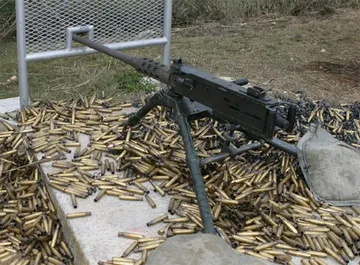
| Heavy machine gun | Crew-served heavy automatic fire | Small Arms Survey treats heavy machine guns as crew-served automatic firearms above 8 mm and below 20 mm, commonly mounted on vehicles or heavy tripods. Sources: Small Arms Survey: Weapons Identification - Light Weapons |
| Vehicle-mounted machine gun | Mounted application | General-purpose and heavy machine guns are frequently attached to vehicle, aircraft, boat, or fixed mounts for sustained-fire applications. Sources: Small Arms Survey: Weapons Identification - Small Arms, Small Arms Survey: Weapons Identification - Light Weapons |
Carrier Boats
The broad machine-gun entry is used for the Cutlass class's documented patrol-boat armament.
| Carrier | Carrier type | Carriage evidence |
|---|---|---|
 | Fast patrol boat | GOV.UK says HMS Cutlass and HMS Dagger initially will carry three purpose machine guns, and Your Gibraltar TV says the boats are armed with three general-purpose machine guns. Sources: GOV.UK: Royal Navy confirms two new fast patrol boats, Royal Navy Gib Squadron Welcomes HMS Cutlass - Your Gibraltar TV |
Timeline
Machine gun Key Events
Gatling patents a rapid-fire predecessor
Richard J. Gatling patented a six-barrel repeating gun that the Smithsonian treats as a rapid-fire Civil War-era predecessor rather than a modern automatic machine gun.
Sources: Smithsonian: Gatling gun patent model
Maxim patents a true automatic gun
Imperial War Museums describes Hiram Maxim's recoil-operated, belt-fed gun as the first fully automatic machine gun design.
Sources: Imperial War Museums: British Maxim machinegun
Light machine-gun roles emerge
Small Arms Survey places the first light machine guns in the early 1910s, as armies separated portable automatic weapons from heavier sustained-fire guns.
Sources: Small Arms Survey: Weapons Identification - Small Arms
Postwar general-purpose guns define a durable class
Small Arms Survey identifies the FN MAG 58 and Soviet PK family as defining examples of the general-purpose machine-gun category.
Sources: Small Arms Survey: Weapons Identification - Small Arms
Related Weapon Systems


Sources
Machine gunPublisher: Encyclopaedia Britannica | Note: Supports machine-gun background, classification, operating principles, and broad rate-of-fire specification context. | Accessed: 2026-07-04Small Arms Survey: Weapons Identification - Small ArmsPublisher: Small Arms Survey | Note: Supports light and general-purpose machine-gun role classes, feed systems, belt types, operating-mechanism context, and postwar GPMG examples. | Accessed: 2026-07-04Small Arms Survey: Weapons Identification - Light WeaponsPublisher: Small Arms Survey | Note: Supports heavy machine-gun classification, crew-served and mount context, and the above-8-mm, below-20-mm heavy machine-gun boundary. | Accessed: 2026-07-04Imperial War Museums: British Maxim machinegunPublisher: Imperial War Museums | Note: Supports Maxim automatic-machine-gun history, recoil operation, and belt-feed context for the timeline. | Accessed: 2026-07-04Smithsonian: Gatling gun patent modelPublisher: Smithsonian National Museum of American History | Note: Supports the 1862 Gatling gun patent and its place as a rapid-fire predecessor in the timeline. | Accessed: 2026-07-04Colombia Police Seize Grenades, Dozens of Guns Belonging to DissidentsPublisher: Voice of America / Reuters | Note: Supports 2016 Colombian FARC Dissident Conflict direct use: an M60 machine gun was used by FARC dissident groups in an arsenal the police reported belonged to the dissidents. | Accessed: 2026-07-04AP News: Who builds the weapons that Hamas fighters usePublisher: AP News | Note: Supports 2023 Israel-Hamas War direct use: AP-reviewed imagery from the first three months of combat showed Hamas fighters with a Type 80 machine gun / PKM-T80 copy. | Accessed: 2026-07-04GOV.UK: Royal Navy confirms two new fast patrol boatsPublisher: GOV.UK | Note: Supports the Cutlass-class machine-gun carriage context by reporting that HMS Cutlass and HMS Dagger initially will carry three purpose machine guns. | Accessed: 2026-07-04Royal Navy Gib Squadron Welcomes HMS Cutlass - Your Gibraltar TVPublisher: Your Gibraltar TV | Note: Supports the Cutlass-class machine-gun carriage context by reporting that HMS Cutlass and HMS Dagger are armed with three general-purpose machine guns. | Accessed: 2026-07-04Hezbollah Weapons Captured by the IDF in South LebanonPublisher: Alma Research and Education Center | Note: Supports 2023 Israel-Hezbollah Conflict direct use: machine guns were used by Hezbollah and appeared among captured Hezbollah weapons in IDF-released southern Lebanon footage. | Accessed: 2026-07-04The IDF seized masses of Hezbollah weapons. What do they tell us?Publisher: The Jerusalem Post | Note: Supports 2023 Israel-Hezbollah Conflict direct use: mounted machine guns were used by Hezbollah on vehicles and appeared among weapons seized in Lebanon. | Accessed: 2026-07-04M240B Medium Machine Gun imagePublisher: Wikimedia Commons | Note: Image provenance and licensing page for the primary representative machine-gun image; listed as public domain U.S. Air Force work. | Accessed: 2026-07-04M60 machine gun imagePublisher: Wikimedia Commons | Note: Image provenance and licensing page for a representative M60 machine-gun image; listed as public domain U.S. Navy work. | Accessed: 2026-07-04M2 machine gun imagePublisher: Wikimedia Commons | Note: Image provenance and licensing page for a representative heavy machine-gun image; listed as public domain U.S. Navy work. | Accessed: 2026-07-04