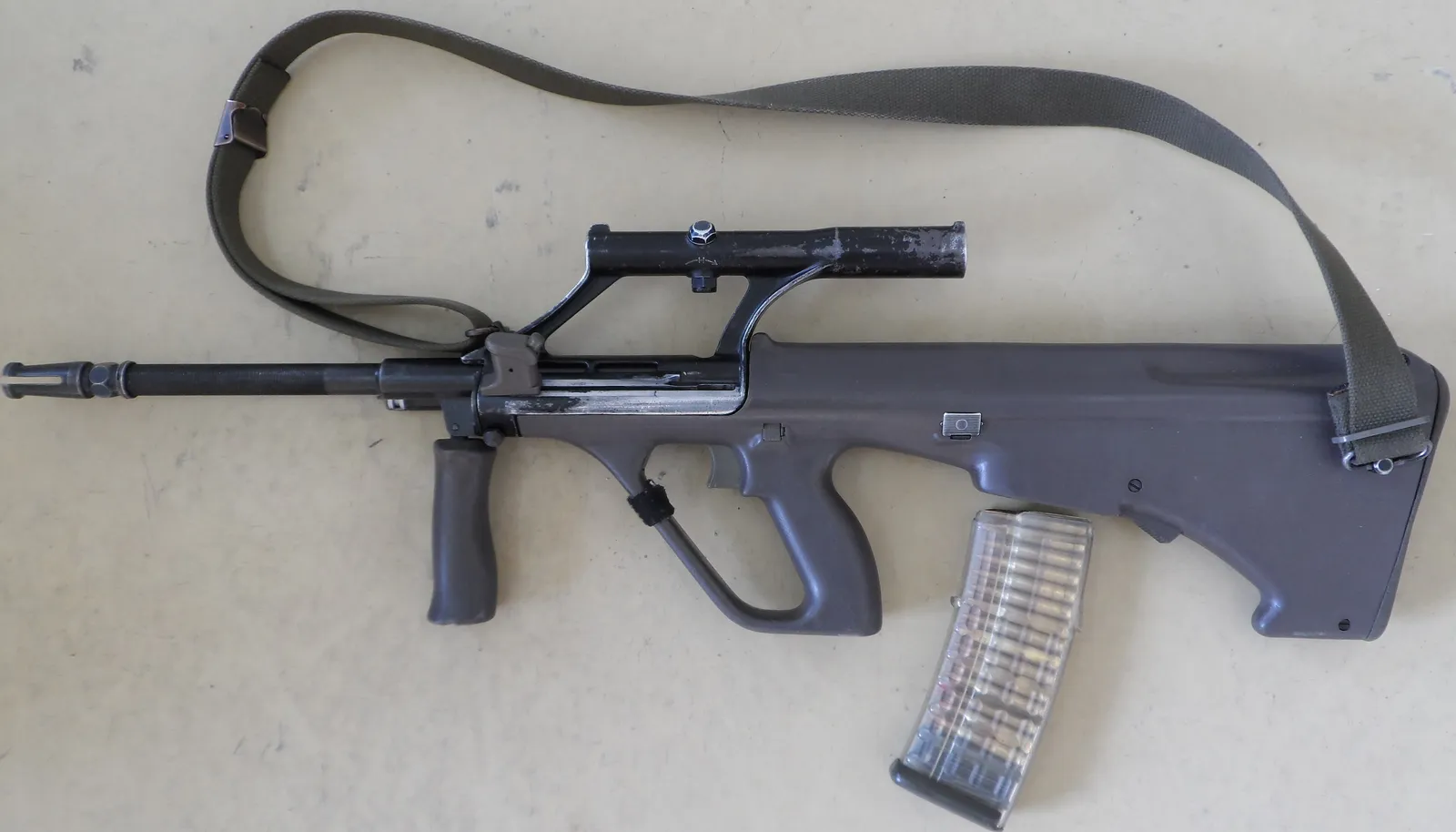
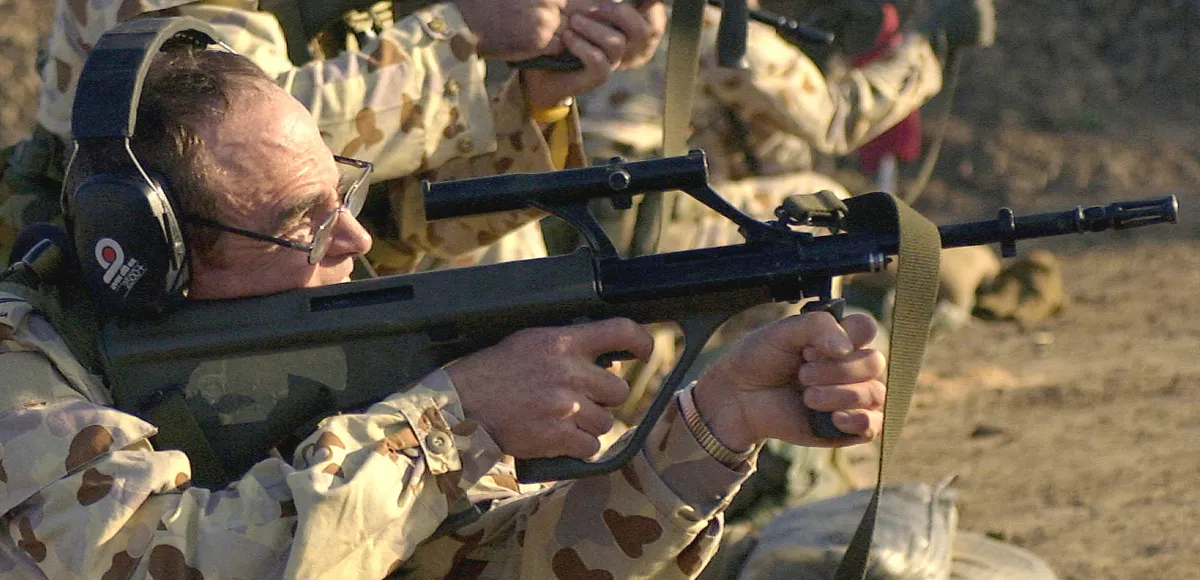
Australian War Memorial collection records from East Timor identify INTERFET personnel in late 1999 and early 2000 carrying Steyr F88 rifles during Australian-led peacekeeping and stabilization operations.
Infantry Weapons
Steyr AUG rifle
Also known as
- Steyr AUG
- AUG
- Armee Universal Gewehr
- Army Universal Rifle
- StG 77
- Sturmgewehr 77
- AUG A1
- AUG A3 9mm
- AUG 9mm
- AUG MP88
- F88 Austeyr
- Steyr F88
- F88A2
- Austeyr
- Enhanced F88
- EF88 Austeyr
- F90
- AUG Mod 14
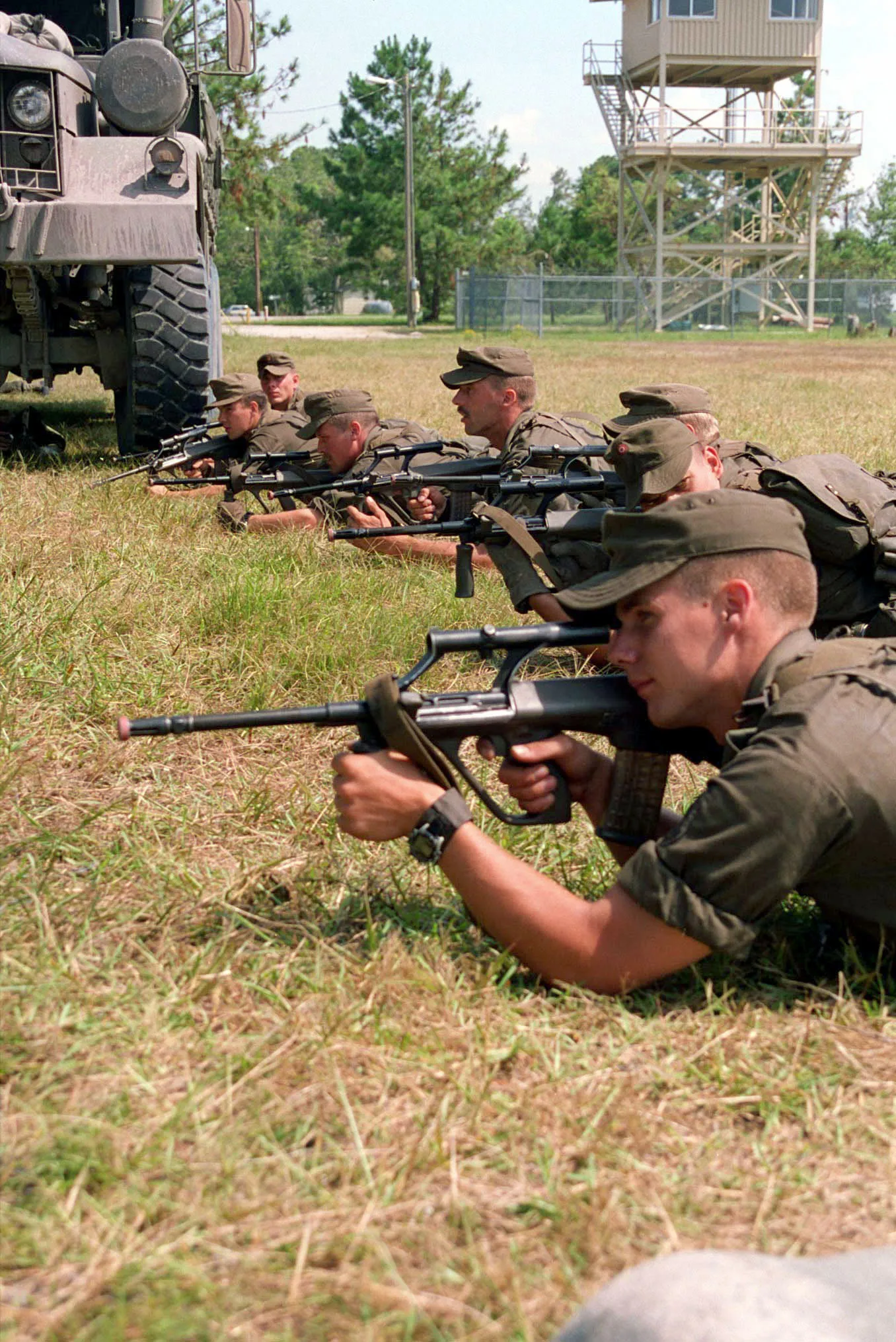
The Steyr AUG is an Austrian-origin bullpup assault-rifle family built around a compact layout, quick-change barrels, rotary-bolt gas operation, and transparent synthetic magazines. Catalog evidence now follows both the Austrian AUG/StG 77 line and Australian F88/EF88 derivatives, with direct conflict documentation from East Timor peacekeeping, Afghanistan, Syrian opposition supply channels, and coalition-linked flows in Yemen.
Role in Conflicts


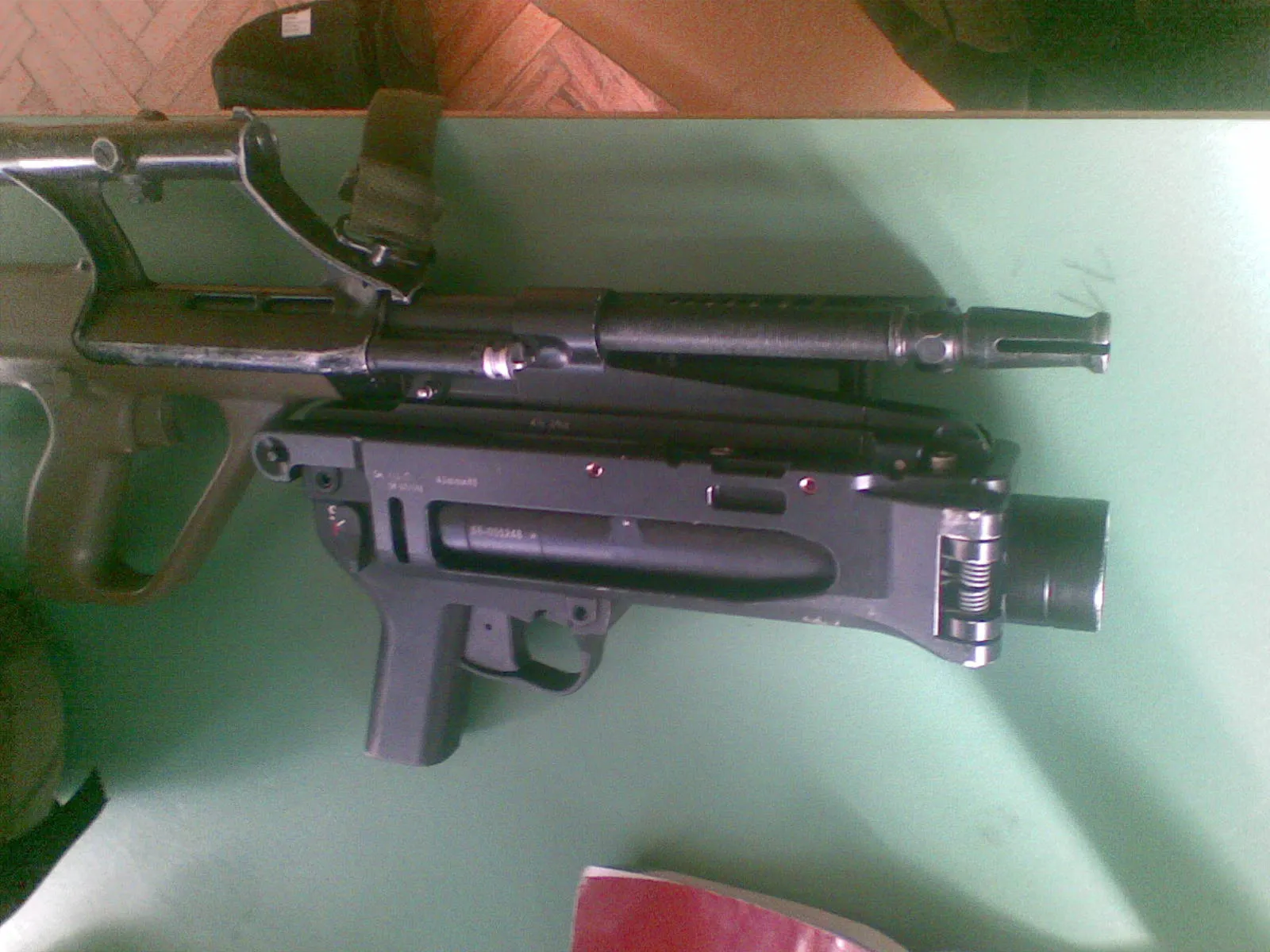
Australian War Memorial collection records document 3RAR soldiers in Uruzgan Province during Operation Slipper carrying F88 Steyr rifles, including an F88 fitted with a grenade-launcher attachment.
Role details
Armament Research Services documented a Steyr AUG offered for sale in opposition-controlled north-western Syria in 2021 and reported that AUG rifles had previously been supplied to northern Syrian opposition forces via Turkey.
Role details
Jamestown reporting during the 2014 Yemen Civil War described Steyr AUG rifles as used by and provided by Saudi Arabia in Yemen, with some coalition-supplied small arms circulating through anti-Houthi forces and local arms markets.
Role detailsProfile / Specs
Profile
- Origin
- Austria; Australian F88/EF88 derivatives and Saudi-linked AUG transfers documented in conflict reporting
- Type
- 5.56 mm bullpup assault rifle family
- Service note
- 1977-present; documented in East Timor, Afghanistan, Syria, and Yemen conflict-use sources
- Designer
- Steyr-Daimler-Puch development team
- Designed
- 1960s-1970s
- Produced
- 1977-present
Specifications
- Caliber
- 5.56x45 mm NATO on standard AUG rifle variants; 9x19 mm on AUG 9mm / MP88-style branches
- Operation
- Gas-operated, rotary bolt with adjustable gas regulator
- Barrel length
- Interchangeable 382 mm, 417 mm, or 508 mm barrels on AUG A3 5.56 mm variants
- Overall length
- 690 mm with 382 mm barrel, 725 mm with 417 mm barrel, or 790 mm with 508 mm barrel
- Weight
- 3.2-3.6 kg depending on 5.56 mm barrel length
- Magazine
- Transparent detachable synthetic box magazine, commonly 30 rounds with 42-round option
- Layout
- Bullpup layout with the magazine and action behind the trigger group
AUG Family Modularity
The AUG family is organized around a compact bullpup layout, with the action and magazine behind the trigger to preserve barrel length while reducing overall length. Steyr's A3 material emphasizes unit-level modularity: barrels, receiver and optic arrangements, rails, stocks, and caliber branches can be configured for rifle, special-forces, NATO-magazine, and 9x19 mm roles.
Core layout
Bullpup 5.56x45 mm rifle family with gas operation, rotary bolt, synthetic magazines, and interchangeable barrel lengths.
Designation spread
Austrian StG 77, Irish AUG Mod 14, Australian F88/EF88 Austeyr, and Lithgow F90 names identify national or derivative branches rather than unrelated weapons.
Variants
The AUG record functions as a family page: Steyr's Austrian AUG/StG 77 line, national service upgrades, and Australian Austeyr/F90 derivatives share the bullpup layout and modular small-arms architecture while differing in receivers, rails, barrels, optics, and service designations.
| Variant | Configuration | Designation notes |
|---|---|---|
| AUG A1 / StG 77 | Original Austrian 5.56 mm service rifle | Steyr says the Austrian Federal Army selected the AUG A1 in 1977 and designated it StG 77; the Bundesheer lists StG 77 as its standard rifle designation. Sources: STG 77 - Birth of an Icon, Sturmgewehr 77, AUG A1 |
| AUG A3 | Modern modular 5.56 mm AUG | Steyr describes the A3 as a modular weapon system configurable between variants at unit level without tools, with Picatinny rails for optics and accessories. Sources: AUG A3 |
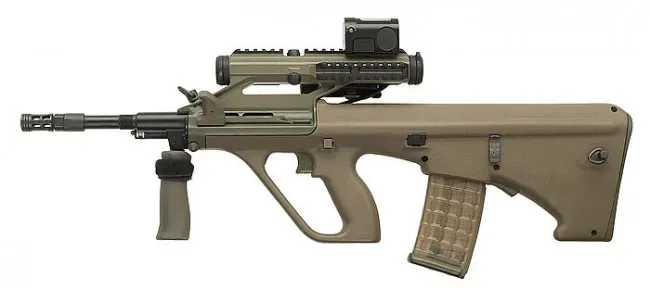
| AUG A3 SF | A3 special-forces configuration | Steyr lists AUG A3 SF as a 5.56 mm A3 version with a 1.5x optical sight and Picatinny rails. Sources: AUG A3 |
| AUG A3 9mm / AUG MP88 | 9x19 mm AUG branch | Steyr lists an AUG A3 9mm version, and Steyr Arms USA markets an AUG MP88-style 9x19 mm variant. Sources: AUG A3, The Steyr AUG |
| AUG A3 M1 | U.S. commercial A3 branch | Steyr Arms USA identifies the A3 M1 as a modernized AUG variant built around the proven AUG system. Sources: The Steyr AUG |
| AUG A3 M2 | Current U.S. standard/NATO-stock branch | Steyr Arms USA lists the A3 M2 as a modernized AUG available in standard or NATO variants. Sources: The Steyr AUG |
| F88 Austeyr / F88A2 | Australian-produced Austeyr service rifle | Australian Army material identifies the F88A2 as the standard combat weapon from 2009 to 2016; Armax traces the F88 Austeyr to Australia's 1988 adoption of the Steyr AUG. Sources: F88 Austeyr, Australia's Bullpup Rifles |
| Enhanced F88 / EF88 Austeyr / F90 | Australian enhanced derivative | Royal Australian Navy material says the EF88 began entering service in mid-2016 to replace the F88; Lithgow describes the F90 as an Australian bullpup automatic rifle family with modular barrel options. Sources: EF88 Austeyr, F90 Automatic Rifle Family |
| Steyr AUG Mod 14 | Irish Defence Forces upgrade | Irish Defence Forces material says the Mod 14 upgrade began in 2014 and added refurbishment, a long Picatinny rail, and a 4x Trijicon ACOG. Sources: Platoon Level Weapons |
Ammunition Fired
The AUG family is primarily a 5.56x45 mm NATO rifle line, with a documented 9x19 mm AUG branch.
| Ammunition | Ammunition type | Firing evidence |
|---|---|---|
 | Standard rifle cartridge | Steyr lists the AUG A1 and AUG A3 rifle variants in 5.56x45 NATO, and Australian F88/EF88 sources identify the same 5.56x45 mm NATO ammunition family. Sources: AUG A1, AUG A3, F88 Austeyr, EF88 Austeyr |
 | 9x19 mm AUG branch | Steyr lists an AUG A3 9mm version in 9x19 mm, and Steyr Arms USA describes an AUG MP88-style 9x19 mm variant. Sources: AUG A3, The Steyr AUG |
Timeline
Steyr AUG rifle Key Events
AUG development begins
Steyr says development of the new AUG assault rifle began in the late 1960s; this entry uses 1968 as an approximate late-decade anchor.
Sources: STG 77 - Birth of an Icon
Austrian StG 77 selection
The Austrian Federal Army selected the AUG A1 as its new standard assault rifle, later designated StG 77.
Sources: STG 77 - Birth of an Icon, Sturmgewehr 77
Irish and Australian service branches
Irish Defence Forces material says the AUG entered Irish service in 1988; Armax records Australia's 1988 adoption of the F88 Austeyr.
Sources: Platoon Level Weapons, Australia's Bullpup Rifles
F88 documented with INTERFET
Australian War Memorial collection records show INTERFET personnel in Dili carrying Steyr F88 rifles around November 1999 during East Timor peacekeeping operations.
Sources: AWM INTERFET Steyr F88 Patrol Photograph
F88A2 Australian standard rifle period begins
Australian Army material identifies the F88A2 as the standard combat weapon between 2009 and 2016.
Sources: F88 Austeyr
Irish Mod 14 upgrade
The Irish Defence Forces began upgrading AUG A1 rifles with refurbishment, a top Picatinny rail, and ACOG optics.
Sources: Platoon Level Weapons
EF88 enters Australian service
Royal Australian Navy material says the EF88 began entering service in mid-2016 and replaced the F88 Austeyr; this entry uses June 2016 as a mid-year anchor.
Sources: EF88 Austeyr
Media
Steyr AUG rifle Videos
Related Weapon Systems


Sources
AUG A3Publisher: Steyr Arms GmbH | Note: Supports manufacturer background, modular AUG A3 description, A3/A3 SF/A3 9mm versions, ammunition compatibility, and 5.56 mm specifications. | Accessed: 2026-07-01The Steyr AUGPublisher: Steyr Arms USA | Note: Supports current AUG variant background, A3 M1, A3 M2, AUG MP88/9x19 mm context, magazine capacity, barrel lengths, and service-family context. | Accessed: 2026-07-01STG 77 - Birth of an IconPublisher: Steyr Arms GmbH | Note: Supports late-1960s AUG development, the 1977 Austrian Federal Army AUG A1 selection, and the StG 77 designation. | Accessed: 2026-07-01AUG A1Publisher: Steyr Arms GmbH | Note: Supports AUG A1 background, 5.56x45 NATO chambering, bullpup layout, quick-change barrel concept, and A1 specifications. | Accessed: 2026-07-01Sturmgewehr 77Publisher: Austrian Armed Forces | Note: Supports StG 77 official designation, Austrian service-rifle context, 5.56 mm caliber, 30-round magazines, and performance specifications. | Accessed: 2026-07-01F88 AusteyrPublisher: Australian Army | Note: Supports Australian F88A2 service period, Australian manufacture, 5.56x45 mm ammunition, grenade-launcher attachment context, and F88 specifications. | Accessed: 2026-07-01EF88 AusteyrPublisher: Royal Australian Navy | Note: Supports EF88 service entry, replacement of the F88, Thales Australia manufacturer attribution, 5.56x45 mm ammunition, and ancillary-attachment context. | Accessed: 2026-07-01Australia's Bullpup RiflesPublisher: Armax: The Journal of Contemporary Arms | Note: Supports F88/EF88 family background: Australia adopted the Steyr AUG as the F88 Austeyr in 1988, produced it domestically in Lithgow, and developed the EF88 from 2009 onward. | Accessed: 2026-07-01Platoon Level WeaponsPublisher: Irish Defence Forces | Note: Supports Armee Universal Gewehr alias, Irish AUG service entry in 1988, bullpup explanation, and the 2014 Mod 14 upgrade with Picatinny rail and ACOG optic. | Accessed: 2026-07-01F90 Automatic Rifle FamilyPublisher: Lithgow Arms | Note: Supports F90 family context, 5.56x45 mm NATO ammunition, modular barrel options, barrel-length specifications, SL40 integration, and F90 derivative background. | Accessed: 2026-07-01AQAP in Southern Yemen: Learning, Adapting and GrowingPublisher: The Jamestown Foundation | Note: Supports 2014 Yemen Civil War direct use context: Steyr AUG rifles were used by and provided by Saudi Arabia in Yemen, with abundance in wartime arms markets. | Accessed: 2026-07-01Yemen: A Dangerous Regional Arms BazaarPublisher: The Jamestown Foundation | Note: Supports 2014 Yemen Civil War direct supply context: Saudi and UAE weapons were supplied to anti-Houthi militias and government-aligned units, and Steyr AUG rifles used by Saudi forces were reported in Yemen's arms markets. | Accessed: 2026-07-01AWM INTERFET Steyr F88 Patrol PhotographPublisher: Australian War Memorial | Note: Supports East Timor, 1999-2013 direct conflict-use context: Australian INTERFET personnel patrolled Dili in November 1999 armed with Steyr F88 rifles. | Accessed: 2026-07-01AWM INTERFET Gunner Wyatt F88 PhotographPublisher: Australian War Memorial | Note: Supports East Timor, 1999-2013 direct conflict-use context: an Australian INTERFET soldier was recorded armed with an F88 Steyr rifle in January 2000. | Accessed: 2026-07-01AWM 3RAR F88 Afghanistan PhotographPublisher: Australian War Memorial | Note: Supports 2001 War in Afghanistan direct conflict-use context: Australian 3RAR personnel in Uruzgan Province during Operation Slipper were documented armed with an F88 Steyr rifle with grenade launcher attachment. | Accessed: 2026-07-01ARES Syria Online Arms Trade April 2021Publisher: Armament Research Services | Note: Supports 2011 Syrian Civil War direct presence and supply context: ARES documented a Steyr AUG offered for sale in opposition-controlled north-western Syria and reported AUG rifles supplied to northern Syrian opposition forces via Turkey. | Accessed: 2026-07-01Steyr AUG 5.56 mm ImagePublisher: Wikimedia Commons | Note: Supports image provenance for a public-domain Steyr AUG/StG 77 photograph by MoserB. | Accessed: 2026-07-01Steyr AUG F88 ImagePublisher: Wikimedia Commons | Note: Supports image provenance for a public-domain U.S. Department of Defense photograph of an AUG/F88 rifle. | Accessed: 2026-07-01Steyr AUG A3 SF ImagePublisher: Wikimedia Commons | Note: Supports image provenance and CC BY-SA 4.0 licensing for a Steyr AUG A3 SF photograph by Alexdelarge15. | Accessed: 2026-07-01Austrian Soldiers With Steyr AUG Rifles ImagePublisher: Wikimedia Commons | Note: Supports image provenance for a public-domain U.S. Marine Corps photograph of Austrian soldiers armed with Steyr AUG rifles. | Accessed: 2026-07-01Steyr AUG A1 With AG-C ImagePublisher: Wikimedia Commons | Note: Supports image provenance for a public-domain photograph of a Steyr AUG A1 fitted with an AG-C grenade launcher. | Accessed: 2026-07-01