WeaponSystems.net lists B-11 use in the Yom Kippur War and describes Egyptian anti-tank teams carrying B-10 and B-11 recoilless guns in layered anti-tank waves.
Infantry Weapons
B-11 recoilless rifle
Also known as
- 107 mm B-11
- 107-mm B-11
- 107mm B-11
- 107 mm recoilless gun B-11
- 52-M-883
- B-11
- Б-11
- RG-107
- RG107
- B-11 recoilless gun
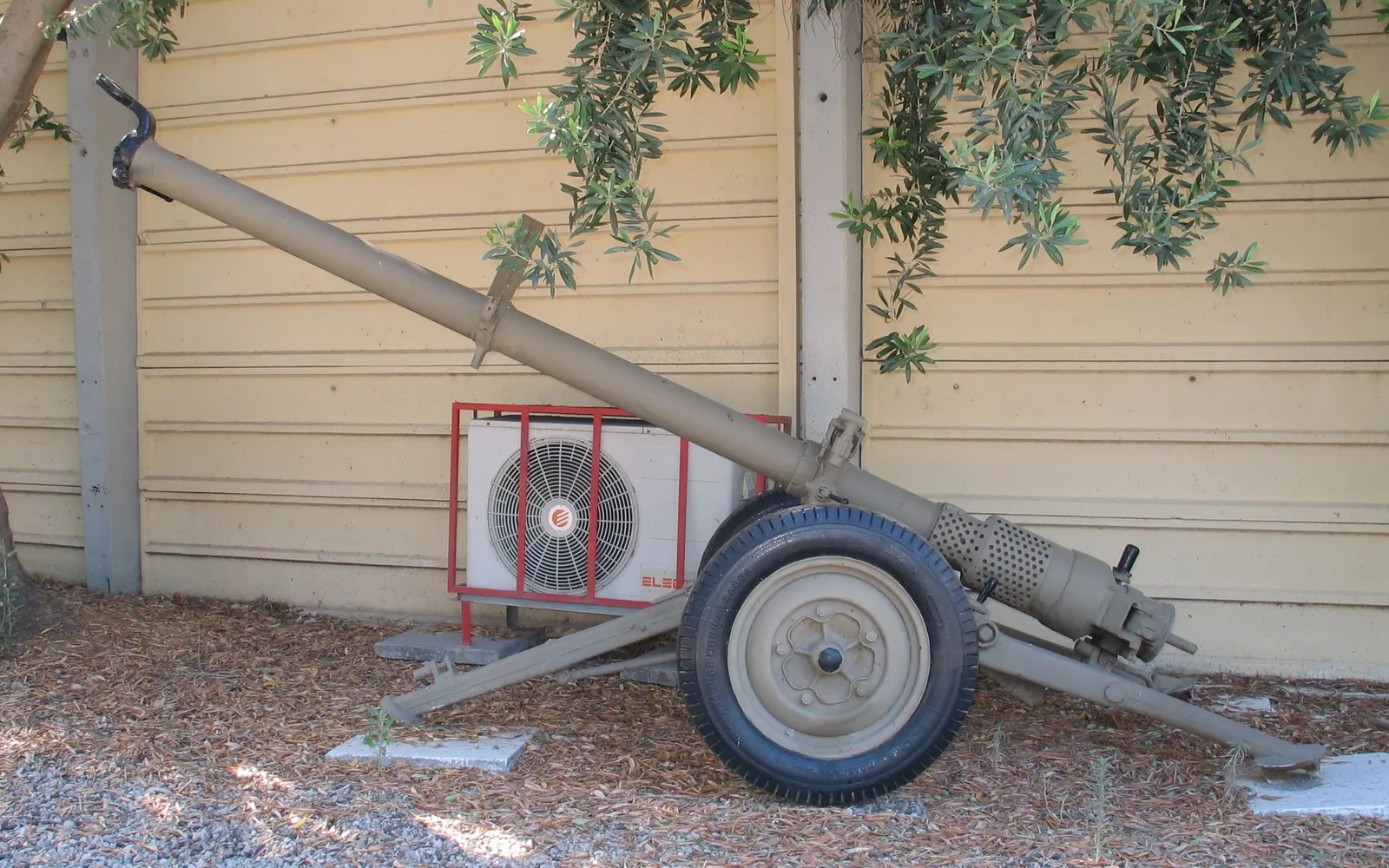
The B-11 is a Soviet 107 mm smoothbore recoilless gun developed for rifle, motor-rifle, and airborne units that needed a crew-served anti-armor and direct-fire support weapon. Its service manual describes HEAT and HE-fragmentation ammunition, tripod or wheeled firing positions, and vehicle towing, while open conflict reporting directly documents Egyptian Yom Kippur War use.
Role in Conflicts
Design And Ammunition
The B-11 combined a smoothbore recoilless barrel with a two-wheel carriage and under-slung tripod so a crew could tow it, manhandle it over short distances, and fire from a prepared tripod position.
Anti-armor round
BK-883 HEAT ammunition gave the gun a direct-shot anti-armor role at about 450 m.
Support round
OF-883A / O-883A HE-fragmentation ammunition extended the weapon into infantry-position and light-structure fire support.
Sight package
The PBO-4 sight supported both direct and indirect fire, with a mechanical sight retained as backup.
Profile / Specs
Profile
- Origin
- Soviet Union
- Built by
- TOZ
- Type
- 107 mm smoothbore recoilless gun
- Service note
- Early Cold War recoilless weapon introduced in the 1950s and later exported to Soviet-aligned forces
- Designer
- KBM Kolomna
- Designed
- Early 1950s
- Produced
- 1954-1964
Specifications
- Caliber
- 107 mm
- Bore
- Smoothbore
- Weapon index
- 52-M-883
- Ammunition
- BK-883 HEAT and OF-883A / O-883A HE-fragmentation rounds
- Crew
- Four-person gun detachment under a gun commander; many references count five including the commander
- Weight in firing position
- About 305 kg with PBO-4 sight
- Travel dimensions
- 3.56 m long, 1.45 m wide, 0.9 m high
- Firing height
- 1.19 m
- Mount
- Two-wheel carriage with under-slung tripod firing position
- Rate of fire
- 4 to 6 rounds/min depending source
- HEAT direct-shot range
- 450 m against a 2 m target
- HE-fragmentation maximum range
- 6,650 m
- HEAT penetration
- About 290-381 mm rolled homogeneous armor depending projectile/source
- Muzzle velocity
- 400 m/s HEAT and 375 m/s HE-fragmentation in the Soviet service manual
- Elevation
- -10 to +45 degrees
- Traverse
- 35 degrees left and 35 degrees right
- Sight
- PBO-4 optical sight for direct and indirect fire
- Emplacement time
- About 1 minute
Related Soviet Recoilless Guns
The B-11 was fielded alongside the smaller B-10 as part of the Soviet postwar recoilless-gun family.
| Compatible item | Item type | Compatibility evidence |
|---|---|---|
 | 82 mm recoilless gun | WeaponSystems.net describes the B-11 as an up-scaled 107 mm counterpart to the 82 mm B-10, and Small Arms Survey groups the B-10 and B-11 among notable postwar Soviet recoilless weapons. |
Carrier Vehicles
Vehicle carriage mattered because the B-11 was a 305 kg crew-served gun rather than a shoulder weapon.

Timeline
B-11 recoilless rifle Key Events
B-11 enters Soviet service
WeaponSystems.net dates B-11 service entry and the start of Soviet production to 1954.
Sources: 107mm B-11
Soviet service manual published
The second edition of the Soviet Ministry of Defence service manual recorded the B-11's 107 mm identity, 52-M-883 supply index, crew, ammunition, sight, mobility, and ballistic data.
Sources: 107 mm B-11 Service Manual
Soviet production run ends
WeaponSystems.net lists the original Soviet B-11 production period as 1954-1964.
Sources: 107mm B-11
Yom Kippur War use documented
WeaponSystems.net lists Yom Kippur War use and describes Egyptian anti-tank teams that included B-10 and B-11 recoilless guns in layered anti-tank waves.
Sources: 107mm B-11
Related Weapon Systems


Sources
107mm B-11Publisher: WeaponSystems.net | Note: Supports B-11 identity, Soviet origin, KBM Kolomna development attribution, TOZ production attribution, 1954 service entry, 1954-1964 production period, recoilless-gun design, 107 mm caliber, HE/HEAT ammunition, carriage and tripod context, B-10 relationship, and direct conflict-use in the 1973 Yom Kippur War by Egyptian anti-tank teams. | Accessed: 2026-07-13107 mm B-11 Service ManualPublisher: Ministry of Defence of the USSR / Voenizdat | Note: Supports the official B-11 service-manual identity, 52-M-883 index, role in rifle, motor-rifle, and airborne units, smoothbore recoilless design, crew, GAZ-63 towing, breakdown into barrel/carriage/wheels, PBO-4 sight, and technical data for weight, range, rate of fire, and ammunition. | Accessed: 2026-07-13Worldwide Equipment Guide B-11Publisher: U.S. Army TRADOC | Note: Supports alternate designation RG107, dimensions, crew count, carriage/tripod firing arrangement, PBO-4 sight, emplacement time, HEAT range, penetration, and general B-11 specifications. | Accessed: 2026-07-13RWD MB III B-11 Technical CatalogPublisher: Raketen- und Waffentechnischer Dienst im Kdo. MB III | Note: Supports B-11 mission roles, 107 mm caliber, 305 kg gun weight, MK-11 and MO-11 ammunition references, muzzle velocities, penetration, rate of fire, crew positions, PBO-4 sight, and main component layout. | Accessed: 2026-07-13Small Arms Survey Recoilless WeaponsPublisher: Small Arms Survey | Note: Supports broader recoilless-weapon context, identifies the 82 mm B-10 and 107 mm B-11 as notable postwar Soviet recoilless weapons, and explains the crew-served mount/vehicle pattern for larger recoilless weapons. | Accessed: 2026-07-13BTR-50Publisher: WeaponSystems.net | Note: Supports the transport relationship between the BTR-50P and B-11 by describing the armored personnel carrier as able to carry one 107 mm B-11 with its five-person crew and ammunition. | Accessed: 2026-07-13B-11 107mm Recoilless Rifle ImagePublisher: Wikimedia Commons | Note: Supports the primary B-11 image provenance and public media URL. | Accessed: 2026-07-13