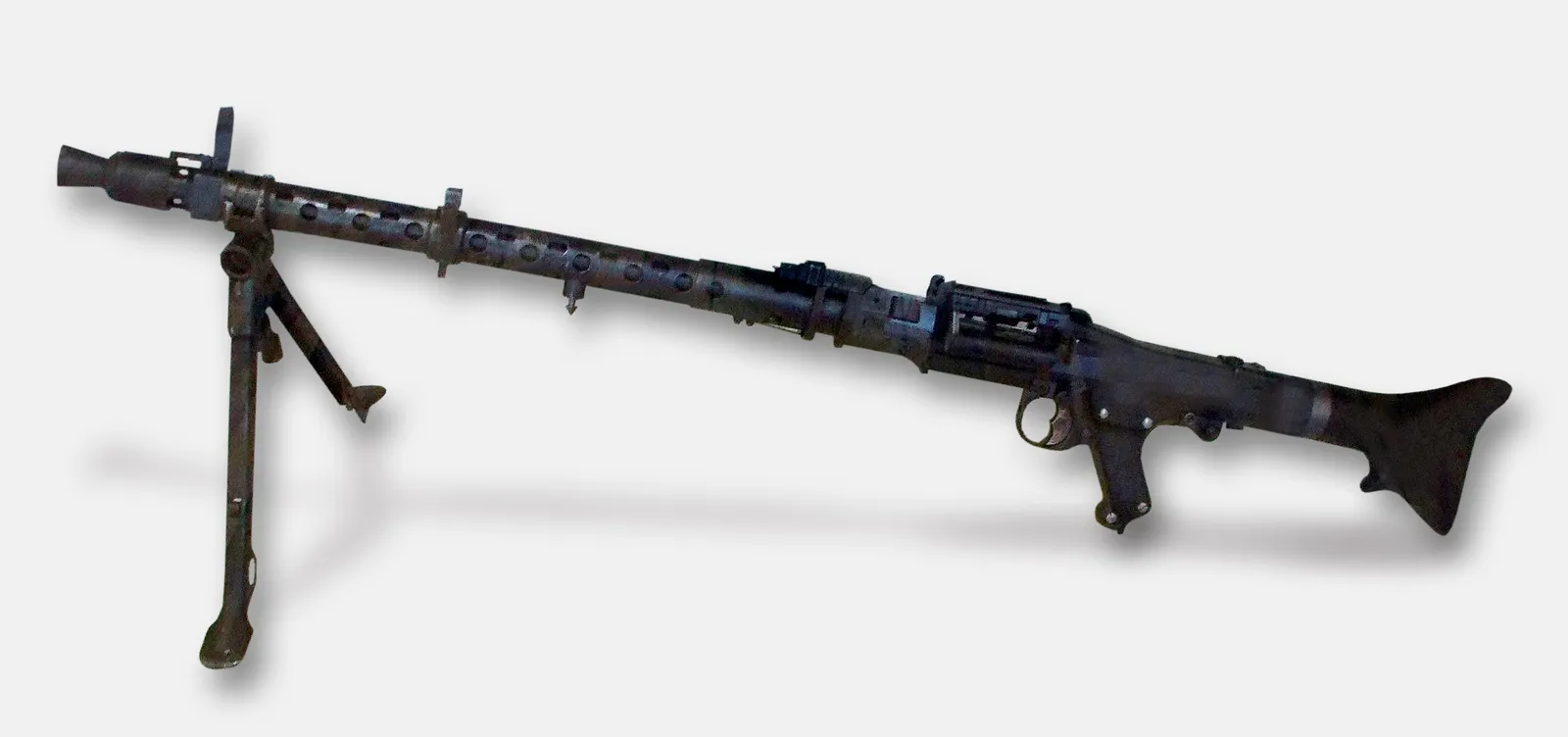
Deutsches Historisches Museum describes the MG 34 as first used on a large scale in Germany's 1939 invasion of Poland, while U.S. War Department manuals identify it as a German dual-purpose machine gun used from infantry, antiaircraft, tripod, and tank mountings during the Second World War.
Infantry Weapons
MG 34
Also known as
- Maschinengewehr 34
- Universal-Maschinengewehr Modell 34
- M.G. 34
- MG34
- MG 34 modified
- MG 34S
- MG 34/41
The MG 34 was a German 7.92 mm general-purpose machine gun developed in the early 1930s and adopted as a standard infantry weapon before the Second World War. U.S. War Department manuals treated it as Germany's original standard dual-purpose machine gun, usable from bipods, tripods, antiaircraft mounts, and armored-vehicle installations; a 1968 Fleet Marine Force Pacific guide also listed the German MG 34 among enemy weapons captured in South Vietnam.
Role in Conflicts
- Side
- North Vietnam and Viet Cong

A 1968 Fleet Marine Force Pacific guide listed the 7.92 mm German MG 34 in its enemy-weapons section, describing the pictured weapons as types captured in South Vietnam and warning Marines to expect the enemy to use a wider range of weapons than those shown.
Profile / Specs
Profile
- Origin
- Nazi Germany
- Built by
- Waffenwerke Brunn
- Type
- 7.92 mm general-purpose machine gun
- Service note
- German service during the Second World War
- Designer
- German small-arms industry design work; this record attributes sourced production context to Rheinmetall production and Waffenwerke Brunn's documented 1945 Brno example.
- Designed
- Early 1930s
- Produced
- 1934-1945
- Number built
- More than 400,000 for the Wehrmacht according to Deutsches Historisches Museum
Specifications
- Caliber
- 7.92 mm / 7.92 x 57 mm
- Operation
- Short recoil with muzzle-blast assistance; air-cooled perforated barrel jacket
- Feed
- 50-round metallic-link belts that could be connected, plus drum feed options for mobile or antiaircraft use
- Weight
- 12.1 kg in the DHM object record; 26.5 lb with bipod and 42 lb with tripod in TM-E 30-451
- Overall length
- 112.5 cm in the DHM object record; 48 in in U.S. War Department tables
- Barrel length
- 62.5 cm in the DHM object record; 23.5 in in U.S. Tactical and Technical Trends comparison tables
- Cyclic rate
- About 900 rounds per minute in DHM and TM-E 30-451 data
- Practical rate
- 100-120 rounds per minute as light machine gun; 300 rounds per minute as heavy machine gun in TM-E 30-451
- Effective range
- 600-800 yd as light machine gun; 2,000-2,500 yd as heavy machine gun in TM-E 30-451
- Sights
- Leaf rear sight, antiaircraft ring sight, and optical sight for tripod use listed in TM-E 30-451
- Configurations
- Bipod, tripod, single or dual antiaircraft mounts, and armored-vehicle mountings
Operating Roles
The MG 34 record is strongest when read as a mount-adaptable system rather than only a squad automatic weapon. Wartime U.S. manuals described the same gun moving between light-machine-gun, heavy-machine-gun, antiaircraft, and tank-armament roles.
Infantry light role
Used from a bipod with belt or drum feed; TM-E 30-451 lists a practical light-machine-gun rate of 100-120 rounds per minute.
Tripod heavy role
Tripod use added optical sighting and a longer effective range category in U.S. tables, with TM-E 30-451 listing 2,000-2,500 yards.
Vehicle and air-defense role
U.S. reporting covered single or dual antiaircraft mounts and tank subsidiary armament, while IWM documents a Panzermantel armored-vehicle example.
Variants
The MG 34 family included infantry, armored-vehicle, and simplified high-rate variants documented in wartime U.S. technical reporting.
| Variant | Configuration | Designation notes |
|---|---|---|
| MG 34 with Panzermantel barrel jacket | armored vehicle gun configuration | Imperial War Museums describes its Waffenwerke Brunn example as an armored vehicle gun fitted with an armored Panzermantel barrel jacket. Sources: IWM MG34 |
| MG 34 modified | armored-vehicle hull-mount variant | A U.S. Tactical and Technical Trends comparison described the modified MG 34 as principally used in armored vehicle hull mounts, with a heavier barrel jacket and no antiaircraft sight bracket. |
| MG 34S | simplified high-rate development | The same wartime comparison grouped the MG 34S with the MG 34/41 as full-automatic-only variants using a shorter barrel, simplified trigger group, stronger recoil/buffer parts, and a modified feed mechanism. |
| MG 34/41 | simplified high-rate development | U.S. reporting distinguished the MG 34/41 from the MG 34S mainly by its perforated operating handle while describing the same broad simplification package. |
Timeline
MG 34 Key Events
Production begins
Deutsches Historisches Museum states that the early-1930s MG 34 entered production at Rheinmetall in 1934.
Adopted for German infantry
The same DHM account says the MG 34 was accepted into standard German infantry equipment as Universalmodell 34 in January 1939.
Large-scale wartime use in Poland
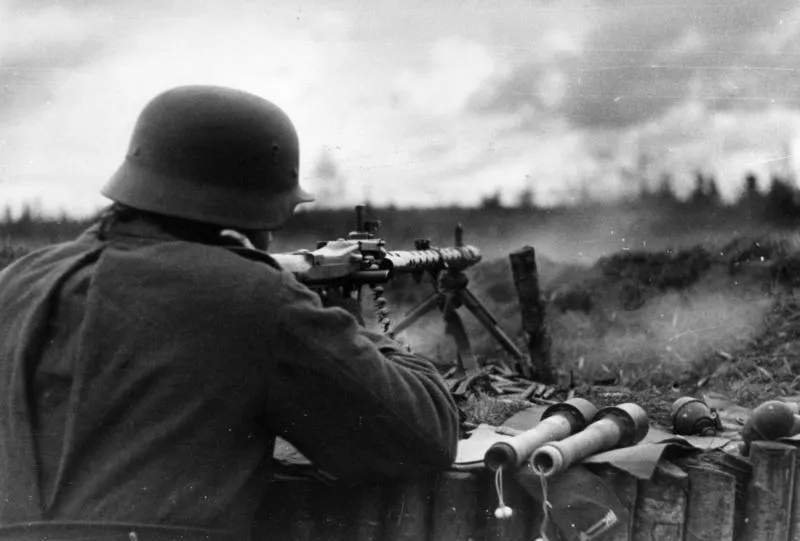
DHM identifies Germany's 1939 invasion of Poland as the MG 34's first large-scale use.
MG 42 starts replacing it
DHM and U.S. War Department reporting both describe the MG 42 as replacing the MG 34 in many roles, while the older gun remained in service.
Brno armored-vehicle example documented
Imperial War Museums records a 1945 Waffenwerke Brunn MG34 armored vehicle gun made in Brno.
Listed in a Vietnam enemy-weapons guide
Fleet Marine Force Pacific's guide to the Republic of Vietnam listed the German MG 34 among enemy weapons captured in South Vietnam.
Media
MG 34 Videos
MG 34 Images
Related Weapon Systems


Sources
DHM LeMO MG 34Publisher: Deutsches Historisches Museum | Note: Supports direct Second World War use by identifying the MG 34's first large-scale employment in Germany's 1939 invasion of Poland, alongside early-1930s development, 1934 Rheinmetall production, January 1939 infantry adoption, more than 400,000 Wehrmacht examples, feed/mount context, and replacement by the MG 42. | Accessed: 2026-07-13DHM MG 34 ObjectPublisher: Deutsches Historisches Museum | Note: Supports physical specifications for a museum MG 34 object, including overall length, barrel length, caliber, weight, 900-round-per-minute rate, replacement by MG 42 from 1942, and more than 400,000 Wehrmacht examples. | Accessed: 2026-07-13IWM MG34Publisher: Imperial War Museums | Note: Supports the Waffenwerke Brunn creator attribution, Brno production location, 1945 production date, armored vehicle gun description, and 7.92 x 57 caliber for a documented MG34 object. | Accessed: 2026-07-13Lone Sentry MG-34 Machine GunPublisher: Lone Sentry / U.S. War Department transcription | Note: Reproduces U.S. Military Intelligence Service Special Series No. 14 from May 25, 1943, supporting MG 34 Second World War German service context, mount types, feed options, and specifications. | Accessed: 2026-07-13War Department TM E9-206A MG34Publisher: U.S. War Department | Note: Supports detailed MG34 technical data, including 7.9 mm dual-purpose identification, short-recoil operation, belt and drum feed options, mount types, cyclic rate, barrel-change guidance, and sensitivity to dirt and sand. | Accessed: 2026-07-13Lone Sentry TM-E 30-451 MG 34Publisher: Lone Sentry / U.S. War Department transcription | Note: Reproduces TM-E 30-451's MG 34 section, supporting direct Second World War German use by describing the MG 34 as Germany's original standard dual-purpose machine gun, still used after MG 42 replacement and as tank subsidiary armament, with sights, feed, practical rates, and effective ranges. | Accessed: 2026-07-13Lone Sentry German Machine Guns ComparisonPublisher: Lone Sentry / U.S. War Department transcription | Note: Reproduces a 1943 Tactical and Technical Trends comparison supporting MG 34 modified, MG 34S, MG 34/41, and MG 42 variant distinctions, mount context, and comparative weights and barrel lengths. | Accessed: 2026-07-13A Marine's Guide to the Republic of VietnamPublisher: Fleet Marine Force Pacific | Note: Supports the MG 34 as an enemy weapon captured in South Vietnam, mapping to North Vietnam and Viet Cong use in the 1955 Vietnam War conflict row. | Accessed: 2026-07-13Commons MG 34 photoPublisher: Wikimedia Commons | Note: Supports image provenance for the MG 34 photograph by Franco Atirador, available under GFDL and CC BY-SA 3.0 licensing. | Accessed: 2026-07-13Commons Bundesarchiv MG 34 Russia photoPublisher: Wikimedia Commons / German Federal Archives | Note: Supports gallery image provenance for a 1942 German Federal Archives photograph of a soldier with an MG 34 in Russia, licensed CC BY-SA 3.0 Germany. | Accessed: 2026-07-13