Infantry Weapons

ArmaLite AR-5

Also known as
  • AR-5
  • AR 5
  • Armalite AR-5
  • MA-1
  • MA-1 survival rifle
  • AR-5A

The ArmaLite AR-5 was a lightweight .22 Hornet takedown rifle developed for U.S. Air Force aircrew survival kits and adopted as the MA-1. Its hollow-stock storage concept and flotation feature made it a direct predecessor of the civilian AR-7 survival rifle, but the sources reviewed here document survival-rifle development rather than direct conflict use.

Profile / Specs

Profile

Origin
United States
Built by
ArmaLite
Type
Bolt-action aircrew survival rifle
Service note
Cold War aircrew survival rifle adopted in the mid-1950s
Designer
ArmaLite design team; George C. Sullivan patented the stock design and Eugene Stoner was ArmaLite chief engineer
Designed
1955
Produced
Adopted as MA-1 in 1956; ArmaLite's historical review says the Air Force did not follow through with a purchase.
Number built
Sources agree broad procurement did not follow adoption; secondary histories commonly describe only a very small test-model run.

Specifications

Crew
1
Cartridge
.22 Hornet
Action
Bolt action
Feed system
Detachable four-shot box magazine in ArmaLite's historical review
Overall length
About 28-30.5 in depending on source and configuration
Barrel length
14 in / 356 mm
Weight
About 2.75 lb in ArmaLite and NRA summaries; some references list about 2.5 lb
Storage
Takedown design with major components stowed inside the hollow stock
Intended role
Aircrew survival weapon for foraging and emergency use rather than a frontline combat rifle
Aircrew Survival Design

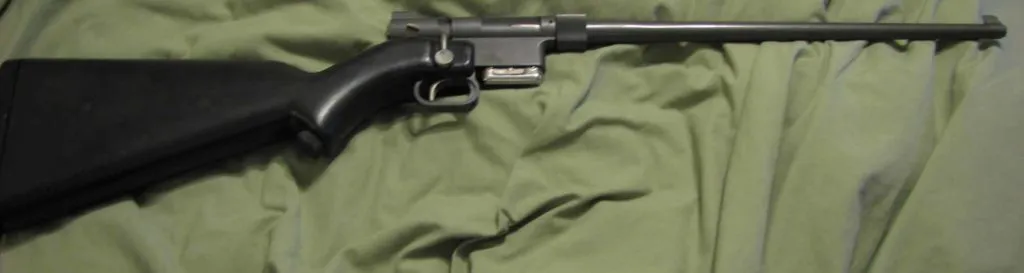
The AR-5 was built around compact storage rather than sustained infantry firepower. Sources describe a lightweight takedown rifle chambered in .22 Hornet, with the barrel and action stowing in the hollow stock for carriage in cramped aircraft survival-kit space.

Storage concept

ArmaLite's historical review says the barrel and action detached and fit inside the stock; with the buttcap replaced, the rifle floated.

Procurement limit

The Air Force adoption did not turn into large-scale issue, and ArmaLite says the service failed to follow through with a purchase.

Design legacy

The AR-7 kept the takedown survival-rifle idea but moved to semi-automatic .22 LR operation for a broader market.
Variants

The AR-5/MA-1 record is best understood as the aircrew-survival predecessor to the later AR-7 family rather than as a large operational rifle series.

VariantConfigurationDesignation notes
MA-1U.S. Air Force designation

The U.S. Air Force adopted the AR-5 under the MA-1 designation in 1956, but did not proceed to broad procurement after the bomber requirement changed.

Sources: ArmaLite historical review, American Rifleman ArmaLite story, Guns.com survival rifles

ArmaLite AR-7, Semi-automatic survival rifle, Infantry WeaponsAR-7Civilian successor design

ArmaLite used the AR-5/MA-1 concept as the basis for the later AR-7, changing to a semi-automatic .22 LR survival rifle for civilian and aircrew-survival markets.

Sources: ArmaLite historical review, NRA Museums AR-7

Successor Survival Rifle

The AR-5 did not become a large Air Force purchase, but its takedown storage and flotation ideas carried into the later AR-7.

Compatible itemItem typeCompatibility evidence
ArmaLite AR-7, Semi-automatic survival rifle, Infantry WeaponsArmaLite AR-7Civilian semi-automatic successor

Company and museum histories describe the AR-7 as the commercial .22 LR rifle developed from the AR-5/MA-1 survival-rifle concept.

Sources: ArmaLite historical review, NRA Museums AR-7

Timeline

ArmaLite AR-5 Key Events

  1. ArmaLite founded under Fairchild

    ArmaLite's current company history says Fairchild Engine Corporation founded the small-arms division in 1954.

    Sources: ArmaLite about us

  2. Gunstock design patent filed

    George C. Sullivan filed the U.S. design-patent application for the AR-5-style gunstock on 13 June 1955.

    Sources: AR-5 gunstock patent

  3. Adopted as the MA-1

    ArmaLite's historical review says the U.S. Air Force adopted the AR-5 as the MA-1 Survival Rifle, but later failed to follow through with a purchase.

    Sources: ArmaLite historical review, American Rifleman ArmaLite story, Guns.com survival rifles

  4. AR-7 follow-on appears

    ArmaLite and museum histories connect the AR-7 to the AR-5/MA-1 design path, with the later rifle using a semi-automatic .22 LR configuration for the survival-rifle market.

    Sources: ArmaLite historical review, NRA Museums AR-7

Related Weapon Systems
Arsenal AR-M9 / AR-M9F, 5.56 x 45 mm Kalashnikov-pattern assault rifle, Infantry WeaponsInfantry WeaponsArsenal AR-M9 / AR-M9F5.56 x 45 mm Kalashnikov-pattern assault rifleThe Arsenal AR-M9 and folding-stock AR-M9F are Bulgarian 5.56 x 45 mm Kalashnikov-pattern assault rifles built by Arsenal JSCo for export and military users. Open-source arms researchers documented fixed-stock AR-M9 rifles with UAE-trained pro-government Yemeni resistance fighters at Al-Anad Air Base and an AR-M9F with a Sudanese coalition soldier in Yemen, placing the family inside Gulf-backed coalition equipment flows during the 2014 Yemen Civil War.
M4/M4A1 carbine, Carbine, Infantry WeaponsInfantry WeaponsM4/M4A1 carbineCarbineThe M4/M4A1 carbine is a U.S.-origin 5.56mm service-rifle family built around a shorter M16 lineage, a collapsible stock, and modular accessory mounting. Conflict-specific evidence documents M4-family use by U.S. forces in Iraq and Afghanistan, coalition and Iraqi partner forces during anti-ISIS operations, Philippine Marines at Marawi, Israeli wartime replenishment, and Ukrainian special-operations transition from Soviet-pattern rifles during the 2014 Russia-Ukraine War.

Sources