Infantry Weapons

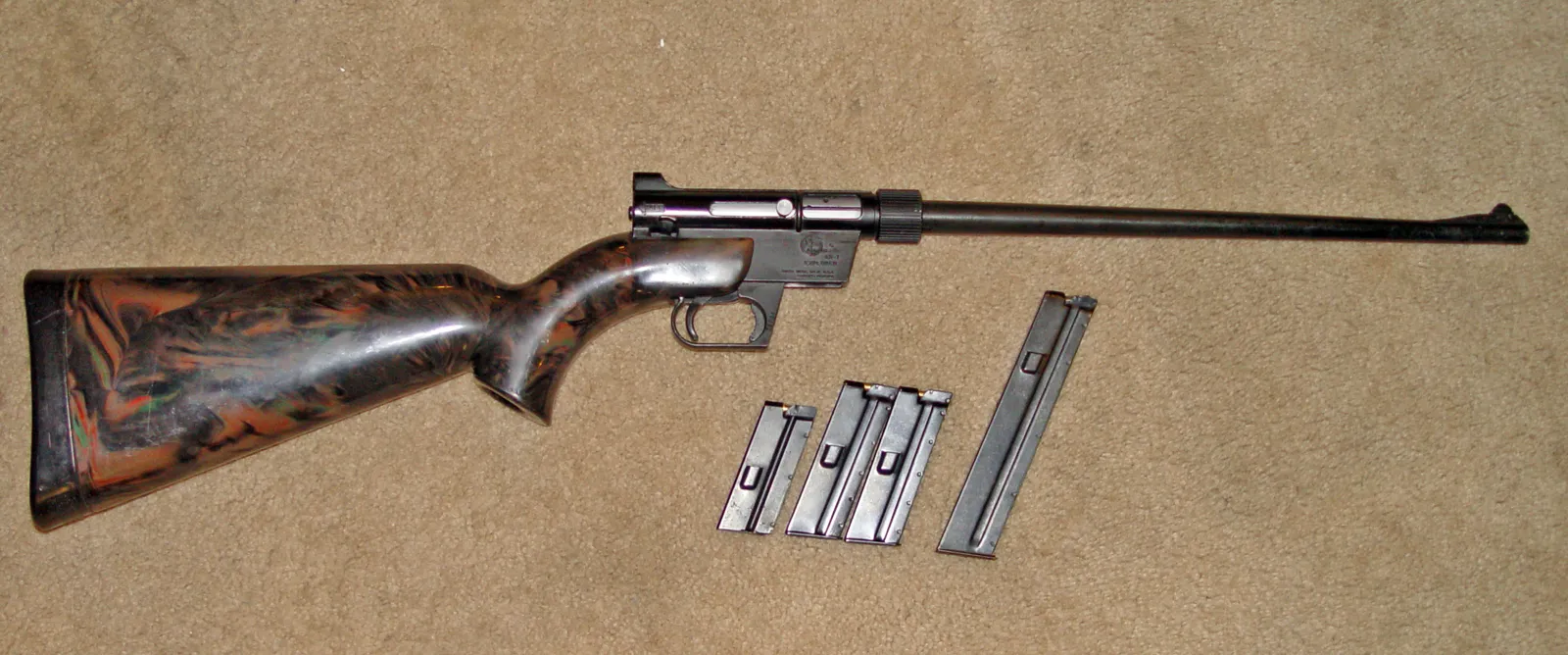
ArmaLite AR-7

Also known as
  • AR-7
  • AR 7
  • ArmaLite AR-7 Explorer
  • AR-7 Explorer
  • U.S. Survival AR-7
  • Henry U.S. Survival Rifle

The ArmaLite AR-7 is a .22 LR semi-automatic takedown survival rifle derived from the AR-5/MA-1 aircrew rifle concept. It retained stock storage and flotation ideas from the AR-5 while moving to a commercial rimfire configuration that later passed through several manufacturers.

Profile / Specs

Profile

Origin
United States
Built by
ArmaLite
Type
Semi-automatic survival rifle
Service note
Cold War survival-rifle design introduced in the late 1950s
Designer
Eugene Stoner
Designed
1958
Produced
Introduced in 1958-1959; ArmaLite production is described through 1973 before later producers continued the design.

Specifications

Crew
1
Cartridge
.22 Long Rifle
Action
Straight-blowback semi-automatic
Feed system
Detachable box magazine; common AR-7 descriptions list a standard eight-round magazine
Barrel length
16 in on the original AR-7; 16.125 in on Henry's current H2 U.S. Survival Rifle
Overall length
35 in
Weight
About 2.5 lb for the original AR-7; Henry lists 3.5 lb for the current H2 version
Storage
Barrel, receiver/action, and magazine components stow in the hollow stock
Intended role
Compact survival and foraging rifle for aircrew, boating, backpacking, and emergency use
Variants

The AR-7 page is kept as a relationship-only support record because the sources reviewed here support survival-rifle lineage and production history, not direct use in a named conflict.

VariantConfigurationDesignation notes
AR-7 ExplorerOriginal ArmaLite semi-automatic survival-rifle configuration

The original AR-7 adapted the AR-5 takedown concept to .22 LR, straight-blowback semi-automatic operation, and an eight-round detachable box magazine.

Sources: American Rifleman AR-7 Explorer, NRA Museums AR-7

Henry U.S. Survival RifleCurrent-production commercial descendant

Henry's current H2 U.S. Survival Rifle listing keeps the AR-7 concept in .22 LR with an eight-round magazine, 16.125-inch barrel, and 35-inch overall length.

Sources: Henry H2 U.S. Survival Rifle

Design Lineage

Published histories describe the AR-7 as the commercial semi-automatic rifle that followed the AR-5/MA-1 survival-rifle work.

Compatible itemItem typeCompatibility evidence
ArmaLite AR-5, Bolt-action aircrew survival rifle, Infantry WeaponsArmaLite AR-5Predecessor survival-rifle design

ArmaLite's own historical review and museum summaries connect the AR-7 to the earlier AR-5/MA-1 takedown aircrew survival rifle.

Sources: ArmaLite historical review, NRA Museums AR-7

Survival Rifle Layout

The AR-7 kept the AR-5 idea of a compact rifle that breaks down into a floating stock, but it changed the weapon around a commercial .22 LR semi-automatic action. The result was less an aircrew procurement item than a long-lived survival-rifle pattern for civilian, emergency, and limited military-survival contexts.

AR-5 inheritance

Museum and company histories describe the AR-7 as the civilian follow-on to the AR-5/MA-1 concept, preserving takedown storage and flotation.

Operating change

The AR-7 moved from the AR-5's .22 Hornet bolt-action layout to .22 LR blowback semi-automatic operation.

Production path

ArmaLite built the early rifle, then later manufacturers continued the design, with Henry listing current H2 U.S. Survival Rifle specifications.
Timeline

ArmaLite AR-7 Key Events

  1. AR-7 Explorer introduced

    American Rifleman describes the AR-7 Explorer as introduced in 1958 after Stoner adapted the AR-5 survival-rifle concept into a .22 LR semi-automatic rifle.

    Sources: American Rifleman AR-7 Explorer

  2. Commercial production begins

    ArmaLite's historical review identifies the AR-7 Explorer as the first commercial item put into production by Fairchild's ArmaLite division.

    Sources: ArmaLite historical review

  3. ArmaLite production gives way to Charter Arms

    NRA Museums and American Rifleman both describe ArmaLite production ending around 1973, after which Charter Arms continued the AR-7.

    Sources: NRA Museums AR-7, American Rifleman AR-7 Explorer

  4. Henry production era

    American Rifleman and Henry's current product page connect the modern U.S. Survival Rifle to Henry Repeating Arms' AR-7 production line.

    Sources: American Rifleman AR-7 Explorer, Henry H2 U.S. Survival Rifle

Related Weapon Systems
Arsenal AR-M9 / AR-M9F, 5.56 x 45 mm Kalashnikov-pattern assault rifle, Infantry WeaponsInfantry WeaponsArsenal AR-M9 / AR-M9F5.56 x 45 mm Kalashnikov-pattern assault rifleThe Arsenal AR-M9 and folding-stock AR-M9F are Bulgarian 5.56 x 45 mm Kalashnikov-pattern assault rifles built by Arsenal JSCo for export and military users. Open-source arms researchers documented fixed-stock AR-M9 rifles with UAE-trained pro-government Yemeni resistance fighters at Al-Anad Air Base and an AR-M9F with a Sudanese coalition soldier in Yemen, placing the family inside Gulf-backed coalition equipment flows during the 2014 Yemen Civil War.
AKM, 7.62x39mm assault rifle, Infantry WeaponsInfantry WeaponsAKM7.62x39mm assault rifleThe AKM is the stamped-receiver modernization of the Soviet Kalashnikov assault rifle, chambered for 7.62x39mm and built around a long-stroke gas piston and rotating bolt. Adopted in 1959, it reduced production burden compared with earlier milled-receiver AK rifles and became a widely licensed baseline for later 7.62mm Kalashnikov-pattern weapons. CAR and ARES field documentation continues to place AKM and AKM-pattern rifles in modern conflict stocks, from Islamic State recoveries in Iraq and Syria to Taliban captures in Afghanistan.
AKMS, Folding-stock 7.62x39mm assault rifle, Infantry WeaponsInfantry WeaponsAKMSFolding-stock 7.62x39mm assault rifleThe AKMS is the under-folding-stock member of the Soviet AKM assault-rifle family, retaining the stamped receiver, long-stroke gas system, select-fire controls, and 7.62x39mm chambering while shortening the rifle for airborne troops, vehicle crews, and compact carry. Conflict Armament Research and ARES documentation places AKMS-family rifles in Islamic State stocks around Kobane and in a 2022 Ukrainian police seizure from an alleged Russian saboteur, showing how older Kalashnikov-pattern rifles remain visible in modern war.
.308-caliber precision rifle, Bolt-action or semi-automatic precision rifle class, Infantry WeaponsInfantry Weapons.308-caliber precision rifleBolt-action or semi-automatic precision rifle class.308-caliber precision rifles are scoped small arms chambered in .308 Winchester, 7.62x51mm NATO, or closely related .30-caliber service cartridges, depending on the model and markings. The class spans law-enforcement, military, sporting, and long-range precision roles. In the 2022 Haitian Gang Conflict entry, the sourcing supports illicit trafficking of .308 rifles into Haiti and gang-linked demand for higher-powered rifles, but it does not identify a specific model or prove a documented firing incident.
IWI Arad assault rifle, Modular assault and battle rifle family, Infantry WeaponsInfantry WeaponsIWI Arad assault rifleModular assault and battle rifle familyThe IWI Arad assault rifle is Israel Weapon Industries' modular AR-pattern rifle family, spanning the 5.56x45mm/.300 BLK ARAD and the 7.62x51mm/6.5 Creedmoor ARAD 7 line. Official IWI material describes short-stroke gas-piston operation, ambidextrous controls, quick-change barrels, and accessory rails, while government and defense-industry sources document Israeli procurement, Peruvian assembly, and reported ARAD-7 use by Israeli police and special-forces units during the 2023 Israel-Hamas War.

Sources