Tanks

M60A1 Patton

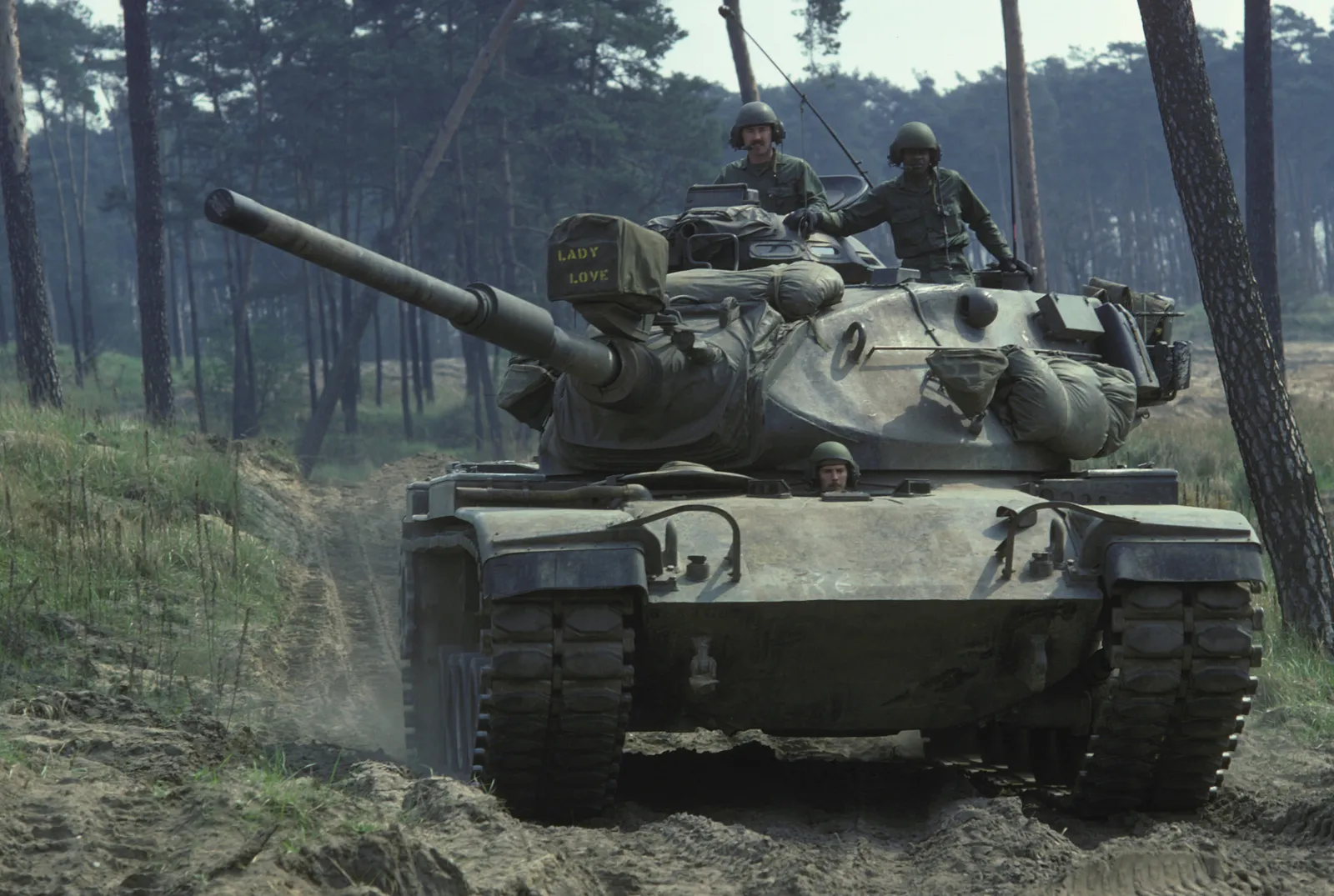
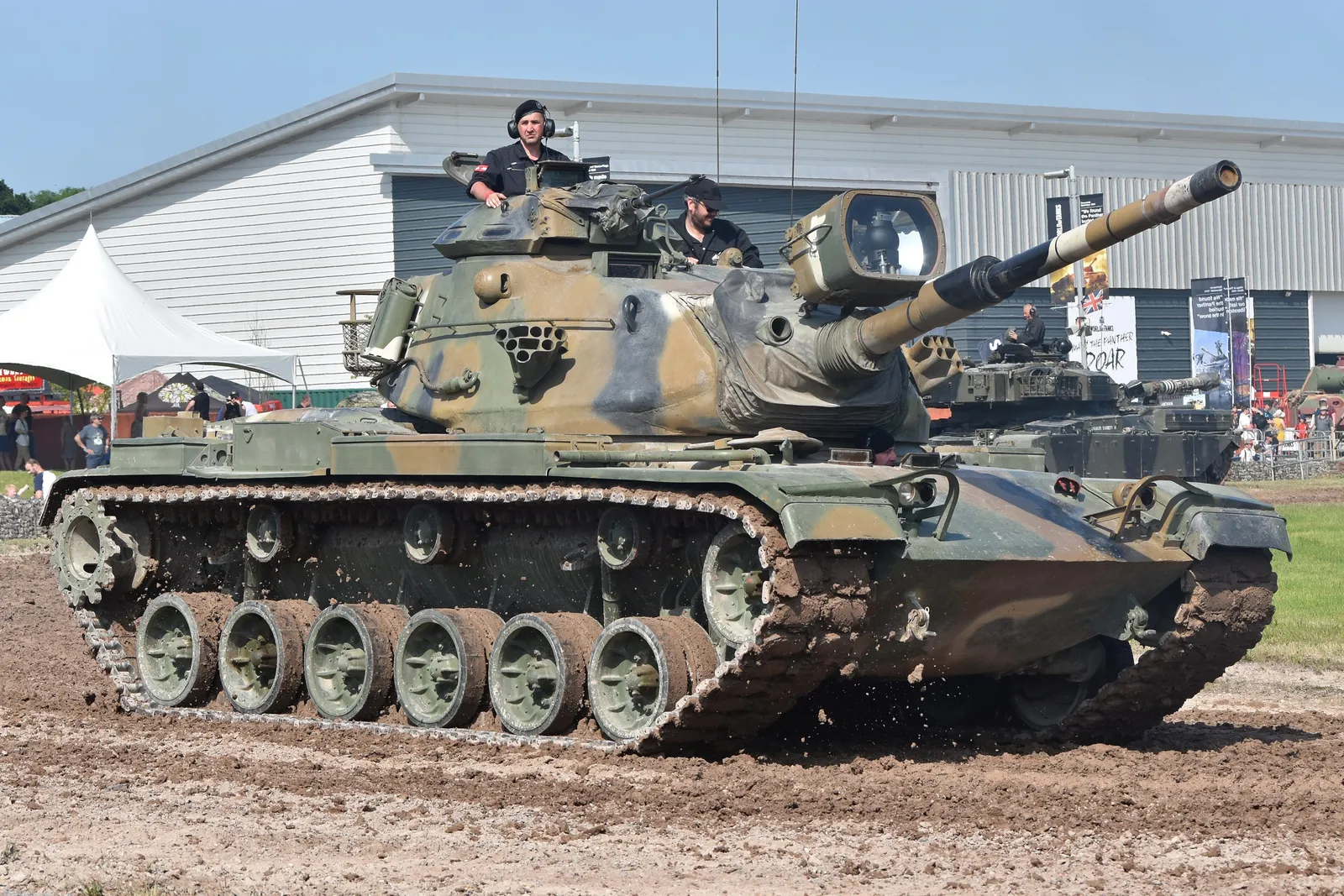
The M60A1 Patton is a U.S.-origin main battle tank built around the 105 mm M68 gun, a four-person crew, and a redesigned long turret with heavier protection than the original M60. Israeli Magach 6A tanks, Iranian M60A1s, and U.S. Marine Corps M60A1s give the type a documented combat record from the 1973 Yom Kippur War through the 1990 Gulf War, while exported vehicles such as Yemen's pre-war inventory kept it visible in later conflicts.

Role in Conflicts

Side
Israel

Israel operated M60A1 tanks under the Magach 6A designation before the 1973 war; the Latrun armor museum account places those tanks in Brigade 600 and the 87th Reconnaissance Battalion and describes their participation in the Chinese Farm fighting and other Yom Kippur War locations.

Side
Iran

Iranian forces used pre-revolution U.S.-built M60A1 tanks during the Iran-Iraq War; Marine Corps History Division material identifies an Iranian M60-A1 as one of hundreds used in the war, while specialist armor coverage describes Iranian M60s fighting Iraqi T-55, T-62, and T-72 tanks.

Side
Israel

Israeli M60A1-derived Magach 6B tanks fought in the First Lebanon War, and Latrun's Magach history also notes that older Magach 6A M60A1 tanks converted toward the 6B configuration took part in Lebanon.

Profile / Specs

Profile

Origin
United States
Type
Second-generation main battle tank
Service note
Cold War design with later RISE and RISE Passive upgrades; retained by some operators into post-Cold War conflicts
Designer
Chrysler Defense
Designed
Early 1960s
Unit cost
Not consistently reported for Yemeni-operated vehicles
Produced
1962 onward for M60A1 production
Number built
7,948 M60A1 acceptances reported by AFV Database

Specifications

Crew
4
Armament
105 mm M68 rifled main gun, 7.62 mm coaxial machine gun, and .50-caliber commander's machine gun
Combat weight
About 105,000 lb / 47,600 kg
Mobility
Continental AVDS-1790 diesel engine; about 30 mph road speed and 280-300 mile range
Ammunition
63 rounds for the 105 mm main gun
Protection
Cast turret and steel hull armor, with improved M60A1 turret protection compared with the original M60
Fire control
M17A1 coincidence rangefinder; M60A1(AOS) tanks added stabilization for the 105 mm M68 gun before later RISE upgrades
Night-fighting equipment
Baseline M60A1s used infrared night-vision equipment; RISE Passive added passive gunner and commander periscopes
Upgrade track
RISE upgrades focused on reliability, filtration, electrical, and track-life changes; documented Marine RISE Passive examples could carry ERA tiles
Variants

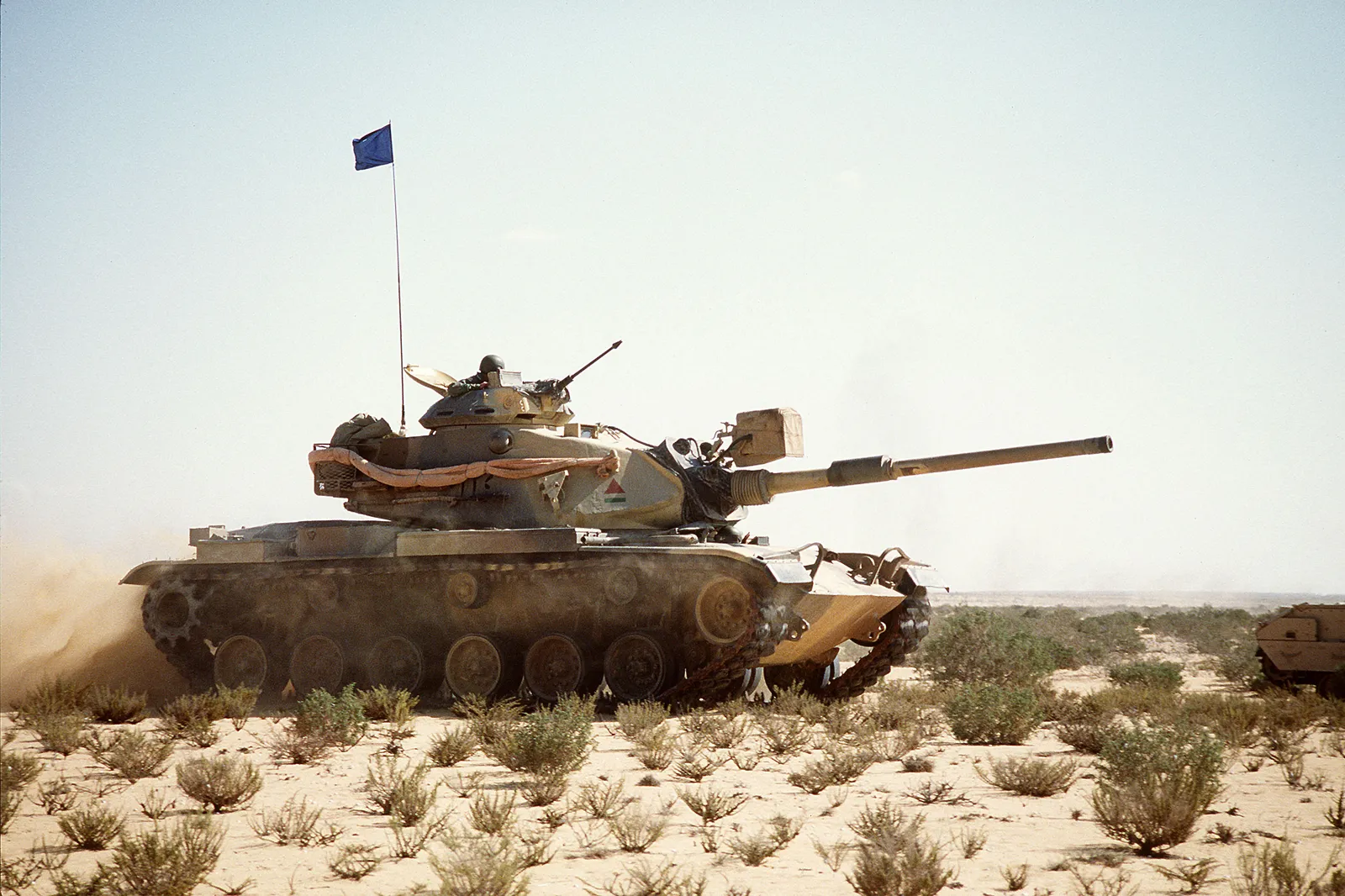
This page treats M60A1 as the long-production M60-series branch and separates the 1970s AOS, RISE, and RISE Passive upgrade steps from later M60A3 fire-control modernization.

VariantConfigurationDesignation notes
M60A1(AOS)Add-On Stabilization update

M60A1 tanks fitted with the 1972 stabilization package for the M68 gun were designated M60A1(AOS).

Sources: 105mm Gun Tank M60

M60A1(RISE)Reliability Improvements for Selected Equipment

The RISE package fielded in 1975 improved engine reliability, air filtration, starter and fuel-system components, turbosuperchargers, electrical systems, and track life.

Sources: 105mm Gun Tank M60, AFV Database M60 Timeline

M60A1(RISE)(PASSIVE)RISE tank with passive night vision

The Passive configuration added a smaller gun-shield searchlight and passive night-vision periscopes for the gunner and commander, and it is the upgraded form associated with Marine Corps Desert Storm tanks.

Sources: 105mm Gun Tank M60, AFV Database M60 Timeline, The M60's Last Hurrah

M60A1(RISE)(PASSIVE) with ERAMarine ERA-equipped configuration

AFV Database photo notes document Marine M60A1(RISE)(PASSIVE) tanks fitted with explosive reactive armor, including a 1989 exercise example and preserved ERA-layout examples.

Sources: 105mm Gun Tank M60 Photo Walkaround

Timeline

M60A1 Patton Key Events

  1. M60A1 accepted

    AFV Database records October 1962 as the first acceptance month for M60A1 production, with 7,948 M60A1 acceptances reported.

    Sources: 105mm Gun Tank M60

  2. Stabilization package creates AOS tanks

    A stabilization system for the M68 gun led to the M60A1(AOS) designation.

    Sources: 105mm Gun Tank M60

  3. RISE reliability package fielded

    The RISE upgrade introduced automotive, filtration, electrical, and track-life improvements for selected M60A1 equipment.

    Sources: 105mm Gun Tank M60

  4. RISE Passive appears

    The RISE Passive configuration added passive night-vision devices and a smaller gun-shield searchlight.

    Sources: 105mm Gun Tank M60, AFV Database M60 Timeline

  5. Marine ERA fit documented

    AFV Database identifies a Marine M60A1(RISE)(PASSIVE) with explosive reactive armor during the U.S.-Thai exercise THALAY THAI '89.

    Sources: 105mm Gun Tank M60 Photo Walkaround

  6. Marine Corps M60A1s fight in Kuwait

    Marine Corps accounts describe upgraded M60 tanks and preserved M60A1 vehicles from Operation Desert Storm, after which the Corps completed its transition to Abrams tanks.

    Sources: The M60's Last Hurrah

Media
Related Weapon Systems
T-62, Main battle tank, TanksTanksT-62Main battle tankThe T-62 is a Soviet main battle tank built around a 115 mm U-5TS/2A20 smoothbore gun, a four-person crew, and a conventional tracked armor layout inherited from the T-54/T-55 design line. Produced in large numbers by Uralvagonzavod, it moved from Cold War export and Soviet service into long-tail combat use: Egyptian and Iraqi T-62s appear in 1970s and 1991 conflict records, while upgraded or inherited T-62M/T-62MV stocks reappeared in Syria, Libya, Ukraine, Tigray, and Yemen.
M26 Pershing, Heavy tank at introduction; later reclassified as a medium tank, TanksTanksM26 PershingHeavy tank at introduction; later reclassified as a medium tankThe M26 Pershing was the U.S. Army's late-World War II T26E3 tank, standardized as the M26 in March 1945 and reclassified as a medium tank in May 1946. It replaced Sherman-era compromises with a 90 mm M3 gun, torsion-bar suspension, heavier armor, and a five-person layout, but its Ford GAF powertrain left it underpowered for its weight and the drivetrain-improved M46 Patton carried the layout into the postwar Patton line.

Sources