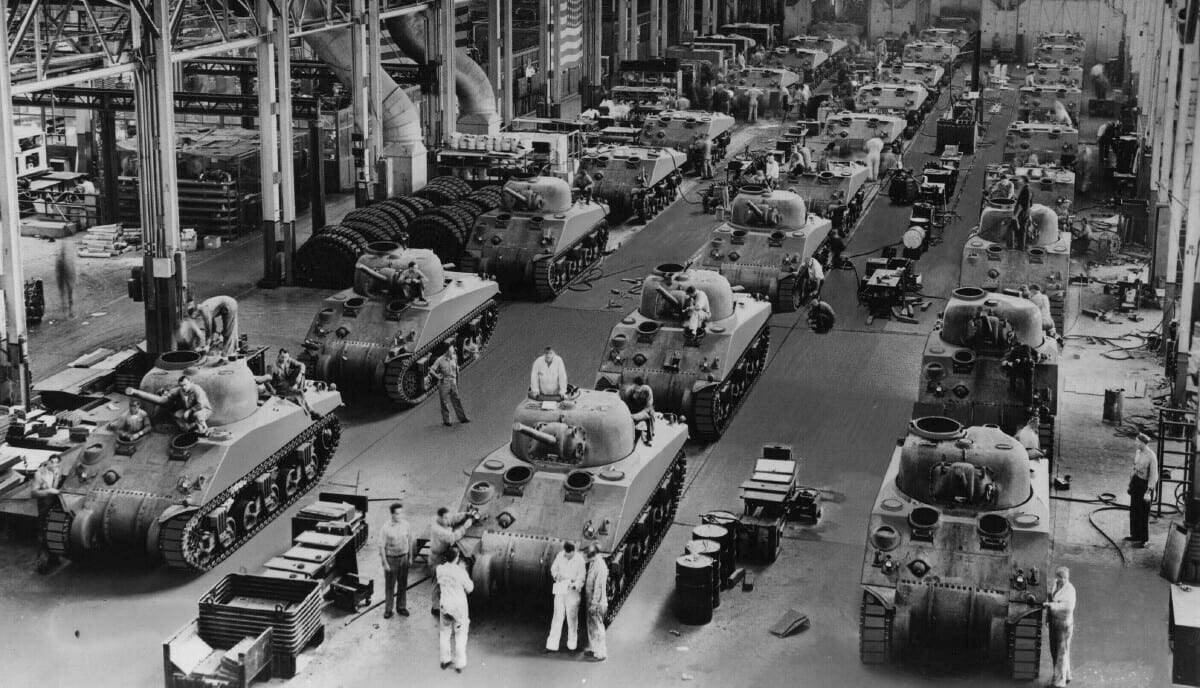
The Sherman was the most common U.S. tank of the war and was fielded by multiple Allied armies, including the United States, Britain, Free French, China, and the Soviet Union.
Tanks
M4 Sherman
Also known as
- Medium Tank M4
- Sherman tank
- M4 medium tank
- General Sherman tank
The M4 Sherman was the principal U.S. medium tank family of the Second World War, built around mass production, mechanical reliability, and a turreted gun tank layout adaptable to multiple engines, hulls, guns, and specialist conversions. Allied armies used Shermans in every major theater, while U.S. industrial plants turned the design into a high-volume armored-vehicle standard.
Role in Conflicts
- Side
- Pakistan

A regimental history of the Poona Horse identifies 35 upgunned Sherman tanks of Pakistan's 20 Lancers in Shakargarh Bulge delaying positions during the December 1971 fighting.
Profile / Specs
Profile
- Origin
- United States
- Type
- Second World War medium tank family
- Service note
- Second World War-era U.S. medium tank family
- Designer
- U.S. Army Ordnance Department
- Designed
- 1941
- Produced
- 1942-1945 for wartime production
- Number built
- 49,234 M4 Sherman tanks, excluding prototype, in AFV Database's family total
Specifications
- Crew
- 5: commander, gunner, loader, driver, assistant driver/bow gunner
- Primary armament
- 75 mm M3, 76 mm M1-series, or 105 mm M4 howitzer depending on variant; British Firefly conversions mounted the 17-pounder
- Secondary armament
- .30 caliber M1919A4 machine guns and a .50 caliber M2 heavy machine gun on the M4A3 data sheet
- Combat weight
- About 65,500-84,000 lb depending on variant and armor package
- Powerplants
- Continental R975 radial, GM 6046 twin diesel, Ford GAA V8, Chrysler A57 multibank, or Caterpillar/Wright diesel depending on branch
- Transmission
- Five forward speeds and one reverse on the M4A3 technical manual
- Armor
- M4A3 manual lists 2 in front slope, 1.5 in hull sides, and 3 in turret front; later branches varied by model
- Suspension
- VVSS on most wartime branches, with late HVSS variants using wider tracks and lower ground pressure
- Production
- AFV Database lists 49,234 Sherman family acceptances, excluding the prototype
- Mobility
- Variant-dependent road speeds generally in the 22-30 mph range; National WWII Museum lists 26 mph for its M4A3
Design And Production Logic
The Sherman was not a single fixed configuration. U.S. production kept the same broad medium-tank purpose while factories built cast or welded hulls, radial, diesel, Ford V8, and Chrysler multibank engine branches, and later 75 mm, 76 mm, and 105 mm gun variants. The result was a family that could be produced at scale and adapted to Allied maintenance, shipping, and theater needs.
Baseline layout
Five-man turreted medium tank with bow and coaxial machine guns and a rear-mounted engine.
Sources: AFV Database M4 Sherman; TM 9-759 Medium Tank M4A3.
Production spread
Major branches used different engines and hull styles while preserving a common battlefield role.
AFV Database separates variant acceptances and powerplants across the family.
Allied service
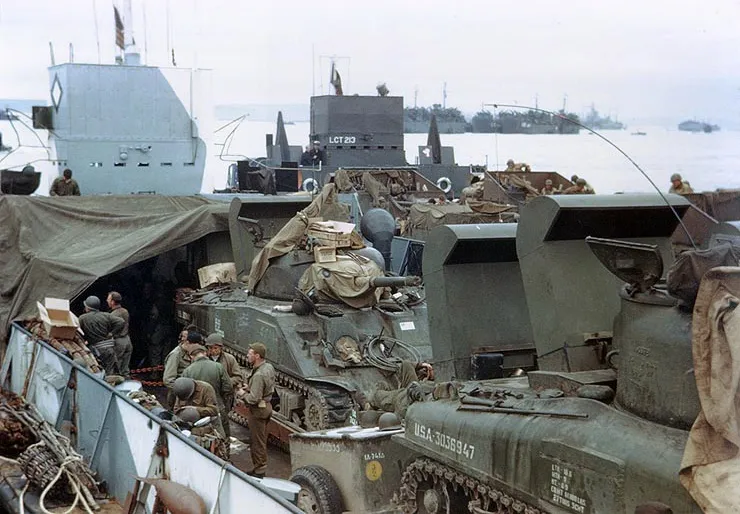
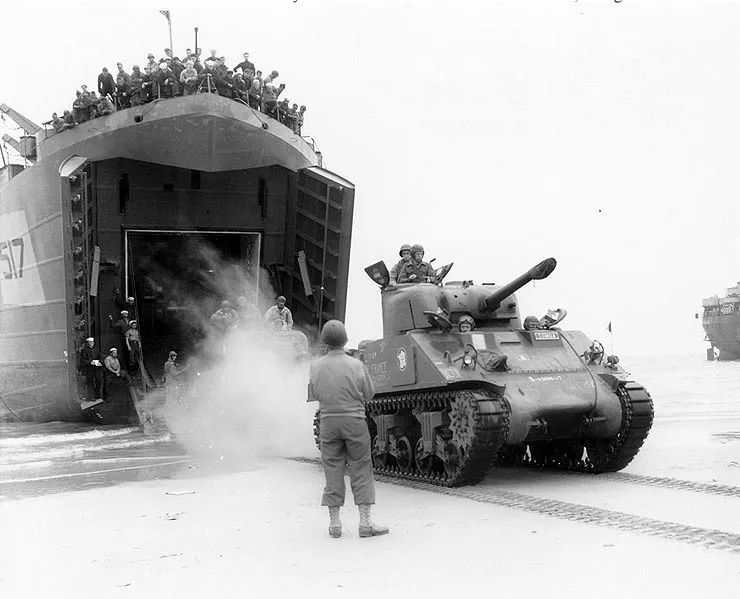
The National WWII Museum describes Shermans in service with U.S., British, Free French, Chinese, and Soviet forces.
That direct conflict-use support anchors the Second World War row.
Variants
The Sherman family used a shared medium-tank architecture across several hull, engine, suspension, gun, and conversion branches. Designations such as M4A1, M4A2, M4A3, and M4A4 usually identify production configuration rather than a separate battlefield role.
| Variant | Configuration | Designation notes |
|---|---|---|
| M4 | Welded-hull baseline | AFV Database lists the M4 with a Continental R975 radial engine and 75 mm armament, with first acceptances in July 1942. Sources: AFV Database M4 Sherman |
| M4A1 | Cast-hull radial-engine variant | AFV Database records the M4A1 as the cast-hull radial-engine branch, accepted from February 1942. Sources: AFV Database M4 Sherman |
| M4A2 | Diesel-engine Sherman variant | AFV Database identifies the M4A2 as the GM 6046 diesel branch and records Grand Blanc/Fisher production in Sherman variant data. Sources: AFV Database M4 Sherman |
| M4A3 | Ford GAA gasoline-engine variant | TM 9-759 describes the M4A3 as powered by a 500 hp Ford tank engine, and the National WWII Museum lists its restored Sherman as a Ford-built M4A3. Sources: TM 9-759 Medium Tank M4A3, M4 Sherman Tank - National WWII Museum |
| M4A4 | Lengthened Chrysler multibank-engine variant | The Tank Museum identifies its M4A4 Sherman as built by Chrysler in Detroit in June 1943 and notes 7,499 M4A4s were built. Sources: M4 Sherman - The Tank Museum |
| M4A6 | Limited diesel production variant | AFV Database records the M4A6 as a limited 75-vehicle production branch accepted in late 1943 and early 1944. Sources: AFV Database M4 Sherman |
| M4(105) | 105 mm howitzer support tank | AFV Database lists 105 mm Sherman acceptances beginning in February 1944 for close-support variants. Sources: AFV Database M4 Sherman |
| M4A3E2 | Assault tank with heavier armor | AFV Database records 254 M4A3E2 assault tanks, with acceptances beginning in June 1944. Sources: AFV Database M4 Sherman |
| M4A3(76)W HVSS | Late 76 mm wet-stowage HVSS branch | AFV Database separates 76 mm, wet-stowage, and HVSS production branches in the late-war M4A3 family. Sources: AFV Database M4 Sherman |
| Sherman Firefly | British 17-pounder conversion | The Tank Museum notes British Firefly conversions alongside other Sherman special-purpose adaptations. Sources: M4 Sherman - The Tank Museum |
| Sherman DD | Duplex Drive amphibious conversion | The Tank Museum identifies DD swimming tanks as part of the Sherman specialist-conversion family. Sources: M4 Sherman - The Tank Museum |
| Sherman Crab | Mine-clearing flail conversion | The Tank Museum lists Crab flail tanks among Sherman specialist conversions. Sources: M4 Sherman - The Tank Museum |
Mounted Machine Guns
Sherman armament combined the main gun with turret, hull, and roof-mounted machine guns for close defense, infantry support, and anti-personnel fire.
| Carried item | Item type | Carriage evidence |
|---|---|---|
 | Roof-mounted heavy machine gun | The National WWII Museum's M4A3 armament list includes one .50 caliber machine gun. |
 | Coaxial and hull machine-gun class | The National WWII Museum lists two .30 caliber machine guns in the M4A3 armament package; TM 9-759 identifies M1919A4 .30 caliber guns in turret and front-plate positions. Sources: M4 Sherman Tank - National WWII Museum, TM 9-759 Medium Tank M4A3 |
Timeline
M4 Sherman Key Events
Design work begins
The Tank Museum dates the M4 design process to April 1941 as the United States moved beyond the interim M3 medium tank.
Sources: M4 Sherman - The Tank Museum
Pilot model completed
The Tank Museum records the Sherman pilot model as ready in September 1941.
Sources: M4 Sherman - The Tank Museum
M4A1 acceptances begin
AFV Database lists February 1942 as the first acceptance month for the M4A1 branch.
Sources: AFV Database M4 Sherman
M4 and M4A4 production branches enter acceptance
AFV Database records July 1942 first acceptances for both the welded-hull M4 and the Chrysler A57-powered M4A4.
Sources: AFV Database M4 Sherman
105 mm support Shermans accepted
AFV Database records February 1944 first acceptances for 105 mm howitzer Sherman branches.
Sources: AFV Database M4 Sherman
M4A3E2 assault tanks accepted
AFV Database records 254 M4A3E2 assault tanks, with first acceptance in June 1944.
Sources: AFV Database M4 Sherman
Wartime Sherman production closes
AFV Database's Sherman family table totals 49,234 accepted tanks, excluding the prototype, across the wartime production run.
Sources: AFV Database M4 Sherman
Armament Evolution
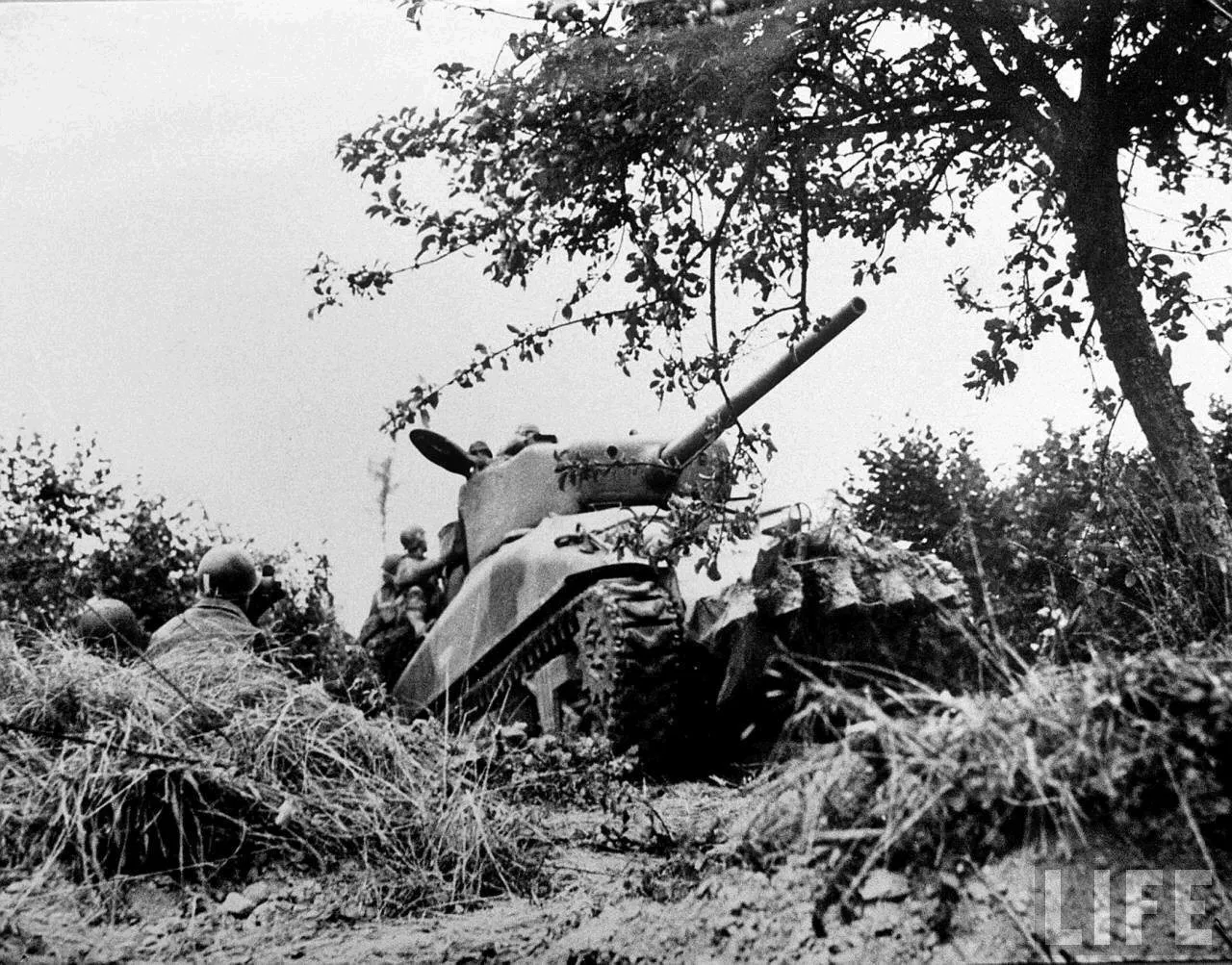
The family began around the 75 mm M3 gun, then added 76 mm anti-armor branches, 105 mm close-support howitzer versions, and British Firefly conversions with the 17-pounder. This spread matters because a Sherman reference can describe a general-purpose gun tank, a support tank, or a more anti-armor-focused late-war configuration.
- 75 mm gun tanks: the standard early family branch, represented in TM 9-759's M4A3 data and the National WWII Museum's M4A3 description.
- 76 mm gun tanks: late-war branches separated in AFV Database production tables, often paired with wet ammunition stowage and, on some variants, HVSS suspension.
- 105 mm howitzer tanks: support variants accepted from 1944 according to AFV Database.
- Firefly conversions: British 17-pounder Shermans noted by The Tank Museum as part of the broader conversion family.
Media
M4 Sherman Videos
Related Weapon Systems


Sources
AFV Database M4 ShermanPublisher: AFV Database | Note: Supports Sherman family acceptances, crew, armament, dimensions, powerplants, automotive data, variant timelines, and manufacturer/background context. | Accessed: 2026-07-13M4 Sherman - The Tank MuseumPublisher: The Tank Museum | Note: Supports M4 design/production timing, Sherman family background, Chrysler Detroit M4A4 context, and Firefly, DD, and Crab conversion context. | Accessed: 2026-07-13M4 Sherman Tank - National WWII MuseumPublisher: The National WWII Museum | Note: Directly supports Second World War conflict use by identifying the Sherman as the most common U.S. tank of the war, used in all combat theaters by several Allied armies; also supports M4A3 specifications and Ford-built example context. | Accessed: 2026-07-13History of the 17th HorsePublisher: Bharat-Rakshak / Poona Horse Regimental Officers Association archive | Note: Directly supports 1971 Indo-Pakistani War conflict use by identifying 35 upgunned Sherman tanks of Pakistan's 20 Lancers in Shakargarh Bulge delaying positions. | Accessed: 2026-07-13TM 9-759 Medium Tank M4A3Publisher: U.S. War Department, hosted by Ibiblio HyperWar | Note: Primary technical manual supporting M4A3 layout, Ford engine, transmission, armor, armament, dimensions, and operating data. | Accessed: 2026-07-13Shermans-loaded-in-LCT.jpgPublisher: Wikimedia Commons | Note: Public-domain U.S. Army Signal Corps image of M4 Sherman tanks loaded in an LCT before the Normandy invasion. | Accessed: 2026-07-13Sherman-french-army-normandy.jpgPublisher: Wikimedia Commons | Note: Public-domain U.S. Army/Navy image of a French Army Sherman landing from USS LST-517 in Normandy on 1944-08-02. | Accessed: 2026-07-13Sherman Rhino Normandy 1944.JPGPublisher: Wikimedia Commons | Note: Public-domain U.S. Army image of a Sherman Rhino hedgerow-cutter tank in Normandy. | Accessed: 2026-07-13GM Defense HistoryPublisher: GM Defense | Note: Supports Fisher Body production of M4 Sherman tanks and broader General Motors wartime manufacturing context. | Accessed: 2026-07-13US Army Detroit Tank Plant.jpgPublisher: Wikimedia Commons | Note: Public-domain U.S. Army TARDEC photo of the Detroit Arsenal Tank Plant during M4A4 Sherman production. | Accessed: 2026-07-13