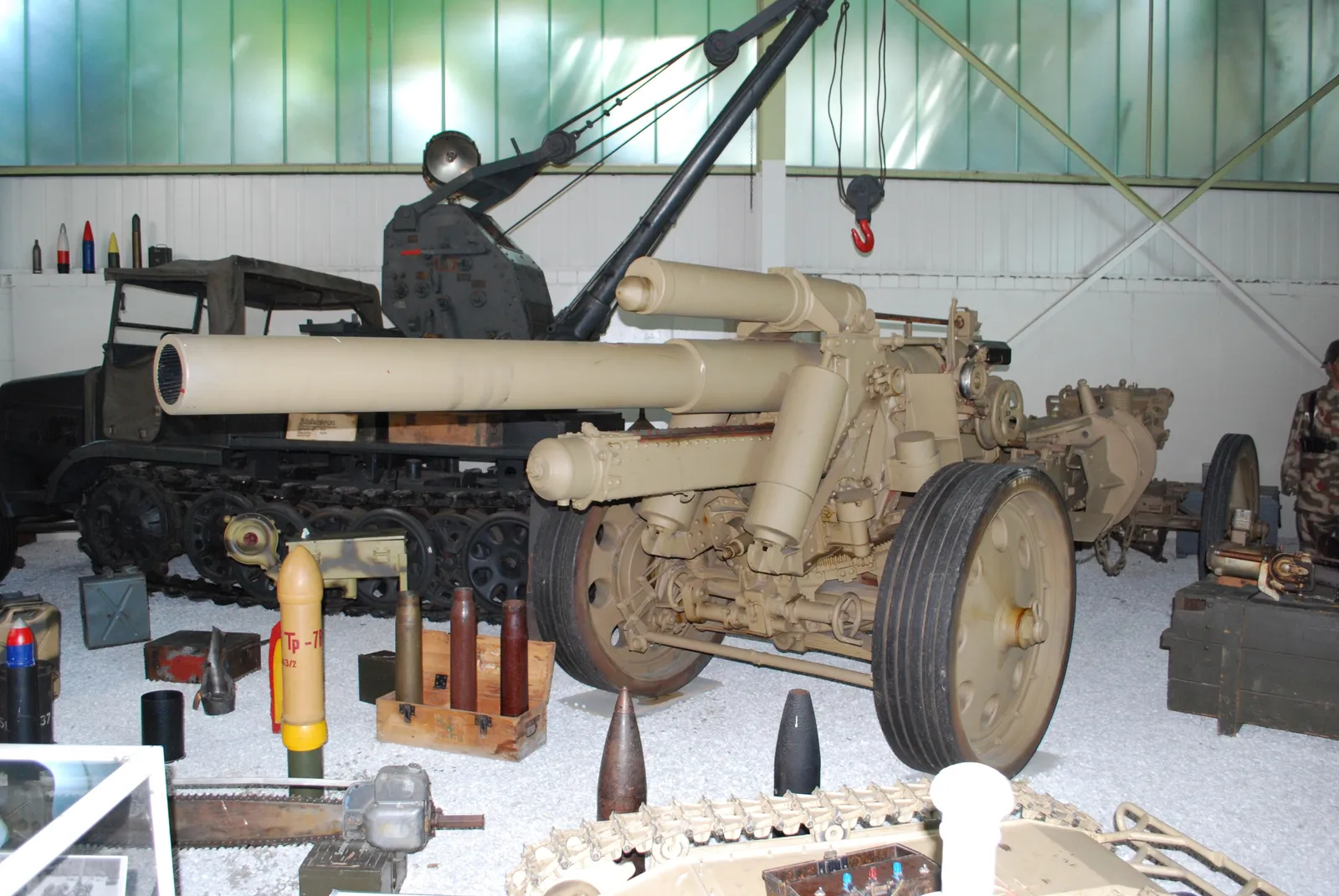
The 15 cm sFH 18 is directly documented in German Second World War service: U.S. War Department material lists it in the medium battalion of German infantry-division artillery regiments, the Royal Canadian Artillery Museum identifies it as Germany's principal heavy divisional howitzer, Lone Sentry's wartime ordnance notes state that it had been in German Army use before 1939, and IWM records a 1940 photograph of one in action.
Artillery
15 cm sFH 18
Also known as
- 15 cm schwere Feldhaubitze 18
- sFH 18
- 15 cm s.F.H. 18
- 15-cm sFH-18
- schwere Feldhaubitze 18
- Immergrun
- Obice 149/28
- 150 H 40
- Howitzer M18
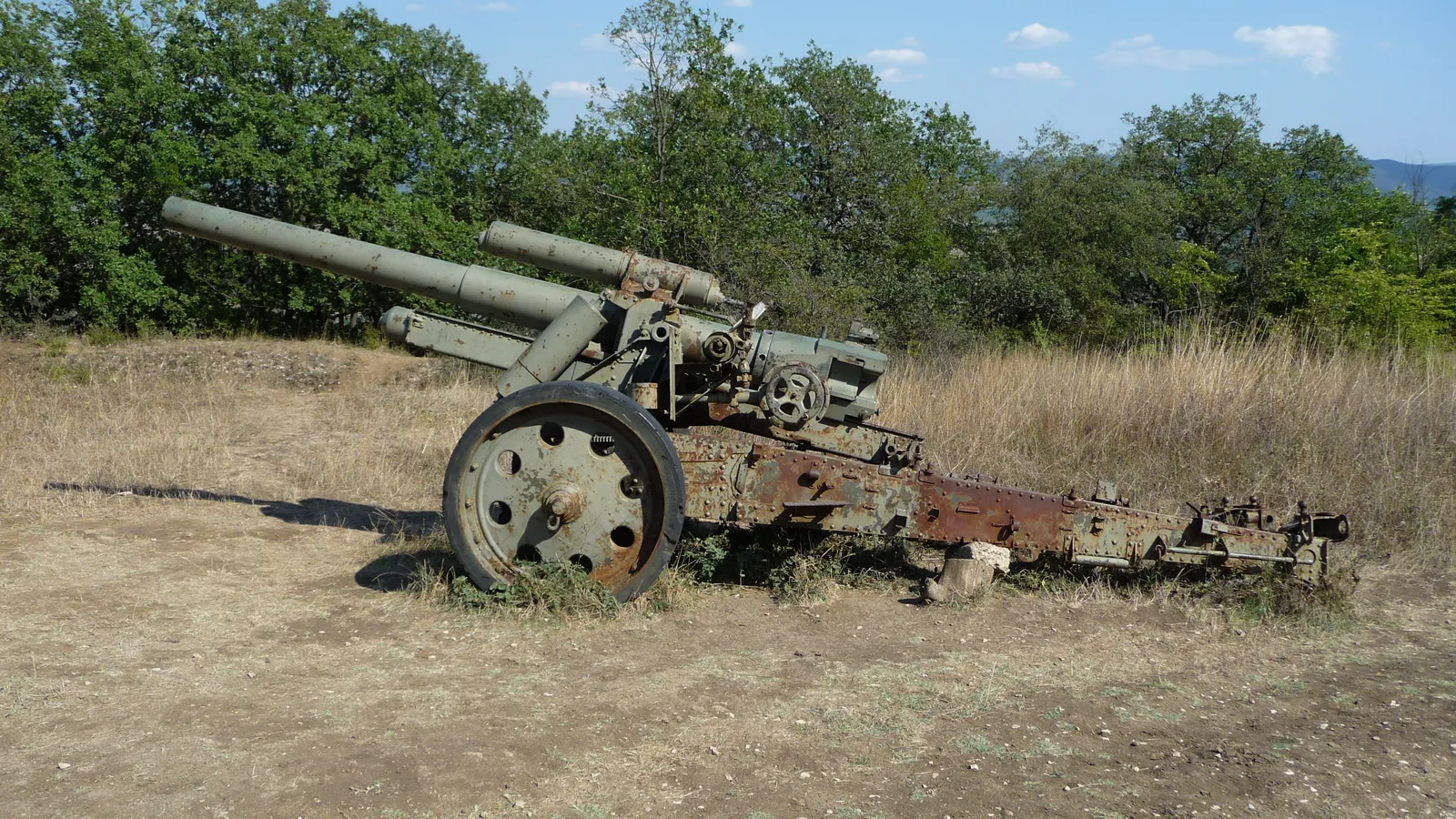
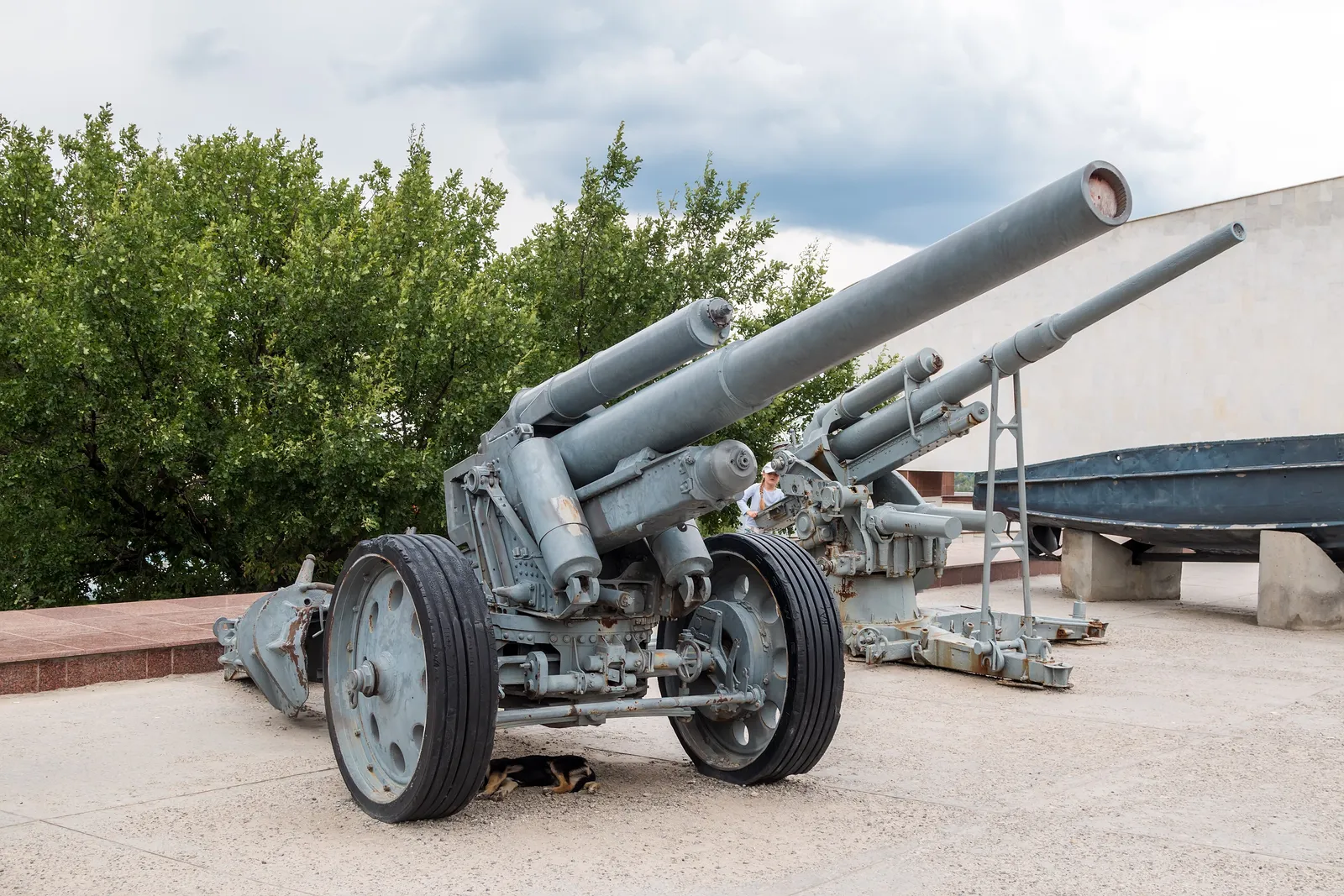
The 15 cm sFH 18 was the German Army's standard heavy divisional howitzer of the Second World War, built around a Rheinmetall barrel, Krupp-pattern split-trail carriage, separate-loading 149 mm ammunition, and a fire-support role that traded mobility for shell weight and sustained field-artillery effect.
Role in Conflicts
Profile / Specs
Profile
- Origin
- Germany
- Built by
- Rheinmetall
- Type
- 149 mm towed heavy field howitzer
- Service note
- Interwar German design with Second World War and postwar foreign-service use
- Designer
- Rheinmetall barrel and Krupp carriage design team
- Designed
- 1926-1930 development period
- Unit cost
- About 40,400 Reichsmarks in 1944, with earlier reported cost around 44,000 Reichsmarks in 1938
- Produced
- 1933-1945
- Number built
- 6,756 total reported by Weaponsystems.net; 1,353 available in 1939
Specifications
- Crew
- 7 on baseline technical references; museum detachment context notes gun, limber, horses or towing vehicle, and 12 gunners
- Caliber
- 149 mm / 15 cm class
- Projectile
- 43.5 kg high-explosive shell
- Ammunition
- 149x260 mmR separate-loading cased charges; HE, concrete-piercing, smoke, armor-piercing, and other wartime ammunition types reported
- Combat weight
- About 5,512 kg in firing position
- Travel weight
- About 6,304 kg in travelling position
- Barrel
- 4.44 m barrel; 150 mm L/29.5 ordnance class
- Muzzle velocity
- About 520 m/s with standard shell
- Range
- About 13,250 m to 13,325 m with standard/restricted high charges; up to about 18,200 m reported with rocket-assisted projectile
- Rate of fire
- About 4 rounds per minute
- Carriage
- Two-wheel split-trail towed carriage with two-wheel limber
- Recoil
- Hydropneumatic recoil mechanism
- Breech
- Horizontal sliding breechblock
- Elevation
- -3 to +45 degrees reported by specialist sources
- Traverse
- About 60 to 64 degrees total depending on source
Design, Ammunition, And Mobility Notes
The sFH 18 was not a light battlefield piece: its split-trail carriage gave useful traverse for a heavy howitzer, but movement depended on horse-team separation into loads or motor towing by heavy vehicles. Its standard 43.5 kg high-explosive projectile made it a divisional fire-support weapon, while rocket-assisted ammunition and muzzle-brake variants show how German designers tried to stretch range without replacing the basic gun.
Design mix
Sources describe a Rheinmetall barrel paired with a Krupp carriage after both firms submitted heavy-howitzer designs.
Transport limit
The gun was too heavy for crew manhandling and required horse loads, halftracks, or heavy trucks for practical movement.
Range experiments
Rocket-assisted ammunition and muzzle-brake variants sought more range, but sources describe accuracy, wear, and recoil-system limits.
Sources: Royal Canadian Artillery Museum 15cm sFH18; HistoryOfWar.org 15cm schwere Feldhaubitz 18; Weaponsystems.net 15-cm sFH-18.
Variants
The sFH 18 family kept the same heavy field-howitzer role while German variants tried to solve transport weight, range, and chamber-wear limits.
| Variant | Configuration | Designation notes |
|---|---|---|
| 15 cm sFH 18 (Bespg.) | Horse-towed transport configuration | The horse-drawn version could be broken into separate barrel and carriage loads for movement before reassembly in action. Sources: HistoryOfWar.org 15cm schwere Feldhaubitz 18, Weaponsystems.net 15-cm sFH-18 |
| 15 cm sFH 18 (fur Kfz.) | Motor-towed transport configuration | The motorized version used a single-load towing arrangement suitable for halftracks or heavy trucks. Sources: HistoryOfWar.org 15cm schwere Feldhaubitz 18, Weaponsystems.net 15-cm sFH-18 |
| 15 cm sFH 18M | Muzzle-brake and chamber-liner modification | The 18M added a muzzle brake and replaceable chamber liner to manage higher charges and extend practical range, though charge limits and wear remained important constraints. |
| 15 cm sFH 36 | Lightened heavy-howitzer derivative | The sFH 36 was a lighter, shorter-barrel attempt to improve horse towing, but its reduced range and light-alloy requirements limited production. Sources: Wikipedia 15 cm sFH 18 baseline |
| 15 cm sFH 18/40 | Extended-range experimental/limited-production derivative | This longer-barrel, muzzle-brake derivative tried to extend range beyond the standard gun, but sources describe limited production and poor accuracy. Sources: Wikipedia 15 cm sFH 18 baseline |
| 15 cm sFH 18/1 | Hummel self-propelled ordnance | The Hummel self-propelled howitzer used ordnance derived from the sFH 18 on an armored tracked chassis rather than replacing the towed gun. Sources: Weaponsystems.net Hummel, Royal Canadian Artillery Museum 15cm sFH18 |
Timeline
15 cm sFH 18 Key Events
Development work begins
Museum and specialist sources describe the sFH 18 as a late-1920s German development that combined Rheinmetall and Krupp design features.
Sources: Royal Canadian Artillery Museum 15cm sFH18, HistoryOfWar.org 15cm schwere Feldhaubitz 18
Production-ready heavy howitzer
The design was ready for production by 1933, matching Germany's rearmament period and the later start of serial production.
Sources: Royal Canadian Artillery Museum 15cm sFH18, Weaponsystems.net 15-cm sFH-18
In German Army service before the war
Lone Sentry's wartime ordnance notes state that the howitzer had been used by the German Army since before 1939, while Weaponsystems.net reports 1,353 available in 1939.
Sources: Lone Sentry Catalog of Enemy Ordnance 15 cm sFH 18, Weaponsystems.net 15-cm sFH-18
Rocket-assisted projectile issued
The Royal Canadian Artillery Museum notes that Germany issued rocket-assisted ammunition for the sFH 18 in 1941, but withdrew it after unsatisfactory results.
Sources: Royal Canadian Artillery Museum 15cm sFH18
Peak wartime production
Weaponsystems.net reports 2,295 sFH 18 guns produced in 1944, the largest annual production figure in its production summary.
Sources: Weaponsystems.net 15-cm sFH-18
Finnish service survivor retired
The Royal Canadian Artillery Museum identifies Finland as the last user to retire upgraded sFH 18-family weapons, in 2007.
Sources: Royal Canadian Artillery Museum 15cm sFH18
Related Weapon Systems


Sources
Royal Canadian Artillery Museum 15cm sFH18Publisher: The Royal Canadian Artillery Museum | Note: Supports Second World War direct conflict use by describing the 15 cm sFH 18 as the principal heavy howitzer in German divisions during the Second World War; also supports development timing, projectile weight, range, detachment context, rocket-assisted ammunition, Hummel context, and Finnish retirement. | Accessed: 2026-07-13Lone Sentry Catalog of Enemy Ordnance 15 cm sFH 18Publisher: Lone Sentry | Note: Republishes 1945 Office of the Chief of Ordnance material supporting direct Second World War use by stating that the 15 cm sFH 18 had been in German Army use before 1939; also supports breech, recoil, carriage, ammunition, range, rate-of-fire, and mobility details. | Accessed: 2026-07-13Company Officer's Handbook of the German Army Special Series No. 22Publisher: U.S. War Department Military Intelligence Division | Note: Supports direct Second World War use by listing the 15 cm sFH 18 as a standard German infantry-division artillery-regiment weapon, usually with eight weapons in the medium battalion; also supports split-trail, hydropneumatic, muzzle-velocity, range, rate-of-fire, ammunition, and projectile-weight details. | Accessed: 2026-07-13IWM German Army in the West 1940 sFH 18Publisher: Imperial War Museums | Note: Supports direct Second World War use by identifying a 1940 photograph of a German 15 cm sFH 18 heavy field howitzer in action. | Accessed: 2026-07-13HistoryOfWar.org 15cm schwere Feldhaubitz 18Publisher: HistoryOfWar.org | Note: Supports the Rheinmetall barrel and Krupp carriage design context, transport configurations, sFH 18M range-improvement context, wartime production plants, service inventory, and baseline specifications. | Accessed: 2026-07-13Weaponsystems.net 15-cm sFH-18Publisher: Weaponsystems.net | Note: Supports detailed specifications, entered-service and production dates, producer locations, unit-cost figures, production totals, designations, mobility limitations, rocket-assisted range, and related Hummel and 10.5 cm leFH 18 context. | Accessed: 2026-07-13Weaponsystems.net HummelPublisher: Weaponsystems.net | Note: Supports the relationship between the Hummel self-propelled howitzer and the sFH 18-derived ordnance. | Accessed: 2026-07-13Wikipedia 15 cm sFH 18 baselinePublisher: Wikipedia | Note: Used only as a baseline terminology and bibliography lead for variant names and broad designation context; claims were cross-checked where possible against stronger sources. | Accessed: 2026-07-13Wikimedia Commons 15 cm sFH 18 Sinsheim imagePublisher: Wikimedia Commons | Note: Supports the gallery image, preserved weapon identification, and CC BY-SA 2.0 licensing provenance for the Sinsheim photograph. | Accessed: 2026-07-13Wikimedia Commons 15 cm sFH 18 Sapun Mountain imagePublisher: Wikimedia Commons | Note: Supports the Sapun Mountain gallery image, preserved weapon identification, and public-domain self-release provenance. | Accessed: 2026-07-13Wikimedia Commons Volgograd Panorama Museum sFH 18 imagePublisher: Wikimedia Commons | Note: Supports the Volgograd Panorama Museum gallery image, preserved weapon identification, and CC BY-SA 3.0 licensing provenance. | Accessed: 2026-07-13