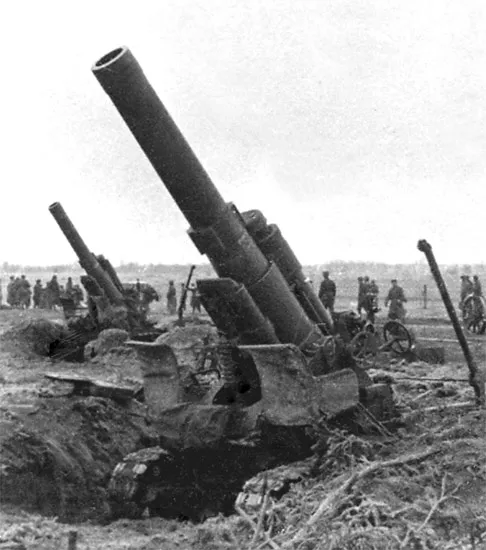
Soviet forces used B-4 heavy howitzers as reserve and siege artillery, including direct urban demolition missions in Berlin; captured B-4s also entered German service on the Eastern Front and elsewhere during the war.
Artillery
203 mm howitzer M1931 (B-4)
Also known as
- 203mm B-4
- 203mm B-4M
- 203 mm B-4M
- B-4 203 mm howitzer
- B-4M
- B-4M howitzer
- M1931 B-4
- 203 mm howitzer M1931
- 203-mm howitzer M1931
- 52-G-625
- 52-G-625M
- 203.4 mm B-4M
- 20.3 cm Haubitze 503/5(r)
- Stalin's sledgehammer
The 203 mm howitzer M1931 (B-4) was a Soviet high-power heavy howitzer built for reserve artillery, siege fire, bunker attack, and urban demolition, later modernized as the wheeled B-4M. Its 203 mm shell, slow rate of fire, and difficult transport made it a specialized weapon rather than a divisional howitzer, but sources document Soviet and captured German use during the Second World War, including prominent employment in the Battle of Berlin.
Role in Conflicts
Profile / Specs
Profile
- Origin
- Soviet Union
- Built by
- Bolshevik PlantBarrikady
- Type
- 203 mm tracked heavy howitzer
- Service note
- Designed in 1931, produced during the 1930s and early 1940s, and fielded as Soviet heavy artillery during the Second World War.
- Designer
- Bolshevik Plant / Soviet artillery design program
- Designed
- 1931 design; adopted for service in the mid-1930s
- Produced
- 1932-1942 in the principal open-source production account
- Number built
- About 800-1,010 examples depending on source and counting method
Specifications
- Caliber
- 203 mm / 8-inch class
- Configuration
- Towed heavy howitzer on a tracked, non-self-propelled carriage
- Combat weight
- About 17,700 kg
- Crew
- 15
- Projectile weight
- About 98.5-100 kg high-explosive projectile; heavier concrete-piercing projectiles also reported
- Ammunition type
- Bag-type, variable-charge separate loading
- Maximum range
- About 18 km / roughly 20,000 yards depending on source and ammunition
- Muzzle velocity
- About 606-607 m/s for full-charge high-explosive fire
- Rate of fire
- Slow; GlobalSecurity gives 0.5-1 round per minute and WW2DB gives 1 round per minute
- Elevation and traverse
- 0 to +60 degrees elevation; about 8 degrees traverse
- Breech and recoil
- Screw-type breechblock with hydraulic / hydropneumatic recoil system
- B-4M carriage
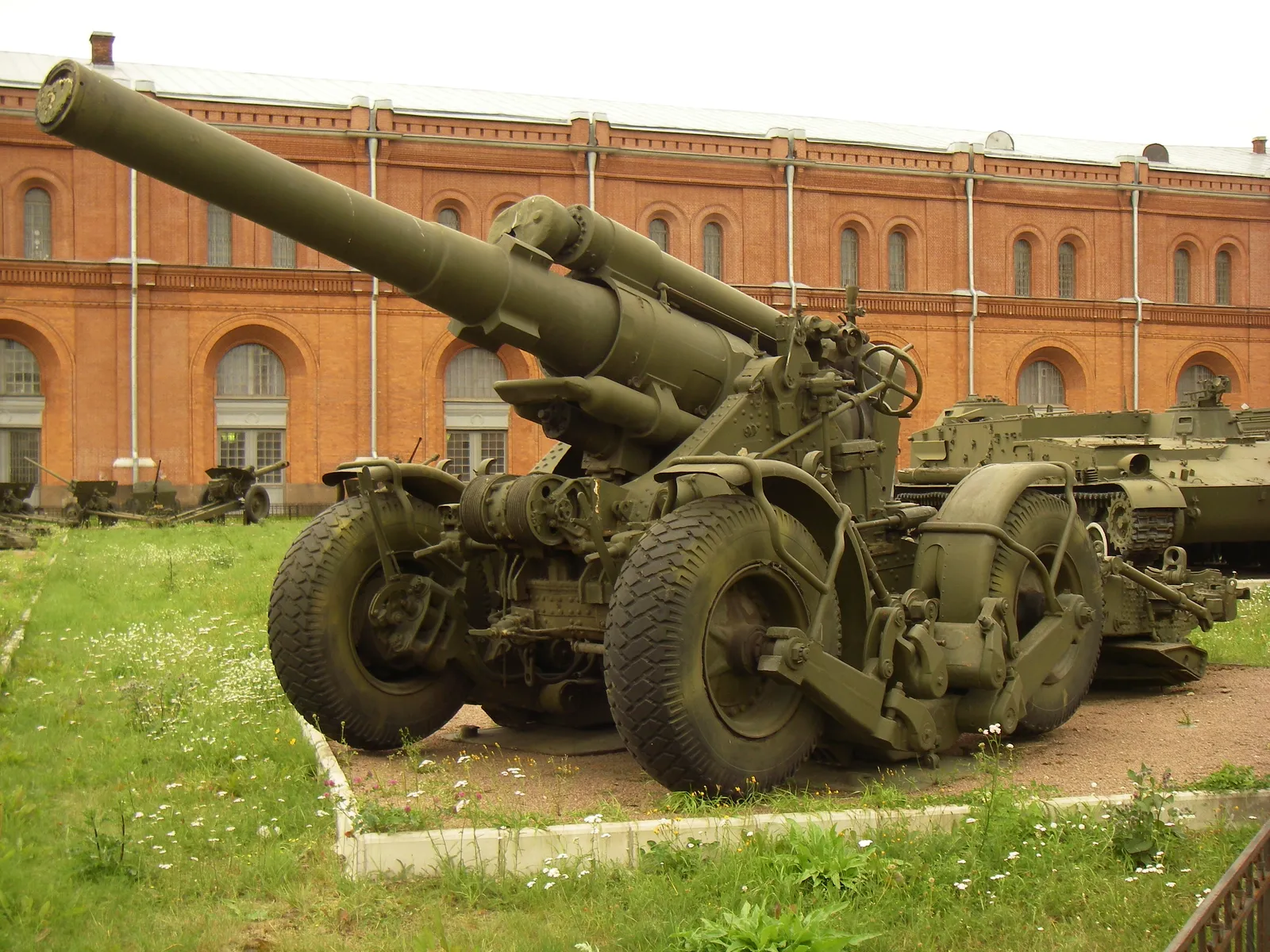
- Postwar four-wheel carriage accepted in 1955, with wheels raised off the ground in firing position
- B-4M towing vehicle
- AT-T heavy artillery tractor
- B-4M towing speed
- About 30 km/h in the WeaponSystems.net profile, compared with lower road speed for the tracked wartime carriage
Tracked Heavy-Howitzer Design
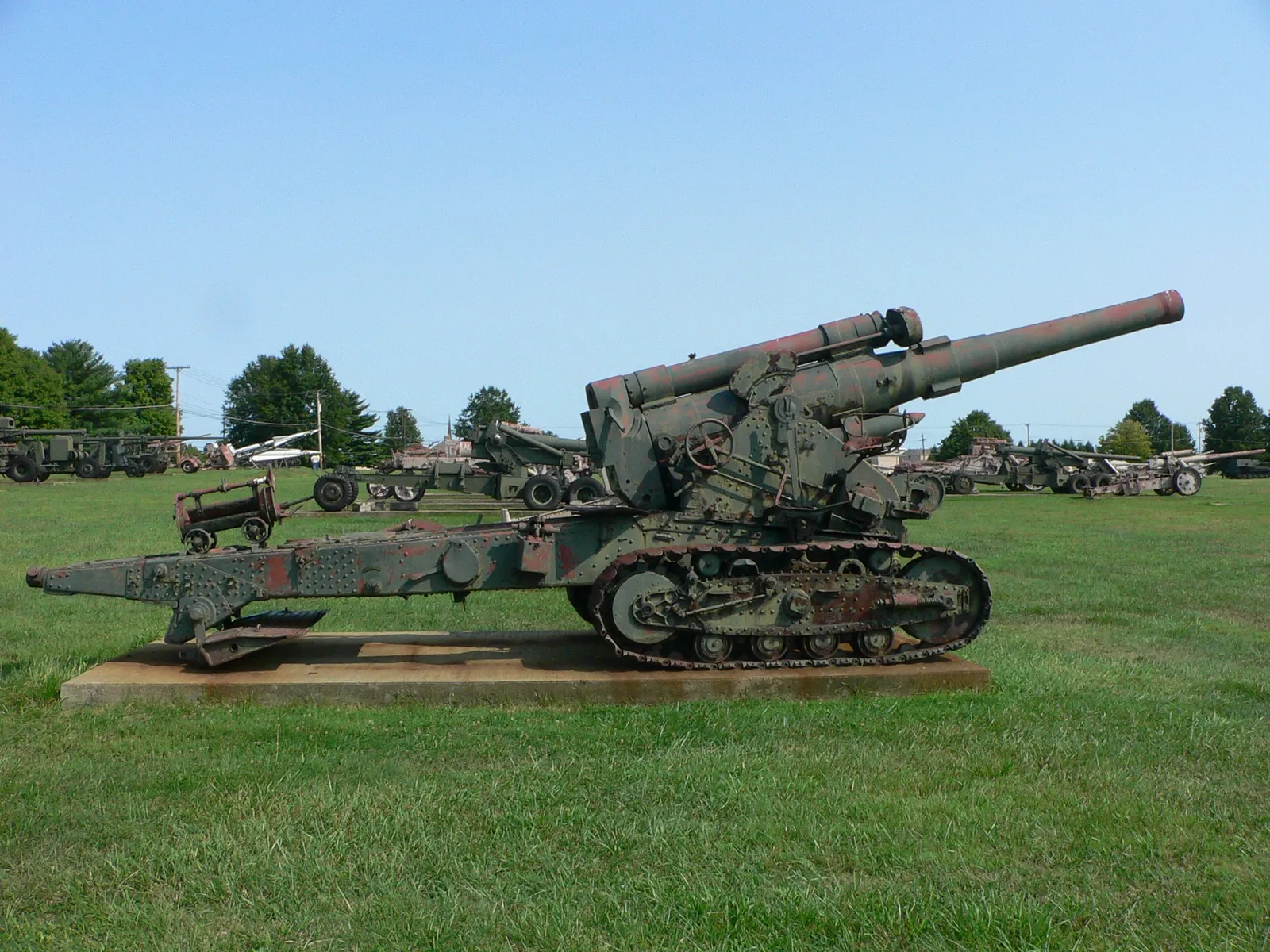
The B-4's tracked carriage was unusual for a towed artillery piece: it was not self-propelled, but it spread weight and improved movement over rough or soft ground. The same design choice also made long movement cumbersome, since early guns could require separate tube transport. Postwar B-4M conversions kept the 203 mm ordnance but moved it to a wheeled carriage for road towing.
Wartime carriage
Tracked, towed carriage for the M1931 B-4, with no engine of its own and limited road-march convenience.
Sources: U.S. Army Field Artillery Museum B-4 article; GlobalSecurity B-4 profile.
B-4M carriage
Four-wheel postwar carriage; the wheels were raised for firing and the weapon rested on its firing platform.
Sources: GlobalSecurity B-4 profile; U.S. Army FM 100-2-3 Soviet Army equipment manual.
Fire mission
Reserve heavy artillery for fortifications, urban strongpoints, and other targets where a 203 mm shell mattered more than mobility or rate of fire.
Sources: U.S. Army Field Artillery Museum B-4 article; World War II Database B-4 profile.
Transport change
The B-4M modernization addressed long-distance movement with AT-T tractor towing and a carriage that avoided removing the tube for routine travel.
Sources: GlobalSecurity B-4 profile; U.S. Army FM 100-2-3 Soviet Army equipment manual.
Ammunition And Projectiles
The B-4 used separate-loading, variable-charge ammunition rather than a fixed cartridge. Accessible sources agree on a roughly 98.5-100 kg high-explosive projectile and also describe heavier concrete-piercing ammunition for hardened targets, which fits the weapon's reserve-artillery and siege role.
Loading system
Bag-type, variable-charge separate loading, with the projectile and propellant handled separately.
Sources: U.S. Army FM 100-2-3 Soviet Army equipment manual; GlobalSecurity B-4 profile.
High explosive
U.S. Army and World War II Database references place the standard HE projectile in the 98.5-100 kg class.
Sources: U.S. Army FM 100-2-3 Soviet Army equipment manual; World War II Database B-4 profile.
Concrete targets
GlobalSecurity lists concrete-piercing projectiles as a main ammunition type and gives a 146 kg concrete-piercing shell weight.
Source: GlobalSecurity B-4 profile.
Range context
The same source set places maximum range around 18 km, with exact figures varying by projectile, charge, and reference.
Sources: U.S. Army FM 100-2-3 Soviet Army equipment manual; GlobalSecurity B-4 profile; World War II Database B-4 profile.
Variants
The B-4 family is most often divided by carriage: the wartime tracked M1931 carriage and the postwar B-4M wheeled modernization.
| Variant | Configuration | Designation notes |
|---|---|---|
| M1931 B-4 tracked carriage | Original high-power howitzer | The original B-4 used a tracked, towed carriage that could move over poor roads and soft ground but had no engine of its own. Sources: U.S. Army Field Artillery Museum B-4 article, GlobalSecurity B-4 profile |
| B-4M | Postwar wheeled-carriage modernization | The B-4M was a 1955 wheeled-carriage modernization rather than a newly produced gun: sources describe refurbished B-4 ordnance mounted on a four-wheel carriage, with the wheels raised for firing and AT-T tractor towing for road moves. Sources: GlobalSecurity B-4 profile, WeaponSystems.net B-4M profile |
| S-51 | Experimental self-propelled mounting | The S-51 was a wartime experimental mounting of the B-4 gun on a KV-1S tank chassis; recoil and vehicle damage problems kept it from series production. Sources: Wikipedia B-4 baseline |
Timeline
203 mm howitzer M1931 (B-4) Key Events
B-4 design completed
Open sources describe the M1931 B-4 as a 203 mm Soviet howitzer designed in 1931.
Sources: U.S. Army Field Artillery Museum B-4 article, GlobalSecurity B-4 profile
Production begins
Reference accounts place production start in 1932, with Bolshevik Plant and Barrikady among the named producers.
Sources: GlobalSecurity B-4 profile, Wikipedia B-4 baseline
Captured guns enter German service
The Fort Sill museum article describes its displayed B-4 as captured by Germany from Soviet forces in 1941 and then used against Soviet forces during the war.
Sources: U.S. Army Field Artillery Museum B-4 article
Berlin urban fire missions
Museum and reference accounts describe Soviet B-4 howitzers used in the Battle of Berlin to demolish German-occupied buildings and strongpoints.
Sources: U.S. Army Field Artillery Museum B-4 article, World War II Database B-4 profile
B-4M test carriages prepared
B-4M accounts describe two prototype wheeled carriages, fitted with B-4 and Br-2 ordnance, being sent for tests in December 1954 after the carriage project was completed earlier that year.
Sources: WeaponSystems.net B-4M profile, Wikipedia B-4M baseline
B-4M enters service
The wheeled B-4M carriage was accepted in 1955, giving the B-4 family a postwar towing configuration better matched to the AT-T artillery tractor.
Sources: WeaponSystems.net B-4M profile, Wikipedia B-4M baseline
Media
203 mm howitzer M1931 (B-4) Images
Related Weapon Systems


Sources
U.S. Army Field Artillery Museum B-4 articlePublisher: U.S. Army | Note: Supports Second World War direct conflict use by documenting the B-4 used by Soviet forces as heavy artillery, used by German forces after capture, and used in the Battle of Berlin urban demolition role; also supports identity, caliber, carriage context, range summary, and Fort Sill museum provenance. | Accessed: 2026-07-13GlobalSecurity B-4 profilePublisher: GlobalSecurity.org | Note: Supports Second World War direct conflict use by documenting B-4 howitzers fielded by Soviet heavy artillery and used by captured German units; also supports development, Bolshevik Plant and Barrikady production attribution, B-4M carriage distinction, ammunition, transport notes, and specifications. | Accessed: 2026-07-13U.S. Army FM 100-2-3 Soviet Army equipment manualPublisher: U.S. Department of the Army | Note: Supports B-4 and B-4M technical context, including carriage types, tube removal for long moves, AT-T towing, separate-loading variable-charge ammunition, projectile weight, range, rate of fire, and replacement by the 2S7. | Accessed: 2026-07-13World War II Database B-4 profilePublisher: World War II Database | Note: Supports Second World War direct conflict use by documenting B-4 howitzers used by Soviet forces against German fortifications during the advance toward Berlin; also supports dimensions and performance figures. | Accessed: 2026-07-13Wikipedia B-4 baselinePublisher: Wikipedia | Note: Baseline terminology and leads for aliases, GRAU index, production figures, S-51 experimental variant, and ammunition-family context; claims are cross-checked where possible against stronger sources. | Accessed: 2026-07-13WeaponSystems.net B-4M profilePublisher: WeaponSystems.net | Note: Supports B-4M identity, 1955 service entry, OKB-221 and Barrikady development context, conversion rather than new-build status, wheeled carriage details, AT-T towing context, and B-4M-specific specifications. | Accessed: 2026-07-13Wikipedia B-4M baselinePublisher: Wikipedia | Note: Baseline terminology and leads for the B-4M GRAU index, 1954-1955 carriage modernization chronology, OKB-221 and Barrikady context, and reported Russian storage figures; used as a secondary lead rather than the sole source for core claims. | Accessed: 2026-07-13Wikimedia Commons 3rd Belorussian Front B-4 imagePublisher: Wikimedia Commons | Note: Supports Second World War direct conflict use by showing a B-4 howitzer used by the Soviet 3rd Belorussian Front in 1944; also supports reusable primary image provenance. | Accessed: 2026-07-13Wikimedia Commons Aberdeen B-4 museum imagePublisher: Wikimedia Commons | Note: Supports reusable gallery image provenance for a B-4 photographed at the United States Army Ordnance Museum, licensed CC BY-SA 2.5 by the uploader. | Accessed: 2026-07-13Wikimedia Commons B-4M Saint Petersburg imagePublisher: Wikimedia Commons | Note: Supports reusable gallery image provenance for a B-4M photographed at the Saint Petersburg Artillery Museum and released into the public domain by the uploader. | Accessed: 2026-07-13