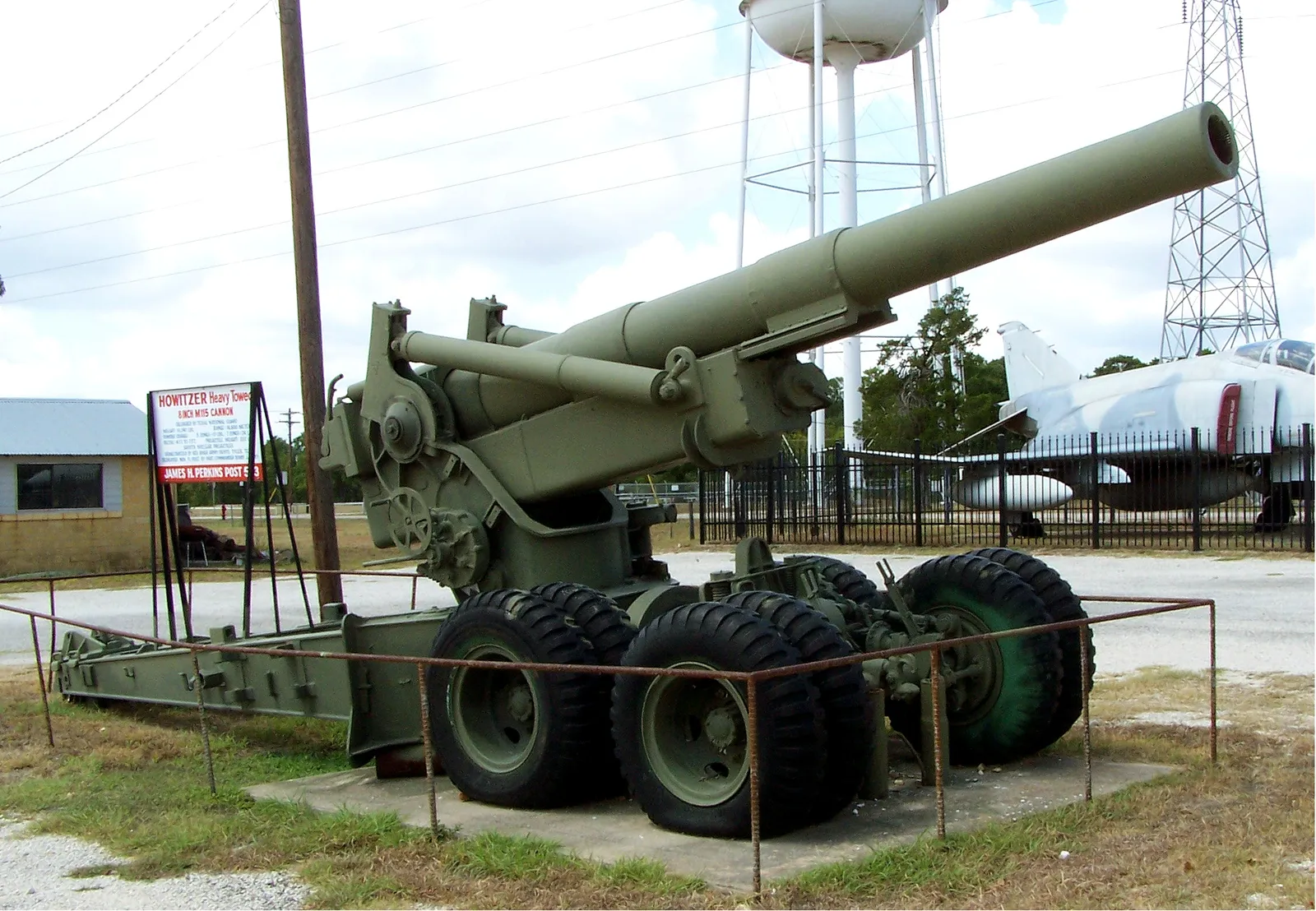
U.S. Army history identifies the 8 inch howitzer M1, later M115, as entering production in 1942 and serving through the Second World War as a heavy field-artillery weapon.
Artillery
203mm M115
Also known as
- M115 8 inch howitzer
- 8 inch Howitzer M1
- 8 inch howitzer M115
- 203 mm M115 howitzer
- 203mm M115 howitzer
- M115 howitzer
- M1 8 inch howitzer
The 203mm M115 was the U.S. Army's 8 inch towed heavy howitzer lineage that entered wartime service as the M1/M2 family and later received the M115 designation. Official Army and museum material links the weapon to U.S. heavy artillery in the Korean and Vietnam Wars, Republic of China use during the 1958 Taiwan Strait crisis, and a captured Iran-to-Iraq-to-U.S. display example from the Iran-Iraq War and Gulf War.
Role in Conflicts
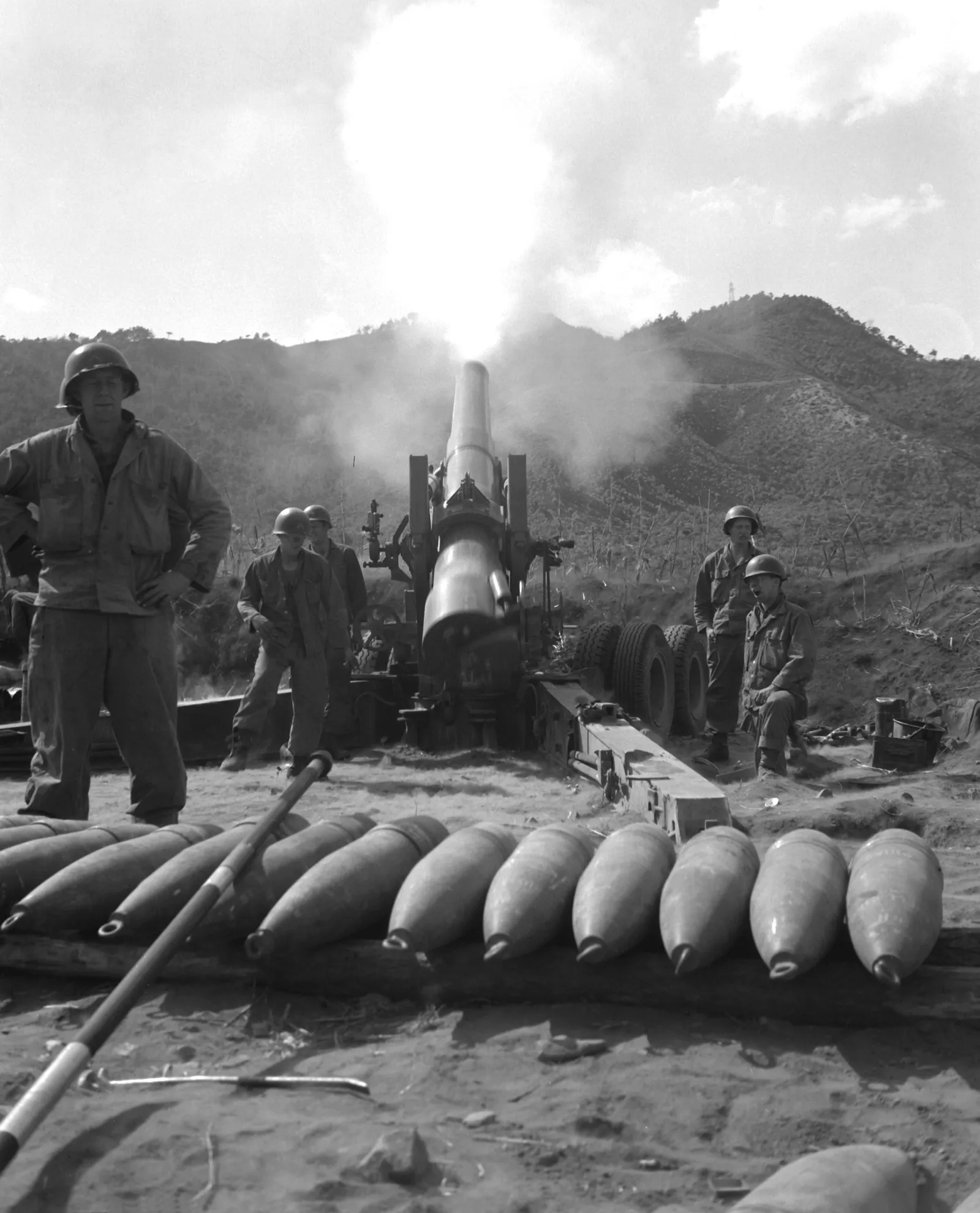
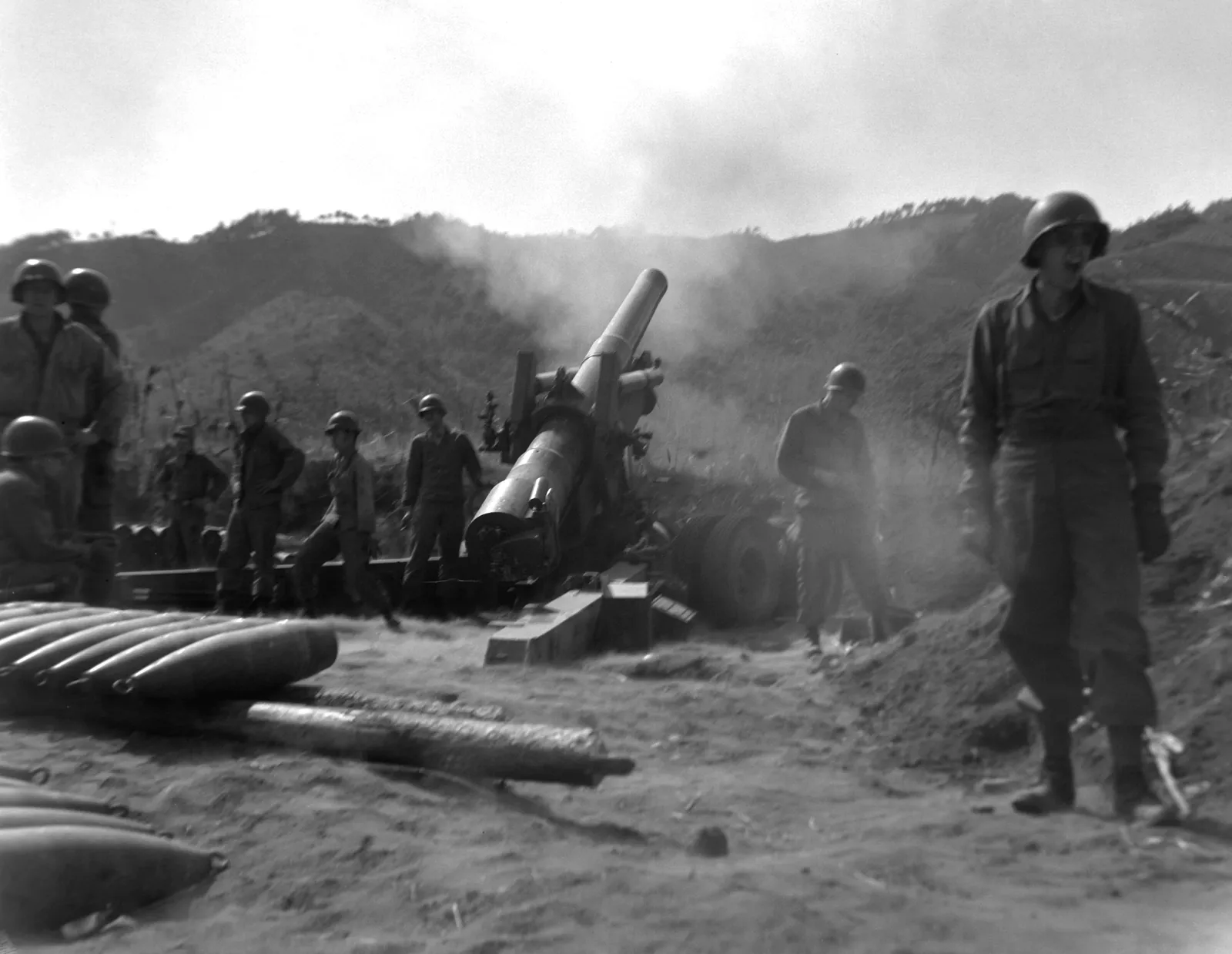
U.S. Army and War Memorial of Korea material identify the M115 / M1 8 inch howitzer as a standard U.S. heavy howitzer used during the Korean War for general artillery support and attacks on rear command, troop, and logistics targets.
War Memorial of Korea display text says Taiwanese forces used M115 8 inch howitzers as their main heavy guns during the August 23 Artillery Battle of 1958 against Chinese artillery near the Taiwan Strait.
- Side
- United States and South Vietnam


U.S. Army and reference material document the M115 as standard U.S. 8 inch towed heavy artillery that remained in service through the Vietnam War.


Rock Island Arsenal documentation for its display M115 says the howitzer was one of 16 sold to Iran in 1978 and was captured by Iraqi troops during the Iran-Iraq War.
- Side
- Iraq
Rock Island Arsenal documentation says the displayed M115 was captured by the United States during Operation Desert Storm after Iraqi forces had earlier captured it from Iran.
Role detailsConflict Service Notes
The M115 record spans several kinds of evidence: U.S. service in large wars, Taiwanese crisis combat, and captured examples that document Iranian and Iraqi custody. The notes below separate those contexts so the page does not imply the same operator or role in every conflict.
U.S. heavy artillery
Army and museum sources describe the 8 inch howitzer as a standard U.S. heavy howitzer in the Korean and Vietnam Wars, following Second World War introduction.
Taiwan Strait crisis
War Memorial of Korea text identifies the M115 as the main heavy gun used by Taiwanese forces in the August 23 Artillery Battle of 1958.
Captured display trail
Rock Island Arsenal material traces one displayed howitzer from a 1978 sale to Iran, Iraqi capture during the Iran-Iraq War, and U.S. capture during Operation Desert Storm.
Sources: RIA Self-Guided Tour: M115 8 IN Howitzer; War Memorial of Korea M115 8-inch towed howitzer; ASC Ordnance: M115 8-in. Howitzer.
Profile / Specs
Profile
- Origin
- United States
- Built by
- Unknown
- Type
- 203 mm towed heavy howitzer
- Service note
- Second World War heavy artillery design with Korean War, 1958 Taiwan Strait, Vietnam War, Iran-Iraq War, and Gulf War service visibility
- Designer
- U.S. Army Ordnance Department
- Designed
- Interwar requirement work began in 1919; the final split-trail design was standardized in 1939
- Produced
- 1942-1945
- Number built
- 1,006 howitzers
Specifications
- Caliber
- 203 mm / 8 inch
- Weapon type
- Towed heavy field howitzer
- Crew
- 14
- Combat weight
- About 14.5 metric tons
- Maximum range
- 16.8 km
- Rate of fire
- About 0.5 rounds per minute
- Projectile weight
- About 91 kg high-explosive projectile class
- Breech
- Interrupted-screw breech mechanism
- Recoil system
- Hydropneumatic recoil mechanism
- Ammunition loading
- Separate-loading ammunition, hand-rammed
- Carriage
- Split-trail heavy carriage with bogie and limber for travel
- Traverse
- 30 degrees left or right
- Elevation
- 0 to 65 degrees
- Transport
- Towed by heavy artillery tractor or truck
Design And Carriage Notes
The M115 sits in the U.S. heavy towed-artillery branch rather than the lighter divisional howitzer line. Army history traces the weapon to an 8 inch replacement requirement, identifies the final standardized design as using the same carriage as the 155 mm gun M1, and records a 1942-1945 production run before the howitzer continued into postwar service.
Caliber class
203 mm / 8 inch heavy howitzer firing separate-loading ammunition.
Carriage family
Shared with the U.S. 155 mm gun M1 according to Army Sustainment Command history.
Emplacement
The 1947 War Department manual describes a bogie-supported traveling position, detachable bogie, removable spades, hydropneumatic recoil, and hand-rammed separate-loading ammunition.
Sources: ASC Ordnance: M115 8-in. Howitzer; GovInfo TM 9-335; WeaponSystems.net 203mm M115.
Variants
The M115 designation was applied after the weapon entered service as the 8 inch Howitzer M1; the carriage relationship to other U.S. heavy artillery is handled separately in the relationship section.
| Variant | Configuration | Designation notes |
|---|---|---|
| 8 inch Howitzer M1 | Original wartime designation | U.S. Army Sustainment Command identifies the wartime 8 inch howitzer M1 as the weapon later redesignated M115. Sources: ASC Ordnance: M115 8-in. Howitzer |
Ammunition Fired
The M115 fired separate-loading 203 mm ammunition, with M106 high-explosive fragmentation projectiles representing the cataloged shell family most directly linked to the 8 inch howitzer.
| Ammunition | Ammunition type | Firing evidence |
|---|---|---|
 | 203 mm high-explosive projectile | METIS identifies the M106 as a U.S. 8 inch high-explosive projectile, matching the M115's 203 mm / 8 inch caliber class. Sources: M106 203 mm Projectile Entry |
Shared Heavy-Artillery Carriage
Army history links the M115 to the same heavy split-trail carriage architecture used by the U.S. 155 mm Gun M1 / M59 Long Tom family.
| Compatible item | Item type | Compatibility evidence |
|---|---|---|
 | 155 mm towed field gun | U.S. Army Sustainment Command states that the 8 inch howitzer M1/M115 used the same carriage as the 155 mm gun M1, making the relationship a carriage-family link rather than shared ammunition or caliber. Sources: ASC Ordnance: M115 8-in. Howitzer |
Timeline
203mm M115 Key Events
Post-First World War requirement begins
U.S. Army Sustainment Command history traces the M115 lineage to a 1919 requirement for a replacement 8 inch howitzer.
Sources: ASC Ordnance: M115 8-in. Howitzer
Final design standardized
The final M1 heavy-howitzer design was standardized in 1939 after earlier development paths were overtaken by changing artillery requirements.
Sources: ASC Ordnance: M115 8-in. Howitzer
Production starts
U.S. Army history records production beginning in 1942, with the howitzer entering service during the Second World War.
Sources: ASC Ordnance: M115 8-in. Howitzer
Production run ends
Public reference material lists 1,006 M115-family howitzers built before production ended in 1945.
Sources: WeaponSystems.net 203mm M115
Iran receives M115 howitzers
Rock Island Arsenal documentation says 16 M115 howitzers were sold to Iran in 1978, including the example later displayed at the arsenal.
Sources: ASC Ordnance: M115 8-in. Howitzer
Displayed example captured in Operation Desert Storm
Rock Island Arsenal says the United States captured its displayed M115 during Operation Desert Storm after the weapon had previously been captured by Iraqi troops.
Sources: ASC Ordnance: M115 8-in. Howitzer
Related Weapon Systems


Sources
ASC Ordnance: M115 8-in. HowitzerPublisher: U.S. Army Sustainment Command | Note: Supports M115 identity, 8 inch / 203 mm caliber, M1 designation history, design and carriage background, 1942 production start, Second World War and postwar service context, and direct conflict-use context for Iran-Iraq War capture and Operation Desert Storm capture. | Accessed: 2026-07-13RIA Self-Guided Tour: M115 8 IN HowitzerPublisher: U.S. Army | Note: Supports M115 Korean War and 1955 Vietnam War direct-use context, crew size, general artillery-support role, nuclear-shell context, 1980 Iran-Iraq War direct capture context by saying Iraqi troops captured the displayed howitzer during that war, and 1990 Gulf War direct capture context by saying U.S. forces captured it during Operation Desert Storm. | Accessed: 2026-07-13War Memorial of Korea M115 8-inch towed howitzerPublisher: War Memorial of Korea via Google Arts & Culture | Note: Supports Korean War direct-use context and 1958 Second Taiwan Strait Crisis direct-use context by identifying U.S. Korean War use and Republic of China M115 heavy-gun use in the August 23 Artillery Battle of 1958. | Accessed: 2026-07-13GovInfo TM 9-335Publisher: War Department via GovInfo | Note: Supports technical-manual context for the 8 inch howitzer M2, carriage M1, mount M17, heavy carriage limber M5, separate-loading ammunition, recoil mechanism, travel/emplacement arrangement, and public-domain government publication status. | Accessed: 2026-07-13WeaponSystems.net 203mm M115Publisher: WeaponSystems.net | Note: Supports M115 specifications, crew, weight, range, rate of fire, production quantity, production years, and 1955 Vietnam War direct conflict use by documenting that the M115 was used during the Vietnam War. | Accessed: 2026-07-13Wikimedia Commons M115 display imagePublisher: Wikimedia Commons | Note: Supports reusable image provenance for the M115 display photograph; Commons lists the file as Larry D. Moore's work under a Creative Commons Attribution 4.0 license. | Accessed: 2026-07-13Wikimedia Commons M115 Korea HM-SN-98-06851Publisher: Wikimedia Commons / U.S. Marine Corps | Note: Supports public-domain image provenance and Korean War direct-use context for an Army 8 inch howitzer battery firing support missions for First Marine Division forces on March 2, 1951. | Accessed: 2026-07-13Wikimedia Commons M115 Korea HM-SN-98-06854Publisher: Wikimedia Commons / U.S. Marine Corps | Note: Supports public-domain image provenance for a second U.S. Marine Corps Korean War view of an M115 / 8 inch howitzer firing support missions in Korea. | Accessed: 2026-07-13M106 203 mm Projectile EntryPublisher: METIS - Fenix Insight | Note: Supports the M106 as a U.S. 8 inch high-explosive projectile, providing the external ammunition-identity basis for the internal catalog link to the M106 projectile entry. | Accessed: 2026-07-13