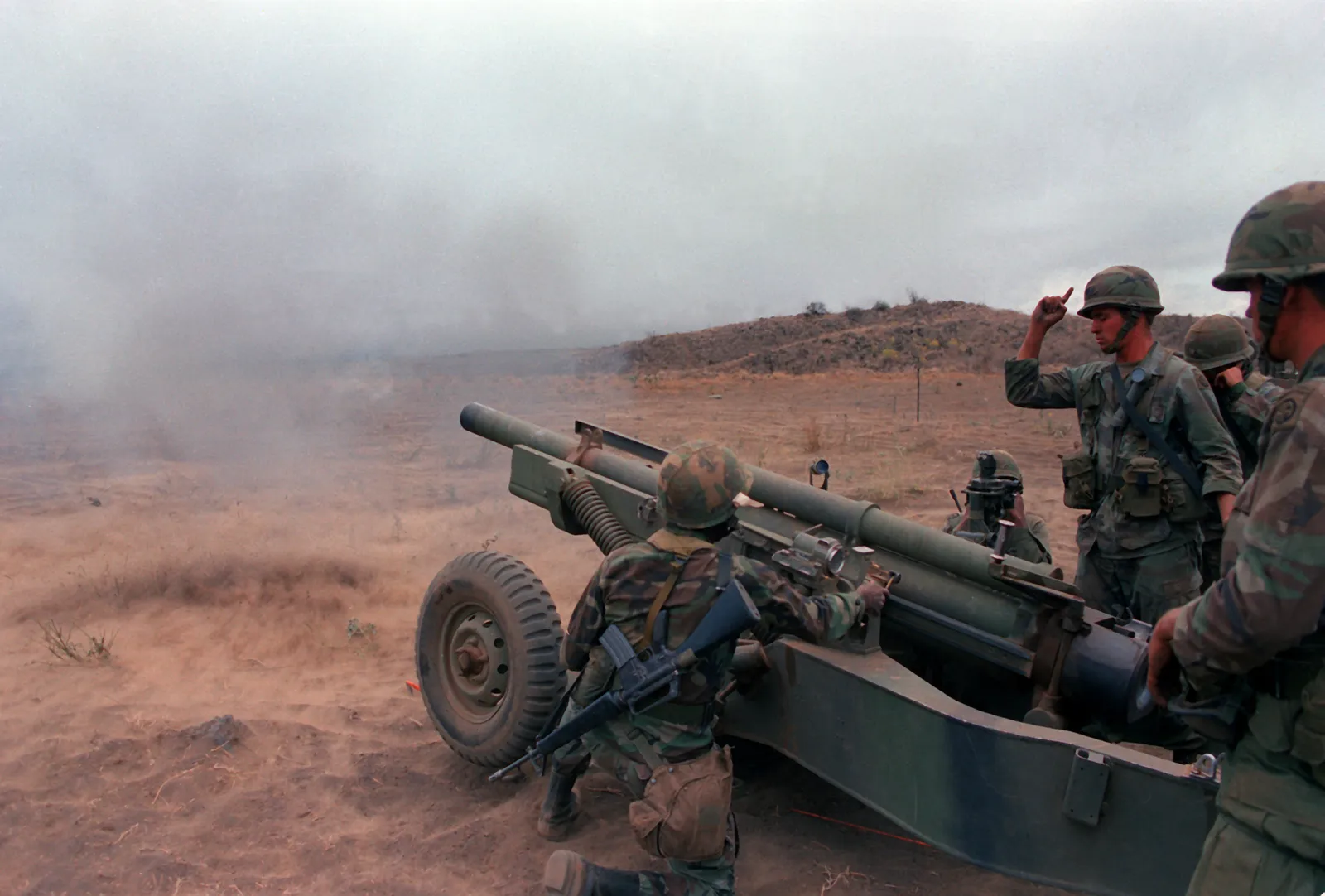
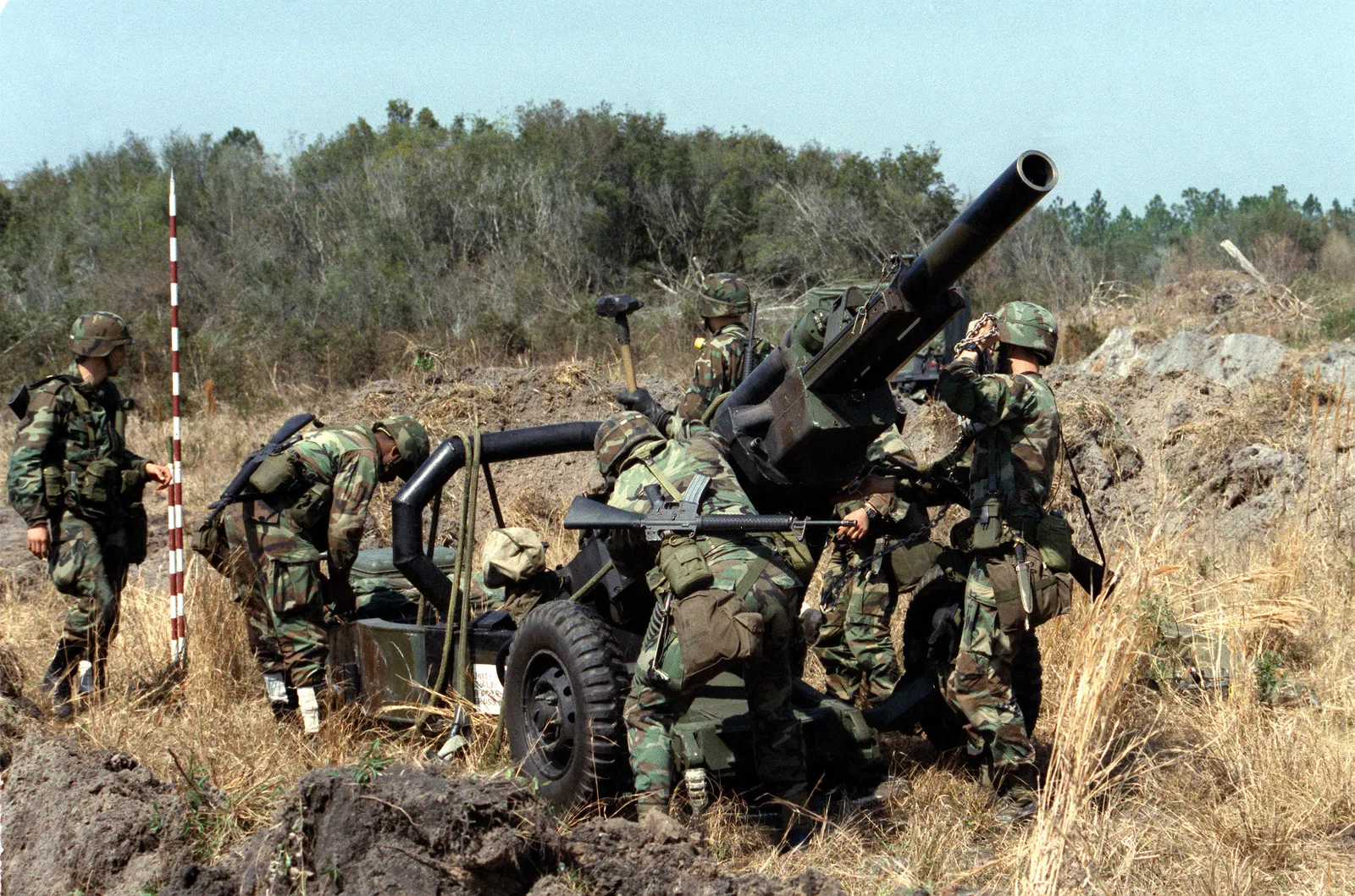
U.S. Army field artillery history and Army Historical Foundation coverage identify the M102 as received in Vietnam in 1966, first issued to 1st Battalion, 21st Field Artillery, and fired by U.S. artillery units in the Vietnam theater.
M102 105 mm Howitzer
- M102
- M102 howitzer
- 105 mm M102
- 105mm M102
- M102 105mm lightweight towed howitzer
- XM102
The M102 is a U.S. 105 mm lightweight towed howitzer developed at Rock Island Arsenal for airborne, air-assault, and light-infantry artillery units. It replaced heavier M101A1 guns in Vietnam, used a low aluminum carriage with 360-degree traverse, and later remained visible through Gulf War, Iraq War, and AC-130 gunship service after Army field artillery units transitioned to the M119.
Role in Conflicts
Army Historical Foundation history states that M102s were used in Iraq during the 1991 Persian Gulf War, where airborne, air-assault, or light-infantry units employed the lightweight howitzer.
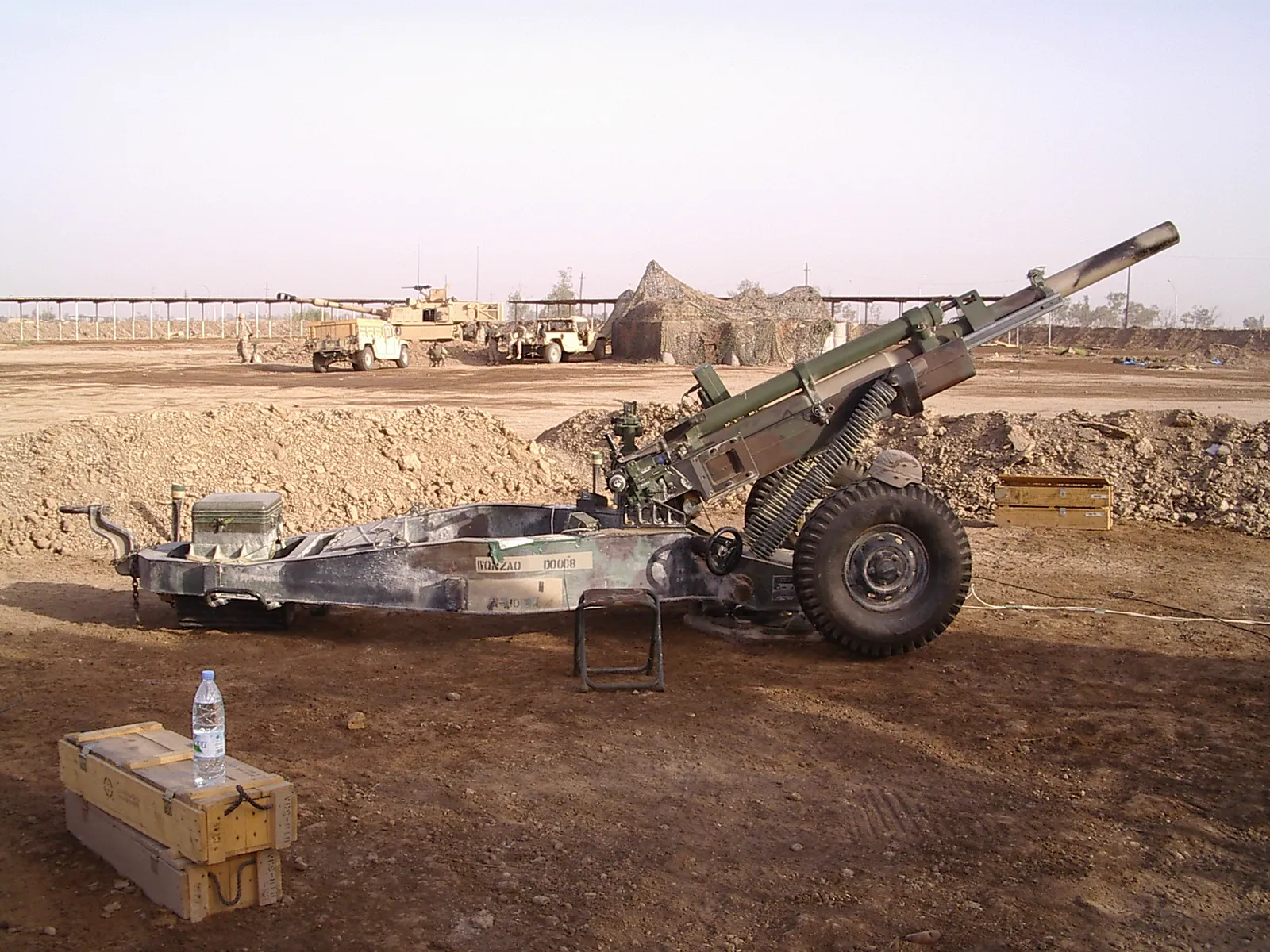
Role detailsA 2004 Camp Taji photograph and Army Historical Foundation history document Battery A, 1st Battalion, 206th Field Artillery M102s in Operation Iraqi Freedom II, providing counter-battery and close fire support for the 39th Brigade Combat Team and 1st Cavalry Division.
Profile / Specs
Profile
- Origin
- United States
- Built by
- Rock Island Arsenal
- Type
- 105 mm lightweight towed howitzer
- Service note
- Entered U.S. Army service in the mid-1960s; retained in National Guard and AC-130-related service after Regular Army M119 replacement
- Designer
- Rock Island Arsenal
- Designed
- 1962 prototype and design work
- Produced
- 1964-1973
- Number built
- Over 1,100 M102 howitzers produced; Army Historical Foundation and Army sources also cite about 1,150 acquired by the U.S. Army
- Developed from
- M101A1 105 mm howitzer replacement requirement
- Developed into
- M119 105 mm howitzer replacement in U.S. Army field artillery units; modified M102 cannon installations on AC-130 gunships
Specifications
- Caliber
- 105 mm
- Projectile
- 33 lb semi-fixed 105 mm ammunition projectile class
- Weight
- About 3,000-3,298 lb depending on source and configuration
- Crew
- Eight-person howitzer section in U.S. field manual organization
- Range
- 11.5 km with standard charge; 15.1 km with rocket-assisted projectile
- Rate of fire
- Up to 10 rounds per minute initially; about 3 rounds per minute sustained
- Muzzle velocity
- 494 m/s at charge 7
- Elevation
- -5 degrees to +75 degrees
- Traverse
- 360 degrees / 6,400 mils on the firing platform
- Mobility
- Towed by light truck or HMMWV, helicopter transportable, and suitable for airborne delivery
Lightweight Carriage And Fire Role
The M102 was built around portability and fast all-around traverse rather than heavy-caliber destructive effect. Its aluminum wishbone carriage, firing platform, and trail roller allowed the gun to be shifted through a full circle after emplacement, while the 105 mm ammunition family kept it light enough for helicopter, light-vehicle, and airborne-unit logistics.
Army Rock Island coverage describes the requirement as a towed 105 mm howitzer under 3,000 pounds that could be delivered by parachute, helicopter, or assault landing.
The XM6 firing platform was developed for M102 use in inundated and soft ground, then tested in Vietnam from September 1967.
GlobalSecurity's Army-derived summary describes the M102 as compensating for smaller projectile weight with volume of fire and mobility in airmobile and light-infantry operations.
Sources: Supporting fire: Stabilizing firepower in a swamp; M102 105mm Lightweight Towed Howitzer; Field Artillery 1954-1973 Chapter 3.
Variants
The M102 record covers the towed howitzer family and the closely related XM102 prototype. AC-130 installations used a modified M102 cannon rather than a separate towed field piece.
| Variant | Configuration | Designation notes |
|---|---|---|
| XM102 | Experimental 105 mm light towed howitzer | Rock Island Arsenal material identifies XM102 as the experimental version, with prototype completion in 1962 and production beginning in 1964. Sources: Supporting fire: Stabilizing firepower in a swamp, RIA Self-Guided Tour: XM102 Experimental 105MM Light Towed Howitzer |
| M102 AC-130 cannon installation | Modified side-firing gunship armament | The National Museum of the U.S. Air Force describes the M102 105 mm cannon as adapted for AC-130 gunships after a 40 mm side-firing gun was replaced to increase firepower. Sources: National Museum M102 105mm Cannon |
Predecessor And Replacement
The M102 sits between two public 105 mm U.S. howitzer records: it replaced the M101A1 in Vietnam-era airborne and light infantry units, then was itself replaced by the M119 in Regular Army field artillery.
| Compatible item | Item type | Compatibility evidence |
|---|---|---|
![]() | Earlier 105 mm towed howitzer | Army Vietnam history describes the M102 replacing the M101A1 in Vietnam because the newer gun was lighter, had better on-carriage traverse, and suited heliborne operations. Sources: Field Artillery 1954-1973 Chapter 3 |
![]() | Later 105 mm lightweight towed howitzer | Army Historical Foundation history identifies the M119 as the U.S. Army replacement for the M102 in Regular Army field artillery units beginning in 1989. |
Gunship Installation
The towed M102 and the AC-130-mounted 105 mm cannon are not identical battlefield packages, but Air Force museum and Army history sources tie the gunship armament directly to the M102 cannon.
| Carrier | Carrier type | Carriage evidence |
|---|---|---|
![]() | Side-firing gunship | The National Museum of the U.S. Air Force states that a modified M102 105 mm cannon replaced one side-firing 40 mm gun on AC-130 gunships to increase firepower. Sources: National Museum M102 105mm Cannon |
Timeline
M102 105 mm Howitzer Key Events
XM102 prototypes completed
Army Rock Island coverage says XM102 prototype work was completed in 1962 as the Army sought a 105 mm howitzer under 3,000 pounds for airborne and air-assault delivery.
Sources: Supporting fire: Stabilizing firepower in a swamp
Production begins
Army reporting records M102 production starting in 1964 and continuing into the early 1970s.
Sources: Supporting fire: Stabilizing firepower in a swamp
First M102s issued in Vietnam
Army Vietnam field artillery history states that the first M102s were issued to 1st Battalion, 21st Field Artillery, in March 1966.
Sources: Field Artillery 1954-1973 Chapter 3
XM6 platform tested with the M102 in Vietnam
Six XM6 airmobile firing-platform prototypes were sent to Vietnam as proof-of-concept equipment for M102 operations in inundated and soft ground.
Sources: Supporting fire: Stabilizing firepower in a swamp
Regular Army replacement begins
Army Historical Foundation history states that the U.S. Army began replacing the M102 with the M119 in Regular Army field artillery units while National Guard battalions retained M102s.
Sources: Army Historical Foundation M102 105mm Howitzer
M102 documented at Camp Taji
A Commons-hosted Operation Iraqi Freedom II photograph identifies an M102 from Battery A, 1st Battalion, 206th Field Artillery at Fire Base Paris, Camp Taji, Iraq.
Sources: Commons M102 Iraq 2004 Image
AC-130J 105 mm gun decision
Army Historical Foundation history notes that Air Force Special Operations Command requested inclusion of the M102-derived 105 mm gun on the AC-130J Ghostrider in early 2015.
Sources: Army Historical Foundation M102 105mm Howitzer
Media
M102 105 mm Howitzer Images
Related Weapon Systems