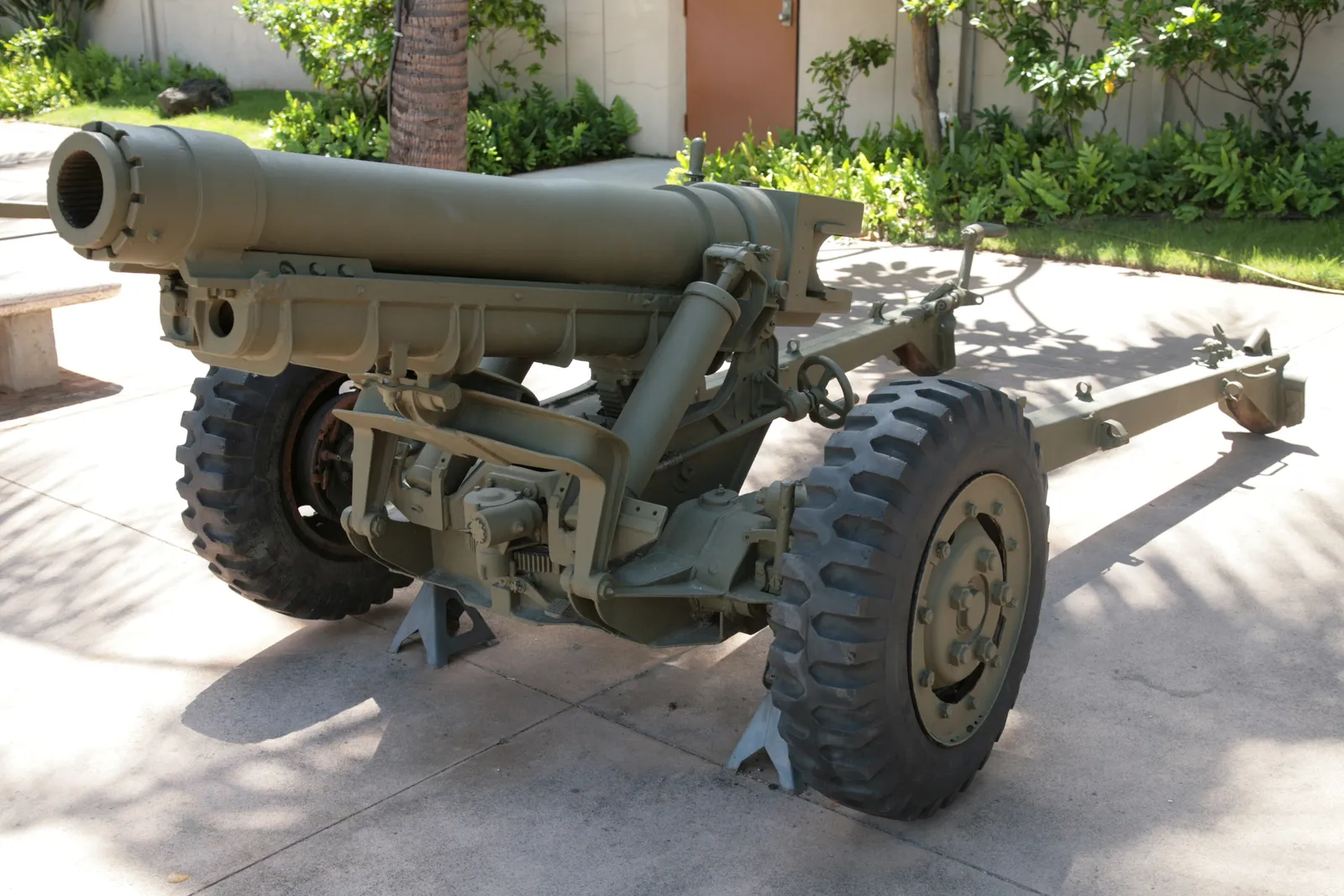
U.S. Army sources document the M3/M3A1 105 mm howitzer in Second World War Allied service, including airborne and infantry cannon-company use in Europe and a CMH photograph caption identifying an M3 shelling enemy positions after Aachen.
Artillery
105 mm Howitzer M3
Also known as
- M3 howitzer
- 105mm Howitzer M3
- M3A1 105 mm howitzer
- Howitzer, 105 mm, M3
The 105 mm Howitzer M3 was a U.S. lightweight towed howitzer built for airborne and infantry cannon-company fire support in the Second World War. Its shortened M2-derived tube, 75 mm pack-howitzer carriage ancestry, and M3A1 reinforced split trails produced an air-portable 105 mm weapon with less range than the standard M2/M101 lineage but documented Allied wartime service in Europe.
Role in Conflicts
Profile / Specs
Profile
- Origin
- United States
- Built by
- Rock Island Arsenal
- Type
- 105 mm lightweight towed howitzer
- Service note
- World War II airborne and infantry cannon-company service
- Designer
- U.S. Army Ordnance Department
- Designed
- 1941-1943
- Unit cost
- Not stated in cited sources
- Produced
- 1943-1945
- Number built
- 2,580
Specifications
- Caliber
- 105 mm
- Weight
- 1,130 kg / 2,495 lb
- Dimensions
- 155 in overall length in traveling position; 68 in width over hub caps; 44 in overall height
- Maximum range
- 7.6 km with HE and smoke shells
- Rate of fire
- 4 rounds per minute short duration; 2 rounds per minute sustained
- Muzzle velocity
- 311 m/s
- Bore length
- Approximately 16 calibers
- Ammunition
- Semifixed 105 mm ammunition using quick-burning propellant for M3 service rounds
- Carriage
- Split-trail high-speed towed carriage; M3A1 trails used heavier steel than M3 trails
Variants
The M3 family designation centered on the airborne 105 mm howitzer and carriage improvements rather than a separate modern weapon lineage.
| Variant | Configuration | Designation notes |
|---|---|---|
| M3 on Carriage M3 | Early production carriage | The War Department manual describes the M3 and M3A1 carriages as generally similar split-trail high-speed carriages, with the M3A1 differing mainly in heavier trail construction. Sources: TM 9-1326: 105-mm Howitzer M3 and Howitzer Carriages M3 and M3A1 |
| M3A1 | Reinforced carriage production variant | The Rock Island Arsenal tour page describes the M3A1 as the production variant with a reinforced split-trail design using thicker metal. Sources: RIA Self-Guided Tour: M3A1 105MM Split Trail Howitzer |
| M3A2 | Shielded carriage variant | Rock Island Arsenal describes the modified M3A2 as fitted with a small shield bracing the barrel to add crew protection. Sources: RIA Self-Guided Tour: M3A1 105MM Split Trail Howitzer |
Ammunition Fired
Open technical summaries describe the M3 as firing semi-fixed 105 mm howitzer ammunition with a faster-burning propelling charge tailored to the shorter tube.
| Ammunition | Ammunition type | Firing evidence |
|---|---|---|
 | 105 mm high-explosive cartridge | GlobalSecurity lists HE M1 among ammunition for the M3, and the existing cartridge record covers the cataloged 105 mm high-explosive M1 round. |
 | 105 mm smoke and white-phosphorus cartridge | GlobalSecurity lists WP M60 smoke ammunition among M3 ammunition types; the linked cartridge record covers the M60 105 mm smoke/WP family. |
Light Howitzer Tradeoffs
The M3 solved a mobility problem rather than replacing the standard 105 mm field howitzer. U.S. Army Rock Island history ties the design to airborne deployment and infantry cannon companies, while technical sources distinguish its shortened tube, lighter carriage ancestry, lower maximum range, and M3A1 reinforced trails.
Air-portable purpose
The T7/M3 design married a short 105 mm barrel to pack-howitzer carriage features so airborne and light infantry units could move heavier fire support than the 75 mm pack howitzer.
Range compromise
The cataloged maximum range is about 7.6 km, substantially shorter than the standard M2/M101 105 mm howitzer family that used a longer tube.
Carriage evolution
The M3A1 variant strengthened the split trails with heavier metal, while the later M3A2 added a small shield for crew protection in Korean War-era ROK service.
Sources: RIA Self-Guided Tour: M3A1 105MM Split Trail Howitzer; TM 9-1326: 105-mm Howitzer M3 and Howitzer Carriages M3 and M3A1; GlobalSecurity.org: M3 105mm Howitzer.
Timeline
105 mm Howitzer M3 Key Events
Airborne requirement produces T7 prototype
U.S. airborne requirements led to the T7 light 105 mm howitzer project, which combined shortened M2 howitzer components with a lighter pack-howitzer-style carriage.
Sources: RIA Self-Guided Tour: M3A1 105MM Split Trail Howitzer
M3A1 enters production
Rock Island Arsenal history says the howitzer entered production in 1943 as the M3A1 with reinforced split trails.
Sources: RIA Self-Guided Tour: M3A1 105MM Split Trail Howitzer
Airborne units receive M3A1 howitzers before Normandy
Rock Island Arsenal history states that some divisions had M3A1 howitzers ahead of the D-Day invasion, while other airborne units retained 75 mm pack howitzers until later in 1944.
Sources: RIA Self-Guided Tour: M3A1 105MM Split Trail Howitzer
Full Allied service authorization
The U.S. Army Rock Island account places the M3A1 in full Allied Forces service in December 1944, with all airborne divisions in Europe using the type by the end of the war.
Sources: RIA Self-Guided Tour: M3A1 105MM Split Trail Howitzer
Related Weapon Systems


Sources
TM 9-1326: 105-mm Howitzer M3 and Howitzer Carriages M3 and M3A1Publisher: United States War Department | Note: Primary 1944 ordnance-maintenance manual supporting M3/M3A1 carriage distinctions, dimensions, ammunition type, range, rate-of-fire, recoil, and technical specifications. | Accessed: 2026-07-13RIA Self-Guided Tour: M3A1 105MM Split Trail HowitzerPublisher: U.S. Army | Note: Supports M3/M3A1 identity, airborne design purpose, M2 and 75 mm pack-howitzer lineage, T7 prototype context, reinforced split-trail production variant, and Second World War use by Allied airborne divisions in Europe. | Accessed: 2026-07-13CMH The War Against Germany: Europe and Adjacent AreasPublisher: U.S. Army Center of Military History | Note: Supports direct Second World War use by identifying a 105 mm Howitzer M3 shelling enemy positions after Aachen during Allied operations in Europe. | Accessed: 2026-07-13GlobalSecurity.org: M3 105mm HowitzerPublisher: GlobalSecurity.org | Note: Specialist technical summary supporting M3 tube lineage, ammunition types, quick-burning propellant, carriage distinctions, and dimensional data. | Accessed: 2026-07-13WeaponSystems.net: 105mm Howitzer M3Publisher: WeaponSystems.net | Note: Supports compact technical specifications for the M3 howitzer, including range, rate of fire, shortened M2 ordnance lineage, and ammunition compatibility context. | Accessed: 2026-07-13M3 105mm Howitzer.jpgPublisher: Wikimedia Commons | Note: Image provenance for the public-domain M3 howitzer display photograph used as the primary image. | Accessed: 2026-07-13