French artillery sources place the 105 Mle 1950 TF in Algerian War frontier-barrier service: in 1959 it replaced 105 L Mle 1936 guns in Tunisian-barrier position sections, and 120 guns were activated especially for radar-gun border-defense units.
105mm Mle 50 TF
- Obusier de 105 modele 1950
- Obusier de 105 mm modele 1950
- Obusier de 105mm TF50
- OB 105 Mle 50
- OB 105 TF 50
- 105 TF 50
- 105 Mle 1950 TF
- 105 mm M1950
- 105 mm trifleche Modele 50
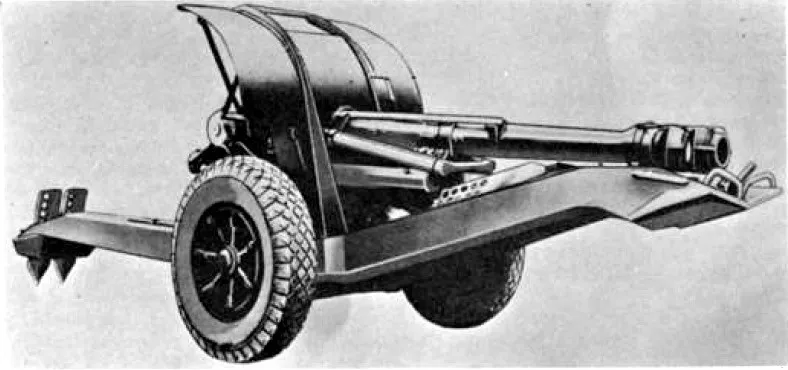
The 105mm Mle 50 TF was a French postwar 105 mm towed howitzer built around a three-outrigger carriage for all-around fire. French artillery sources place it in late Algerian War border-barrier service, where its 360-degree traverse suited static radar-gun defense, but its heavy layout and long development cycle left it with a short operational career compared with lighter 105 mm howitzers.
Role in Conflicts
Profile / Specs
Profile
- Origin
- France
- Built by
- Arsenal de Bourges
- Type
- 105 mm towed howitzer
- Service note
- Early Cold War French service; limited Algerian War use documented near the end of the conflict
- Designer
- DEFA / Atelier de Bourges
- Designed
- 1946-1950 design program
- Produced
- 1950s; operational status reached near the end of the decade
- Number built
- 120 towed howitzers reported for French service
Specifications
- Caliber
- 105 mm
- Barrel
- 23 calibers / about 2.4 m including muzzle brake
- Crew
- 6
- Combat weight
- About 2,900-2,922 kg in firing position
- Travel weight
- About 3,200 kg
- Carriage
- Three-outrigger tripod carriage with wheels raised in firing position
- Traverse
- 360 degrees
- Elevation
- -7 deg to +70 deg
- Maximum range
- 14.5 km with 105 mm Mle 1953 high-explosive shell
- Rate of fire
- 6 rpm normal; up to 10 rpm short burst reported
- Muzzle velocity
- 568-580 m/s, depending on source
- Ammunition
- Semi-fixed 105x372 mm R / 105 mm Mle 1953 high-explosive shell
Three-Outrigger Layout
The Mle 50 TF was designed around a trifleche carriage: three outriggers opened around a central firing platform, the wheels lifted in firing position, and the howitzer could traverse through 360 degrees. That made the gun attractive for static border and base-defense roles, but the same arrangement made it heavier and slower to handle than lighter 105 mm howitzers.
360 degrees from the tripod firing platform.
Best documented in fixed Algerian border-barrier positions and radar-gun defense units.
Better all-around coverage than conventional split-trail guns, but with more weight and a longer development path.
Sources: BASART Obusier de 105mm TF50; Maquetland Obusier 105 mm trifleche Modele 50; WeaponSystems 105mm Mle 50 TF.
Variants
The Mle 50 TF designation refers to the towed three-outrigger howitzer; the same 105 mm ordnance also informed AMX-13-based self-propelled artillery.
| Variant | Configuration | Designation notes |
|---|---|---|
| OB 105 Mle 50TF | Towed three-outrigger howitzer | French artillery-history sources give OB 105 Mle 50TF and OB 105 TF 50 as designation forms for the adopted towed weapon. Sources: Maquetland Obusier 105 mm trifleche Modele 50, BASART Obusier de 105mm TF50 |
| 105 AU 50 / AMX-105 | Self-propelled derivative on AMX-13 chassis | WeaponSystems, BASART, and Maquetland describe the AMX-105 / 105 AU 50 self-propelled howitzer as using a modified Obusier de 105 modele 1950 ordnance on an AMX-13 chassis. Sources: WeaponSystems 105mm Mle 50 TF, WeaponSystems AMX-105, BASART Obusier automoteur de 105mm Au 50, Maquetland Obusier 105 mm trifleche Modele 50 |
Ammunition Fired
Open technical sources identify the French Mle 53 explosive shell as the TF50's documented high-explosive ammunition.
| Ammunition | Ammunition type | Firing evidence |
|---|---|---|
![]() | 105 mm high-explosive shell | BASART identifies the Mle 53 explosive shell in the TF50 data sheet, and WeaponSystems describes the Mle 50 howitzer as mainly firing the Mle 53 shell. Sources: BASART Obusier de 105mm TF50, WeaponSystems 105mm Mle 50 TF |
Family Context
The Mle 50 TF belongs to a small group of postwar howitzers built around wide traverse from a central platform. It was intended to improve on the M101/HM2 class in range and all-around fire, while the Soviet D-30 122 mm howitzer later became the much more widely produced three-leg comparison point.
| System | Relationship | Source-backed context |
|---|---|---|
![]() | Replacement benchmark | French sources describe the Mle 50 TF program as a French attempt to replace the U.S.-supplied 105 HM2/M101 family, seeking more range and all-around fire. |
![]() | Layout comparison | WeaponSystems compares the D-30 as another towed howitzer using a three-leg carriage, while noting the Mle 50 TF as the French trifleche example. |
Sources: Maquetland Obusier 105 mm trifleche Modele 50; WeaponSystems 105mm Mle 50 TF.
Self-Propelled Derivative
The towed TF50 also fed a tracked artillery branch. BASART describes the 105 AU 50 as a self-propelled howitzer using the modified rotating ordnance mass of the OB 105 Mle 50 TF in a fixed casemate on an AMX-13 tank chassis. That relationship explains why the catalog keeps AMX-105 as a derivative designation here rather than treating the towed TF50's Algerian War evidence as proof for the self-propelled vehicle.
105 AU 50 / AMX-105 self-propelled howitzer.
AMX-13 chassis with fixed rear casemate.
Modified OB 105 Mle 50 TF rotating gun mass.
Sources: BASART Obusier automoteur de 105mm Au 50; WeaponSystems AMX-105.
Timeline
105mm Mle 50 TF Key Events
French 105 mm replacement program formalized
Maquetland traces the postwar French 105 mm howitzer program to a 31 July 1946 ministerial decision aimed at replacing U.S.-supplied 105 HM2 guns.
Sources: Maquetland Obusier 105 mm trifleche Modele 50
Mle 50 TF designation adopted
French artillery-history sources identify 1950 as the adoption point for the 105 mm trifleche howitzer designation, although operational maturity came later.
Sources: BASART Obusier de 105mm TF50, Maquetland Obusier 105 mm trifleche Modele 50
Barrier-position replacement in Algeria
BASART's Algeria artillery table notes that the 105 Mle 1950 TF replaced the 105 L Mle 1936 in Tunisian-barrier position sections in 1959.
Sources: BASART Artillerie sol-sol en Algerie
Operational career winds down after Algeria
BASART states that the howitzers no longer had an operational role after the Algerian War and became static instruction pieces.
Sources: BASART Obusier de 105mm TF50
Related Weapon Systems


