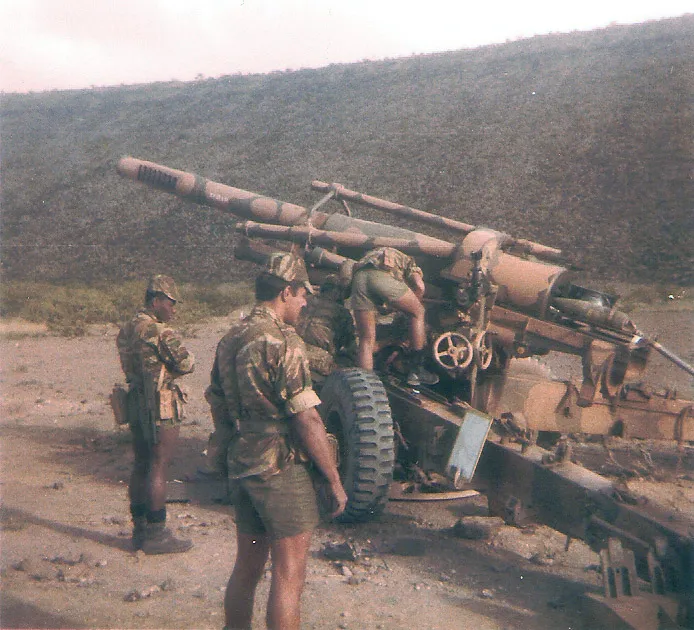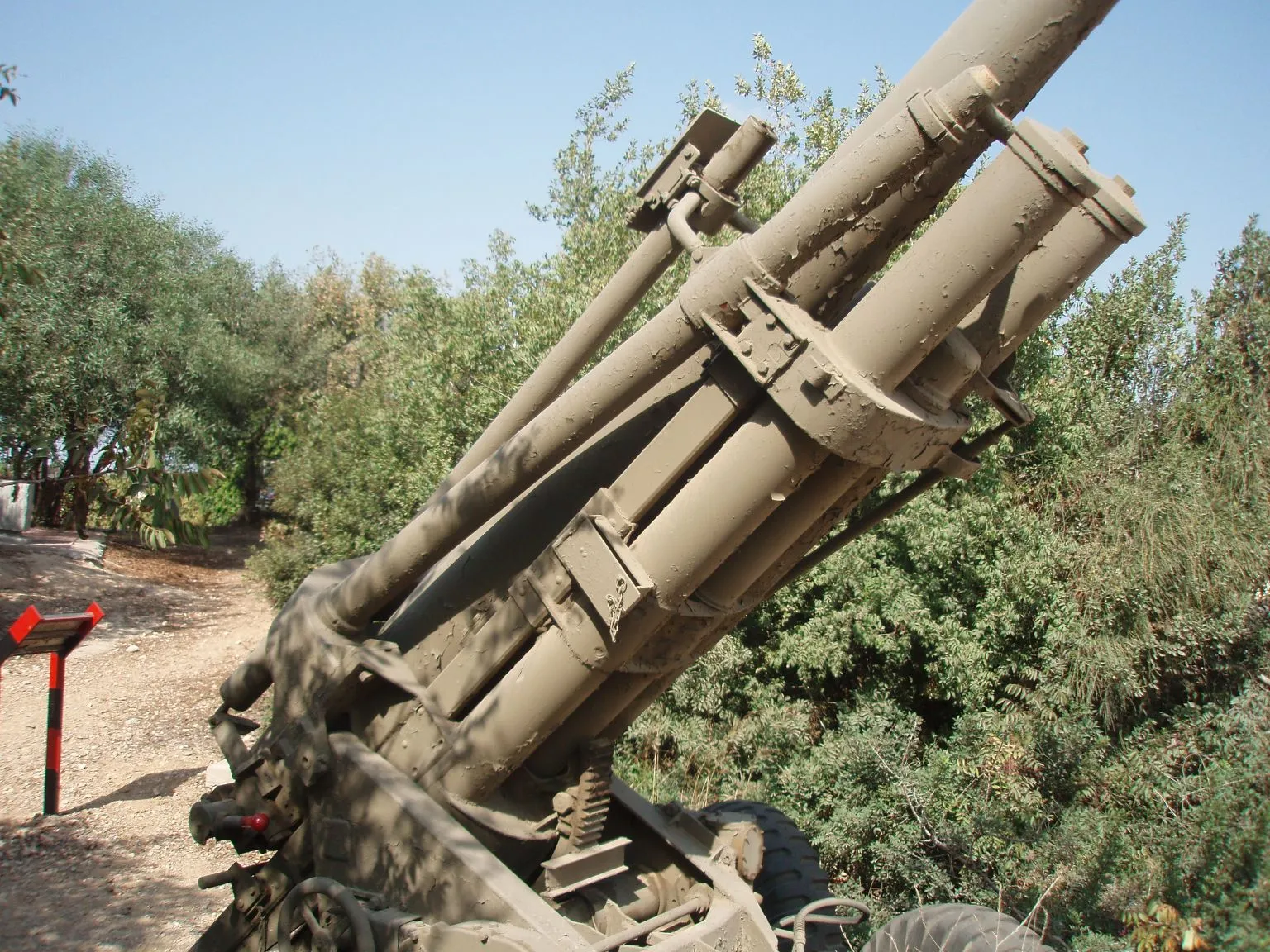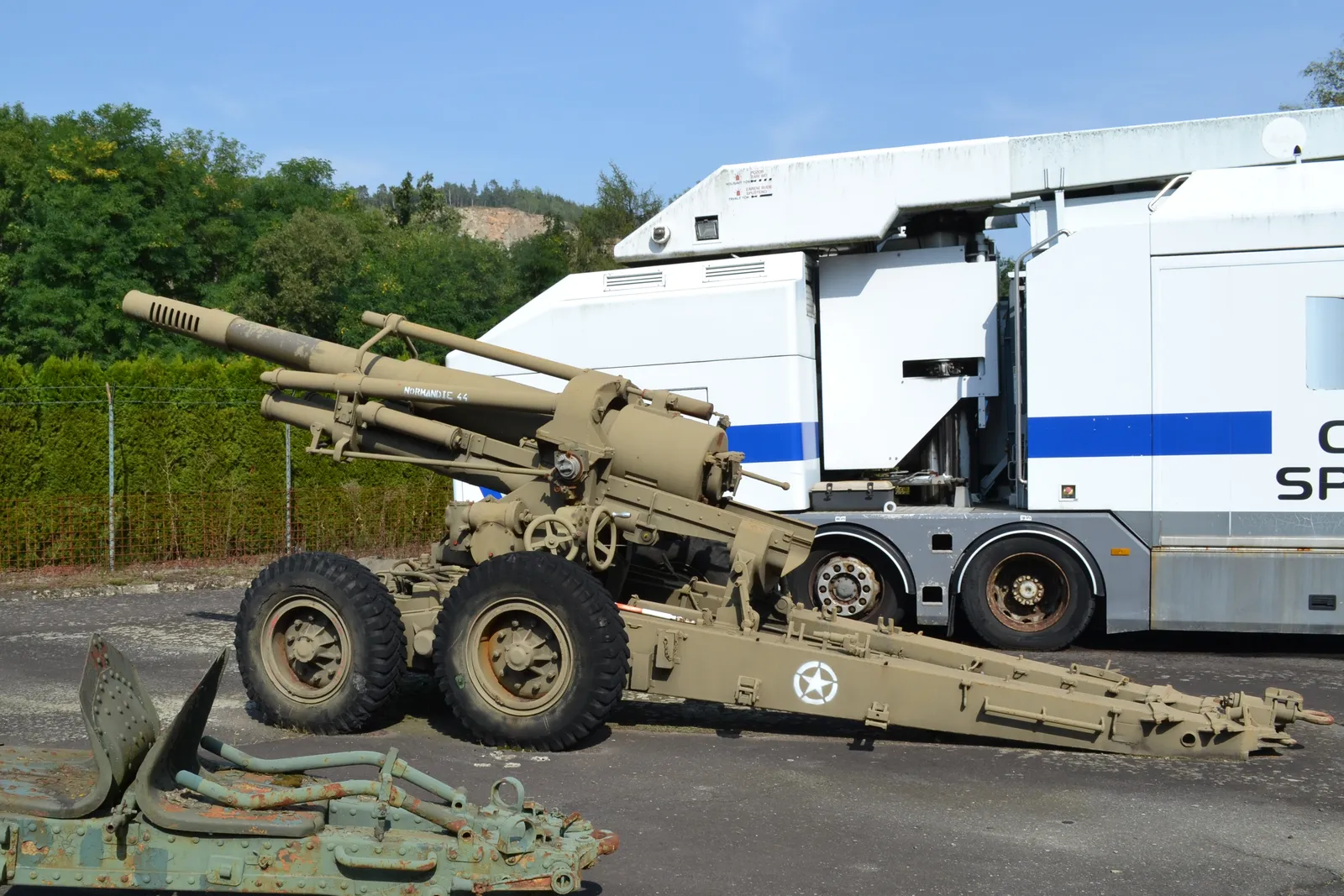
- Side
- French forces

BASART lists the 155 BF 50 / Mle 1950 among French ground-artillery equipment used in Algeria; a French artillery-history article places the type late in the war.
The 155 mm Modèle 50 was France's postwar split-trail 155 mm howitzer, produced for French service and export before the TRF1 replaced it. Its catalog record is anchored by documented French use in Algeria and Israeli Modèle 50 artillery service in the 1973 Yom Kippur War, with Swedish license production known as 15,5 cm Haubits F.
BASART lists the 155 BF 50 / Mle 1950 among French ground-artillery equipment used in Algeria; a French artillery-history article places the type late in the war.
Army Recognition describes Israeli M-50 vehicles based on the Modèle 50 piece falling into Egyptian hands during violent Suez Canal fighting in the 1973 Yom Kippur War, while WeaponSystems describes the Modèle 50 as core Israeli artillery in the 1973 conflict.
The Modèle 50 was a heavy towed howitzer built around a four-wheel split-trail carriage and a circular firing platform under the forward carriage. In firing position the front of the carriage rested on the platform, the trails opened behind the weapon, and the 155 mm tube used a prominent multi-slotted muzzle brake with hydropneumatic recoil equipment.
An eleven-person crew and 6x6 truck towing arrangement made the gun a battery asset rather than a manhandled field piece.
Reference data gives about -4 to +69 degrees of elevation and roughly 80 degrees of total traverse from the split-trail mount.
Separate-loading projectiles and charges supported French HE, U.S. M107, smoke, illumination, and rocket-assisted rounds depending on source and operator.
Sources: BASART Obusier de 155 mm modele 1950/1963; WeaponSystems 155mm Modele 50; Army Recognition Model 50 155mm.
The Modèle 50 family used French service, export, and licensed Swedish designations; Israeli M-50 self-propelled guns mounted the same French 155 mm ordnance on modified Sherman chassis.
| Variant | Configuration | Designation notes |
|---|---|---|
| OB-155-50 BF | French split-trail towed howitzer designation | WeaponSystems and Army Recognition identify OB-155-50 BF as a French designation for the Modèle 50 split-trail howitzer. Sources: WeaponSystems 155mm Modele 50, Army Recognition Model 50 155mm |
| 15,5 cm Haubits F | Swedish licensed-service designation | WeaponSystems lists the Swedish service designation and describes licensed Swedish production by Bofors from 1955 to 1958. Sources: WeaponSystems 155mm Modele 50 |
| M-50 self-propelled howitzer | Israeli Sherman-chassis derivative | Army Recognition describes the Israeli M-50 as the Modèle 50 piece adapted to a heavily modified Sherman chassis; no separate public catalog record existed during this entry's creation. Sources: Army Recognition Model 50 155mm |
The Modèle 50 fired separate-loading 155 mm ammunition, including French Mle 1956 high-explosive shells and U.S. M107 projectiles in source-backed range tables.
| Ammunition | Ammunition type | Firing evidence |
|---|---|---|
 | 155 mm high-explosive projectile | WeaponSystems lists a 14.8 km Modèle 50 range with the U.S. M107 shell, while French artillery references distinguish the Mle 1956 HE shell as the standard French projectile. Sources: WeaponSystems 155mm Modele 50, BASART Obusier de 155 mm modele 1950/1963 |
French and Swedish service moved from the Modèle 50 generation to later 155 mm systems rather than treating the gun as a current-standard howitzer.
| Compatible item | Item type | Compatibility evidence |
|---|---|---|
 | French 155 mm towed howitzer replacement | WeaponSystems says the TRF1 replaced the Modèle 50 in French service. Sources: WeaponSystems 155mm Modele 50 |
 | Swedish 155 mm howitzer successor | WeaponSystems says the Bofors FH77 replaced the Modèle 50 / Haubits F in Swedish service. Sources: WeaponSystems 155mm Modele 50 |
The Modèle 50 record has two production tracks: French state artillery production for domestic and export guns, and Swedish licensed production by Bofors for the Haubits F. The catalog manufacturer fields keep both the Bourges design attribution and the Bofors licensed-production lineage visible.
French sources associate the design with Bourges and specialist data lists about 980 French-built guns.
WeaponSystems lists Swedish Bofors production from 1955 to 1958 and about 100 Swedish-built guns.
French OB-155-50 BF and Swedish 15,5 cm Haubits F labels refer to the same Modèle 50 design family.
Sources: WeaponSystems 155mm Modele 50; BASART Obusier de 155 mm modele 1950/1963; Army Recognition Model 50 155mm.
French and specialist references identify 1950 as the design or adoption point for the postwar French 155 mm howitzer program.
Sources: WeaponSystems 155mm Modele 50, BASART Obusier de 155 mm modele 1950/1963
WeaponSystems places French production and service entry in 1952, with the gun replacing older U.S.-supplied and wartime 155 mm howitzers in French service.
Sources: WeaponSystems 155mm Modele 50
WeaponSystems lists Swedish Bofors production from 1955 to 1958, supporting the 15,5 cm Haubits F designation and Swedish production context.
Sources: WeaponSystems 155mm Modele 50
Specialist references describe the Modèle 50 as a core Israeli artillery system in the 1973 war and describe Israeli M-50 self-propelled vehicles based on the Modèle 50 piece in Suez Canal fighting.
Sources: WeaponSystems 155mm Modele 50, Army Recognition Model 50 155mm
References describe the TRF1 as the French replacement for the Modèle 50 from the 1980s, while reserve use continued longer.
Sources: WeaponSystems 155mm Modele 50, BASART Obusier de 155 mm modele 1950/1963