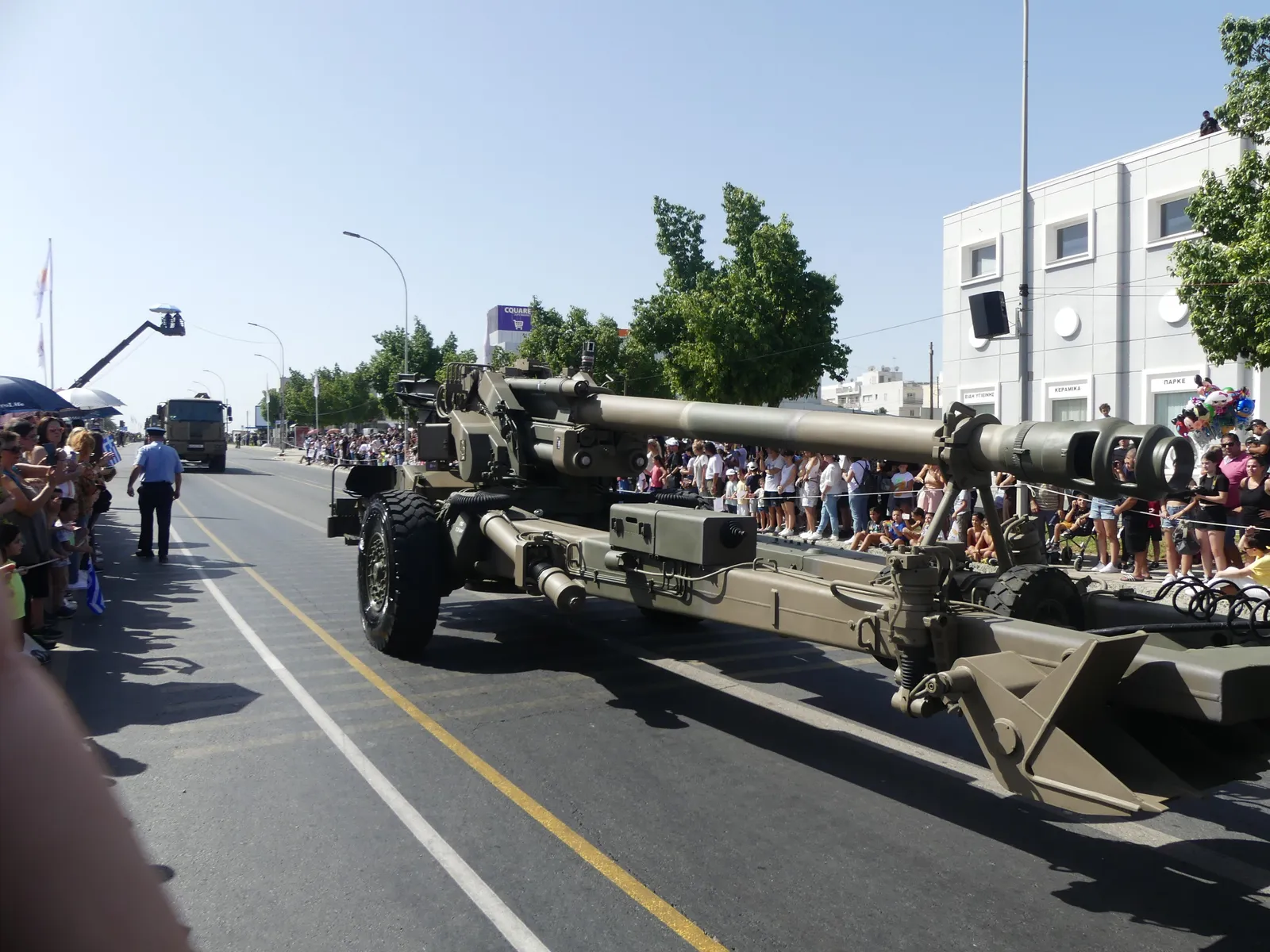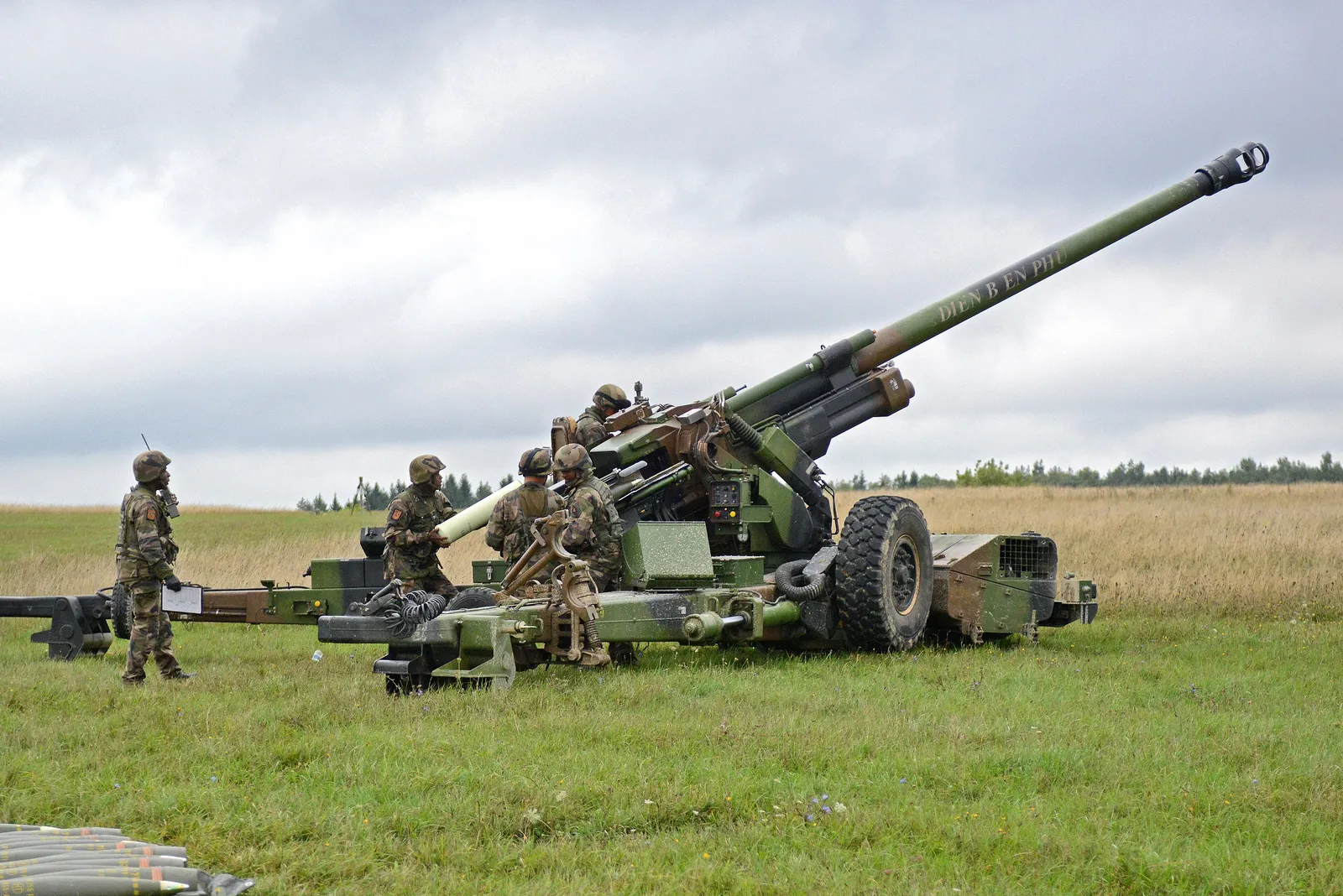
- Side
- Coalition forces

A French Ministry of the Armed Forces memory dossier records 18 TRF1 towed guns among the Division Daguet equipment deployed with coalition forces during the 1990-1991 Gulf War.
Role detailsThe TRF1 is a French 155 mm towed howitzer built by GIAT Industries for NATO-standard indirect fire. It entered French service in 1989, uses an auxiliary power unit for short self-movement, and can fire NATO-standard 155 mm ammunition as well as extended-range and BONUS projectiles; French sources document the gun with Division Daguet in the Gulf War and in later deliveries to Ukraine.
A French Ministry of the Armed Forces memory dossier records 18 TRF1 towed guns among the Division Daguet equipment deployed with coalition forces during the 1990-1991 Gulf War.
Role detailsFrance's official delivered-equipment list recorded six TRF1 howitzers and 155 mm ammunition supplied to Ukraine, adding NATO-caliber towed artillery to Ukrainian fire-support units.
Role detailsWeaponsystems.net describes the TRF1 as a towed gun with an auxiliary power unit and a travel-oriented layout that shortens the ordnance during movement.
| Feature | Documented detail |
|---|---|
| Auxiliary power unit | Mounted in front of the wheels and used for autonomous travel at up to 9 km/h. |
| Travel layout | The 155 mm L/40 ordnance swings 180 degrees toward the rear for movement. |
| Loading aid | A hydraulic rammer assists shell loading. |
| Towing | The gun is normally towed by a 6x6 truck; French service uses the Renault TRM 10000. |
Forecast International describes the TRF1 as a French Army-sponsored GIAT system whose production line went dormant after the French requirement, with limited export sales and later marketing centered on longer-caliber options.
| Context | Documented detail |
|---|---|
| French procurement | Development and French procurement were sponsored by the French Ministry of Defense through French Army armaments channels. |
| Production status | The production line went dormant in July 1993 after the French requirement was completed, while marketing for new orders continued. |
| Export distribution | The same report lists export sales to Cyprus and Saudi Arabia alongside the French inventory. |
| Development path | Longer-caliber TRF1 work fed into the truck-mounted CAESAR development path and a proposed export model. |
Forecast International reported no specific TRF1 variants, but documented an export model, longer-caliber development work, and the CAESAR truck-mounted path from a 52-caliber TRF1 cannon and associated components.
| Variant | Configuration | Designation notes |
|---|---|---|
| Export model | Modified export configuration | Forecast International described an export model with a modified chamber and elevation increased to 70 degrees. Sources: 155 TR F1 155 mm Howitzer - Archived |
 | Truck-mounted 52-caliber development path | Forecast International described the 52-caliber TRF1 cannon and associated components being integrated with a Mercedes-Benz U 2450 L chassis in the program that became CAESAR. Sources: 155 TR F1 155 mm Howitzer - Archived |
Weaponsystems.net publishes separate range figures by ammunition type, while Forecast International describes the TRF1 as compatible with NATO-standard 155 mm ammunition and the BONUS projectile.
| Ammunition | Ammunition type | Firing evidence |
|---|---|---|
 | 155 mm NATO ammunition family | Forecast International states that the TRF1 can fire NATO-standard 155 mm ammunition, supporting a broad ammunition-family link. Sources: 155 TR F1 155 mm Howitzer - Archived |
 | 155 mm high-explosive projectile | Weaponsystems.net lists the TRF1 at 18.5 km with M107 rounds, linking the gun directly to the M107 family. Sources: 155mm TR-F1 |
 | 155 mm top-attack submunition projectile | Forecast International lists the TRF1 as compatible with the BONUS submunition dispensing projectile. Sources: 155 TR F1 155 mm Howitzer - Archived |
The Commons file page describes the TRF1 as being showcased in 1979 at Eurosatory.
Sources: TRF1 155mm.jpg
Weaponsystems.net lists the TRF1 as entering service in 1989.
Sources: 155mm TR-F1
A French government Gulf War dossier lists 18 TRF1 towed guns in the Division Daguet equipment set during the 1990-1991 Gulf War.
Sources: La guerre du Golfe (1990-1991): Opération Daguet
The French Ministry for the Armed Forces listed six TRF1 howitzers in its October 2022 Ukraine equipment release.
Sources: French Military Equipment Delivered to Ukraine
Weaponsystems.net separates the TRF1's range by ammunition type, which makes the gun's standard and extended-range shots easy to compare.
| Ammunition | Published range | Note |
|---|---|---|
| Standard 155 mm shells | 24 km | Baseline range for normal firing. |
| M107 rounds | 18.5 km | Specific figure published for the M107 high-explosive projectile. |
| ERFB base-bleed ammunition | 32.9 km | Long-range ammunition class listed in the entry. |
| Direct fire | 2 km | Short direct-fire mode published on the reference page. |