Tanks

M26 Pershing

Also known as
  • T26E3
  • Heavy Tank T26E3
  • Medium Tank M26
  • M26A1
  • T26E4
  • Super Pershing

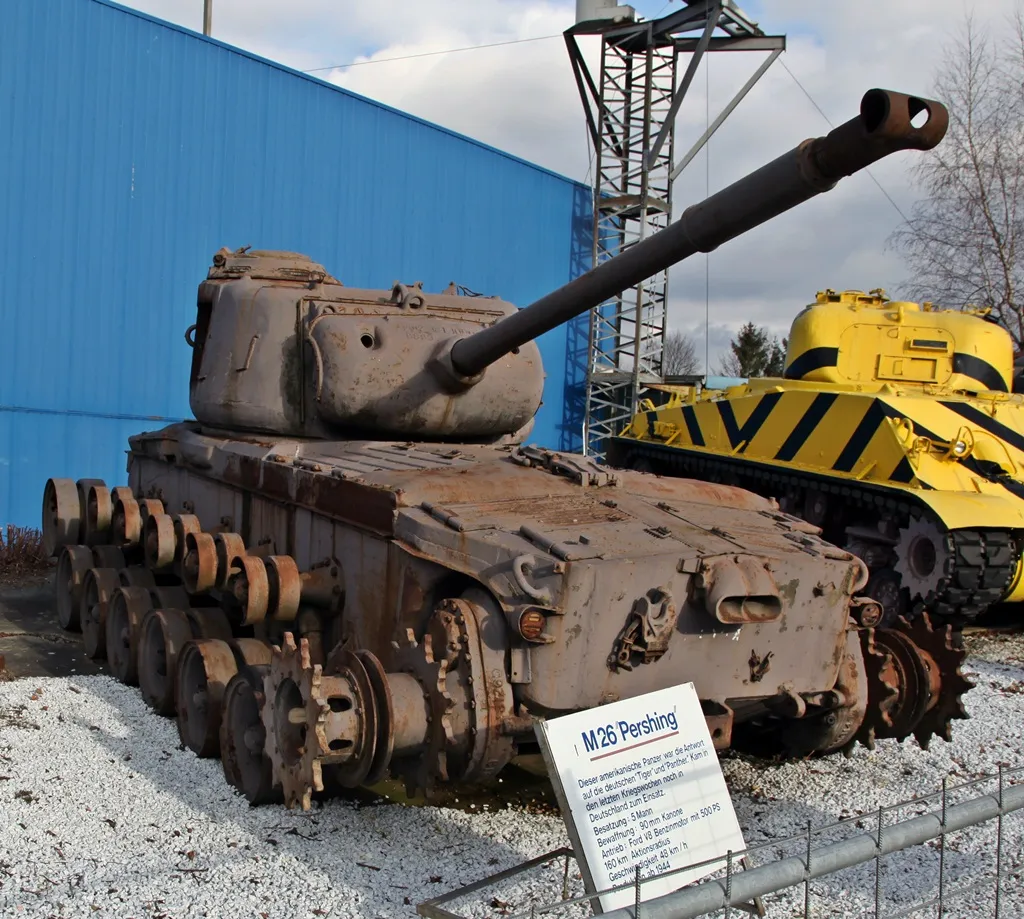
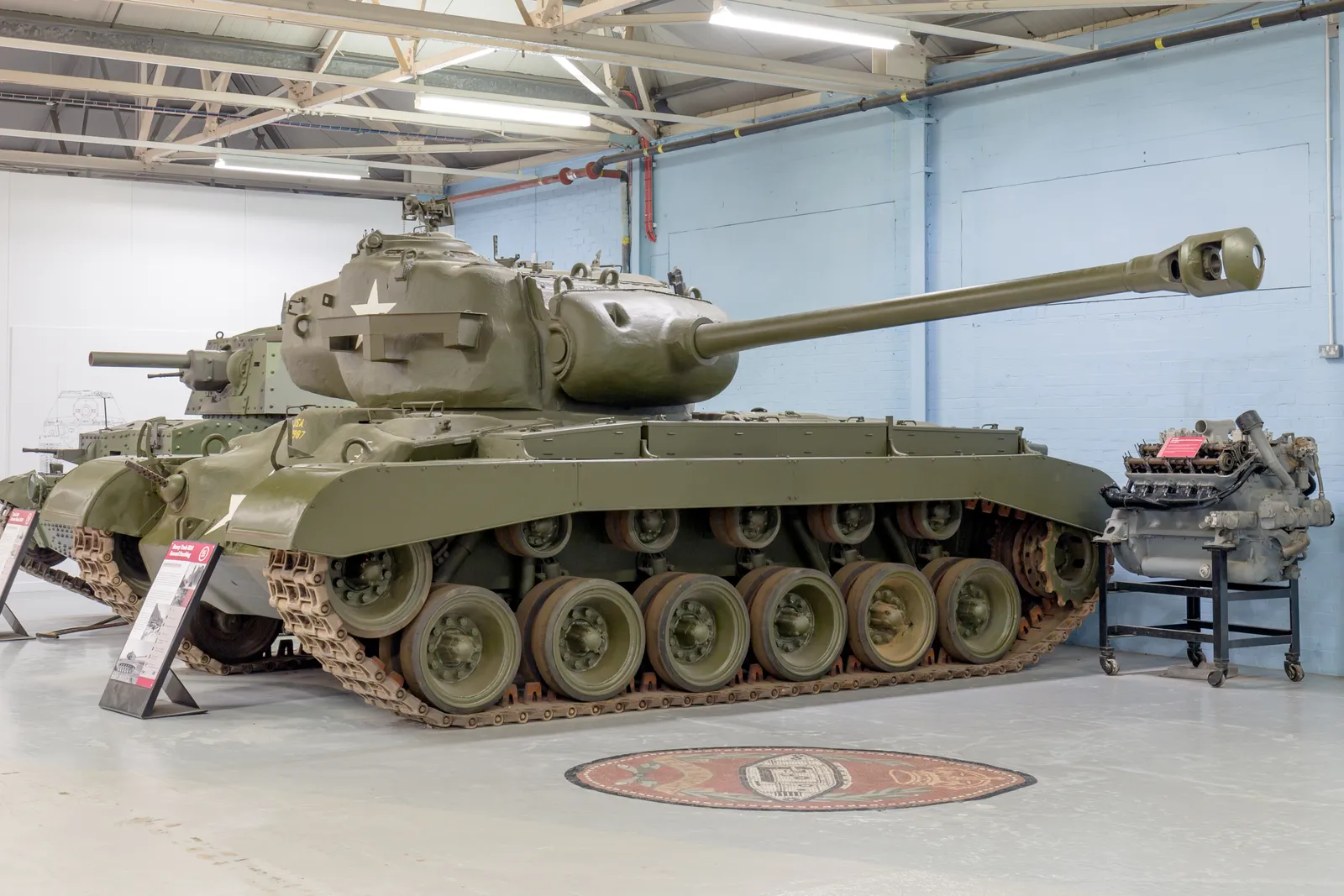
The M26 Pershing was the U.S. Army's late-World War II T26E3 tank, standardized as the M26 in March 1945 and reclassified as a medium tank in May 1946. It replaced Sherman-era compromises with a 90 mm M3 gun, torsion-bar suspension, heavier armor, and a five-person layout, but its Ford GAF powertrain left it underpowered for its weight and the drivetrain-improved M46 Patton carried the layout into the postwar Patton line.

Profile / Specs

Profile

Origin
United States
Type
Heavy tank at introduction; later reclassified as a medium tank
Service note
Late World War II and Korean War-era U.S. tank
Designed
1942-1944
Produced
First accepted in November 1944; wartime and postwar acceptances continued into 1945
Number built
2,202 M26 accepted; 25 T26E4 accepted separately; secondary counts vary when conversions or prototypes are included
Developed from
T20/T25/T26 medium-tank development series
Developed into
M46 Patton

Specifications

Crew
5: commander, gunner, loader, driver, assistant driver/bow gunner
Main armament
90 mm Gun M3 in M67 turret mount; 70 rounds, 10 ready
Secondary armament
.50 cal M2HB on turret anti-aircraft mount with 550 rounds; two .30 cal M1919A4 machine guns with 5,000 rounds total
Combat weight
92,355 lb / 41,892 kg for M26
Engine
Ford GAF 8-cylinder gasoline engine, 450 hp net / 500 hp gross at 2,600 rpm
Transmission
Torqmatic, 3 forward speeds and 1 reverse
Suspension
Torsion bar; six individually sprung dual road wheels per track
Road speed
25 mph sustained / 30 mph dash for M26
Road range
About 100 miles / 160 km
Armor
M26 upper front hull 4 in / 10 cm at 46 degrees; turret gun shield 4.5 in / 11 cm; turret front 4 in / 10 cm
Service Context

Documented combat service falls in late World War II Europe and the Korean War. The notes below keep that service history distinct from the tank's design and postwar development path.

Central Europe, 1945

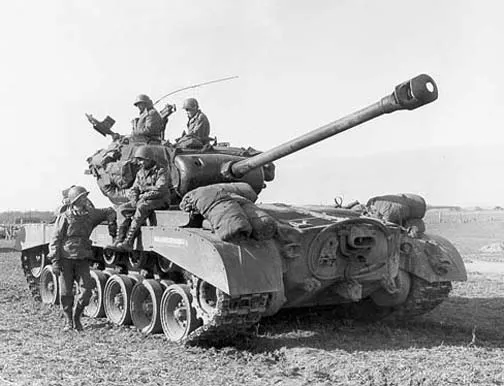
U.S. Army sources place new M26 Pershing heavy tanks with 3rd Armored Division elements during the late-March 1945 drive toward Paderborn.

Korea, 1950

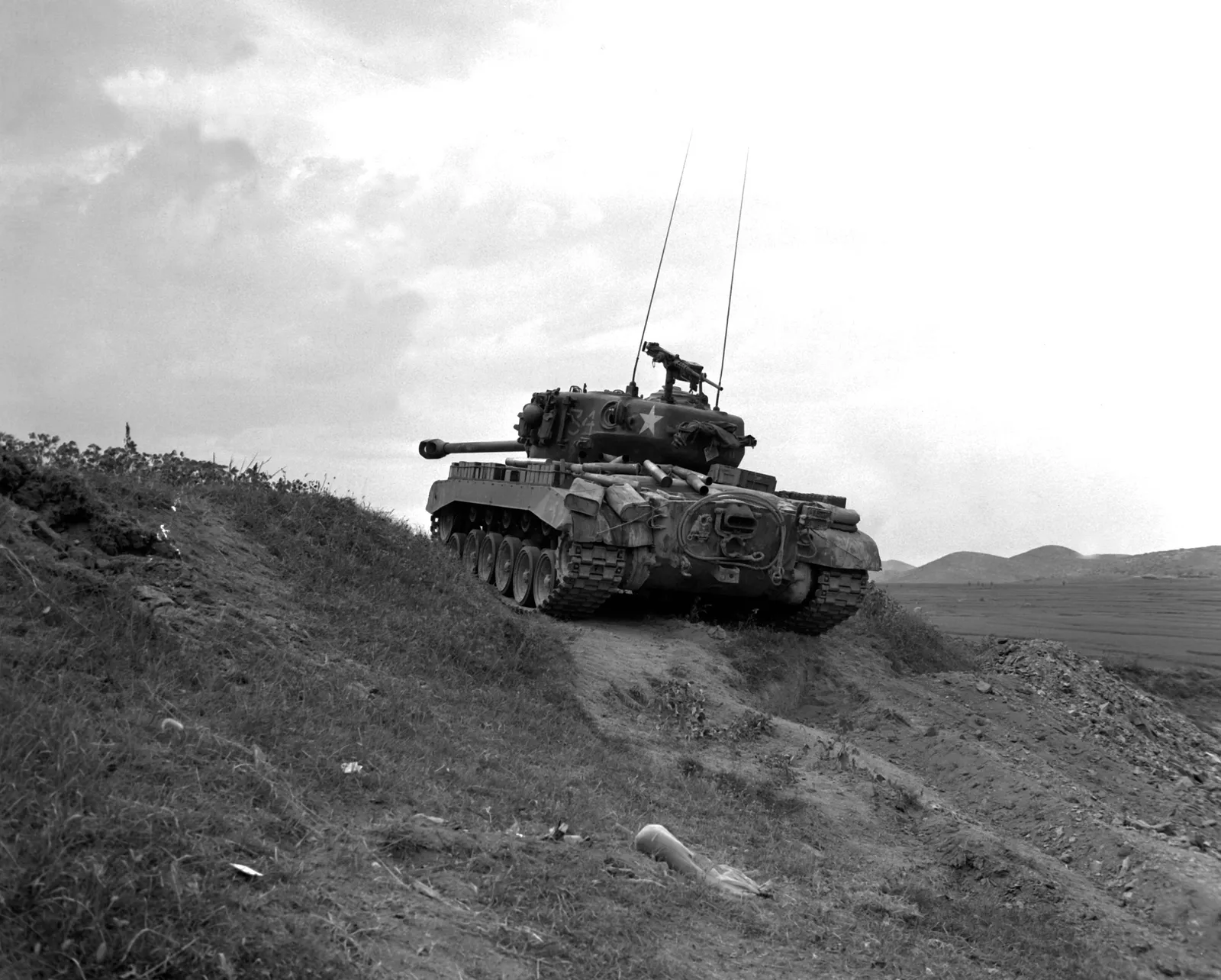
Marine Corps and Army accounts document Pershings in early Korean War actions, including Marine M26s landing at Pusan and a 72nd Tank Battalion M26 fight near the Naktong River.

Postwar transition

The M26A1 updated the gun installation while the M46 Patton addressed the Pershing's drivetrain limitations and carried the basic layout forward.

Sources: Central Europe; Fire Brigade: U.S. Marines in the Pusan Perimeter; Holding the Tank at Naktong Bulge; AFV Database M26 Pershing.
Variants

The Pershing family moved from the combat-deployed T26E3/M26 baseline to postwar M26A1 gun improvements and the limited T26E4 Super Pershing long-gun program.

VariantConfigurationDesignation notes
T26E3 / M26Baseline production Pershing

T26E3 vehicles deployed to Europe before standardization; the Army standardized the type as M26 in March 1945.

Sources: The M26 Pershing Tank, AFV Database M26 Pershing

M26A1Postwar gun and mount upgrade

Accepted from 1948 with the 90 mm M3A1 gun, bore evacuator, lighter single-baffle muzzle brake, M67A1 mount changes, and related travel-lock updates.

Sources: AFV Database M26 Pershing

T26E4 Super PershingLong 90 mm gun variant

Built around the longer T15-series 90 mm gun; 25 T26E4 tanks were accepted after the first pilot vehicle reached Europe.

Sources: AFV Database M26 Pershing, T26E4 Pershing Tank

Carried Weapons

Weaponsystems.net identifies the Pershing as mounting a 90 mm M3 main gun, paired .30-06 M1919A4 machine guns, and a roof-mounted 12.7 mm M2HB heavy machine gun.

Carried itemItem typeCarriage evidence
.30-Caliber Machine Gun, Crew-served medium machine gun, Infantry Weapons.30-Caliber Machine GunVehicle-mounted medium machine gun

Weaponsystems.net states that the M26 Pershing carried .30-06 M1919A4 machine guns as both coaxial and bow armament.

Sources: M26 Pershing | Weaponsystems.net

12.7 mm heavy machine gun, Belt-fed, crew-served heavy machine gun class, Infantry Weapons12.7 mm heavy machine gunRoof-mounted heavy machine gun

Weaponsystems.net states that the M26 Pershing mounted a 12.7 mm M2HB heavy machine gun on the turret roof for anti-aircraft use.

Sources: M26 Pershing | Weaponsystems.net

Timeline

M26 Pershing Key Events

  1. T20-series development begins

    The Pershing lineage grew from the T20 series, an effort to move beyond the M4 Sherman layout with a lower profile, rear drive layout, and heavier armament options.

    Sources: The M26 Pershing Tank, AFV Database M26 Pershing

  2. T26 series reclassified as heavy tanks

    AFV Database records the T26 series as reclassified from medium to heavy tanks on June 29, 1944.

    Sources: AFV Database M26 Pershing

  3. M26 first acceptance

    AFV Database lists November 1944 as the M26 date of first acceptance.

    Sources: AFV Database M26 Pershing

  4. Zebra Mission sends T26E3s to Europe

    The first 20 T26E3 tanks were issued to the 3rd and 9th Armored Divisions for combat testing in Europe.

    Sources: The M26 Pershing Tank

  5. T26E3 standardized as M26 Pershing

    After early combat use, the Army standardized the T26E3 as the M26 and named it for General John J. Pershing.

    Sources: The M26 Pershing Tank, AFV Database M26 Pershing

  6. First T26E4 pilot reaches Europe

    AFV Database says the first T26E4 pilot arrived in Europe with the 90 mm T15E1 gun and later received in-theater applique armor.

    Sources: AFV Database M26 Pershing

  7. M26 reclassified as medium tank

    AFV Database records the Pershing as reclassified as a medium tank in May 1946.

    Sources: AFV Database M26 Pershing

  8. M26A1 first accepted

    The first improved M26A1s were accepted in 1948 with the 90 mm M3A1 gun, bore evacuator, and single-baffle muzzle brake.

    Sources: AFV Database M26 Pershing

Media
Related Weapon Systems
M1083 6x6 medium tactical vehicle, 5-ton 6x6 medium tactical cargo truck, Support EquipmentSupport EquipmentM1083 6x6 medium tactical vehicle5-ton 6x6 medium tactical cargo truckThe M1083 6x6 medium tactical vehicle is the standard 5-ton cargo member of the U.S. Family of Medium Tactical Vehicles line. Army budget materials describe the M1083 as a cargo-and-soldier transport truck with hinged side rails and optional bench seats, Ukrainian reporting identifies an M1083A1P2 tractor supporting M777 howitzers in the 2014 Russia-Ukraine War, and Janes notes that the AN/TPQ-53 radar has also been mounted on the M1083 platform.
Alvis Saladin, 6x6 armored reconnaissance car, Armored VehiclesArmored VehiclesAlvis Saladin6x6 armored reconnaissance carThe Alvis Saladin is a British FV601 6x6 armored reconnaissance car developed from a postwar British Army requirement and produced at Coventry from 1958 to 1972. Its production Mk 2 form combined a three-person turreted layout, a 76 mm L5A1 low-pressure gun, welded steel protection, and road mobility suited to reconnaissance, convoy escort, internal-security, and light direct-fire roles. Yemen evidence remains inventory-level: Oryx lists the Saladin in pre-war Yemeni Army armored-fighting-vehicle stocks available to parties after the 2014-2015 takeover, so this entry does not claim a specific Saladin engagement in that war.
Panhard M3 armored personnel carrier, 4x4 amphibious armored personnel carrier, Armored VehiclesArmored VehiclesPanhard M3 armored personnel carrier4x4 amphibious armored personnel carrierThe Panhard M3 is a French 4x4 amphibious armored personnel carrier developed as an export troop carrier around the Panhard AML armored-car family. The design shared most AML automotive components but moved the powerpack behind the driver to free a rear troop compartment for two crew and up to ten infantry. In 2014 Yemen Civil War sourcing it appears as a legacy Yemeni Army M3 VTT inventory type rather than a newly supplied or incident-specific system, so the conflict row stays limited to protected troop-movement context where serviceable vehicles remained available.

Sources