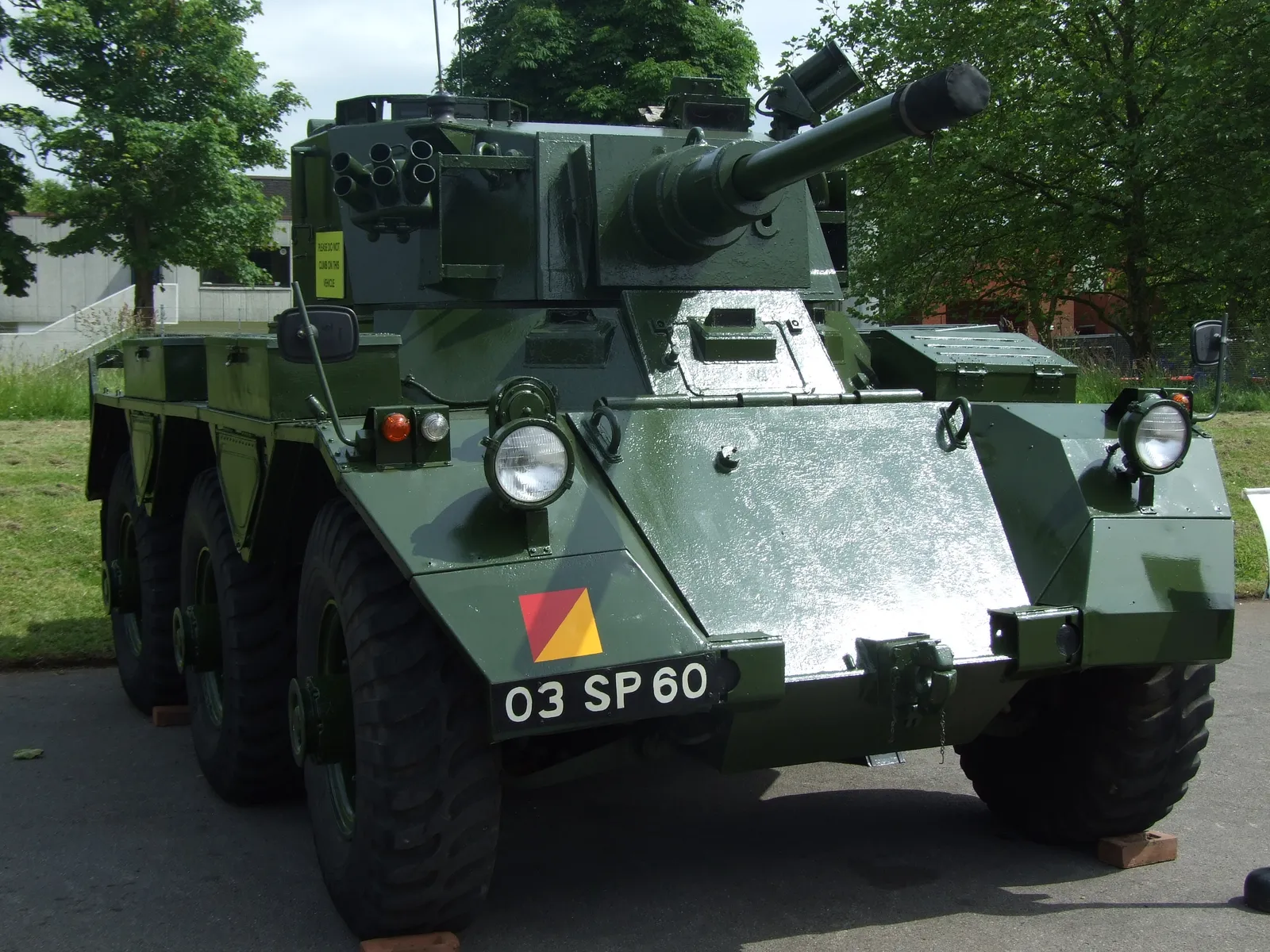

Documented in the Yemeni Army's pre-war armored-fighting-vehicle inventory as the 2014-2015 Houthi takeover split national stocks and left equipment available to battlefield parties; no specific Saladin battle action is claimed.
Role detailsArmored Vehicles
Alvis Saladin
Also known as
- FV601 Saladin
- FV601C Saladin Mk 2
- Saladin Mk 2
- Armoured Car 76 mm Gun Alvis Saladin Mk 2 6x6
- Saladin armored car
- Saladin armoured car
- Alvis FV601 Saladin
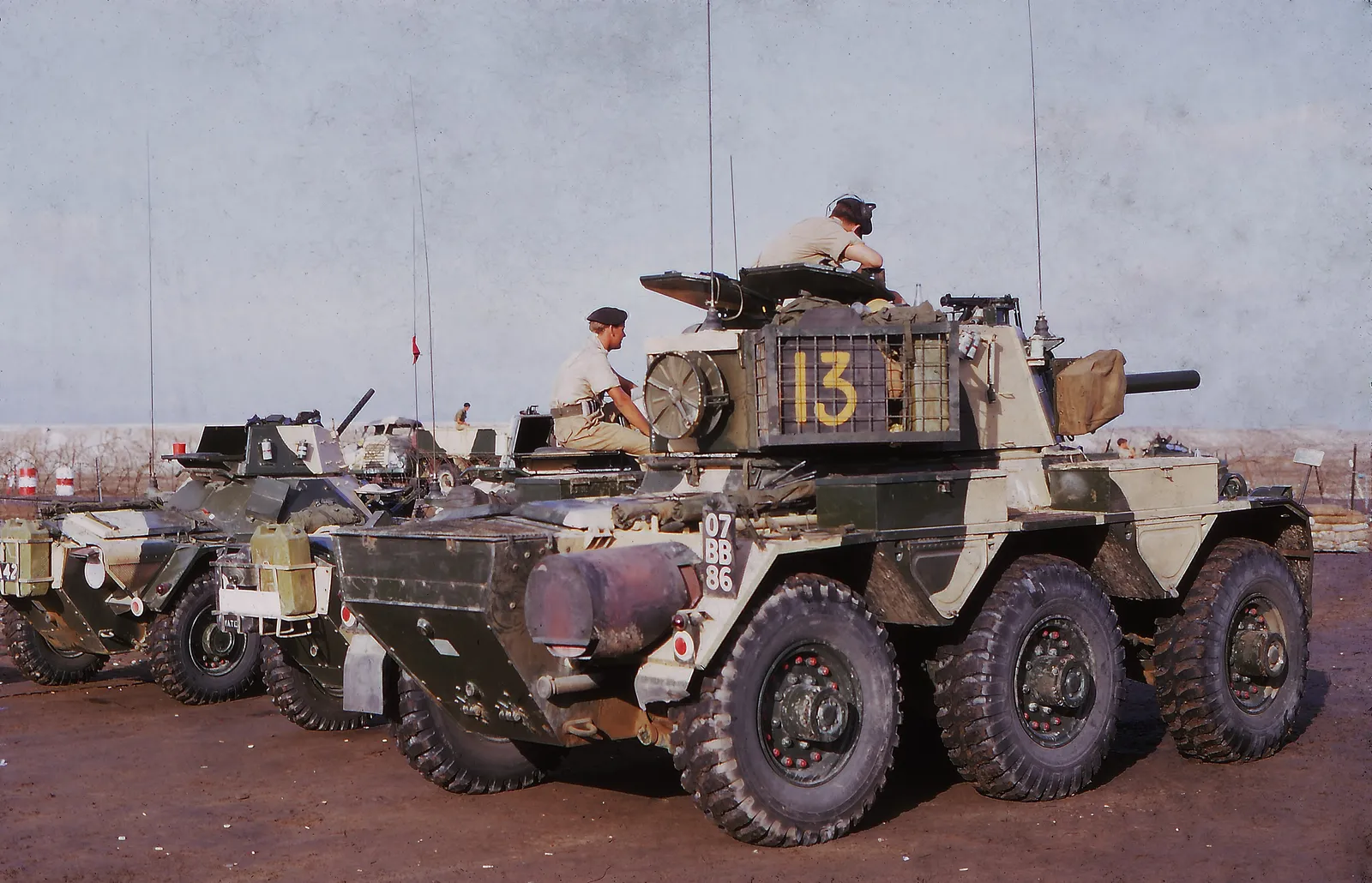
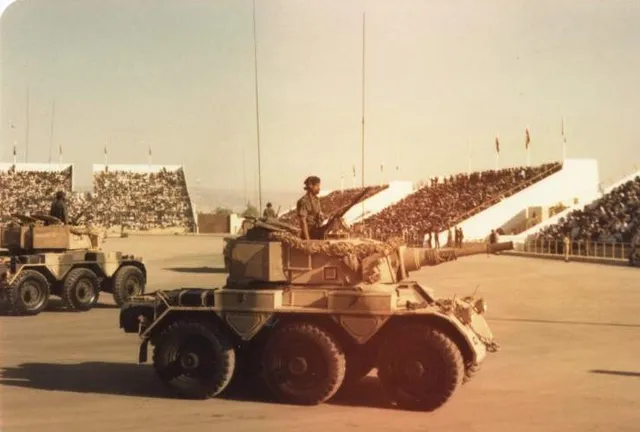
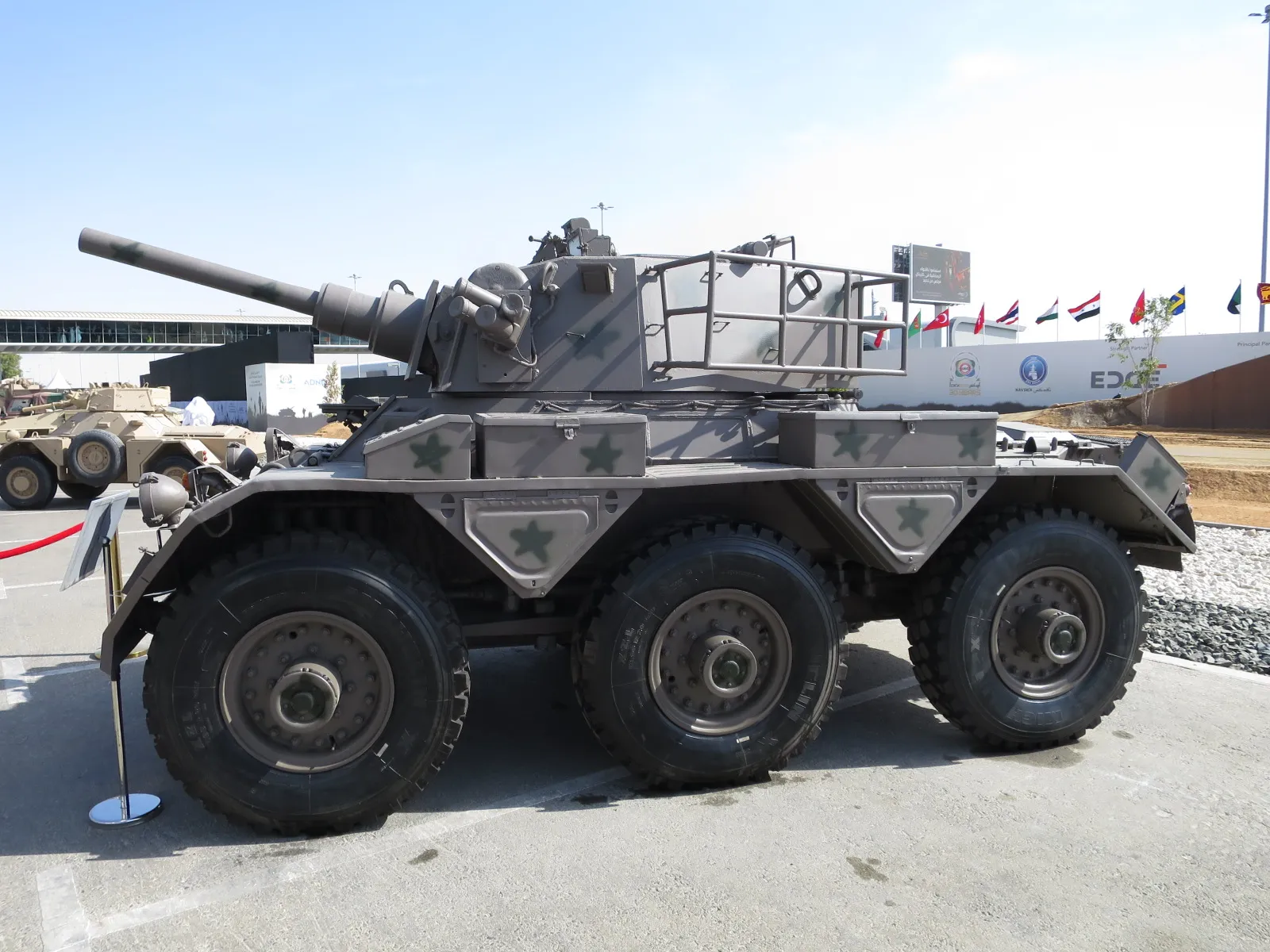
The Alvis Saladin is a British FV601 6x6 armored reconnaissance car developed from a postwar British Army requirement and produced at Coventry from 1958 to 1972. Its production Mk 2 form combined a three-person turreted layout, a 76 mm L5A1 low-pressure gun, welded steel protection, and road mobility suited to reconnaissance, convoy escort, internal-security, and light direct-fire roles. Yemen evidence remains inventory-level: Oryx lists the Saladin in pre-war Yemeni Army armored-fighting-vehicle stocks available to parties after the 2014-2015 takeover, so this entry does not claim a specific Saladin engagement in that war.
Role in Conflicts
- Side
- Sri Lankan government forces

Sri Lanka Army history places a 1 SLAC troop with one Saladin in the August 1996 Sathjaya II operation; secondary armor research separately documents LTTE use of a captured Saladin turret on a converted YW531 hull, but this row does not claim confirmed LTTE use of an intact Saladin.
Profile / Specs
Profile
- Origin
- United Kingdom
- Built by
- Alvis
- Type
- 6x6 armored reconnaissance car
- Service note
- Cold War design retained in secondary inventories
- Designer
- Crossley Motors
- Designed
- 1954
- Produced
- 1958-1972
- Number built
- 1,177
Specifications
- Crew
- 3: driver, gunner, and commander/loader
- Armament
- 76 mm L5A1 low-pressure rifled gun; coaxial and roof-mounted 7.62 mm Browning/M1919 machine guns; smoke grenade dischargers
- Ammunition
- 42 rounds for the 76 mm gun; published references differ on total machine-gun ammunition stowage
- Combat weight
- About 11.6 tonnes combat loaded
- Dimensions
- 5.28 m length with gun forward, 4.93 m hull length, 2.54 m width, 2.39 m height
- Mobility
- 6x6 wheeled chassis; Rolls-Royce B80 Mk.6A petrol engine; about 72 km/h road speed and 400 km road range
- Transmission
- Semi-automatic/preselector transmission with five forward and five reverse speeds
- Protection
- Welded steel hull and turret; about 10-16 mm on hull sides/rear and up to 32 mm on turret front/glacis in open references
Design Role
The Saladin was not a tank substitute in the tracked-armour sense; its value came from combining road mobility, a turreted 76 mm gun, and a compact reconnaissance crew. RAF Museum notes frame the gun car as useful in politically sensitive colonial settings where a heavier tracked vehicle was harder to justify, while Think Defence lists reconnaissance, convoy escort, internal security, counter-insurgency, and infantry fire-support tasks among its intended roles.
Mobility concept
Six-wheel chassis with a Rolls-Royce B-series petrol engine, built for rapid road movement and forward reconnaissance.
Fire-support concept
Two-man turret with the 76 mm L5A1 gun, giving a light armored car direct-fire support beyond a machine-gun scout vehicle.
Evidence limit
The current Yemen row is inventory-level evidence; it does not identify a specific Saladin engagement or confirmed firing event.
Sources: RAF Museum Alvis Saladin; Think Defence Saladin Armoured Car; Handbook Of Pre-War Yemeni Fighting Vehicles.
Variants
Saladin designations cover early prototype and pre-production vehicles, the FV601C production Mk 2, internal-security adaptations, and later upgrade concepts rather than separate weapon families.
| Variant | Configuration | Designation notes |
|---|---|---|
| FV601A | prototype | Army Guide describes the initial prototype path before the 76 mm L5A1 production configuration was finalized. Sources: SALADIN Reconnaissance Vehicle |
| FV601B | pre-production vehicle | Army Guide and Think Defence describe Crossley-built pre-production vehicles produced before the FV601C/Mk 2 production model. Sources: SALADIN Reconnaissance Vehicle, Think Defence Saladin Armoured Car |
| FV601C Saladin Mk 2 | standard production model | Army Guide identifies the FV601C as the production Armoured Car 76 mm Gun, Alvis Saladin Mk 2, with production at Coventry from 1958. Sources: SALADIN Reconnaissance Vehicle |
| FV601D | internal-security variant | Think Defence and WeaponSystems.net describe an internal-security version with equipment differences from the standard gun car. |
| Saladin Repower | diesel repower package | Army Guide and Think Defence describe a later modernization path replacing the petrol engine with a Perkins diesel and related drivetrain updates. Sources: SALADIN Reconnaissance Vehicle, Think Defence Saladin Armoured Car |
| Saladin 90 | 90 mm gun upgrade | Think Defence describes a 90 mm upgrade concept using a MECAR/Kenerga-type gun and drivetrain changes. Sources: Think Defence Saladin Armoured Car |
| Saladin RARDEN | 30 mm concept | Think Defence describes an export concept using a 30 mm RARDEN cannon and modified CVR(T)-type turret that did not move beyond concept stage. Sources: Think Defence Saladin Armoured Car |
Installed Gun
The Saladin page links the vehicle to the gun component that defines its direct-fire role.
| Carried item | Item type | Carriage evidence |
|---|---|---|
 | 76 mm low-pressure rifled gun | Army Guide and Think Defence identify the Ordnance QF 76 mm L5A1 as the Saladin's main armament, with 42 rounds carried in the vehicle. Sources: SALADIN Reconnaissance Vehicle, Think Defence Saladin Armoured Car |
Ammunition Fired
Chemring and Nexter catalogs place the Saladin's L5 gun in a 76 mm ammunition family shared with later Scorpion L23/L23A1 guns.
| Ammunition | Ammunition type | Firing evidence |
|---|---|---|
 | 76 mm HEP-T / HESH service round | Chemring lists M329 in the 76 mm ammunition family for the L5 and L23 weapon systems used on Saladin and Scorpion vehicles. Sources: Chemring Munitions Catalog |
| 76 mm high-explosive tracer round | Nexter lists M330 for the Saladin's 76 mm L5A1 gun family as an HE-T round for personnel and materiel targets. Sources: Nexter 2016 Catalog |
| 76 mm HESH training round | Chemring and Nexter list M331 as a 76 mm training round for the L5A1 and L23/L23A1 gun family. |
 | 76 mm canister round | Nexter identifies the Saladin's 76 mm L5A1 gun as one of the weapon fits for the M333 canister round. Sources: Nexter 2016 Catalog |
| 76 mm blank cartridge | Nexter lists M335 for the 76 mm L5A1 on Saladin and the L23/L23A1 guns on Scorpion for training and saluting. Sources: Nexter 2016 Catalog |
| 76 mm smoke round | Nexter lists M337 as a smoke-screening, spotting, and signalling round for the L5A1 and L23/L23A1 gun family. Sources: Nexter 2016 Catalog |
Timeline
Alvis Saladin Key Events
Alvis prototype contract
Think Defence describes a 1947 Alvis contract for FV601 prototypes, with Crossley Motors subcontracted for part of the development work.
Sources: Think Defence Saladin Armoured Car
Production begins at Coventry
Army Guide and Think Defence place Saladin production at Coventry from 1958 after the program's extended gun and turret development.
Sources: SALADIN Reconnaissance Vehicle, Think Defence Saladin Armoured Car
British Army service entry
The RAF Museum collection note says the Saladin entered service the year after production began, while Army Guide says first vehicles were delivered to the army in 1959.
Sources: RAF Museum Alvis Saladin, SALADIN Reconnaissance Vehicle
Production run ends
Army Guide and Think Defence both give 1972 as the end of production, with 1,177 vehicles built.
Sources: SALADIN Reconnaissance Vehicle, Think Defence Saladin Armoured Car
Yemeni inventory evidence cataloged
Oryx listed Alvis Saladin among Yemeni Army armored fighting vehicles available to battlefield parties after the 2014-2015 Houthi takeover.
Sources: Handbook Of Pre-War Yemeni Fighting Vehicles
Related Weapon Systems


Sources
Alvis SaladinPublisher: WeaponSystems.net | Note: Supports background, manufacturer, role, variant naming, production period, armament, mobility, protection, and core specifications. | Accessed: 2026-07-04Chemring Munitions CatalogPublisher: Yumpu / Chemring Group PLC | Note: Supports the 76 mm ammunition family context used with the L5A1 and L23/L23A1 gun family, including M329 and M331 listings. | Accessed: 2026-07-04Nexter 2016 CatalogPublisher: Internet Archive / Nexter | Note: Supports the Saladin L5A1 and Scorpion L23/L23A1 76 mm gun family ammunition listings, including M330, M331, M333, M335, and M337. | Accessed: 2026-07-04Think Defence Saladin Armoured CarPublisher: Think Defence | Note: Supports the Saladin development sequence, Crossley/Alvis context, intended roles, FV601C production, L5A1 gun fit, ammunition stowage, protection notes, and production totals. | Accessed: 2026-07-04SALADIN Reconnaissance VehiclePublisher: Army Guide | Note: Supports manufacturer background, official FV601C designation, production history, 76 mm armament, crew layout, mobility, armor, and service-entry specifications. | Accessed: 2026-07-04RAF Museum Alvis SaladinPublisher: Royal Air Force Museum | Note: Supports the collection identity, production and service-entry context, and the Saladin's wheeled direct-fire support role in politically sensitive colonial settings. | Accessed: 2026-07-04Alvis Archive Fighting VehiclesPublisher: Alvis Archive | Note: Supports Alvis's fighting-vehicle family context, including Saladin FV601 and the later shift from six-wheeled vehicles to the Scorpion tracked family. | Accessed: 2026-07-04Handbook Of Pre-War Yemeni Fighting VehiclesPublisher: Oryx | Note: Supports 2014 Yemen Civil War fielded by Yemeni Army context by listing Alvis Saladin in the pre-war Yemeni Army inventory and explaining that the catalog clarifies equipment available to Yemeni battlefield parties after the 2014-2015 Houthi takeover. | Accessed: 2026-07-0430 Years History of 5 Reconnaissance Regiment 1994-2024Publisher: Sri Lanka Armoured Corps / Sri Lanka Army | Note: Supports 1983 Sri Lankan Civil War fielded by Sri Lankan government forces context by listing one 1 SLAC Saladin in the armored force for the August 1996 Sathjaya II operation. | Accessed: 2026-07-04Tamil Tigers Light TankPublisher: Tank Encyclopedia | Note: Supports the Sri Lanka conflict-use caveat that LTTE evidence concerns a captured Saladin turret mounted on a converted YW531 hull rather than confirmed use of an intact Saladin armored car. | Accessed: 2026-07-04Aden, Sheikh Othman 1967Publisher: Wikimedia Commons | Note: Supports image provenance for the Aden Saladin gallery image; Commons records Brian Harrington Spier/Flickr and CC BY-SA 2.0 licensing. | Accessed: 2026-07-04Alvis Saladin Armoured CarPublisher: Wikimedia Commons | Note: Supports image provenance for the primary Aldershot Military Museum Saladin image; Commons records own work by Gaius Cornelius and CC BY-SA 3.0/GFDL licensing. | Accessed: 2026-07-04Alvis FV601 Saladin, Oman 1981Publisher: Wikimedia Commons | Note: Supports image provenance for the Omani Saladin parade image; Commons records Brian Harrington Spier/Flickr and CC BY-SA 2.0 licensing. | Accessed: 2026-07-04UAE Army Alvis Saladin at IDEX 2023Publisher: Wikimedia Commons | Note: Supports image provenance for a UAE Army Saladin display image; Commons records own work by Mztourist and CC BY-SA 4.0 licensing. | Accessed: 2026-07-04