Armored Vehicles

Alvis Saracen

Also known as
  • FV603 Saracen
  • FV 603 Saracen
  • FV603 Alvis Saracen
  • Alvis FV603 Saracen
  • Saracen APC
  • Saracen armoured personnel carrier
  • Saracen armored personnel carrier

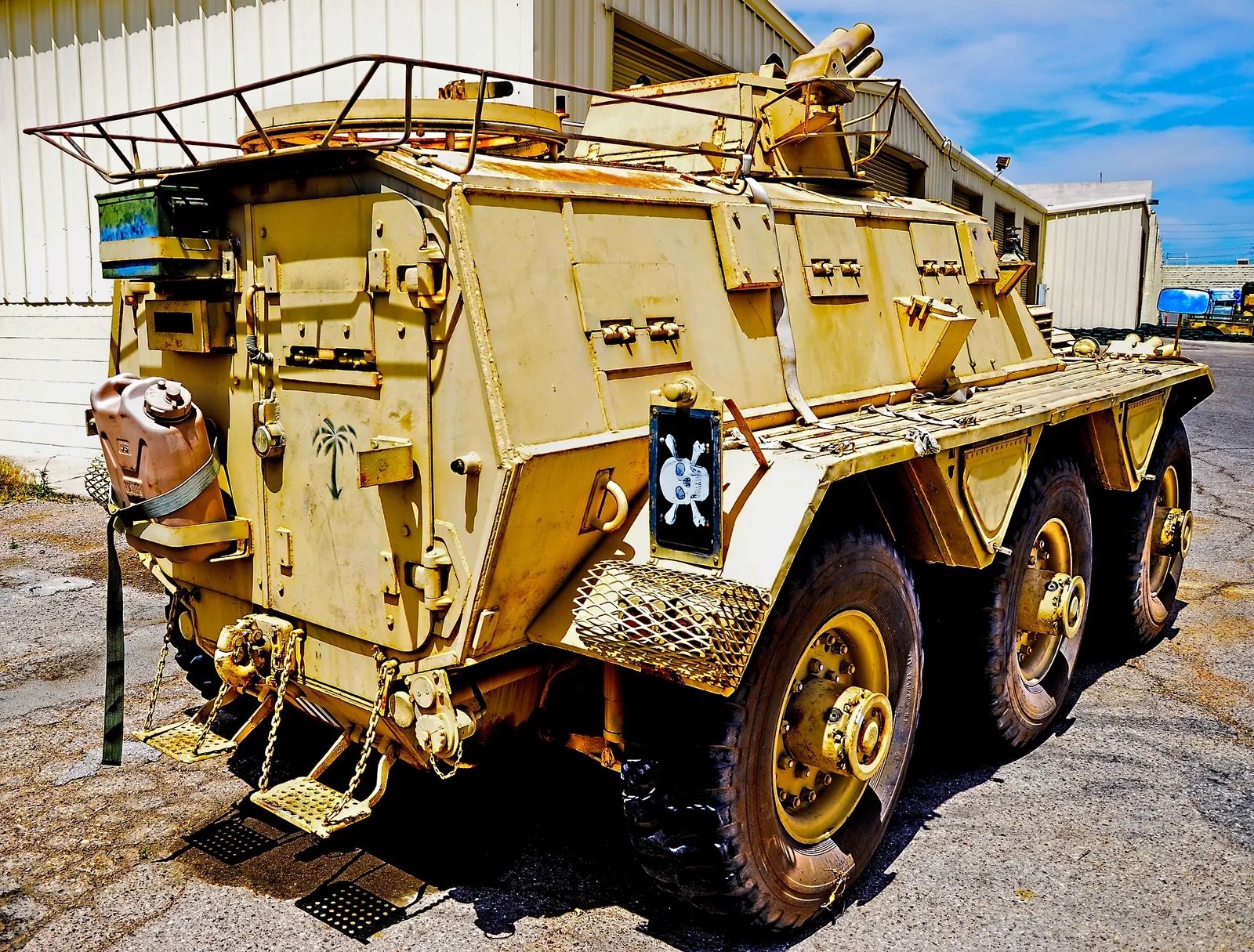
The Alvis Saracen is the FV603 6x6 armored personnel carrier of Britain's FV600 wheeled-vehicle family, developed by Alvis for protected troop movement and internal-security work before the Saladin armored car reached production. It carried a small crew and an infantry section in a welded steel hull, used a Rolls-Royce B80 petrol engine and machine-gun turret, and was adapted into command, ambulance, and up-armored Northern Ireland marks. Sri Lanka Army sources document Saracen service with the Sri Lanka Armoured Corps during the civil-war period, while UN arms-transfer reporting records five Alvis Saracens among 2023 United Kingdom armored-combat-vehicle exports to Ukraine.

Role in Conflicts

Troop Carrier Layout

The Saracen was built around protected movement rather than a heavy direct-fire weapon. Its front engine, central driver position, rear troop doors, roof hatches, and small machine-gun turret gave infantry a protected carrier for patrol, convoy, and internal-security work.

Passenger load

Crew of two plus up to nine or ten troops in open references.

Think Defence lists both 2+10 narrative capacity and a 2+9 table value.

Protection basis

All-welded steel hull with armor cited up to 16 mm in open technical references.

Designed for small-arms and fragmentation protection rather than tank-level survivability.

Internal security marks

Northern Ireland conversions added appliqué armor, internal padding, seatbelts, and riot-control fittings.

Think Defence identifies Mk 5 and Mk 6 as up-armored internal-security conversions.
Profile / Specs

Profile

Origin
United Kingdom
Built by
Alvis
Type
6x6 armored personnel carrier
Service note
Cold War armored personnel carrier retained in late-20th-century internal-security and counterinsurgency service
Designer
Alvis
Designed
Late 1940s to early 1950s FV600 development
Produced
1952-1972
Number built
1,838

Specifications

Crew and passengers
Crew of 2 plus up to 9-10 troops depending on source and configuration
Armament
Turret-mounted .30-caliber Browning or 7.62 mm machine gun; rear Bren/GPMG provision and smoke dischargers on many vehicles
Combat weight
About 11 tonnes
Dimensions
About 4.93 m long, 2.54 m wide, and 2.46 m high
Engine
Rolls-Royce B80 Mk 6A eight-cylinder petrol engine, about 160 bhp
Mobility
6x6 wheeled drive with independent torsion-bar suspension; about 72 km/h road speed and 400 km range
Protection
All-welded steel hull; open sources cite armor up to about 16 mm
Primary role
Protected troop transport, convoy/patrol mobility, command, ambulance, and internal-security variants
Variants

Saracen designations cover FV603 personnel carriers, specialist FV600-family derivatives, and later hot-climate or Northern Ireland protection modifications.

VariantConfigurationDesignation notes
FV603 Mk 1early personnel carrier

Think Defence describes the Mk 1 as the initial personnel carrier with the early turret arrangement and .30-caliber Browning/Bren armament fit.

Sources: Think Defence Alvis Saracen

FV603 Mk 2standardized turret variant

The Mk 2 retained the personnel-carrier role with a revised two-door turret and became a common production mark.

Sources: Think Defence Alvis Saracen

FV603 Mk 3hot-climate cooling variant

Think Defence describes the Mk 3 as a Mk 2-based version with reverse-flow cooling for arid or hot-weather operators.

Sources: Think Defence Alvis Saracen

FV603 Mk 5Northern Ireland up-armored conversion

Mk 5 conversions added appliqué armor, internal padding, and passenger restraints for the urban internal-security threat in Northern Ireland.

Sources: Think Defence Alvis Saracen

FV604armored command vehicle

The FV604 replaced troop seating with command, radio, and map-board equipment in the Saracen family.

Sources: Think Defence Alvis Saracen

FV606 / FV611armored ambulance

Think Defence lists ambulance derivatives on the Saracen chassis for casualty evacuation rather than troop carriage.

Sources: Think Defence Alvis Saracen

FV610Royal Artillery command post

The FV610 used a turretless raised command-post body for artillery command work and associated plotting equipment.

Sources: Think Defence Alvis Saracen

FV600 Family Context

Saracen shared the broader British FV600 wheeled-family design setting with the Saladin armored car, while filling the troop-carrier role that was prioritized for Malaya-era protected mobility.

Compatible itemItem typeCompatibility evidence
Alvis Saladin, 6x6 armored reconnaissance car, Armored VehiclesAlvis Saladin6x6 armored reconnaissance car

Think Defence places Saracen and Saladin in the same FV600 program and explains that Saracen production was prioritized before Saladin because protected infantry mobility was urgently needed.

Sources: Think Defence Alvis Saracen

Timeline

Alvis Saracen Key Events

  1. Prototype deliveries begin

    Think Defence says the first Saracen prototype was delivered in June 1951, with two vehicles sent directly to Malaya for field trials.

    Sources: Think Defence Alvis Saracen

  2. Production order and service-driven variants

    The 1952 production specification covered personnel carrier, command, signals, ambulance, radar, sonic-detection, and infantry command-post variants.

    Sources: Think Defence Alvis Saracen

  3. Production ends

    Think Defence records 1,838 Saracens built by the end of production in 1972.

    Sources: Think Defence Alvis Saracen

  4. Saracens photographed on Northern Ireland patrols

    Imperial War Museums collection records show British troops using Saracen armored personnel carriers during border and Belfast patrol duties in 1977.

    Sources: IWM Saracen border patrol, IWM Saracen Belfast patrol

  5. Sri Lanka Army induction date

    Sri Lanka Armoured Corps AFV records list the Saracen armored car/APC type as a United Kingdom-origin vehicle inducted on 11 April 1986.

    Sources: Sri Lanka Armoured Corps AFV details

  6. 3rd Reconnaissance Regiment receives Saracens

    The Sri Lanka Armoured Corps history of 3rd Regiment says the unit received four Saracen armored cars on 5 January 1990 before later deployment in Jaffna Peninsula.

    Sources: History of the 3rd Armoured Regiment Sri Lanka Armoured Corps

  7. UK transfer to Ukraine reported

    United Nations-published arms-transfer reporting lists five Alvis Saracens among United Kingdom armored-combat-vehicle exports to Ukraine for 2023.

    Sources: UNROCA 2023 United Kingdom arms transfers

Media

Alvis Saracen Images

Related Weapon Systems
Alvis Saladin, 6x6 armored reconnaissance car, Armored VehiclesArmored VehiclesAlvis Saladin6x6 armored reconnaissance carThe Alvis Saladin is a British FV601 6x6 armored reconnaissance car developed from a postwar British Army requirement and produced at Coventry from 1958 to 1972. Its production Mk 2 form combined a three-person turreted layout, a 76 mm L5A1 low-pressure gun, welded steel protection, and road mobility suited to reconnaissance, convoy escort, internal-security, and light direct-fire roles. Yemen evidence remains inventory-level: Oryx lists the Saladin in pre-war Yemeni Army armored-fighting-vehicle stocks available to parties after the 2014-2015 takeover, so this entry does not claim a specific Saladin engagement in that war.
Daimler Ferret armoured car, 4x4 armored reconnaissance car, Armored VehiclesArmored VehiclesDaimler Ferret armoured car4x4 armored reconnaissance carThe Daimler Ferret is a compact British 4x4 armored reconnaissance car built for liaison, scouting, patrol, and internal-security work. Daimler produced the type from the 1950s into the early 1970s, and its small hull, machine-gun armament, smoke dischargers, and high road speed made it a durable export vehicle after British service. Sri Lanka Army history places Ferret scout cars in its reconnaissance fleet before civil-war armor deployments, while Ukrainian Mk 1 vehicles have appeared as improvised light reconnaissance and force-protection platforms, including a modified example with anti-drone grilles and electronic-warfare equipment during the 2025 Nadiia operation.
KrAZ Fiona, 6x6 MRAP / armored personnel carrier, Armored VehiclesArmored VehiclesKrAZ Fiona6x6 MRAP / armored personnel carrierThe KrAZ Fiona is a 6x6 mine-resistant armored personnel carrier developed around the KrAZ-6322 truck chassis by Kremenchug Automobile Plant with STREIT Group involvement. Official export data presents it as a V-hull protected-mobility vehicle for patrol, convoy escort, troop transport, command-and-control, and medical-evacuation configurations; open reporting supports Ukrainian military test and evaluation during the Russia-Ukraine War, but not a standardized battlefield fleet.
FV432, Tracked armored personnel carrier, Armored VehiclesArmored VehiclesFV432Tracked armored personnel carrierThe FV432 is the British FV430-series tracked armored personnel carrier built around a simple steel-hulled troop compartment for carrying infantry, command teams, mortar crews, engineers, or evacuation loads under armor. GKN Sankey produced the type for British service from the early 1960s, and the family later split into command, ambulance, mortar, recovery, engineering, and upgraded Bulldog forms. Public sources directly document FV432 vehicles with British coalition forces in the 1990 Gulf War and later FV432 APC transfers to Ukrainian Territorial Defense Forces during the 2014 Russia-Ukraine War.
FV104 Samaritan, Tracked armored ambulance, Armored VehiclesArmored VehiclesFV104 SamaritanTracked armored ambulanceThe FV104 Samaritan is the armored ambulance member of the British CVR(T) tracked-vehicle family, built by Alvis around the same compact mobility package as Scorpion and Spartan but configured for protected casualty evacuation. It is unarmed apart from smoke dischargers, carries a driver and medical attendant with stretcher or seated casualties, and is documented with British forces in Operation Desert Storm and Ukrainian service after CVR(T) transfers.

Sources